
CIHS – Centre for Integrated and Holistic Studies

Date/Time:

Blog Post

CIHS – Centre for Integrated and Holistic Studies > Articles by: Vinod Kumar Shukla
Bharat – Islamic Confluence

Bharat – Islamic Confluence

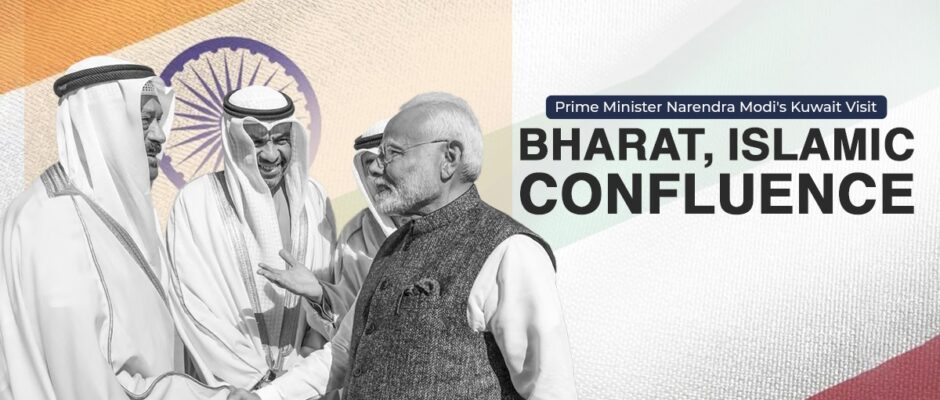
From Decades of Dormancy to Dynamic Diplomacy: How PM Modi’s Kuwait Visit Redefined Bharat’s Global Engagements. Vinod Kumar Shukla There is a misnomer that foreign policy of any country remains more or less the same while governments come and go. This is not true. Actually, it changes with the kind of government a country has from being submissive to assertive. Look at the case of Bharat where, ever since Prime Minister Narendra Modi took over, engagements with gulf countries have been of mutual interest by de-bracketing them from solely being Islamic nations, a great departure from the erstwhile Pakistan-centric foreign policy. Bharat has made its Western neighbour’s self-styled claim of being a stakeholder everywhere especially with Islamic nations meaningless. The engagement of Bharat with rest of the global communities are on equal footings. Ushering in a new era of global engagements, Prime Minister Narendra Modi expressed his concern during his Kuwait visit from December 21-22, 2024 stated that “it takes four hours to reach Kuwait from India but it took four decades for the Prime Minister.” This is despite the fact that over a million people of Bharat in Kuwait are the largest expatriate community which is regarded as the community of first preference among expatriates. The Gulf nation is a key source of investment for Bharat from the current president, Shaikh Mishal Al Ahmad Al Jaber Al Sabah, the Amir of Kuwait, of the Gulf Cooperation Council (GCC). Approximately 89 per cent of the total FDI from the GCC has been received in the last decade and bilateral trade between India and Kuwait in the last financial year was over $10 billion. The PM’s Kuwait visit is to further strengthen bilateral ties, operationalise security agreements that have been moving at a snail’s pace. Prime Minister Modi has been trying to make West Asia a trade gateway for the rest of Asia and Europe and create a business-friendly environment to invite and secure investments in the region. Bharat’s bilateral relations with most of the Gulf countries by de-bracketing Pakistan is no less than an achievement for any government. Now most of the countries are keen on deeper bilateral ties. But the way Kuwait facilitated PM’s interactions with diaspora and respected New Delhi’s sensitivities on cultural and religious matters, it clearly indicates Bharat’s growing diplomatic clout not only in the region but globally as well. West Asian countries are generally considered as oil supplying nations but Modi dispensation looks at them with mutual trust and opportunity in gamut of issues. Besides trade, regional security is another concern. The ongoing Israel-Hamas conflict and post-Assad instability in Syria are matters of concern. They are not only impacting regional security but also business prospects. Diplomatically cornering Pakistan, the two sides unequivocally condemned terrorism in all its forms and manifestations, including cross-border terrorism and called for disrupting of terrorism financing networks and safe havens, and dismantling of terror infrastructure during PM’s visit. They agreed to enhance cooperation in counter-terrorism operations, information and intelligence sharing, developing and exchanging experiences, best practices and technologies, capacity building and to strengthen cooperation in law enforcement, anti-money laundering, drug-trafficking and other transnational crimes. The two sides discussed ways and means to promote cooperation in cybersecurity, including prevention of use of cyberspace for terrorism, radicalisation and for disturbing social harmony. Defence cooperation is another area of mutual benefit and a Memorandum of Understanding (MoU) was signed between India and Kuwait to institutionalize bilateral cooperation in defence that included training, exchange of personnel and experts, joint exercises, cooperation in defence industry, supply of defence equipment, and collaboration in research and development, among others. India is gradually emerging as a defence exporting nation in a big way with its Make in India programme. The other issue that is very dear to the PM is solar energy (green energy) and making an oil exporting country like Kuwait the member of International Solar Alliance (ISA) is certainly a big deal. The world knows it well that solar energy is the future as fossil fuels are not forever. The ISA collectively covers the deployment of solar energy and addresses key common challenges to scale up its use to help member countries to develop low-carbon growth trajectories. Reducing carbon footprint is a global challenge and India has lived up to its global commitment. It wants others including developed nations to follow suit. Cultural linkages with West Asia are age-old and Bharat has always been wanting to continue which the PM has always been mentioning in his speeches. An understanding about Cultural Exchange Programme (CEP) between India and Kuwait for the years 2025-2029 has been reached about which would facilitate greater cultural exchanges in art, music, dance, literature and theatre, cooperation in preservation of cultural heritage, research and development in the area of culture and organizing of festivals. Sports is another area where India needs to do better and cooperation with friendly nations will help them to excel together. Executive Programme (EP) for Cooperation in the Field of Sports (2025-2028) is a similar measure that India and Kuwait have arrived at during PM’s recent visit which will strengthen bilateral cooperation in the field of sports by promoting exchange of visits of sports leaders for experience sharing, participation in programs and projects in the field of sports, exchange of expertise in sports medicine, sports management, sports media, sports science, among others. Most importantly, the persona and initiatives of Prime Minister Narendra Modi has been so overwhelming that Kuwait has bestowed upon him its highest knighthood order ‘The Order of Mubarak Al Kabeer’ which is the 20th international honour given to him. During his visit, the PM met with Crown Prince of Kuwait Sheikh Sabah Al-Khaled Al-Hamad Al-Mubarak Al-Sabah and discussed the importance to Bharat’s bilateral relations with Kuwait acknowledging that bilateral relations were progressing well and welcomed their elevation to a strategic partnership. They emphasized on close coordination between both sides in UN and other multilateral fora where India is not only seeking major reform and is emerging as an important player. In the context of the UN reforms, both leaders emphasized on the
Read More
Yunus is Lying, Plain and Simple

Yunus is Lying, Plain and Simple!

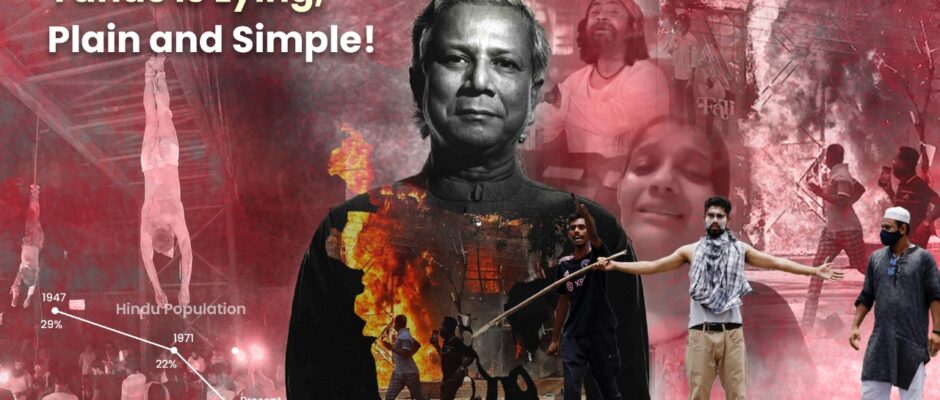
Bangladesh government has no plausible explanation for Hindus exodus while jihadists and jamaatis have a field day. Vinod Kumar Shukla The person who would have been in jail serving life time in Bangladesh on graft charges was hurriedly acquitted by Bangladesh’s anti-corruption commission  after his sworn in to run an interim government. Sheikh Hasina’s unceremonious ouster was reduced to a brief item in most media coverage on turn of events in Bangladesh. The Commission acquitted Muhammad Yunus, head of caretaker government and 13 others from corruption charges. Had Yunus been found guilty of money laundering charges, he would have been in jail for life. The caretaker government freed Jashimuddin Rahmani, the chief of Ansarullah Bangla Team (ABT), an al-Qaeda-affiliated terrorist outfit. And, Mohammad Yunus is making desperate attempts to speak from the high podium with teachings on good neighbour etiquette to India. In the melee, Hindus in Bangladesh faced a tricky situation with a government that took the lead in unleashing terror on her own minorities. Backing from Democratic White House till Kamala Harris bit the dust in recent US elections lent credibility to the genocide of Hindus in Bangladesh front-ended by Jamaatis, army, civil police and para-military forces. The government mandated to protect Hindus lives, property, jobs and honour was not just turning a blind eye but went on a denial mode by saying that reports of attacks on Hindus and other minorities were exaggerated. This lie has been repeated from August 5, 2024 when the then Prime Minister Sheikh Hasina was forced to flee in view of students’ protests actually orchestrated by radical Islamist organisations. Yunus not just downplayed attacks on Hindus but claimed that violence against minorities “only in some cases” and most complaints were “completely exaggerated”. Yunus ascribed  political angle to attacks are more of politics rather than acting against jihadist elements that unleashed terror on Hindus, Budhists, Jains, Christians, Ahmadis and other minor groups of colour. His opined that attacks against Hindus was more political and on afterthought said that such reports were more exaggerated. On the contrary, Bangladesh government has taken an anti-Hindu stand notwithstanding that jihadists have had a free run. Atrocities on Hindus post-August 5 is reminiscent of direct action by Mohammad Ali Jinnah, first Governor General of united Pakistan that began from Noakhali in Bangladesh killing thousands of Hindus. Hindus had been subject to persecution by Islamists in the region from pre-independence days asurping their basic right to live with dignity. Islamists were very strongly poised even in erstwhile East Pakistan but after Bangladesh Liberation war they had gone underground albeit for a very short period. Testimony to this is that Hindus who made up 22 per cent of Bangladesh’s population in 1971 and 29 per cent in 1947 were reduced to about 8 per cent of 17 crore population. Genocide on Hindus continued in full glare and was not hidden from anyone except that Yunus who apparently doesn’t read newspapers and listen to scholars of his own country. One scholar predicted way back in 2016 that no Hindus would be left in Bangladesh in 30 years if current rate of “exodus” at 632 people from minority community leaving each day continued.“The rate of exodus over past 49-years point in that direction,” Dr Abul Barkat, a Dhaka university professor had said in 2016. If things were hunky dory for Hindus in Bangladesh as Muhammad Yunus is trying to portray, there’s no plausible explanation for continued and enhanced exodus. One needs to reflect as to why Taslima Nasreen was forced to flee Bangladesh for writing Lajja that documented killings, rapes, conversion and capturing properties of Hindus in Bangladesh. In the present context, Sheikh Hasina was big hurdle in giving free run to jihadists in whose hand Muhammad Yunus seems to be playing along. Big questions therefore loom large before Muhammad Yunus. As chief of interim government, does he have anything to say about an Islamic song being recited at a Durga Puja gathering in Chittagong?  Was the case filed in connection with the incident?  Were reports on arrest of two people by his government fake? The incident occurred on September 26, 2024 at Durga Puja celebration at JM Sen Hall in Rahmatganj area of the city. Insaf Keemkari Chhatra-Janta, a radical Islamic group, staged a protest in Dhaka against use of playground by the Hindu community for Durga Puja celebrations. There were many instances where Aarti and Bhajan were not allowed and organisers of Durga Puja were threatened with dire consequences. In certain cases, immersion Durga idols were not allowed in flagrant violation of basic right to practice one’s ‘faith’. On September 19, 2024 violent muslim mobs attacked Buddhist Chakma and Hindu Tripuri communities in Dighinala and Khagrachhari Sadar in the Chittagong Division of Bangladesh. They set fire to over 200 shops and homes belonging to the minority groups. The Muslim mob also attacked a Buddhist temple and carried out an arson attack in which many people were killed. Some of the deceased identified were 20-year-old Junan Chakma, 60-year-old Dhananjoy Chakma and 30-year-old Rubel Tripura. Prime Minister of India Narendra Modi on August 15, expressed hope that the situation in violence-hit Bangladesh would return to normal soon and said 1.4 billion Indians were concerned about safety of Hindus and minorities in the neighbouring country. President-elect Donald Trump appointed Tulsi Gabbard as Director of National Intelligence (DNI) in his administration and often condemned the atrocities against Hindus and other minorities in Pakistan and Bangladesh. This could be one factor for Yunus trying to whitewash the hundreds of crimes committed against Hindus and minorities. Social media is replete with instances of attacks on Hindu villages, houses, temples and many other installations. The minority Hindu population faced vandalism of their businesses and properties, as well as the destruction of Hindu temples. They were forced to resign from government jobs. And, it was irony that Yunus urged them to protest as citizens of the country with equal rights and not as Hindus. Bangladesh Hindu Buddhist Christian

Read More

RSS Reflects Bharat’s Soul, Spirit & Identity

Congress creating fuss on government officials being allowed to associate with Sangh is regressive and part of self-centred political machinations Vinod Kumar Shukla The July 9, 2024 order of Indian government lifting restrictions on government officials from associating with Rashtriya Swayamsevak Sangh (RSS) has kicked up a needless row. An authoritarian decision of then Prime Minister Indira Gandhi on November 30, 1966 was overturned by Narendra Modi government. Indira Gandhi’s alibi to restrict government officials from participating in RSS activities was that they should keep away from ‘political parties or any organisation which takes part in politics’. While impugned order related to government officials keeping away from politics, extending it RSS was untenable as it’s an all-embracing Hindu centric organization that’s neck deep in bringing about change. Self-centred political machinations of Pandit Jawaharlal Nehru and later Indira Gandhi led Congress led to ban on RSS rather than latter being a political entity. Well, Congress leadership seems to have gone one step further to create a ruckus in the Parliament and outside on lifting restrictions on government officials freely involving themselves in selfless service activities of the Sangh. Home Ministry directive issued earlier this month referred to previous orders of November 30, 1966, July 25, 1970 and October 28, 1980. It stated that these instructions have been reviewed and decided to remove RSS from these orders meant for political entities. On all three occasions, RSS was banned and restrictions imposed owing to selfish Congress leadership that never allowed any other organization to flourish in socio-economic space post-independence from imperial British rule. Successive Congress governments were forced to lift restrictions and ban on RSS given the ‘tyrannical nature’ of the political decisions at highest level. Nehru-led government first banned RSS in 1948 hiding behind assassination of Mahatma Gandhi instead of accepting its administrative failure. It’s well established that a disinformation campaign was unleased by Congress and its cohorts to falsely implicate RSS in assassination of Mahatma Gandhi which exposed its hollowness and reeked lack of ‘fair play’ in public space. From Kapur Commission to many subsequent writings clearly suggest that Sangh has no role in Mahatma’s assassination whatsoever.  But for political gains and appeasement politics of Congress, lies about RSS involvement were peddled for decades and even today. On each of the occasions that Nehru or people from Congress first family were on slippery ground of losing power, they resorted to such tactics and gimmicks in the past to divert the peoples’ attention. Congress history is replete with suggestions that Nehru was not the popular choice to be appointed Prime Minister. It was he was Mahatma Gandhi’s intervention that led to Nehru’s coronation. Knowing very well that post-independence euphoria would evaporate shortly and nationalist ideology was gaining credence, Gandhi’s assassination was used to discredit RSS. By doing so, Nehru sought to consolidate his position within the fledgling Congress and outside.  Painting RSS with ‘communal’ taint has been part of Congress’ larger divisive political agenda and it put up a smoke screen on its pro-Muslim agenda and appeasing Muslims. Secularism was added to Preamble of the Constitution in 1976 through a Constitutional amendment. Carving out a minorities’ ministry, Waqf Act, Shah Bano case, Places of Worship Act and proposed Communal and Targeted Violence Bill are some examples that reflect anti-Hindu agenda of Congress. This is where Congress feels threatened by the RSS especially after its gradual decision in political space. Contrary to Congress allegations or charges, RSS is all inclusive and not elitist or exclusive organization. Sangh is more focused on socio-economic transformative projects that translate to social transformation.Over 125,000 service projects across economic empowerment, education and healthcare are being run Sangh swayamsevaks, parivar affiliates and in partnership with community-led organizations. From running schools in far-flung tribal areas to providing healthcare with a healing touch amongst most neglected tribal groups through selfless volunteerism is something RSS has done all through. RSS has been continuously engaged in rebuilding the nation in last 99-years and it continues to double up its efforts as the Sangh enters the centennial year in 2025.RSS contribution to national security, unity, integrity and Swayamsevaks selfless service during natural disasters is something that one cannot easily forget. Social leadership evolved by RSS to run these service projects is unique in trying circumstances. Lifting restrictions on government employees participation or association with RSS would only strengthen the Indian democratic credentials that are open and flexible sans intolerance of Congress variety. Rahul Gandhi’s comparison of RSS with theocratic and regressive Muslim Brotherhood and claims of Muslim League being a rounded secular organisation reflects Congress leadership’s mind-set that’s anti-Hindu and anti-Bharat. Sangh, by no stretch of imagination can be designated as a political organisation. Congress and its ecosystem shameless spread of lies on RSS only reflects the oldest political party’s degenerative positioning in ideological terms. In the process, the grand old party has easily forgotten that many of its former members have moved on to the Sangh parivar bandwagon. Also, on its rolls there are several leaders that have been groomed by RSS in their formative years. Even on independence movement, contributions and yeoman role played by several organizations including RSS have been systematically relegated to side-lines even as Congress continues to seek complete control on the legacy of the struggles against colonial rule. Latest decision of Modi government to lift restrictions on government employees joining or participating in RSS activities was logical extension of Hindu renaissance that has redefined Bharat’s spirit, soul and identity. (Author is a senior journalist and associated with Centre for Integrated and Holistic Studies, a non-partisan think-tank based in New Delhi)

Read More

Foreign Funding Has No Place in Democratic Self-Governance!

Vinod Kumar Shukla In Abraham Lincoln’s words democracy is a government of the people, by the people and for the people which supposedly means free from any influence to protect the rights of citizens of democratic self-governance. But foreign intervention has become a big challenge for democratic countries around the world and the US is also not free from it. To facilitate all this, US federal law prohibits foreign citizens and governments from spending in any election in the US. But certain foreign players cocked a snook at law in 2016 and 2020 by spending huge money to influence US elections exposing vulnerabilities of campaign finance laws. Such elements are still at work in the 2024 elections. With the digital world being a reality, laws governing campaign finance systems failed to catch up. Inaction by Federal Election Commission (FEC) and inadequate Electoral Transparency Laws allow foreign players to influence US elections. Around $1 billion “dark money,” has been spent over the past one decade. National Counterintelligence And Security Center tells that foreign interference fall into five categories: Cyber operations targeting election infrastructure; Cyber operations targeting political parties, campaigns, and public officials; Covert influence operations to assist or harm political organizations, campaigns, or public officials; Covert influence operations to influence public opinion and sow division; and Covert efforts to influence policymakers and the public. Narrative of political image; internet communities created for specific electoral goals and extensive use of humour and satire to influence electorates were at play in the campaigns in the US. The US State Department recently alleged Russia for covertly spending over $300 million since 2014 to influence elections in more than two dozen countries which is just the tip of the iceberg. US Secretary of State Antony Blinken during his three-day visit to China in April 2024 said that there is evidence of Chinese attempts to “influence and arguably interfere” upcoming US elections, despite Chinese President Xi Jinping’s commitment not to do so. A Microsoft research report published in April 2024 suggests that Russian online campaigns to influence November 2024 US elections geared up over the past 45 days, but the pace is slower than the past elections. Russia-linked accounts are allegedly disseminating divisive content. The observation of Microsoft is that activities of Russia are not as intense as in previous elections but it may increase in the days to come. Online disinformation campaigns are unleashed with posts starting with a whistleblower or citizen journalist posting content on a video channel or social media. That content is mostly taken up by websites like DC Weekly, Miami Chronicle and The Intel Drop. However, the Kremlin has denied any such meddling in November 2024 elections and also in 2016 and 2020 elections. China too has been interfering in the democratic process of countries across the world for a long time which has now become a foreign policy trouble for the US administration especially for those managing the poll process. Both Joe Biden and Donald Trump are of the view that China has the intent and capabilities to challenge the US-led world order. But the Biden administration has outlined several reasons to remain engaged with China. This might make sense to US companies working in China and to political realists who don’t see much wrong in working out a way to coexist with another great power. But 81 per cent Republicans, 59 per cent Independents and 56 per cent Democrats see China as a threat giving Republicans a political stick to beat Biden with for going soft on China. As it gives green signal to foreign interests to spend money on elections despite the fact that there is a ban on foreign spending in Federal, State, and local elections. The FEC interprets the ban applicable on contesting elections and letting foreign players pour millions in elections. For the US, dealing with foreign interference in elections has been critical since Russia allegedly worked to influence the outcome of the 2016 presidential election. Investigations reveal that Russia targeted Black Americans on social media to disincentivize them from voting in the 2016 election — the tactics were aimed at magnifying race-based societal divisions. Since then, the US adopted a whole-of-government approach against election cyberthreats and foreign interference ensuring that all government agencies work in tandem to track and counter cyberthreats on election-related manipulations to protect voters’ objectivity and election infrastructure. China has been meddling elections in every corner of the globe and the US being the most apparent target for its geopolitical interests. In February 2024, the Office of the Director of National Intelligence stated: “Beijing is expanding its global covert influence posture to better support the CCP’s goals. The PRC aims to sow doubts about US leadership, undermine democracy, and extend Beijing’s influence.” The US media extensively reported that covert Chinese accounts were masquerading online as American supporters of former President Donald Trump, promoting conspiracy theories, stoking domestic divisions and attacking President Biden ahead of the November election. This ‘spamouflage’ prompted Meta to take down thousands of fake Facebook accounts operating in China. But Chinese interference in elections is a significant policy change. In 2021, the US intelligence departments concluded that China would not interfere in US elections. The Chinese decision was attributed to the fact that costs of being caught meddling harms the country of potential benefits as Russia’s efforts to interfere in the 2016 election significantly damaged Moscow’s position and relationship with the US. Still the US authorities were not off guard and were looking at every aspect of foreign intervention knowing well that if there is any gap in the US laws and they remained unaddressed, foreign players can and will exploit them. Plugging loopholes that permit foreign spending and making the source of campaign funds transparent can prevent foreign players influencing the US elections. A strong policy to prevent foreign interference in elections must include updating treatment of digital campaign advertisements and requiring disclosure of the true source of campaign funds. But also spending in elections by

Read More