CIHS – Centre for Integrated and Holistic Studies

Date/Time:

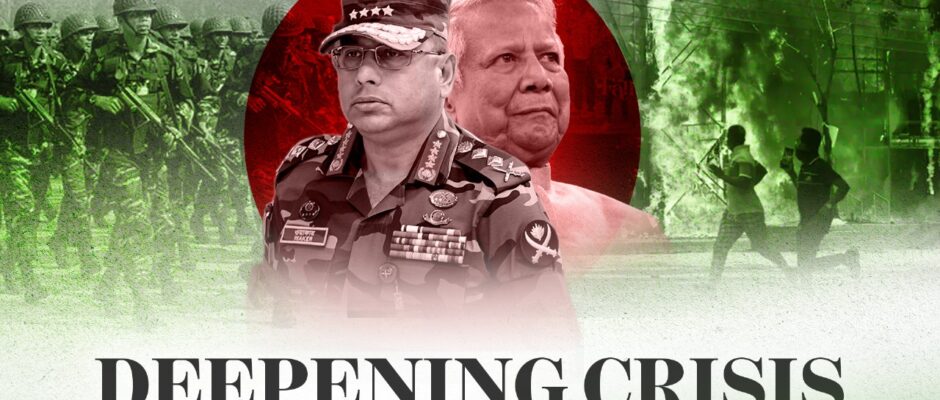
Deepening Crisis

Deepening Crisis

Shrinking democratic space, Yunus going jihadist way and western powers weary of his idiosyncrasies has turned Bangladesh a hotspot.  Rohan Giri Bangladesh is in the midst of a major crisis given the political chessboard that exposes changing power dynamics, jihdist takeover, assertion of the military junta and people left to fend for them with the state giving up on governance. It’s not mere domestic political reconfiguration but a crisis in the making with both national and regional consequences. At the heart of this narrative lies decline of a figure once championed in Western capitals, Muhammad Yunus and subdued recalibration of power that tells extensively about where Bangladesh is headed and how the world must understand this transition. Muhammad Yunus, once hailed as a Nobel laureate and Grameen Bank microfinance model builder, was long seen as a link with Western liberal values.  But in today’s Dhaka, Yunus no longer commands the stature of a unifying reformist and an elderly statesman. His legal troubles, political marginalisation and increasing distance from the country’s current power centres suggest a systemic and perhaps irreversible break from liberal-democratic experiment that he once symbolised. His estrangement from the Bangladesh Nationalist Party (BNP), historically the principal opposition to erstwhile ruling Awami League, marks a decisive shift. Even Yunus lacks institutional support from security establishments, rendering such alliances practically ineffective. A recent massive rally titled “Rally for Establishing Youth Political Rights” was held in Dhaka by three BNP-affiliated groups, Jatiyatabadi Chhatra Dal, Jubo Dal, and Swechchhasebak Dal as Yunus left for a four-day visit to Japan. BNP Acting Chairman Tarique Rahman addressed the rally virtually, criticising the Yunus-led government. Days earlier, a BNP delegation demanded an election roadmap by December and urged the interim government to avoid long-term policy decisions especially on issues like the Rohingya corridor and Chattogram port. The political gap left after fall from the Awami League’s unquestionable supremacy has not resulted in democratic transition, realignment of democratic forces.  Once a prominent player in Bangladeshi politics, Awami League under Sheikh Hasina, has been accused of authoritarian drift, methodical repression of opposition and getting alienated from voters. The conditions are ripe for alternative centres of power to emerge not necessarily from existing political formations but actors whose influence is wielded from behind the veil of legitimacy. One such actor is Bangladeshi military that has distanced from Yunus. Historically, taking a cautious, if not aloof, approach to overt governance. The current climate indicates its willingness to fill the power vacuum. Notably, words and postures emanating from within the army reflect displeasure with both existing political leadership and personalities, like Yunus, who are frequently portrayed as associated with Western liberal objectives. The military’s reluctance to re-embrace Yunus reveals a deeper strategic concern: aligning too closely with an internationally admired but locally polarising individual risks alienating burgeoning nationalist sentiments and undermining internal cohesion. Compounding the uncertainty is reemergence of hardline Islamic factions, particularly the Jamaat-e-Islami, long banned but far from being irrelevant. In times of institutional fragility, such groups often find space to maneuver, projecting themselves as defenders of moral order and religious authenticity. Their attempt to “call the shots” politically, often through proxies and sympathetic networks, is no longer a fringe development but a potential axis of influence, especially in disenfranchised and conservative constituencies. Under the guise of populism and faith-based legitimacy, ideological extremists are bound to acquire traction due to the Awami League and BNP’s combined weakness or non-existence in political arena. In this calculus, pro-democracy actors, while vocal and active, remain largely performative in impact. The civil society fabric of Bangladesh, which once brimmed with journalistic bravery, legal advocacy, and grassroots mobilisation, now finds itself overpowered by a combination of state repression, media censorship and judicial intimidation. Though aligned ideologically with purported liberal reformists such as Yunus, these elements are neither organised nor empowered to counter the influence of either the security apparatus or resurgent Islamist formations. Individuals who are more concerned with maintaining institutional or ideological domination than with preserving democracy are increasingly filling the gap left by middle-ground political participation. From a geopolitical standpoint, these internal realignments have not escaped the attention of regional and global powers. United States, under shifting administrations, have shown signs of strategic disinterest in Yunus continued involvement in Bangladeshi politics. At the same time, US seems to be investing in other forms of influence projection, most notably through declaration of interest in Saint Martin’s Island, a location with increasing significance due to its naval and logistical potential. Although formally within Bangladeshi territory, US maneuvers signal a willingness to challenge regional hegemonies through presence rather than partnership. Interestingly, the Bangladeshi army’s own worldview appears increasingly decoupled from traditional alignments. While military engagement with China continues through defence procurements and limited logistical cooperation, the army remains skeptical of Pakistan, a country with which historical scars and ideological differences remain deeply etched. Since New Delhi is well aware of Pakistan’s ongoing attempts to retain influence in Dhaka through both ideological and illegal means, this suspicion may be a means of fostering understanding with India. India’s own perspective on these developments is complex and evolving. New Delhi has traditionally favoured stability over unrest in its eastern neighbourhood. Assam Chief Minister Himanta Biswa Sarma has however articulated concerns about Bangladesh’s vulnerability to becoming a chokepoint, a potential “chicken neck” in a broader strategic contest involving China, US and radical Islamic networks. The parallel highlights a concern about India’s own strategic bottleneck, the Siliguri Corridor and how instability in Bangladesh could lead to logistical and security issues in the northeast. Indian engagement, therefore, is not only about diplomatic alignment but about protecting crucial linkages and resisting China’s growing influence. The present course of Bangladesh raises uneasy concerns for democracies in the West. Common trends that are frequently disregarded in favour of short-term strategic collaboration or economic stability include the emergence of hardline forces, dwindling liberal voices and the assertion of military prerogative. If these trends are not addressed, they run the risk of combining to
Read More
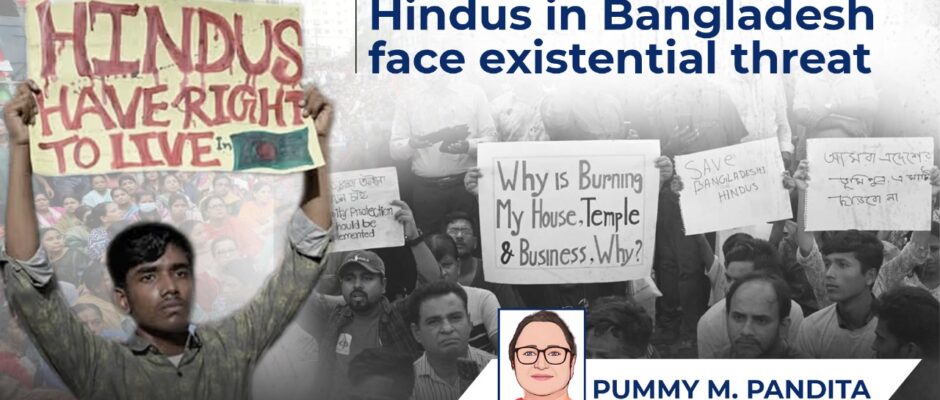
Hindus in Bangladesh Face Existential Threat

Hindus in Bangladesh Face Existential Threat

CIHS, UN reports meticulously documented atrocities against minorities while Yunus government is on denial mode. Pummy M Pandita Centre for Integrated and Holistic Studies (CIHS) had in August 2024 released a report titled “Hindu Genocide Unfolding in Bangladesh,” detailing systematic persecution of Hindus in that country. The report highlighted how minorities and in particular Hindus suffered oppression, forced conversions and violent attacks since partition of India in 1947. With the Hindu population dwindling from nearly 30 per cent in 1947 to less than 8 per cent today, the report documented the ” … ongoing ethnic cleansing.” CIHS report findings are further corroborated by United Nations Human Rights (UNHR) Office which released its own scathing report on the persecution of Hindus in Bangladesh. UN report reinforces the notion of targeted violence, displacement and systemic discrimination against Hindus, echoing concerns previously voiced by CIHS. The two reports underscore severity of crisis and the urgent need for international action. US Director of National Intelligence Tulsi Gabbard, in an interview, stated, “The long-time unfortunate persecution, killing, and abuse of religious minorities—Hindus, Buddhists, Christians, Catholics, and others—have been a major area of concern for the United States government and, of course, President Trump and his administration”. Bangladeshi however was unmoved and went on a denial mode. As per media reports, Chief Adviser’s press wing of Bangladesh’s interim government stated, “Bangladesh as a nation traditionally practices Islam that is famously inclusive and peaceful and it has made remarkable strides in its fight against extremism and terrorism.” Such response starkly contrasts the reality documented in both CIHS and UNHR reports. UNHR observations highlight a harsh reality: a systematic record of violence, displacement and persecution against a religious minority group in a state that takes pride in pluralism. This report is presented against the backdrop when rising extremism in South Asia is drawing international attention to the region and makes it acutely necessary that the situation must be evaluated factually with recourse to historical reality. Some specific incidents highlighted in the report are torching of three temples and the looting of about 20 houses in Burashardubi, Hatibandha and Lalmonirhat. UN report identifies these attacks to factors like religious and ethnic discrimination, targeted attacks on supposed supporters of former Awami League government among minorities, local communal land disputes, and personal conflicts. It also mentions involvement of some members and supporters of Jamaat-e-Islami and Bangladesh Nationalist Party (BNP) in perpetuating violence. Even after initial denials, Bangladesh’s interim caretaker government admitted at least 88 incidents of violence against minorities, predominantly Hindus, after August 2024. These happenings have raised significant concerns both within the country and globally, emphasizing urgent need for effective measures to protect minority communities in Bangladesh. Bangladesh has witnessed a considerable increase in widespread violence erupted following the ousting of former Prime Minister Sheikh Hasina in August 2024, disproportionately affecting Hindu minorities.  UN report documents that Hindu homes, businesses and temples were targeted on a systematic basis particularly in rural and historically tense areas. Some of the notable incidents include: Violence was not limited to these districts only. Other districts viz., Feni, Patuakhali, and Moulvibazar, also reported heinous crimes such as arson attacks on temples and brutal murder of Hindu individuals. These assaults, involving property destruction, arson and direct physical threats often exacerbated by inadequate police response suggest institutional impunity and perhaps political motivations.  UN Report states that there are several Bangladeshi localities which have emerged as hotspots of anti-Hindu attacks. The incidents recorded in report: The report documents these attacks with descriptions of victims, as verified by independent human rights groups. It is disturbing to record that police responses have been tardy or ineffective, permitting perpetrators to operate with impunity. The magnitude of the atrocities is appalling. UN report puts the number of deaths during the protests and violence that followed between July 1 and August 15, 2024, at an estimated 1,400. The overwhelming majority of these were caused by actions of Bangladesh’s security forces, who were accused of gross human rights abuses, including summary killings and shooting unarmed protesters. Children comprised around 12 – 13 per cent of these victims. Violence in Bangladesh mid-last year (2024) is not a lone phenomenon. The Hindu population in Bangladesh has been progressively dwindling due to amalgamation of targeted violence, legal discrimination and systemic exclusion. According to census 2022 data, Bangladesh’s population was 165,191,648 with percentage breakup detailed below: Religion Population Per cent breakdown Muslims 150,360,406 91.04 Hindus    13,130,109 07.95 Buddhists      1,007,468 0.61 Christians          495,475 0.30 Others          198,190  0.12 The reason for this decline is threefold—state indifference, mob violence and land grabs through Vested Property Act which has traditionally allowed seizure of Hindu-held property on various pretexts. Sheikh Hasina-led Awami League government in Bangladesh had presented itself as secular. The state’s inability to intervene strongly against perpetrators of violence against Hindus creates disquieting doubts about its commitment to protecting minorities. Though there have been some arrests after occurrence of violence, conviction is an exception and political convenience becomes the rule. The growing power of Islamist parties such as Hefazat-e-Islam has further intensified the issue as political parties are reluctant to act decisively against extremists for fear of electoral retribution. One of the worrying features brought out by UNHR report is the failure of law enforcement agencies to act. In spite of large-scale nature of the attacks, there was an overwhelming failure to intervene to save Hindu communities. This institutionalized impunity has encouraged perpetrators to continue perpetrating violence against minorities in a cycle of repetition. UN report also incriminates the former government and its security establishment for planning a calculated and well-coordinated effort to quell dissent. This included hundreds of extrajudicial executions, arbitrary arrests, detentions and cases of torture. These acts were said to have been committed with awareness and coordination of political leadership and top security officials, possibly constituting crimes against humanity. Global community has raised severe concerns regarding the developments. UN High Commissioner for Human Rights, Volker Türk, has demanded serious probes into all deaths

Read More
Dangerous Global Bias Goes Unchecked

Dangerous Global Bias Goes Unchecked

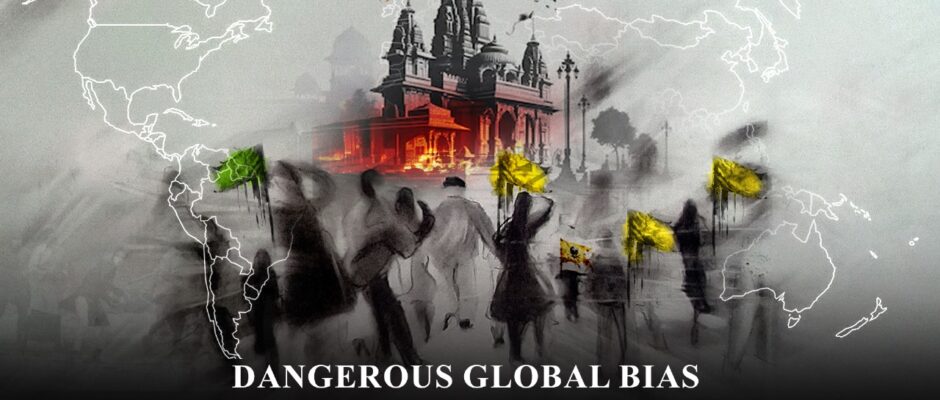
Hindu Temples, places of worship, communities in Western democracies and Islamic nations face grave threat and metamorphosed into a huge crisis. Dr Shailendra Kumar Pathak There’s a pattern to it. Hate and violence against Hindu communities has gone global. From Hindu temples, individuals and organizations have experienced extreme violence, vandalism and intolerance. These acts and incidents of violence have been reported in continuum with no respite to Hindus that seek to practice their faith in peace or live the Dharmic way propagating peace, tranquility and provide hope to humanity that’s under stress. From Brampton and Mississauga in Canada to Bangladesh where scores of temples have either been vandalized or closed down ‘by force’, Hindu minorities have been at the receiving end.  Khalistani terrorists, jihadists to Christian evangelists have targeted temples and places of worship even in Bharat that’s home to over a billion Hindus.  Most disturbing is that these violent incidents that totaled to over 300 in last few months went largely unnoticed or unreported. Intolerance is something that’s common to most of the violent incidents. For instance, on November 3 in Brampton, Canada, aggressive Khalistani terrorists attacked Hindu mandir in Brampton as practicing Hindus lined up for peaceful worship and Indian government representatives were busy verifying documents of elderly Sikhs and Hindus to ensure continuity in payment of pension back home. Devotees were beaten up, harassed, roughed up and pushed around violently while the Canadian police played dumb and deaf. It’s not an isolated incident. Mississauga Hindu temple was also vandalized with anti-Hindu graffiti and intimidation of extreme variety.  On November 12, 2024, Vishwa Hindu Parishad (VHP) released a comprehensive report documenting a series of attacks on Hindu communities around the world underscoring the need for attention to what many see as an escalating crisis. VHP report for 2024 documented hate crimes and attacks on temples in several nations like Canada, United States, United Kingdom, and Australia. Sharp rise in hate crimes targeting temples, cultural centers, and individuals has sent shock waves globally among 1.4 billion strong hindus spread across about 100 countries. In Canada, multiple Hindu temples faced attacks over the year including desecration of Gauri Shankar Mandir in Brampton and BAPS Swaminarayan temple in Windsor, which were both defaced with anti-Hindu slurs. United States temples in New Jersey, California and Texas vandalized and practicing Hindus harassed and defacement that included hateful messages specifically targeting Hindu beliefs and symbols were reported. This disturbing pattern suggests that these incidents are not random but part of a broader anti-Hindu agenda that is spreading in Western democracies. In United Kingdom, similar wave of anti-Hindu violence has been reported. Just last year, Leicester, a city with large South Asian population, witnessed intense anti-Hindu violence. Hindu homes, businesses and temples were attacked as mobs chanted slogans against the community, forcing Hindu families to stay indoors in fear. VHP’s report underscore that incidents like these signal an emboldened campaign against Hindu communities in societies that have long prided themselves on tolerance and inclusivity. Australia, too, has not been immune to this wave of hostility. The VHP’s November 2024 report documents attacks on Hindu temples in Melbourne where Hindu symbols were defaced with graffiti linking Hinduism to unrelated political disputes. This graffiti, filled with hateful rhetoric, was intended to shame and intimidate the Hindu community. Such acts reflect a deepening Hinduphobia that is no longer limited to casual prejudice but has manifested into violent, organized attacks on religious and cultural symbols. For Hindus living in these Western democracies, these incidents are betrayal of the promise of freedom and equality. VHP’s comprehensive report also highlights a dire situation for Hindus in neighboring Islamic countries including Pakistan, Bangladesh and Afghanistan where the situation is far more severe. In Pakistan, targeting Hindus has reached what some activists call protracted genocide. Hindu temples are routinely desecrated or destroyed, often with little to no response from authorities. Hindu girls, particularly in Sindh, face an alarming risk of abduction, forced conversion and marriage to much older Muslim men. VHP’s report included recent cases of Hindu girls being forcibly converted, torn from their families and left without any recourse for justice. Such violence and intimidation have become daily reality for Hindus in Pakistan where systemic discrimination allows these crimes to go largely unchecked. In Bangladesh, Hindus are staring at total erasure. VHP report notes that in early August 2024 in a span of five hours more than 50 attacks were recorded on Hindu homes, temples and businesses across various districts in Bangladesh. In places like Feni and Dinajpur, Hindu temples were desecrated and homes looted. Reports indicate that mobs of hundreds gathered to burn Hindu homes and assault community leaders as witnessed in multiple Bangladeshi districts such as Khulna, Satkhira and Bogura. This wave of violence has drawn international attention, as videos of the attacks went viral on social media showing mobs surrounding Hindu households, desecrating temples and forcing residents to flee their homes. VHP’s extensive list of incidents in its November 2024 report illustrates alarming scale and frequency of these attacks. It emphasizes that this violence against Hindus often has ideological backing, particularly from radical Islamic factions or Khalistani extremists which justify hostility toward Hindus under religious pretexts. VHP draws attention to anti-Hindu sentiment driven by certain missionary groups which promote aggressive conversion agendas in South Asia. This dynamic, the VHP argues, reveals that anti-Hindu prejudice is not only pervasive but systemic, fueled by a mix of religious and cultural biases. Equally concerning is general lack of accountability or response. When Hindu temples are attacked in Canada or Australia, political leaders and media outlets often remain mute spectators contrasting sharply with the swift response seen for crimes against other communities. This discrepancy has led many within the Hindu diaspora to question double standard practiced in international houses in reporting hate crimes. VHP has noted that Hinduphobia remains underreported and misunderstood, even as acts of Hindumisia (hatred for Hindu beliefs and practices) rise steadily. Unlike Islamophobia or anti-Semitism which are widely

Read More
Yunus is Lying, Plain and Simple

Yunus is Lying, Plain and Simple!

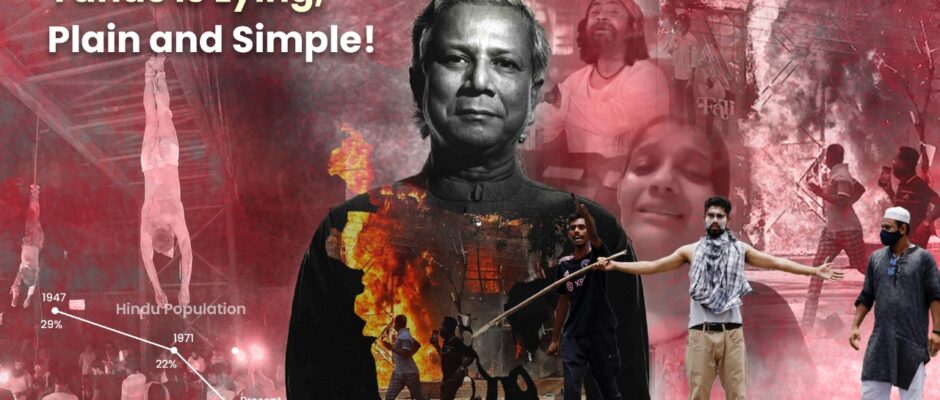
Bangladesh government has no plausible explanation for Hindus exodus while jihadists and jamaatis have a field day. Vinod Kumar Shukla The person who would have been in jail serving life time in Bangladesh on graft charges was hurriedly acquitted by Bangladesh’s anti-corruption commission  after his sworn in to run an interim government. Sheikh Hasina’s unceremonious ouster was reduced to a brief item in most media coverage on turn of events in Bangladesh. The Commission acquitted Muhammad Yunus, head of caretaker government and 13 others from corruption charges. Had Yunus been found guilty of money laundering charges, he would have been in jail for life. The caretaker government freed Jashimuddin Rahmani, the chief of Ansarullah Bangla Team (ABT), an al-Qaeda-affiliated terrorist outfit. And, Mohammad Yunus is making desperate attempts to speak from the high podium with teachings on good neighbour etiquette to India. In the melee, Hindus in Bangladesh faced a tricky situation with a government that took the lead in unleashing terror on her own minorities. Backing from Democratic White House till Kamala Harris bit the dust in recent US elections lent credibility to the genocide of Hindus in Bangladesh front-ended by Jamaatis, army, civil police and para-military forces. The government mandated to protect Hindus lives, property, jobs and honour was not just turning a blind eye but went on a denial mode by saying that reports of attacks on Hindus and other minorities were exaggerated. This lie has been repeated from August 5, 2024 when the then Prime Minister Sheikh Hasina was forced to flee in view of students’ protests actually orchestrated by radical Islamist organisations. Yunus not just downplayed attacks on Hindus but claimed that violence against minorities “only in some cases” and most complaints were “completely exaggerated”. Yunus ascribed  political angle to attacks are more of politics rather than acting against jihadist elements that unleashed terror on Hindus, Budhists, Jains, Christians, Ahmadis and other minor groups of colour. His opined that attacks against Hindus was more political and on afterthought said that such reports were more exaggerated. On the contrary, Bangladesh government has taken an anti-Hindu stand notwithstanding that jihadists have had a free run. Atrocities on Hindus post-August 5 is reminiscent of direct action by Mohammad Ali Jinnah, first Governor General of united Pakistan that began from Noakhali in Bangladesh killing thousands of Hindus. Hindus had been subject to persecution by Islamists in the region from pre-independence days asurping their basic right to live with dignity. Islamists were very strongly poised even in erstwhile East Pakistan but after Bangladesh Liberation war they had gone underground albeit for a very short period. Testimony to this is that Hindus who made up 22 per cent of Bangladesh’s population in 1971 and 29 per cent in 1947 were reduced to about 8 per cent of 17 crore population. Genocide on Hindus continued in full glare and was not hidden from anyone except that Yunus who apparently doesn’t read newspapers and listen to scholars of his own country. One scholar predicted way back in 2016 that no Hindus would be left in Bangladesh in 30 years if current rate of “exodus” at 632 people from minority community leaving each day continued.“The rate of exodus over past 49-years point in that direction,” Dr Abul Barkat, a Dhaka university professor had said in 2016. If things were hunky dory for Hindus in Bangladesh as Muhammad Yunus is trying to portray, there’s no plausible explanation for continued and enhanced exodus. One needs to reflect as to why Taslima Nasreen was forced to flee Bangladesh for writing Lajja that documented killings, rapes, conversion and capturing properties of Hindus in Bangladesh. In the present context, Sheikh Hasina was big hurdle in giving free run to jihadists in whose hand Muhammad Yunus seems to be playing along. Big questions therefore loom large before Muhammad Yunus. As chief of interim government, does he have anything to say about an Islamic song being recited at a Durga Puja gathering in Chittagong?  Was the case filed in connection with the incident?  Were reports on arrest of two people by his government fake? The incident occurred on September 26, 2024 at Durga Puja celebration at JM Sen Hall in Rahmatganj area of the city. Insaf Keemkari Chhatra-Janta, a radical Islamic group, staged a protest in Dhaka against use of playground by the Hindu community for Durga Puja celebrations. There were many instances where Aarti and Bhajan were not allowed and organisers of Durga Puja were threatened with dire consequences. In certain cases, immersion Durga idols were not allowed in flagrant violation of basic right to practice one’s ‘faith’. On September 19, 2024 violent muslim mobs attacked Buddhist Chakma and Hindu Tripuri communities in Dighinala and Khagrachhari Sadar in the Chittagong Division of Bangladesh. They set fire to over 200 shops and homes belonging to the minority groups. The Muslim mob also attacked a Buddhist temple and carried out an arson attack in which many people were killed. Some of the deceased identified were 20-year-old Junan Chakma, 60-year-old Dhananjoy Chakma and 30-year-old Rubel Tripura. Prime Minister of India Narendra Modi on August 15, expressed hope that the situation in violence-hit Bangladesh would return to normal soon and said 1.4 billion Indians were concerned about safety of Hindus and minorities in the neighbouring country. President-elect Donald Trump appointed Tulsi Gabbard as Director of National Intelligence (DNI) in his administration and often condemned the atrocities against Hindus and other minorities in Pakistan and Bangladesh. This could be one factor for Yunus trying to whitewash the hundreds of crimes committed against Hindus and minorities. Social media is replete with instances of attacks on Hindu villages, houses, temples and many other installations. The minority Hindu population faced vandalism of their businesses and properties, as well as the destruction of Hindu temples. They were forced to resign from government jobs. And, it was irony that Yunus urged them to protest as citizens of the country with equal rights and not as Hindus. Bangladesh Hindu Buddhist Christian

Read More

Hindus are Safe in Bangladesh, Really?

Zafar Sobhan, ���The Print’ made false, tall claims about fair treatment to Hindus. Bangladesh President Yunus came close to stating the truth, Are Hindus really not under threat from jihadists in Bangladesh? Are they safer than Muslims and other minorities in India? Well, Zafar Sobhan in a write up has made vague but determined attempt to whitewash continued atrocities against Hindus with no letup in the genocidal campaign. But, Sobhan falsely claimed that Hindus were safe in turbulent, unsettling and violence ridden Bangladesh ignoring the publicly available data, case studies and unhindered persecution. ‘The Print’ provided its columns to Zafar Sobhan for spreading these falsehoods like agenda-based international media organizations like Al Jazeera etc.   This response will methodically debunk Zafar’s fallacies and provide a true picture of minority conditions in Bangladesh. From rapes, violent attacks, forced resignation of Hindu officials to loot and occupation of their properties has become the norm while the likes of Zafar look the other way. As per Bangladesh Bureau of Statistics, Hindu population in the country has dropped drastically to 8.5 per cent in 2011and down further in last 13 years from 13.5 per cent in 1974. This demographic shift is not merely result of migration for economic opportunities but deeply intertwined with systemic discrimination, land dispossession through Vested Property Act and constant incidents of targeted attacks on Hindu society. By design and intent, Zafar seems to have downplayed incidences of violence against minorities in Bangladesh, implying that such incidents were isolated and do not reflect greater societal issues. Centre for Integrated and Holistic Studies investigations uncover that Hindu temples, businesses and houses are frequently and widely attacked particularly during times of recent political turmoil. These occurrences are not random acts of violence; they are frequently coordinated by extremist groups aiming to impose control or exploit political instability. Data for June – August 2024 indicate an organized attempt to intimidate, harm and ultimately wipe out Hindu population in Bangladesh. The attacks were carried out in several areas, targeting vulnerable individuals and religious sites. Temples in Moulvi bazar, Chittagong and Sitakunda are a few known cases of desecration that highlighted coordinated campaign of genocide and eradication. Zafar offered to paint the violent political movement that resulted in Sheikh Hasina’s departure as ‘democratic uprising free of Islamist influence’. This portrayal is inaccurate and ignores the complex realities of Bangladesh’s political scene. Islamist Influence and Extremism Emergence of extreme Islamist outfits such as Jamaat-e-Islami and Hefazat-e-Islam in Bangladesh’s political setting cannot be ignored. These organizations have documented history of campaigning for policies that oppress minorities and undermine the concept of secularism. Zafar’s denial of Islamist involvement in contemporary political movements is not supported by facts which demonstrates that these outfits have used political turmoil to promote their interests at the cost of minority oppression. Political Transitions’ Impact on Minorities In Bangladesh, it is a trend for minorities to become the targets of violent attacks during any political movements. An example of the kind of widespread violence that can result in deaths, serious injuries, significant property destruction, and vandalism of temples, was in 2021 during Durga Puja. These events demonstrate how vulnerable minorities are during times of political instability, contradicting Zafar’s assertion that minorities are safer in Bangladesh. Over years, persecution and intentional attacks against the Hindu community in Bangladesh have had a profound and long-lasting effect. For instance, massive violence against Hindus erupted in 2013 when Jamaat-e-Islami leader Delwar Hossain Sayeedi was found convicted. Around 50 temples were attacked and more than 1,500 Hindu homes were demolished. This incident fits into a larger pattern in which elections and political upheaval are followed by violent attacks against Hindus. Numerous instances occurred between 2013 and 2020, one of which was looting and demolition of 500 Hindu homes in Gopalpur village alone during the 2014 post-election riots. These acts demonstrate how this religious minority in Bangladesh is subjected to systematic and ongoing persecution. Historical Background, Persecution and Displacement It is critical to comprehend the historical background in order to evaluate current state of minority affairs in Bangladesh. The long-term patterns that have influenced lives of minorities in Bangladesh have not been sufficiently taken into account by Zafar Sobhan. Periods of severe persecution are a defining feature of the history of minorities in Bangladesh, especially during and after the 1971 Bangladesh Liberation War. Deliberate persecution of Hindus throughout the conflict and ensuing appropriation of land under the Vested Property Act have left a lasting impact on the community, leading to their uprooting and economic marginalization. During the time of struggle for Bangladesh Liberation, on March 25, 1971, the Pakistani military launched a horrific operation of genocide against Bengalis, notably on the Hindu community. Around three million individuals were killed in systematic atrocities during this genocide, which lasted until Bangladesh gained independence on December 16, 1971. At least 200,000 women were raped, and some estimates put the figure as high as 400,000. Brutality such as the Burunga massacre of May 26, 1971, when 94 Hindus were brutally killed by the Pakistani military at Burunga High School, marked the darkest height of the genocide. Over 10 million Bengalis, mostly Hindus, were forced to flee to India as a result of extensive atrocities committed by the Pakistani army, which saw no distinction between Hindu, Bengali, and Indian identities. In the blunt repercussions of the Babri structure demolition in India, Islamist groups in Bangladesh began a violent massacre against Bengali Hindus on December 7, 1992. The earliest target was the Dhakeshwari Temple in Dhaka, which was attacked and set on fire. Further targets were the Bholanath Giri Ashram, which was robbed, and the Hindu-owned jewelry stores in old Dhaka, which were destroyed. The following days saw more bloodshed when Islamist attackers in Cox’s Bazar District set fire to fourteen Hindu temples and demolished 51 Hindu houses in Ali Akbar Dale. Five temples suffered significant damage, and villages in Chittagong District such as Fatikchari and Mireswari were nearly completely destroyed by fire. By the time the

Read More

Boys Play Big in Muddied Waters!

US, China with diverse agendas coupled with religious extremist forces in Islam and evangelists may shrink open space to operate for Bharat that has big stakes in Bangladesh K.A.Badarinath The big boys are at play. Bangladesh government under Nobel laureate Muhammad Yunus is bound to be pulled apart by both United States of America seeking to establish a military base in South Asia and Chinese Communist Party led by President Xi Jingping that’s seeking unquestioned dominance in Asia. Jamaat-e-Islami and Bangladesh National Party (BNP) led by Khalid Zia would play willing tools in the big boys power play with Pakistan reduced to a lackey of minor variety. There’s denying that Muslim Brotherhood that’s globally dreaded would complicate the equation with its Islamist – Jihadist agenda on Bharat’s Eastern frontiers. ‘Razakars’ would become handy frontline private army in the hands of jihadist Muslim leadership internationally. There have been reports that already these Razakars have taken over civic policing as an occupational army of zealots. Well, tasks for Bharat are cut out after Sheikh Hasina’s government fell last week, Awami League purged, safe exit to her provided in a swift deal and Army took reins in a coup. Though interim government headed by Yunus and a battery of over dozen advisors have taken charge, nothing seems to have changed on the ground while Army calls the shots. Bangladesh’s under-belly has several layers that must be understood before Bharat gets to the drawing board to establish a working relationship with the new Army controlled, Yunus fronted regime given that Chinese, US and Pakistan deep state haggling for their pound of flesh. The ‘transitional’ Yunus regime got legitimacy as Democratic White House was first to recognise the government. Secretary of State’s spokesperson was drafted to convey that US was ‘ready and looked forward’ to working with Dhaka under Yunus. St Martin Island also known as ‘Narikel Jinjira’ (Coconut Island) or ‘Daruchini Dweep’ (Cinnamon Island) off-the-Chittagong coast may be eyed by US to set up a military base to lord over both Bharat and her expansionist neighbour China. Direct US presence in the region may not be encouraged or welcomed by Bharat given the strategic implications. Also, Bharat would get cut off virtually from entire South East Asia in terms of trade, investment and services. Church driven ‘Project K’ to carve out an artificial autonomous region christened as ‘Kukiland’ will come to the forefront. Church’s fancy idea of a separate Christian state encompasses parts of Bangladesh, Burma and Bharat’s Manipur and Mizoram. This Christian agenda is expected to get complete backing of White House under President Joe Biden or his possible successor Kamala Harris. Even if Donald Trump upstages the democrats and gets elected in November 2024 elections, this agenda may get going. Even if general elections in Bangladesh were to be held anytime now, a pliable government in Dhaka is what Washington DC may expect to see in the saddle given that Awami League is virtually out of power play. On the other hand, China would try and get Teesta River Project and other infrastructure ventures that provide Beijing proximity to India’s ‘chicken neck’ area. Weeks before Hasina government fell, US $ two billion worth interest free, concessional, commercial loans apart from grants were reportedly promised by China after a meeting that Bangladesh Prime Minister had with President Xi. On face of it, funding infrastructure projects either directly or through Asian Infrastructure Investment Bank (AIIB) may not just be limited to investment push. Instead, it will result in strategic issues for Bharat giving China advantage at her doorstep. Third dimension to Bangladesh story is the Jamaat-e-Islami backed by Pakistan and part of larger Muslim Brotherhood going berserk would pose serious challenges to Bharat. Jamaat pursuing genocide of Hindus in Bangladesh has been widely reported. CIHS has meticulously documented these grave crimes. Jamaat is popular as ‘congregation of Muslims’. Known as the largest Muslim formation founded in 1975, Jamaat was banned from political participation by Bangladesh Supreme Court in 2013 citing its opposition to religious freedom or practice of faith. Within its ambit were other organizations like Al – Badr, Al – Shams and self-styled peace committee that formed the jihadist network. All these are pronouncedly anti-Hindu, Buddhists and Christians in Bangladesh. Evangelists and Islamist forces are expected to be on collusion course given their extremely divergent agendas for Bangladesh. Bid to carve out an autonomous Christian area by extreme evangelists with backing from US may be at odds with ‘theocratic’ ‘Islamist’ state that Jamaat may like to evolve Bangladesh into. Conflict between evangelists and Muslims may turn rough reported from several cities in European countries. Contrarian geo-political forces in China, US and religious extremism donned by evangelists and Jamaat leaves very little space for open, flexible and forward thinking democratic agenda in Bangladesh. This is a heady mix in which India will have to tread carefully to safeguard her geo-political and strategic interests apart from that of Hindus and Indian origin people living in Bangladesh. Rightly, Prime Minister Narendra Modi has emphasised that Yunus government in Bangladesh must take steps to protect Hindus lives, properties, businesses especially women that have been targeted by Jihadists. For Bharat, dealing with influx of Bangladeshis fleeing the violence torn country may be a big priority apart from safeguarding her people in Bangladesh. Secondly, New Delhi may have to swerve through muddy waters that have become playground for both US and China apart from minions like Pakistan. Thirdly, recalibrating equations with Dhaka given an array of forces from far-left extremists, religious jihadists to military establishment may pose a big challenge. Fourthly, pursuing her agenda of peace, tranquillity and prosperity in South Asia may not be easy for Bharat. Fifthly, smoothening relations with Bangladesh may turn tricky while former Prime Minister and senior Awami League leader Sheikh Hasina continue to be respected state guest in Delhi. Sixthly, working with likeminded stakeholders to ring in democracy with all forces in tact may be a tall order. Seventhly, relatively tension free

Read More

Hindu Genocide Unfolding in Bangladesh

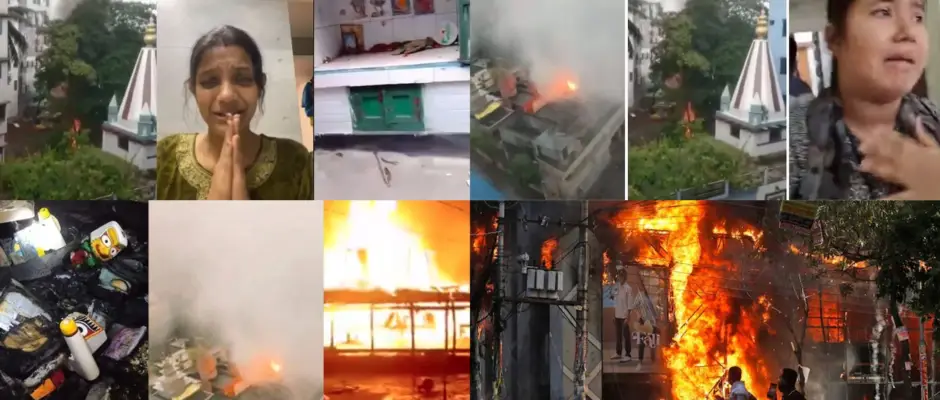
The situation in Bangladesh has reached a critical and alarming juncture, with a systematic and coordinated campaign targeting the Hindu community through acts of violence, destruction, and terror. This genocide, characterized by the deliberate annihilation of Hindu religious and cultural sites, as well as the targeted killings and displacement of individuals, poses an existential threat to the Hindu population in Bangladesh. The interim government must act with urgency and decisiveness: deploying security forces to protect vulnerable communities, ensuring justice through swift prosecution of those responsible, and initiating a comprehensive restoration of destroyed religious and cultural heritage. Moreover, the government must engage with international bodies to secure support and demonstrate a commitment to protecting all citizens, ensuring that such atrocities never occur again. Immediate action is not only a moral imperative but also crucial for the preservation of Bangladesh’s core fabric. Updated – Hindu Genocide Unfolding in Bangladesh

Read More

Hindu Genocide Unfolding in Bangladesh

Hindus, Buddhists, Jains and Christian bear brunt of unprecedented violence unleashed by uncouth Islamists & their handlers. Rahul Pawa Today, Bangladesh faces critical juncture as Prime Minister Sheikh Hasina resigned amidst escalating unrest with an interim government now set to take charge under the military’s supervision. This comes as the country is engulfed in violence with the Hindus and other minority communities bearing brunt of what is rapidly becoming genocide of unimaginable proportions. As the world watched Bangladesh in horror, a systematic campaign of terror was fueled by Islamist extremists’ targeting Hindu homes, businesses, temples and lives. The unrest that began in June over a government job quota system has spiraled out of control. Initially seen as a movement for fairness, the protests quickly devolved into a pretext for Islamist factions including Jamaat-e-Islami, Hefazat-e-Islam and Jamaat Shibir to launch brutal attacks against Hindu and other minority community. The violence has been widespread and systematic: in Moulvibazar, the Notun Kali Temple was desecrated and Hindu homes were set ablaze displacing most families. In Chittagong’s Hajari Goli, Sri Krishna Temple was attacked and mobs attempted to break into Hindu homes specifically targeting families with young girls. These are not isolated incidents but part of a coordinated effort to annihilate Hindus in Bangladesh. Strikingly, the violence against Hindus in Bangladesh bore hallmark of genocide under international law. Genocide is defined as acts committed with the intent to destroy, in whole or in part, a national, ethnical, racial, or religious group. The targeted killings, such as the murder of Hindu police constable Suman Kumar and lynching of Hindu Awami League leader Haradhan Roy and his nephew are clear indicators of a calculated effort to eliminate this minority group. Furthermore, systematic attacks on religious sites including ISKCON and Kali temples and destruction of Hindu homes and businesses point to an organised campaign with genocidal intent. This is not random violence but sheer number of incidents reflects deliberate and coordinated effort to eradicate Hindus from Bangladesh. It is pertinent that the international community must recognize these signs and act before it is too late. For those closely monitoring events in Bangladesh, rapid spread of violence against Hindus following military takeover comes as no surprise. Bangladesh Army Chief held meetings with Jamaat-e-Islami and Hefazat-e-Islam leaders. But, there’s not a word on organised targeting of Hindus. The message is univocally clear, Hindus in Bangladesh are now under siege. In Feni Bash, Parsta Hindu Temple was attacked while riots have engulfed Hindu areas nationwide. In last two days, Islamists murdered two Hindus in Rangpur town and three more were killed by Jamaat Shibir protestors. Entire families have been wiped out, leaving survivors in fear and despair as Hindu temples, homes and businesses are systematically destroyed. The international community cannot remain passive while an entire population is being targeted for destruction. Moreover, Pakistan and China’s involvement in this crisis adds a dangerous dimension to the violence. Both nations have a vested interest in destabilising Bangladesh, and by backing Islamist factions like Jamaat-e-Islami, Hefazat-e-Islam, and Jamaat Shibir, they are advancing their geopolitical agendas while exacerbating the humanitarian crisis. Pakistan, known for supporting Islamist extremism and terrorism, has reportedly provided financial and logistical support to these extremist groups. China, leveraging its influence in the region, has further destabilised the situation, turning a blind eye to the atrocities committed against the Hindu population. This geopolitical strategy has made the situation far more complex, demanding global attention. The violence in Bangladesh is not merely an internal issue; it is part of a broader strategy that threatens the lives of millions of innocent people. The involvement of these two nations must be scrutinised and they should be investigated for their role in this unfolding genocide. The global community, including the United Nations, human rights organizations, and nations that believe in democracy, especially India, the regional super-power must take immediate action to prevent further atrocities. Diplomatic pressure should be applied to ensure the protection of Bangladeshi citizens, and an independent investigation into the crimes against Hindus must be initiated. The world has seen too many genocides in the past; one cannot afford to let history repeat itself. Immediate action is needed to halt the bloodshed and to ensure that justice is served for the victims of these heinous crimes. The time to act is now, before the situation escalates further and another dark chapter is written in the history of human rights violations. (Author is Director – Research at CIHS in New Delhi)

Read More

China-Pakistan Agenda in Bangladesh Protests

Violent protests by students against job quotas may have been conveniently used by Beijing & Islamabad to further their interests Rahul Pawa China, Pakistan, geo-political interest groups and international stakeholders may have muddied Bangladesh waters. They may have either directly or indirectly contributed to current wave of violent protests that resulted in 130 fatalities. These players may have conveniently used the anger against quotas for government jobs as a cover to stroke flames of dissent against Prime Minister Sheikh Hasina and her Awami League government. The current spate of violent incidents seems to have been triggered by Communist Party of China and Pakistan that have taken an adversarial position and spread discontent against Sheikh Hasina’s government. Protests erupted after Appellate Division of the Supreme Court decided on July 10, 2024 to maintain status quo on quota system intended for freedom fighters and their families for four weeks. This came after a High Court ruled on June 5, 2024 that declared 2018 government circular canceling 30 per cent quota for freedom fighter’s descendants in government jobs illegal. This sparked widespread anger among students and larger population, culminating in violent clashes and a death toll that continued to rise. Students from various universities in Dhaka united to demand quota reforms. After initial postponement owing to Eid and summer holidays, students movement resumed on July 1 with demonstrations. Students and teachers from public universities like University of Dhaka, Rajshahi University of Engineering and Technology and Jahangirnagar University, among others were soon joined by counterparts from private institutions such as North South University and BRAC University. Under the banner of Anti-discrimination Students Movement, they launched ‘Bangla Blockade’ (Bangladesh Shutdown) thereby disrupting domestic train and road transportation networks. Online activism surged with calls for “another 2018” in reference to previous quota reform movement. Subsequently, protestors call for a ‘Bangla Blockade’ intensified on July 7. As demonstrations spread nationwide, clashes with police on July 11 marked a significant escalation. Prime Minister Sheikh Hasina’s remarks on July 14, referring to Razakars (Bangladeshis who collaborated with Pakistan during 1971war) made during a press conference after her return from China coupled with the ruling Awami League’s hardened stance intensified the situation. This led to violent suppressions by Chhatra League and resulted in hundreds of injuries. The kindling for this unrest had been laid well before the court’s ruling as flames were fanned earlier this month during Prime Minister Sheikh Hasina’s visit to Beijing from July 8 to 10, 2024. The visit, intended to secure significant financial aid and strengthen bilateral ties ended abruptly, hinting at Hasina’s deep-seated dissatisfaction with the Communist Party of China (CPC). China offered only $100 million in financial assistance, a far cry from the initially promised $5 billion. Adding to the discord, Xi gave Hasina very little time as Beijing proposed a controversial ten-year re-education policy aimed at countering Islamic culture and promoting Chinese lifestyles, similar to measures implemented in Pakistan during 2010. This proposal, perceived as racist and a direct affront to Bangladesh’s cultural sovereignty, significantly strained Dhaka – Beijing relationship. The protests in Dhaka quickly escalated as protesting students and citizens voiced their dissatisfaction with reinstated job reservation quota. This policy initially abolished in 2018 reserved 30 percent government jobs for families of 1971 independence war veterans. The new quota system, viewed as unreasonable and discriminatory, exacerbated existing frustrations amid high unemployment and rampant inflation. Pakistan-backed Islamist groups such as Jamat-e-Islami, which have significantly undermined Bangladesh’s private sector, exacerbating economic challenges the country already faces.This influence, funded by the Middle East via Pakistan, has made government jobs even more sought after. The resulting volatility in the private sector has created a hostile environment, where economic grievances easily morph into political unrest. This destabilising influence was earlier evident during the violent response to the Bangladesh government’s attempt to modernise labor laws in 2018. The proposed changes aimed to attract more foreign investment by aligning local labour practices with international standards. However, Islamist groups, heavily funded by Pakistan vehemently opposed these changes arguing they would undermine Islamic values and worker rights. Jamat-e-Islami with its significant political clout mobilised large-scale protests and strikes which paralysed many sectors of the economy including the vital garment industry. This unrest discouraged foreign investment and highlighted the fragility of private sector in the face of Islamist political and religious extremism. Moreover, China’s involvement in Bangladesh’s student unions further escalates the situation. Reports indicate that CPC has infiltrated Bangladesh universities through education and student exchange programmes. Five Chinese universities in Yunnan province alone teach Bangla language and culture, sending students to Dhaka to create intelligence assets and funding channels for student wings. This strategy aims to mobilise Bangladeshi students against their own government’s policies thereby creating more space for CPC influence. Notably, student unions that staunchly defended Islam in Bangladesh remained conspicuously silent on CPC policies against Uyghur Muslims. The current situation reiterates CPC’s potential to influence and organise student protests in Bangladesh. Earlier, on April 13, 2021, students gathered at the Dhaka Press Club, demanding better arrangements from Hasina Administration for studying in China. The protest pressuring the Bangladeshi government nearly turned violent, demonstrating CPC’s influence and capability to mobilise students in Dhaka, highlighting its broader strategy of using education and cultural programs as tools of influence. Moreover, China-Pakistan nexus in Bangladesh adds another layer of complexity. Pakistani students often affiliated with Jamat-e-Islami collaborate with their Bangladeshi counterparts facilitating communication and coordination for protests. The human intelligence (HUMINT) capacity of Pakistan’s ISI has been instrumental in channeling Chinese funds to stage ongoing protests in Dhaka. Bangladeshi workers in Chinese companies are reported to have been trained to mobilise pro-China rallies as seen in 2019 when workers of Jingjiu Group in Bangladesh who were seen chanting Pro-China slogans in Mandarin. Intriguingly, CPC’s interest in Bangladesh extends beyond financial aid. Beijing aimed to establish strong foothold in South Asia leveraging its Belt and Road Initiative (BRI) aspiring to integrate Bangladesh into its economic sphere. Despite the disappointing loan offer, China has

Read More