CIHS – Centre for Integrated and Holistic Studies

Date/Time:

USAID Shady Agenda Exposed

USAID Shady Agenda Exposed

Foreign influence peddling is not new to India. From colonial trade networks to modern soft power strategies, external forces have long sought to shape the nation’s socio-political landscape. In the present era, dominance is not limited to dominance through military strength but exercised via economic dependencies, cultural narratives and policy interventions to try and subjugate communities to slavery of ultra-modern variety. In Indian context, foreign influence is often orchestrated through a meticulously structured network of private corporations, non-governmental organizations (NGOs), think tanks and academic institutions with funding streams strategically directed to shape public discourse and policy formulation. And, in most cases, it’s an operation of the deep state. At the heart of this intricate web, the common patron is United States Agency for International Development (USAID).

Read More
Washington Post’s Propaganda, Prejudice, Prevarication

Washington Post’s Propaganda, Prejudice, Prevarication

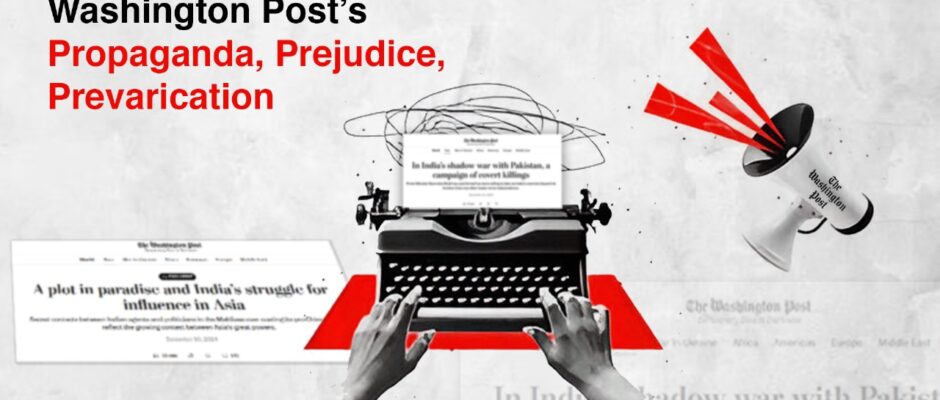
Wild allegations that Bharat masterminded killings in Pakistan or sought to destabilize Muizzu regime in Maldives is part of WaPo’s agenda driven falsehoods. Why is The Washington Post turning hostile towards Bharat? Has the editorial policy of The Washington Post biased and agenda driven? Who’s behind this framing against Bharat and its people? These are questions for which the Post may not have any plausible explanation even to its own readers. In recent days, two such write ups that kicked up big controversy in Bharat relate to alleged killings done by Bharat in Pakistan and purported plot to destabilize Maldivian government headed by President Muizzu. On December 31, 2024, WaPo published, “In India’s shadow war with Pakistan, a campaign of covert killings,” written by Gerry Shih. It is a glaring example of the paper’s disturbing record of bias and agenda-driven journalism. Promptly, Randhir Jaiswal, spokesperson for Ministry of External Affairs, Government of India responded quoting Hillary Clinton, the former US Secretary of State, as saying, “You can’t keep snakes in your backyard and expect them only to bite your neighbours,” as a warning to Pakistan about terrorist organizations. A day earlier, Gerry Shih and Siddharth Roy wrote, “A plot in paradise and India’s struggle for influence in Asia” to allege that there was a serious plot to destabilize a government led by President Muizzu. The Washington Post went ahead with its own agenda driven write up though former Maldivian President Mohamed Nasheed, leader of opposition Maldivian Democratic Party debunked the write up. He stated that India has always supported democracy in the Maldives and will never engage in such acts. Both the writer ups were nothing more than an attempt to make a sensational yearend with biased and heavily skewed narrative that undermines India’s legitimate national security concerns while conveniently ignoring political standing, mutual interests and Pakistan’s long-standing sponsorship of cross-border terrorism. This kind of coverage necessitates a critical, incisive and unapologetic reaction since it not only misinforms global audiences but also raises disturbing issues about The Washington Post’s editorial biases and the agenda underlying its ongoing anti-India stance. WaPo’s Double Standards and Troubling History This is the same newspaper that frequently criticized countries like India who have made serious moves protect her sovereignty from unfriendly neighbours. While The Washington Post had the zeal to spread false narratives, it conveniently failed to report on issues back home in United States’ or its partners’ covert activities and extrajudicial actions. For example, why was The Washington Post silent on CIA’s drone strikes in Pakistan’s tribal regions that killed scores of civilians? Where is the serious investigation of US role in destabilizing entire regions via proxy wars and targeted assassinations? The selective anger is obvious. The Washington Post’s history is rife with paradoxes and instances of questionable journalism. Eugene Meyer, a billionaire and influential Republican, purchased the insolvent Post in 1933, promising the public that it was politically independent. Meyer’s hostility to Roosevelt’s New Deal resulted in biased editorials and even pseudonymously authored news pieces that mirrored his ideological leanings. His wife, Agnes Ernst Meyer, contributed socialist ideas to the Post’s pages, spotlighting people such as John Dewey and Saul Alinsky, demonstrating the publication’s contrasting influences. Meyer further shaped the paper’s ideological stance in1940s by using his political and family ties, such as bringing in his son-in-law Phil Graham as publisher. The Post’s political stance was tainted for decades by the ties with Georgetown elites and well-known political figures like the Kennedys. In the twenty-first century, the paper’s coverage of Iraq War was blatantly erroneous with over 140 front-page articles endorsing the invasion by Bush administration while censoring criticism from within. Its present coverage follows this pattern of selective reporting and ideological scheming which includes publicly criticizing India while neglecting more significant structural problems in other spheres. Baseless Allegations and Flimsy Evidence There is serious lack of reliable evidence to support the article’s core argument stating that a string of assassinations in Pakistan had been planned by India’s intelligence agency, Research and Analysis Wing (RAW). The article makes extensive use of Pakistani officials, which is a notoriously untrustworthy source considering the country’s history of creating stories to divert attention away from its own shortcomings. Pakistan’s Inter-Services Intelligence (ISI) has been the mastermind behind cross-border terrorism for decades, funding organizations like Jaish-e-Mohammed (JeM) and Lashkar-e-Taiba (LeT) that have caused chaos in India and beyond. Pakistan has been regularly accused by the international community of harbouring and funding terrorists, particularly by Financial Action Task Force (FATF) and United Nations. However, the story in The Washington Post ignores this fact and instead concentrates on unsupported allegations against India. The article’s reliance on “Western officials” to support its assertions is absurd considering that these sources provide no hard evidence. The reported “evidence” consists of ambiguous allusions to WhatsApp messages and purported confessions that were taken under dubious conditions. Such little evidence would not be sufficient to support a real journalistic investigation, much less stand up in any court of law. Ignoring the Root Cause: Pakistan’s State-Sponsored Terrorism Pakistan’s unrelenting financing of terrorism is a major issue that must be addressed before any conversation regarding clandestine activities in South Asia can be considered complete. Pakistan has used terror as an instrument of state policy since it came into being. Numerous acts of terror against India, be it the 1947 Kabali raid, 2001 Parliament Attack, 2008 Mumbai attacks, 2016 Uri attack and 2019 Pulwama bombing, clearly bear Pakistan’s fingerprints. Beyond India, Pakistan is a global hub for terrorism, as evidenced by its backing for Taliban’s comeback in Afghanistan and its role in providing sanctuary to Osama bin Laden in Abbottabad. The Washington Post piece, however, attempts to minimize this uncomfortable reality by portraying Pakistan as a helpless victim rather than an offender. This must be taken into consideration when evaluating India’s purported actions as detailed in the article. India has a policy of “zero tolerance against terrorism” given that terror activities led to loss of thousands of its

Read More
Trouble with ‘The Economist’

Trouble with ‘The Economist’

Write-up on RSS is steeped in distortions, prejudices, agenda driven narrative push rather than nuanced analysis that stands scrutiny. On December 19, 2024, as festive season approached, The Economist released its holiday double issue, featuring an unnamed article on Rashtriya Swayamsevak Sangh (RSS). The publication, owned by immensely wealthy Agnelli and Rothschild families, traces its origins to 1843, when it was founded to advocate for repeal of import tariffs. Yet, in its long history, The Economist has strayed little from its original mission of pushing selective agendas cloaked in garb of intellectual rigour. Over the years, it has subtly perfected the art of propaganda, blending curated narratives with psychological imprinting to advance the interests of its elite patrons. This Christmas edition is no exception. Beneath the veneer of incisive commentary lies a carefully orchestrated exercise in bias—shaping perceptions to align with the ruling class worldview that The Economist so loyally upholds. Whether degrading communities or offering justifications for wars, the magazine has long operated as a conduit for dangerous and radical global agendas. In this latest offering, the publication’s signature word crafting meets its predictable penchant for soft-pedaling propaganda, leaving readers with a polished but shallow narrative that serves its masters across oceans, rather than the truth it claims to champion. In its article titled “Inside the RSS: The World’s Most Powerful Group,” The Economist employs its arsenal of rhetoric to perpetuate a troubling narrative against what it perceives as a significant ideological opposition to its wealthy western ruling elite. The elite, seemingly vested in a global order conducive to its own interests, appears to view Rashtriya Swayamsevak Sangh (RSS) as a formidable challenge. The article alleges that RSS is a paramilitary organization culpable for persecution of India’s post-partition minorities —a claim that rests on foundation of conjecture rather than tangible evidence. In reality, Bharat boasts a thriving minority landscape, some of the world’s most robust legal protections and welfare schemes for minorities, unparalleled in their scope and inclusivity. At a time when Western corporations and elite amass fortunes from wars that devastate nations across the globe, Bharat’s ethos has consistently championed inclusivity, cultural oneness and wellness. The worldview embodied by the RSS—an organization that represents the world’s largest voluntary movement—is deeply rooted in this ancient Indian philosophy. Far from the aggression suggested by The Economist, the RSS reflects a commitment to harmony and resilience, offering a counterpoint to exploitative frameworks perpetuated by those who profit from division and conflict. By choosing to distort rather than understand this ethos, The Economist exhibits its own inability—or unwillingness—to engage with perspectives that challenge the interests of its benefactors. More so, in relentless pursuit of narrative control, The Economist once again attempts to link Nathuram Godse, the assassin of Mahatma Gandhi, to the RSS, describing him as an “ex-member” of the organization. This is a jaded agenda-based narrative that has had exposed RSS rivals. This very fixation not only underscores the publication’s penchant for propaganda but reveals a troubling reliance on conspiracy theories when they align with its agenda. Interestingly, The Economist spares no effort in crafting curated narratives about others while maintaining a conspicuous silence on controversies closer to its own sphere of influence. The Rothschilds, for instance—a family whose immense wealth and influence have been the subject of countless theories, from the Kennedy assassination to the Islamic State—remain untouched by the magazine’s purported investigative zeal. Similarly, the rumoured role of US government in assassination of Martin Luther King Jr. is conspicuously absent from its pages, despite widespread historic scrutiny. This selective focus speaks volumes about the publication’s biases and priorities. For those who can discern fact from fiction, The Economist’s approach serves as a reminder to distinguish credible media from outlets that prioritize agenda driven narratives over professional reportage. By choosing to amplify baseless charges against the RSS while ignoring deeper, systemic issues tied to its elite patrons, The Economist exposes its own limitations as a serious journalistic institution – which it tries to project itself. Ironically, The Economist expects its readers to believe that the RSS draws inspiration from Hitler’s Nazi Germany—a claim that is as baseless as it is sensational. The narrative point that lost its shelf life in last couple of decades, undoubtedly was reborn in champagne circles and elite echo chambers and it fails to hold up against the reality experienced by millions across India. From the youngest child to the eldest member of society, anyone who has encountered RSS firsthand can unequivocally attest to its true source of inspiration: the sacred Vedas, Upanishads and Sanatan Dharmic philosophy and outlook to Hindu way of life. Far from the twisted historical parallels The Economist seeks to draw, RSS is deeply rooted in timeless principles of Indian philosophy, centered on harmony, inclusivity, and selfless service. Such erroneous narratives find little resonance with the Indian population, who recognize them for what they are—attempts to vilify through misinformation. Instead, they gain traction in controlled settings where carefully curated echo chambers are created, often with backing of media outfits like The Economist. By perpetuating these flawed depictions, the magazine reveals not just its bias, but also its disconnect from ethos of a nation it claims to critique. In its relentless campaign against Bharat’s leadership, The Economist perpetuates baseless accusation that Prime Minister Narendra Modi bears responsibility for unfortunate Gujarat riots of 2002. This charge, however, crumbles under scrutiny, exposing not only its absurdity but also the Hinduphobic bias that underpins such narratives. What The Economist conveniently omits—and what must be highlighted—is the inhumane and brutal burning alive of 59 Hindu kar sevaks (volunteers) aboard Sabarmati Express at Godhra. This act of terror, meticulously planned and coordinated by Islamist extremists, sparked the violence that followed. Among those convicted for orchestrating this atrocity were Maulvi Umarji, Farooq Bhana and Imran Sheru—a stark reminder of premeditated nature of the attack. Yet, this foundational context finds no mention in The Economist’s coverage, which prefers to portray Hindus as aggressors while absolving the instigators of their

Read More

Boys Play Big in Muddied Waters!

US, China with diverse agendas coupled with religious extremist forces in Islam and evangelists may shrink open space to operate for Bharat that has big stakes in Bangladesh K.A.Badarinath The big boys are at play. Bangladesh government under Nobel laureate Muhammad Yunus is bound to be pulled apart by both United States of America seeking to establish a military base in South Asia and Chinese Communist Party led by President Xi Jingping that’s seeking unquestioned dominance in Asia. Jamaat-e-Islami and Bangladesh National Party (BNP) led by Khalid Zia would play willing tools in the big boys power play with Pakistan reduced to a lackey of minor variety. There’s denying that Muslim Brotherhood that’s globally dreaded would complicate the equation with its Islamist – Jihadist agenda on Bharat’s Eastern frontiers. ‘Razakars’ would become handy frontline private army in the hands of jihadist Muslim leadership internationally. There have been reports that already these Razakars have taken over civic policing as an occupational army of zealots. Well, tasks for Bharat are cut out after Sheikh Hasina’s government fell last week, Awami League purged, safe exit to her provided in a swift deal and Army took reins in a coup. Though interim government headed by Yunus and a battery of over dozen advisors have taken charge, nothing seems to have changed on the ground while Army calls the shots. Bangladesh’s under-belly has several layers that must be understood before Bharat gets to the drawing board to establish a working relationship with the new Army controlled, Yunus fronted regime given that Chinese, US and Pakistan deep state haggling for their pound of flesh. The ‘transitional’ Yunus regime got legitimacy as Democratic White House was first to recognise the government. Secretary of State’s spokesperson was drafted to convey that US was ‘ready and looked forward’ to working with Dhaka under Yunus. St Martin Island also known as ‘Narikel Jinjira’ (Coconut Island) or ‘Daruchini Dweep’ (Cinnamon Island) off-the-Chittagong coast may be eyed by US to set up a military base to lord over both Bharat and her expansionist neighbour China. Direct US presence in the region may not be encouraged or welcomed by Bharat given the strategic implications. Also, Bharat would get cut off virtually from entire South East Asia in terms of trade, investment and services. Church driven ‘Project K’ to carve out an artificial autonomous region christened as ‘Kukiland’ will come to the forefront. Church’s fancy idea of a separate Christian state encompasses parts of Bangladesh, Burma and Bharat’s Manipur and Mizoram. This Christian agenda is expected to get complete backing of White House under President Joe Biden or his possible successor Kamala Harris. Even if Donald Trump upstages the democrats and gets elected in November 2024 elections, this agenda may get going. Even if general elections in Bangladesh were to be held anytime now, a pliable government in Dhaka is what Washington DC may expect to see in the saddle given that Awami League is virtually out of power play. On the other hand, China would try and get Teesta River Project and other infrastructure ventures that provide Beijing proximity to India’s ‘chicken neck’ area. Weeks before Hasina government fell, US $ two billion worth interest free, concessional, commercial loans apart from grants were reportedly promised by China after a meeting that Bangladesh Prime Minister had with President Xi. On face of it, funding infrastructure projects either directly or through Asian Infrastructure Investment Bank (AIIB) may not just be limited to investment push. Instead, it will result in strategic issues for Bharat giving China advantage at her doorstep. Third dimension to Bangladesh story is the Jamaat-e-Islami backed by Pakistan and part of larger Muslim Brotherhood going berserk would pose serious challenges to Bharat. Jamaat pursuing genocide of Hindus in Bangladesh has been widely reported. CIHS has meticulously documented these grave crimes. Jamaat is popular as ‘congregation of Muslims’. Known as the largest Muslim formation founded in 1975, Jamaat was banned from political participation by Bangladesh Supreme Court in 2013 citing its opposition to religious freedom or practice of faith. Within its ambit were other organizations like Al – Badr, Al – Shams and self-styled peace committee that formed the jihadist network. All these are pronouncedly anti-Hindu, Buddhists and Christians in Bangladesh. Evangelists and Islamist forces are expected to be on collusion course given their extremely divergent agendas for Bangladesh. Bid to carve out an autonomous Christian area by extreme evangelists with backing from US may be at odds with ‘theocratic’ ‘Islamist’ state that Jamaat may like to evolve Bangladesh into. Conflict between evangelists and Muslims may turn rough reported from several cities in European countries. Contrarian geo-political forces in China, US and religious extremism donned by evangelists and Jamaat leaves very little space for open, flexible and forward thinking democratic agenda in Bangladesh. This is a heady mix in which India will have to tread carefully to safeguard her geo-political and strategic interests apart from that of Hindus and Indian origin people living in Bangladesh. Rightly, Prime Minister Narendra Modi has emphasised that Yunus government in Bangladesh must take steps to protect Hindus lives, properties, businesses especially women that have been targeted by Jihadists. For Bharat, dealing with influx of Bangladeshis fleeing the violence torn country may be a big priority apart from safeguarding her people in Bangladesh. Secondly, New Delhi may have to swerve through muddy waters that have become playground for both US and China apart from minions like Pakistan. Thirdly, recalibrating equations with Dhaka given an array of forces from far-left extremists, religious jihadists to military establishment may pose a big challenge. Fourthly, pursuing her agenda of peace, tranquillity and prosperity in South Asia may not be easy for Bharat. Fifthly, smoothening relations with Bangladesh may turn tricky while former Prime Minister and senior Awami League leader Sheikh Hasina continue to be respected state guest in Delhi. Sixthly, working with likeminded stakeholders to ring in democracy with all forces in tact may be a tall order. Seventhly, relatively tension free

Read More

Hindu Genocide Unfolding in Bangladesh

The situation in Bangladesh has reached a critical and alarming juncture, with a systematic and coordinated campaign targeting the Hindu community through acts of violence, destruction, and terror. This genocide, characterized by the deliberate annihilation of Hindu religious and cultural sites, as well as the targeted killings and displacement of individuals, poses an existential threat to the Hindu population in Bangladesh. The interim government must act with urgency and decisiveness: deploying security forces to protect vulnerable communities, ensuring justice through swift prosecution of those responsible, and initiating a comprehensive restoration of destroyed religious and cultural heritage. Moreover, the government must engage with international bodies to secure support and demonstrate a commitment to protecting all citizens, ensuring that such atrocities never occur again. Immediate action is not only a moral imperative but also crucial for the preservation of Bangladesh’s core fabric. Updated – Hindu Genocide Unfolding in Bangladesh

Read More

Hindu Genocide Unfolding in Bangladesh

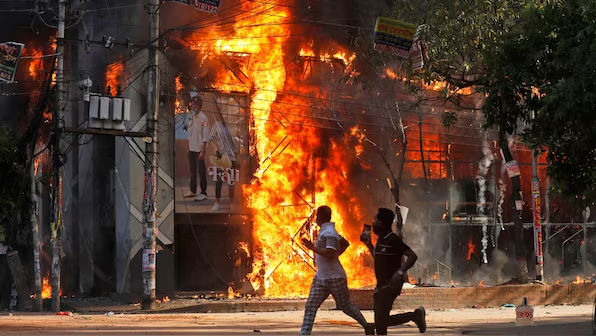
Hindus, Buddhists, Jains and Christian bear brunt of unprecedented violence unleashed by uncouth Islamists & their handlers. Rahul Pawa Today, Bangladesh faces critical juncture as Prime Minister Sheikh Hasina resigned amidst escalating unrest with an interim government now set to take charge under the military’s supervision. This comes as the country is engulfed in violence with the Hindus and other minority communities bearing brunt of what is rapidly becoming genocide of unimaginable proportions. As the world watched Bangladesh in horror, a systematic campaign of terror was fueled by Islamist extremists’ targeting Hindu homes, businesses, temples and lives. The unrest that began in June over a government job quota system has spiraled out of control. Initially seen as a movement for fairness, the protests quickly devolved into a pretext for Islamist factions including Jamaat-e-Islami, Hefazat-e-Islam and Jamaat Shibir to launch brutal attacks against Hindu and other minority community. The violence has been widespread and systematic: in Moulvibazar, the Notun Kali Temple was desecrated and Hindu homes were set ablaze displacing most families. In Chittagong’s Hajari Goli, Sri Krishna Temple was attacked and mobs attempted to break into Hindu homes specifically targeting families with young girls. These are not isolated incidents but part of a coordinated effort to annihilate Hindus in Bangladesh. Strikingly, the violence against Hindus in Bangladesh bore hallmark of genocide under international law. Genocide is defined as acts committed with the intent to destroy, in whole or in part, a national, ethnical, racial, or religious group. The targeted killings, such as the murder of Hindu police constable Suman Kumar and lynching of Hindu Awami League leader Haradhan Roy and his nephew are clear indicators of a calculated effort to eliminate this minority group. Furthermore, systematic attacks on religious sites including ISKCON and Kali temples and destruction of Hindu homes and businesses point to an organised campaign with genocidal intent. This is not random violence but sheer number of incidents reflects deliberate and coordinated effort to eradicate Hindus from Bangladesh. It is pertinent that the international community must recognize these signs and act before it is too late. For those closely monitoring events in Bangladesh, rapid spread of violence against Hindus following military takeover comes as no surprise. Bangladesh Army Chief held meetings with Jamaat-e-Islami and Hefazat-e-Islam leaders. But, there’s not a word on organised targeting of Hindus. The message is univocally clear, Hindus in Bangladesh are now under siege. In Feni Bash, Parsta Hindu Temple was attacked while riots have engulfed Hindu areas nationwide. In last two days, Islamists murdered two Hindus in Rangpur town and three more were killed by Jamaat Shibir protestors. Entire families have been wiped out, leaving survivors in fear and despair as Hindu temples, homes and businesses are systematically destroyed. The international community cannot remain passive while an entire population is being targeted for destruction. Moreover, Pakistan and China’s involvement in this crisis adds a dangerous dimension to the violence. Both nations have a vested interest in destabilising Bangladesh, and by backing Islamist factions like Jamaat-e-Islami, Hefazat-e-Islam, and Jamaat Shibir, they are advancing their geopolitical agendas while exacerbating the humanitarian crisis. Pakistan, known for supporting Islamist extremism and terrorism, has reportedly provided financial and logistical support to these extremist groups. China, leveraging its influence in the region, has further destabilised the situation, turning a blind eye to the atrocities committed against the Hindu population. This geopolitical strategy has made the situation far more complex, demanding global attention. The violence in Bangladesh is not merely an internal issue; it is part of a broader strategy that threatens the lives of millions of innocent people. The involvement of these two nations must be scrutinised and they should be investigated for their role in this unfolding genocide. The global community, including the United Nations, human rights organizations, and nations that believe in democracy, especially India, the regional super-power must take immediate action to prevent further atrocities. Diplomatic pressure should be applied to ensure the protection of Bangladeshi citizens, and an independent investigation into the crimes against Hindus must be initiated. The world has seen too many genocides in the past; one cannot afford to let history repeat itself. Immediate action is needed to halt the bloodshed and to ensure that justice is served for the victims of these heinous crimes. The time to act is now, before the situation escalates further and another dark chapter is written in the history of human rights violations. (Author is Director – Research at CIHS in New Delhi)

Read More

Injustice Faced by Indian Students & Diaspora in the United States: Neglected Safety and Crimes

Triveni Kaul United States was/is a dream destination for quality education and better futuristic opportunities amongst the international students for several years. The most significant number of students are made up of Indian community. Even though Indian students have made substantial contribution to the academic and financial growth of the US, however they constantly encounter a wide range of threats and difficulties, from safety concerns to racial prejudices. It is an alarming situation for Indian student diaspora as the US government allegedly disregards the safety and well-being of the larger international community. With their unbeatable skills, Indian community is leading the multi-trillion-dollars technology, medicine, and academic industries. In federal taxes they pay more than $12 billion annually and represent about one percent of the country’s population. Indian community accounting nearly eight percent of all doctors, ten percent professionals in technology business and in the sector of startup Indian founders accounts approximately twenty five percent. In venture capital Indian American entrepreneurs have raised over $30 billion. With over 400,000 Indian-owned businesses making almost $100 billion in revenue, the community is vibrant to economic progress. To enrich America’s social fabric, community contributes over $1.5 billion annually to philanthropic causes. This strong presence fosters innovation and cultural diversity across the nation. Notwithstanding these outstanding contributions, hate crimes and racial prejudice continue to target the Indian student community. The worry has grown in light of the xenophobic rhetoric and targeted attacks in recent years. It appears that verbal, physical, and violent attacks are intended against Indian students. The tragic case of Srinivas Kuchibhotla, an Indian engineer who was shot and killed in Kansas in 2017 while a man yelled, “Get out of my country,” serves as a grievous reminder of the risks this population faces. These instances are often covered by media, yet they are just a tip of the iceberg. Because of disdain for the legal system or fear of repercussions, many hate crimes remain overlooked. The lack of strong punishment to offenders and frequently mild sentences further encourage others to carry out similar crimes. Systemic failure in effective dealing of hate crimes has created an atmosphere of insecurity and fear amongst Indian students.  Recent incidents of suspicious attacks and police response underscore the severity of the situation. In the beginning of this year (January-February 2024) more than nine Indian students were killed. On January 23, Kevin Dave’s police car reportedly struck Jaahnavi Kandula, a 23-year-old Indian student in Seattle, USA. Officer Dave was reportedly driving at a speed of around 120 km/h when the incident occurred while responding to a drug overdose call. Further to the grief, bodycam footage from Seattle Police Department shows Officer Daniel Auderer making a flippant remark about terrible accident, saying, “Just write a cheque.” The amount is USD 11,000. Most astonishing is that The King County Prosecutor’s Office decided not to file criminal charges against Seattle Police Officer Kevin Dave. In November 2021, the tragic murder of Pravin Varughese, a 19-year-old Indian American student at Southern Illinois University. Varughese was found dead in a wooded area, and police preliminarily reported hypothermia as the cause of death. However, an independent autopsy discovered that he had suffered blunt force trauma in the head, raising worries of foul play. The investigation was marred by holdups and speculative mismanagement of proofs, leading to extensive condemnation of local law enforcement’s response. Similarly, the case of Sharath Koppu, a 25-year-old Indian student at the University of Missouri-Kansas City, emphasized the vulnerabilities confronted by Indian students. Koppu was shot and killed in July 2018 during an attempted robbery at a restaurant where he worked part-time. The occurrence sparked outrage and prompted attention to the larger concern of safety for international students, predominantly those who work in unquestionably unsafe environments to support their education. Another troubling incident occurred in 2019 when Vamshi Reddy Mamidala, a 27-year-old computer science master’s student, was found dead in his California residence. Although the exact cause of his death is still unknown, the case has highlighted the need for improved safety precautions for off-campus students. Indian students repeatedly feel their concerns are not taken seriously and these crime reports are overlooked by law enforcement and government authorities. This negligence stems from cultural misunderstandings, racial biases, and administrative inadequacies. At the time of assistance, a lot of students claim to be patronized or ignored, and police may neglect to file complaints or carry out in-depth investigations. In addition to sustaining a cycle of injustice and neglect, this lack of responsiveness erodes confidence in law enforcement. For Indian students, added difficulties are aggravated by US immigration and visa laws. Getting an H-1B visa, which is essential to work and live in US, is becoming more and more challenging. Ambiguity over visa approval and concerns about deportation increase tension and anxiety. Stability is brought about by restrictive immigration laws and regular adjustments to regulations. Even though it was later reversed, the Trump administration’s attempt to deny visas to foreign students enrolled in online programs during the COVID-19 outbreak exposed their vulnerability and caused concern for many of them regarding their future in the US. The psychological well-being of students is significantly impacted by the persistent fear of violence, prejudice, and uncertainty pertaining to immigration. Due to the stigma and the dearth of counselling facilities that are sensitive to cultural differences. (Incomplete sentence) Even though institutions offer mental health services, they frequently aren’t enough to meet the requirements of international students. The inability to communicate, cultural differences, and the fear of misunderstandings prevent them from asking for assistance, which exacerbates their sense of injustice and loneliness. In order to guarantee the security and well-being of students, educational institutions can play a crucial role. To combat discrimination, universities must be proactive in offering counselling that is culturally sensitive, providing diverse education, and establishing clear procedures for reporting hate crimes. It’s also critical to support overseas students in developing a sense of community. The biases and indifferences that Indian Americans and students experience have to be seriously

Read More

Foreign Funding Has No Place in Democratic Self-Governance!

Vinod Kumar Shukla In Abraham Lincoln’s words democracy is a government of the people, by the people and for the people which supposedly means free from any influence to protect the rights of citizens of democratic self-governance. But foreign intervention has become a big challenge for democratic countries around the world and the US is also not free from it. To facilitate all this, US federal law prohibits foreign citizens and governments from spending in any election in the US. But certain foreign players cocked a snook at law in 2016 and 2020 by spending huge money to influence US elections exposing vulnerabilities of campaign finance laws. Such elements are still at work in the 2024 elections. With the digital world being a reality, laws governing campaign finance systems failed to catch up. Inaction by Federal Election Commission (FEC) and inadequate Electoral Transparency Laws allow foreign players to influence US elections. Around $1 billion “dark money,” has been spent over the past one decade. National Counterintelligence And Security Center tells that foreign interference fall into five categories: Cyber operations targeting election infrastructure; Cyber operations targeting political parties, campaigns, and public officials; Covert influence operations to assist or harm political organizations, campaigns, or public officials; Covert influence operations to influence public opinion and sow division; and Covert efforts to influence policymakers and the public. Narrative of political image; internet communities created for specific electoral goals and extensive use of humour and satire to influence electorates were at play in the campaigns in the US. The US State Department recently alleged Russia for covertly spending over $300 million since 2014 to influence elections in more than two dozen countries which is just the tip of the iceberg. US Secretary of State Antony Blinken during his three-day visit to China in April 2024 said that there is evidence of Chinese attempts to “influence and arguably interfere” upcoming US elections, despite Chinese President Xi Jinping’s commitment not to do so. A Microsoft research report published in April 2024 suggests that Russian online campaigns to influence November 2024 US elections geared up over the past 45 days, but the pace is slower than the past elections. Russia-linked accounts are allegedly disseminating divisive content. The observation of Microsoft is that activities of Russia are not as intense as in previous elections but it may increase in the days to come. Online disinformation campaigns are unleashed with posts starting with a whistleblower or citizen journalist posting content on a video channel or social media. That content is mostly taken up by websites like DC Weekly, Miami Chronicle and The Intel Drop. However, the Kremlin has denied any such meddling in November 2024 elections and also in 2016 and 2020 elections. China too has been interfering in the democratic process of countries across the world for a long time which has now become a foreign policy trouble for the US administration especially for those managing the poll process. Both Joe Biden and Donald Trump are of the view that China has the intent and capabilities to challenge the US-led world order. But the Biden administration has outlined several reasons to remain engaged with China. This might make sense to US companies working in China and to political realists who don’t see much wrong in working out a way to coexist with another great power. But 81 per cent Republicans, 59 per cent Independents and 56 per cent Democrats see China as a threat giving Republicans a political stick to beat Biden with for going soft on China. As it gives green signal to foreign interests to spend money on elections despite the fact that there is a ban on foreign spending in Federal, State, and local elections. The FEC interprets the ban applicable on contesting elections and letting foreign players pour millions in elections. For the US, dealing with foreign interference in elections has been critical since Russia allegedly worked to influence the outcome of the 2016 presidential election. Investigations reveal that Russia targeted Black Americans on social media to disincentivize them from voting in the 2016 election — the tactics were aimed at magnifying race-based societal divisions. Since then, the US adopted a whole-of-government approach against election cyberthreats and foreign interference ensuring that all government agencies work in tandem to track and counter cyberthreats on election-related manipulations to protect voters’ objectivity and election infrastructure. China has been meddling elections in every corner of the globe and the US being the most apparent target for its geopolitical interests. In February 2024, the Office of the Director of National Intelligence stated: “Beijing is expanding its global covert influence posture to better support the CCP’s goals. The PRC aims to sow doubts about US leadership, undermine democracy, and extend Beijing’s influence.” The US media extensively reported that covert Chinese accounts were masquerading online as American supporters of former President Donald Trump, promoting conspiracy theories, stoking domestic divisions and attacking President Biden ahead of the November election. This ‘spamouflage’ prompted Meta to take down thousands of fake Facebook accounts operating in China. But Chinese interference in elections is a significant policy change. In 2021, the US intelligence departments concluded that China would not interfere in US elections. The Chinese decision was attributed to the fact that costs of being caught meddling harms the country of potential benefits as Russia’s efforts to interfere in the 2016 election significantly damaged Moscow’s position and relationship with the US. Still the US authorities were not off guard and were looking at every aspect of foreign intervention knowing well that if there is any gap in the US laws and they remained unaddressed, foreign players can and will exploit them. Plugging loopholes that permit foreign spending and making the source of campaign funds transparent can prevent foreign players influencing the US elections. A strong policy to prevent foreign interference in elections must include updating treatment of digital campaign advertisements and requiring disclosure of the true source of campaign funds. But also spending in elections by

Read More

Identity in Flux: Understanding Complexities of Self-Perception

Balbir Punj While speaking in Lok Sabha on Monday (July 1), Rahul Gandhi issued a proclamation, “Aap Hindu Ho Hi Nahin” (You are not Hindu). The diatribe was undoubtedly directed against the Bharatiya Janata Party and the RSS, including Prime Minister Narendra Modi, his cabinet colleagues, fellow members of both houses and millions of voters and supporters of the saffron outfit. Rahul’s profane rant smacked of three things— his sense of entitlement, ignorance of Indian ethos and outright contempt for democratic norms. Can Rahul or anybody else decide who is a Hindu or not? During the just concluded Lok Sabha polls, 23.59 crore Indians had voted for the BJP. There would be millions more who support the BJP but couldn’t vote for their favourite party for various reasons. Without a doubt, overwhelmingly, they identify themselves as Hindus. In a jiffy, Rahul stripped them of their faith and identity! Who can dare make such a condescending statement? Only someone with an acute sense of entitlement. Unlike Abrahamic religions, Hinduism is timeless (hence also Sanatan), catholic and pluralistic. There is no centralised authority in Hinduism, and none has any right to pass such edicts regarding the faith. However, Abrahamic faiths are different. The Ahmadiyya sect in Pakistan has been shunned from Islam, and its followers are routinely persecuted because their belief system, differs a little from the mainline Shia-Sunni doctrine. These two sects are also perpetually locked in internecine wars because of their conflicting theological beliefs. Ironically, Ahmadiyyas were at the forefront, along with the Communists and Muslim League, in striving for an Islamic Pakistan. Doesn’t Rahul somewhat sound like a Pakistani establishment when he decrees in Lok Sabha who is a Hindu and who isn’t? During his one-hour 40-minute speech, Rahul also observed, “Those who call themselves Hindus indulge in hatred, violence and untruths 24×7.” Can anyone, including Rahul, make such an acerbic statement about Islam, or any other faith? Don’t miss the contradiction. After suspects are identified following a terror episode anywhere in the world, the usual comment is: a terrorist has no religion. The perpetrators of terror, however, insist that they caused the mayhem as a part of a divine mandate ordained by their faith. Rahul’s scalding allegations against Hinduism are without any basis whatsoever. He can get away with this charade because of the immunity members of Parliament enjoy. In their entire history, Hindus have resorted to violence only to defend themselves. Hinduism is inclusive and has in its fold numerous traditions, all equally valid – ranging from devout idol worshippers to outright heretic atheists. Anyone who cares to call oneself a Hindu is a Hindu. Rahul spoke about violence and hate. Given his track record in this respect, he sounds sanctimonious? While Rahul argues against the two evils, he happily promotes divisive narratives and conveniently allies with those very forces that seek to divide Indians based on caste, region and faith. Reducing Indians to sheer caste identity was central to his election campaign. Hate and divisiveness, the bane of India, have been introduced into its socio-economic-religio-cultural life by alien creeds. Use of violence and or deceit are a part of their playbook while dealing with non-believers or dissent within their ranks. Uniformity, particularly in matters relating to faith, is central to their existence. In contrast, Indian ethos indifferent to uniformity, focuses only on harmony. Who ceded one-fourth of India (August 1947) to the forces of Islamic fundamentalism, where only hate and intolerance rule? Pakistan is not just a country; it’s a bigoted idea that transcends borders. Recall 1980-90 when Pakistan trained, and funded terrorists, with local help, hounded Kashmiri Pandits, out of their ancestral homeland. In a recent interview, the newly elected National Conference Member of Parliament Aga Syed Ruhullah Mehdi threatened a repetition of the black decade in retaliation to the abrogation of Articles 370 and 35A. In the recent past, Kanhaiya Lal (28 June 2022) in Rajasthan and Umesh (21 June 2022) in Maharashtra, were beheaded by Islamic zealots. Last week (June 30, 2024), a young couple was publicly humiliated and battered in Taliban style by a muscleman affiliated with the local ruling party in West Bengal’s Uttar Dinajpur. On 27 June 2024, a Muslim woman was stripped, dragged by her hair and thrashed for over an hour by goons for supporting the BJP in West Bengal’s Cooch Behar. Berating and inhuman torture of victims such as Anees Mian-Parveen Jahan (Uttarakhand, 2022), Samina (Madhya Pradesh, 2023), and Tahira Bano (Rajasthan, 2023) don’t figure in public discourse. Killings of Hafizul Sheikh (West Bengal- 2024), Aijaz Ahmad Sheikh (J&K- 2024), Babar Ali (Uttar Pradesh- 2022), Sheikh Waseem Bari (J&K- 2020) etc. could get hardly any traction at home or abroad. They were all victims of hate and were guilty of a common ‘crime’: supporting the BJP. This list of hate crimes is indicative and not an exhaustive one. This loathsome itinerary of hate and violence, however, doesn’t concern Rahul. His public utterances are shaped by the compulsions of power politics and the requirements of the ideological ecosystem he is aligned with. His narrative, divorced from reality, is solely fashioned by political dividends he is aiming to reap. No wonder, with complete disregard to facts, he conveniently blames only those “who call themselves Hindus…” for these twin evils. There is a method to this madness. For decades, Congress has been on the decline. Rahul is in a hurry to resurrect it. His options are limited. It’s difficult to fault the incumbent Modi with his performance- his achievements are outstanding in most areas. As a shortcut to gather electoral support, Rahul is increasingly leaning on identity politics and aligning, knowingly or unknowingly, with the forces of neo-colonialism, that abhor a resurgent India. Rahul won Wayanad with the Indian Union Muslim League’s (IUML) support— a rabidly communal party, a post-independence reincarnation of the infamous Mohamed Ali Jinnah-led Muslim League. M. Muhammad Ismail fathered IUML after independence. Prior to 1947, he was the President of the Madras unit of the

Read More

Games that China Plays

Psychological warfare, media propaganda, narratives coupled with operations beyond diplomatic relations is what China is known for. Is the world listening? Dr Amritpal Kaur Prima Facie, diplomacy is a well-rehearsed hard bargain negotiation among countries to achieve the best possible outcomes for a nation without resorting to crude force. What does not however meet the eye is that it is an incessant process to resolve outstanding issues lurking around the corners, brewing for years before the final settlement, if ever, is achieved. With core interests at the heart of diplomatic deliberations, the high stakes make this complicated dance on eggshells all more crucial. It is assumed that deliberations conducted by diplomats are a standard process with similar training in negotiation processes and the parlance used in discussions. In reality, diplomatic negotiation is a high-voltage tussle with deep and far-reaching consequences. Even more astounding is that it does not end on the negotiation table but runs like an undercurrent. In the era of Globalization or ‘Complex interdependence’ as much as the international community is reality of domestic national life, diplomacy and diplomatic signals become more significant for nations. If diplomatic engagement is mired in psychological games with the intention of one-upmanship, bilateral engagements become complex and if one of the parties is contemporary China, it raises its own share of issues. Conspicuous silence President Xi Jingping maintained when Prime Minister Modi assumed office for historic third consecutive term was marked by world leaders. This silence seems to have sent out an eloquent underlying message. Though Chinese Premier Li Qiang joined top world leaders in congratulating Prime Minister Modi ahead of swearing in on June 9, 2024, President Xi’s silence was ostensibly aimed at mounting psychological pressure on India. Post-second world war, China and its international relations give us glimpse into the country’s thinking on its relations with others including India. Beginning with Zhau Enlai, average Chinese have relentlessly pursued overt and covert ways to achieve its desired bilateral outcomes with an astonishing disregard for international treaties and modus operandi. Indo-Chinese agreement of 1993, intermittent border skirmishes and war (1962) since 1948 reiterates the point that it’s not over, until the last bell rang. Border dispute with India and People’s Liberation Army operations on Indo-Chinese border comes at crucial junctures. Former National Security Advisor Shiv Shankar Menon recounted in his book Choices (2016) that in 2014 when the first Modi government took office and President Xi came to India, PLA engaged in border skirmishes with India. Similarly, during Prime Minister Modi’s visit to China, a similar tactic unfolded. Probable explanation to such acts, according to Menon is to create psychological pressure on the newly elected Indian prime Minister as to who is the sheriff in town. Richard Solomon, former diplomat in US and former Foreign Secretary of India Vijay Gokhale have written respectively about the Chinese style of diplomacy which is remarkably different from diplomacy of democratic countries. Chinese engage in psychological warfare even in diplomacy at various levels. From setting agenda to building narratives, Chinese are adept at controlling the whole process and go beyond closed doors of diplomatic negotiations. One pattern is to engage in crude coercion and use of force while the other is to leverage media to create narratives. Two examples can be cited here, one is that of 1950s when Pt. Jawaharlal Nehru was called the ‘Bourgeoise Imperialist’ by Chinese media. Earlier this month, the state-sponsored Chinese media and related ecosystem described Prime Minister Modi as ‘weakened’ leader. These reports also suggested possible use of counter measures by China if India maintains policy status quo. Why is it that Chinese takes recourse to multi-pronged games in strategic and diplomatic relations with other countries eventually leading to disturbing regional peace and tranquility? Nature of Chinese state perhaps necessitates such behaviour. To begin with, Henry Kissinger in On China argued that since antiquity China has believed in ‘Middle Kingdom’ phenomenon which places the Chinese state over rest of the world and only beneath the heaven. This perceived middle Kingdom phenomenon has percolated to Communist China as well and hence they believe that other countries can only be vassals to the dragon power. There have been suggestions to the effect that Chinese communist expansionists harbor the idea that bilateral relations cannot be between equal sovereigns. These relations should centre on ‘superior’ China and ‘inferior’ other nations. With regards to Bharat, Chinese terminology includes ‘legalized hegemony’ and perceives India as an inferior state given that it does not have a permanent seat in United Nations Security Council. Chinese may have effortlessly used this aspect to tip balance of power in their favour, as former NSA Shiv Shankar Menon calls it.  Former foreign secretary Gokhale argued that Chinese engage in such tactics to keep power equation in their favour. Communist Party of China is the state itself and officials are appointed by the Party and not the state. Hence, their allegiance is with the Party and not the state per se. Menon sums the Chinese position succinctly when he argues that China is a lonely state rising in a crowded neighbourhood with an acute need for regime survival and internal harmony. Hence, its no wonder that being adventurous in foreign relations was to offset domestic attention from key issues. Since China is viewed as a formidable power, there is critical need to find a mutually beneficial bilateral mechanism. But, there’s no letup in tricky Chinese games loaded with psychological operations that have implications for outstanding bilateral issues. China experts, time and again, underscore that if we had to deal with China, understanding its game is more important. Only then can we find favourable outcomes in diplomatic negotiations. Jiang Zemin was famous for saying in English that it takes two to tango and it is true in this case well. For bilateral relations to succeed, it takes two to clap and a possible egalitarian approach in Chinese diplomacy. (Author is Assistant Professor in Political Sciences, Dayal Singh College, Delhi University, New Delhi)

Read More