CIHS – Centre for Integrated and Holistic Studies

Date/Time:

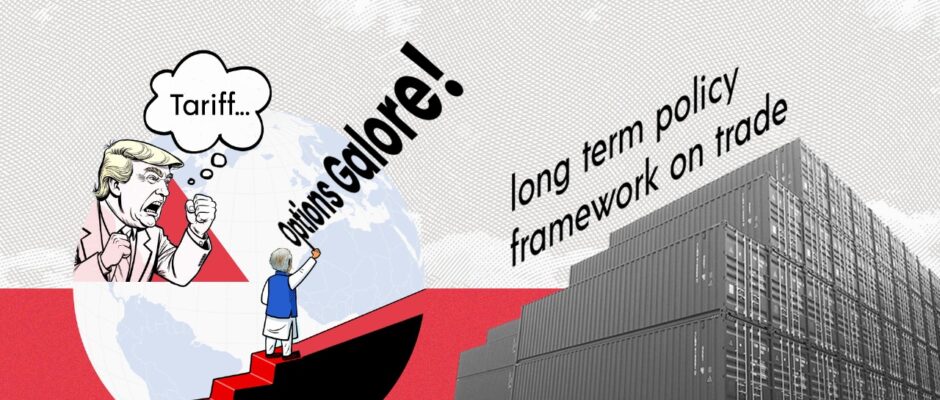
Options Galore!

Options Galore!

Putting in place long term policy framework on trade, investments, currencies, geo-political alignments to protect Bharat’s interests must be priority. K.A.Badarinath United States President Donald Trump’s adversarial tariff policy on India has largely been regarded ‘flip flop’ hinting at fluid stance and diabolical in spirit and content. From being most favoured trading ally with minimal tariff proposal of 10 per cent in April 2025, India has been bracketed in the list of enemy countries that attract highest impost of 50 per cent. Numbers and data apart, there has been a lot of noise, nervousness and anxiety as clock ticked 4 pm in last few days in India. It’s at about that time of the day Trump first announced 25 per cent and later doubled it to 50 per cent triggering a flurry of activity. Old timers did not miss the drama, show shah and high decibel drama that Trump put on these days targeting one or other trading partners.  It was the turn of Bharat in last few days. A 21-day window announced for tariffs to kick in signalled that Trump was open to negotiation before inking the trade deal. It’s one way of exerting pressure on New Delhi’s negotiators to sign on a ‘bad trade deal’ which means granting US unhindered access to agriculture, fisheries and dairy sector in India. President Trump’s optimism to drive a hard bargain also reflects from his statement, “it’s only been eight hours, let’s see what happens…you are going to see a lot more and some secondary sanctions”. The eight hour time frame referred to by Trump hints at his ‘wait, watch and strike’ attitude in the midst of serious negotiations. Contrary to drama associated with Trump’s diatribe, India’s response has been mature, measured and nuanced in last fortnight within and outside the parliament. Unreasonable, unfair and unjustified is how India described Trump’s executive order on 50 per cent levy. For the first time, Prime Minister Narendra Modi stuck his neck out and took it upon himself the consequences of tariffs tantrums thrown by President Trump. Modi said unequivocally that he was willing to pay a heavy personal price as Trump’s tariffs would impact large number of labour intensive and rural sectors. First, Prime Minister Modi has taken personal responsibility for the impact trade pact and tariffs would have on 1.4 billion plus Indians. Modi’s statement at M.S.Swaminathan International Centenary Conference on Thursday is very significant. He’s not willing to compromise on protecting farmers, rural people interests and labour intensive industrial sectors. Also, he was willing to face the political flak and pay heavy personal price on consequences given opposition parties’ intransigent line on United States. Prime Minister Modi understands that throwing open the agriculture sector to US is not only economically unviable but politically unsalable to the core Hindu vote bank, Sangh parivar and the ecosystem. On factual analysis, Modi government will have to deal with adverse impact on GDP growth of 0.2 – 0.4 per cent in case tariffs finally stay at 25 per cent during this fiscal. Top analysts estimate that entire US $ 86.5 billion annual goods exports from India to United States may turn non-competitive or commercially viable. Given that US is top market for India and constitutes about 18 per cent of its global goods exports and constitutes 2.2 per cent GDP, strains have begun to appear on near future. Given Prime Minister Modi’s steadfast commitment to protect India’s national interests, Indian negotiators are breathing easy. The proposed 50 per cent duties, if they kick in finally, translate to unannounced trade sanctions or embargo on India thereby worsening the strain in relations between the two countries. One big fall out that’s largely speculated was that India may not buy F-35 stealth fighter jet aircraft from United States. Factual position so far is that after US offered to sell these jets, formal negotiations have not yet begun. And, these discussions may remain a non-starter. Secondly, India may consider imposing retaliatory duties on 28 US products including its apples and walnuts given the precedent in 2019 to counter restrictive levies Washington DC had imposed on Indian steel and aluminium products. Thirdly, the arc of dis-engagement between India and US may widen for the time being unless recalibrates its trade and tariff policies. Fourthly, an aggressive campaign may be launched by the ruling party and the government to go local and opt for ‘made in India’ products and services. Fifthly, Prime Minister Narendra Modi may mobilize people in socio-economic spheres for adapting ‘swadeshi’. Sixthly, realigning India’s trade, investment, economic, geo-strategic relations may be a big option. Russia, China and other countries engagement may be enhanced to counter-balance US Republican White House under President Trump’s stewardship. Aligning with countries like Brazil who have been put on high tariff line by US could be an option. Seventhly, present developments may lead to expanding time tested foreign policy of strategic autonomy to protect India’s offensive and defensive interests. This may also be the right moment to promote south – south trade engagement. Eighthly, upcoming conclaves of Shanghai Cooperation Organization (SCO), Quad and BRICS may be occasions for India to sharpen its policy framework for global engagement. Ninthly, evolving an independent financial architecture, decoupling from US dollar or hastening BRICS currency to opt for diversification in payments may also be considered. Tenthly, putting in place medium and long term policy on currencies and oil will go the India way. (Author is Director and Chief Executive of non-partisan New Delhi based think tank, Centre for Integrated and Holistic Studies)

Read More
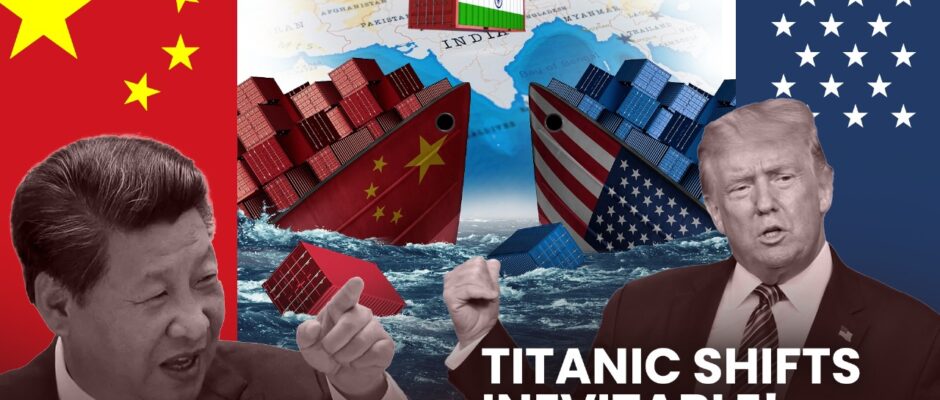
Titanic Shifts Inevitable!

Titanic Shifts Inevitable!

Trump’s tariff wars provide a window of opportunity to Bharat for proving its mettle as a global force to reckon with its own economic development model. K.A.Badarinath There’s a huge body of analyses on possible impact of tariff orders signed by US President Donald Trump in last few weeks. Those in favour and against have argued emphatically leaving room for further discussion given that tariffs, trade and economic engagement has gained pre-eminence and a developing story. Several analysts described recalibration of tariffs as trade war. Yet others have attempted to look at implications of the trade centric conflict overflowing into geo-political stratosphere.  Markets – equities, currencies, commodities, bullion and a host of financial products – felt the immediate impact. There has been roil in the market place. Billions of dollars’ worth investors’ wealth either vanished over night or partially restored as tariff orders were released by the White House in quick succession beginning ‘liberation day’ as Trump pompously described. Companies, services providers and logistics firms scurried for cover even as President Trump essentially targeted European Union with whom US has a trade deficit of $ 200 billion and China with deficit exceeding US $ 300 billion. Sixty countries – friends and foes – were treated by Trump with derision and slapped with counter-tariffs to bring down the US trade deficit that piled up to US $ 1.2 trillion. Some economists also pointed to trade surpluses run by US with about 100 countries which were royally ignored by ‘transactional Trump’ administration. Trump’s political agenda in run up to 2024 Presidential campaign centred around correcting the ‘unfair’ ripping of American people, businesses and denying his ‘voters’ the job opportunities thereby shifting manufacturing out of US. This is also the biggest ‘political agenda’ item of Trump that got him into power for a defining second four-year term. Apart from addressing domestic core whites’ constituency that were central to his ‘Make America Great Again’ agenda, Trump’s belief centre’s around ‘lifting the burden of American people’ on whose shoulders the world rejoices. Now that the trade, tariffs, manufacturing and jobs agenda gets to be implemented in US, the signals are ominous for anyone and everyone to pick up and put their counter-offensive in place. A lot of counter-offensive from US trade partners was kept on hold as 90-days window to fast-track trade and economic partnership negotiations began in Washington DC and elsewhere. China, however, has been treated differently after having slapped 145 per cent duties on most goods and services exported to US. China that countered with 84 per cent tariff on US goods and services was not part of the 90-days pause plan announced by President Trump. For now, trade war has turned direct and vicious between US and China while the latter owed ‘fight to finish’ action plan. Trade centric war is evolving and one may not see much hope in bringing this to an early close as negotiations between trade partners and US would be a long drawn process. Even if trade issues are sorted out, the impact would be profound on Western model of ‘globalization’ that got rolled out post-World War II and setting up of Bretton Wood institutions is bound to hit reset button. A fresh look at global trade and economic engagement is something that’s unavoidable or rather inevitable. This re-engagement will have huge bearing on socio-economic development paradigm of global communities especially with larger number of people reeling under poverty. A more America-centric economic policy roll out by Trump and ‘inward’ looking framework would lead to conceding geo-political and economic space to big players like Communist China. Each country – big or small – will have to learn fast to fend for itself and not depend on big brothers in either US, China or European Union. Next four years may also see ‘many more’ socio-economic self-reliance campaigns. It’s in this context that Bharat’s ‘self-reliance’ campaigns being run last eleven years would gain significance as existing value chains get rejigged, decoupling and re-engagement were definitively on the horizon. Bharat’s ‘strategic autonomy’ in terms of foreign policy and by extension, economic engagement, will hold strong. Unwilling to react in a hurry, announce counter-measures in a huff like several members of European Union or China, Bharat fell back on ‘time tested’ autonomous policy postulation. Free Trade Agreements (FTAs) with US, European Union and United Kingdom may have to be reworked with other economic parameters like investments more closely aligned. Secondly, given that Bharat has been treated ‘even handed’ with 26 per cent additional tariff, New Delhi should resist the temptation of falling into anti-US blocks. This should not translate to closing the door firmly on China that offered to align with Bharat to take on US. Thirdly, Bharat may consider making new partners on equitable and respectable terms that’s ‘mutually beneficial’ and ‘long lasting’ while economic engagement takes on new hue and different shade. Fourthly, measured and nuanced approach to trade, economic, development and geo-political engagement may have to be pursued in the spirit of ‘vasudaiva kutumbakam,’ the world is one big family. Fifthly, given that Bharat is on an ascent mode, wading through economic uncertainties globally and achieving its objective of becoming a ‘responsible economic power house’ will have to be carefully crafted. Sixthly, open, flexible, rules and regulations driven economic engagement with a ‘human face’ in reaching out to last man standing in queue should be basis for Bharat’s approach. Seventhly, this is the perfect time and context to present its own model of socio-economic development model that’s not exploitative, solely driven by consumer centric approach and instead push for synergies between nature and human living that’s sustainable in terms of judicious utilization of resources. Eighthly, realignment of global forces, both geo-political and market centric, is inevitable. And, carving out a distinct role for itself with responsibility is what’s recommended. Ninthly, falling back big on indigenous knowledge, development ecosystem based on sanatan Dharmic values for shared prosperity will test Bharat’s mettle. Tenthly, leadership role cannot be played from

Read More
Disruption In World Order Guaranteed!

Disruption in World Order Guaranteed!

Donald Trump’s second term may not allow ‘business as usual’ approach to global affairs given underpinnings of ‘Make America Great Again’ thrust. K.A.Badarinath Across continents one big question that’s seriously debated and pored over is what’s in store during second term of President Donald Trump that would kick off in three weeks from now. Jokes, boardroom banter, hate, repulsion to cult following notwithstanding, Donald John Trump cannot be ignored as President United States of America (USA) given the landslide mandate that Americans have given him. One can rest be assured, he would make next four years very eventful at Oval Office after having gained serious insights into functioning of the Presidential role in his first term that ended in turbulence. Trump would not let the world forget in a hurry that he’s the only President who has been returned to White House after eviction from White House after Grover Cleveland several decades ago. Hence, it’s not surprising that from Africa, Asia, Europe to West Asia, tongues have begun to wag on state of play with staunch and determined Republican President at the hot seat in White House. But, what can easily be predicted is pursuit of aggressive ‘America First’ and ‘Make America Great Again’ that would dominate Trump Presidency on all fronts, be it economy, investment and trade, civilizational ties, diplomatic engagements, wars and conflicts in which US has direct or indirect linkages. Ultra nationalist sentiment of Western variety will have a sway during Trump regime within and beyond American borders. Expressive articulation of America First and Make America Great Again cannot be missed. A thorough review of all engagements including Israel, Ukraine and other conflict zones would become a priority for President Trump. And, rogue states like Pakistan are expected to face big time shove if Trump has his way. China may top Trump agenda with 50 per cent tariffs proposed on all exports to United States to rebalance bilateral trade. These levies would turn as many products non-competitive forcing Bejing to rethink its export strategy using third country labels to overcome the proposed tariff barriers. Bharat along with other BRICS member countries have already been put on alert as Trump has threatened with 100 per cent tariffs if the big developing countries went ahead with a common currency regime rivalling the American dollar. ‘De-dollarization’ move apart, Bharat may have to revisit its list of 30 US goods identified in 2018 and approached World Trade Organization for levying retaliatory tariffs on US. Also, sticky issues like Gautam Adani’s case in American courts and reported life bid on Khalistani terrorist Gurupatwant Singh Pannun will have to be dealt with deftly. Of late, growing anti-Bharat sentiment being belted out by American media outlets especially following Sriram Krishnan’s appointment as advisor on artificial intelligence to Trump may have to be addressed. Future of H1B work visas, US citizenship to children of such visas has turned absolutely uncertain. President Trump may have to take a call on this key issue. On two occasions in his first term, Trump had referred to 50 per cent restrictive duties on Harley Davidson motorcycles by Bharat. Even after his re-election in recent weeks, President-elect Trump described Bharat as ‘tariff king’. He conveniently chose to not refer to hiked tariffs on Indian steel and metallic products exports by him in his first term. Though the volume and value of defence exports to US are modest at US $ 1.5 billion, they may come under scanner of quixotic Trump. There are several such Indian export items that may be put to scrutiny by new regime. No wonder, Prime Minister Narendra Modi despatched his foreign minister Subramanyam Jaishankar to US in preparation for bilateral engagement with the ‘Don’. Modi who shares personal rapport with Donald Trump is expected to find a way out given that Indian investors are waiting in the wings to take larger positions – directly or indirectly — in US markets. President Trump would prioritize huge cuts in ‘federal spending’ of ‘non-essential’ and ‘non-strategic’ expenses by his government given the burgeoning long term deficits that US has piled up over years. Every dollar spent may be accounted for especially with technology czars like Elon Musk breathing down the neck pushing for ‘government efficiency’ on resources. Under President Trump, ‘radical left lunatics’ may get a big bashing on the butt that would eventually inflict damage on support structures for democrats. These Left hardliners have been peddling narratives that ‘liberal, open democratic character’ of US was under threat once the ‘Don’s’ second term began in 2025. Narrative battles in US between Left leaning ‘self-proclaimed’ liberals and Republicans under Donald Trump are expected to intensify further. Basically, ‘business as usual’ may not be possible with Donald Trump. Be it Canada, Panama, Greenland, Syria or elsewhere, there’s bound to be restlessness in Republican White House demanding a big changeover. Donald Trump seeking to turn Canada into 51st state of US sent shivers for Justin Trudeau who’s fighting with his back to the wall seeking re-election later next year. Here again, Trump demanded lowering of tariffs and in return offered US security cover to Canadians as fifty first state. Similarly, Panama was put on notice by Donald Trump who made two significant points from his perspective. One, the Panama Canal was being illegally controlled by Chinese people liberation army and the tariffs on movement of American goods were too huge that warranted a rollback. Thirdly, Donald Trump may have hit a raw nerve when he sought American pound of flesh in administration of resources-rich Greenland. Given that European Union has effective control on Greenland, Brussels may not take Trump’s comments rather lightly and forced to engage with him on the issue apart from legal migration and infiltration across US and EU member countries. Donald Trump may like to leave his imprint as a global leader in his four-year regime that’s bound to be eventful and has the potential to change face of global engagement. (Author is Director & Chief Executive at

Read More
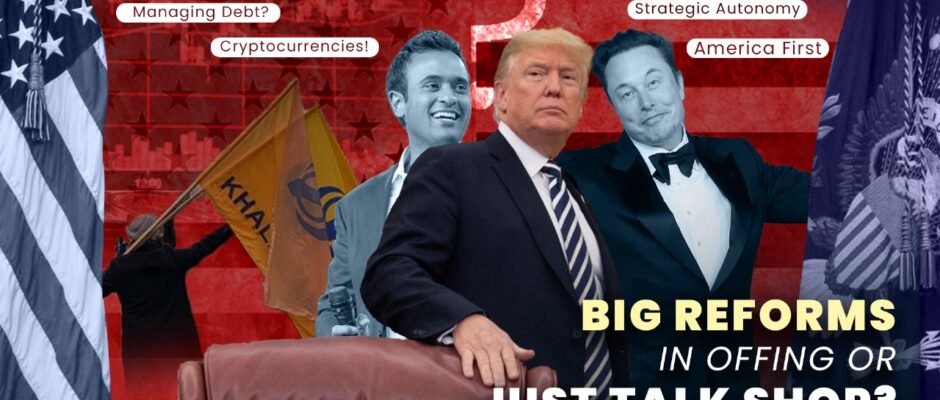
Big Reforms in Offing or Just Talk Shop?

Big Reforms in Offing or Just Talk Shop?

Republican White House under President Trump will have to respect and partner with Bharat in sync with her ‘strategic autonomy’ framework. K.A.Badarinath Exuberance aside, Donald Trump is ready to don the mantle as 47th President, United States of America. Trump’s return to White House has several messages for diverse stakeholders. While these groups grapple with the reality, there’s no denying that huge drama continues to unfold as transfer of power to Grand Old Party began. After Republicans decisive show in the just concluded Presidential elections and democrats tasting big defeats, the new government takes shape to run this powerful country for four years. Trump seems to be all out for tapping talent and leadership at the high table with cabinet berths and elsewhere. For development hawks like me, picking Vivek Ramaswamy and Elon Musk to bring about structural reforms in governance is a big message to ‘one and all’. Belt tightening measures, living within one’s own earnings and limiting both public and private debt is something which would happen as consequence. Unless belt-tightening measures are spelt, there are very limited options before President Trump to manage or sustain US $ 35.95 trillion piled up by October 2024. More than the public and intra-government debt that’s hit the roof, speed with which its multiplying without any let up is all the more mind-boggling. Every hundred days, this debt goes up US $ one trillion and over 14 per cent of annual federal spending goes into servicing this debt. In this backdrop, aggressive governance reforms to cut wasteful expenses, prune bureaucracy and reduce the flab are what’s paramount if US were to chart a sustainable socio-economic development policy framework for the future. Newly carved out Department of Government Efficiency under Musk and Indo-American entrepreneur Vivek Ramaswamy will have to chart this futuristic plan. Down-sizing the US government by 2026 when the country would celebrate its 250-year of independence is something to watch out for. If serious efforts were to be made at governance reforms, healthy economic growth posted in last two quarters at 3 per cent and 2.7 per cent could act as right spring board. Better public debt and intra-government debt management would provide further impetus to the United States economy having implications far and wide. Lesser regulations and revamping federal agencies is again governance reform. Most conversations relate to making crypto currencies regulation more attractive and mainstream these digital currencies. US Federal Reserve has been grappling for policy framework to deal with ‘unregulated’ crypto-currencies that are virtually outside the central bank’s domain. Globally an accepted governance framework is what was on the drawing board especially when the G-20 Presidents and Prime Ministers met in New Delhi a few months back. Bharat along with Brazil and other large developing countries have had pushed for an agreed framework for crypto currencies. Digital rupee was found as an immediate alternative to cryptos that are not recognized as currency in Bharat nor can they be offered as collateral for any transaction. President Trump’s policy towards crypto currencies will also have huge impact on global financial transactions and currencies managed by central banks. The move to ‘de-dollarize’ trade deals and make them happen in local currencies may gain momentum as discussed at recent BRICS summit. President Trump’s majority in both houses of US Parliament must be leveraged to push far and wide digitized dollar as immediate priority rather than tilting aggressively to cryptos before hammering a consensus on the policy framework with US partners. Crypto-currencies exposure or linkages with President Trump’s personal business empire may impact the US government’s possible policy shift on the issue. On evolving a workable security blueprint, President Trump’s pick of national security advisor in Florida Congressman Michael Waltz has been widely reported. Unlike the Democrats who have been infiltrated by Lefties, President Trump may like to go lethal vis-à-vis China. Waltz antecedents as India caucus co-chair in the US and Trump’s own antipathy for anything China especially on trade front may provide enough impetus to both trade and security framework vis-à-vis China. US President-elect Trump had talked about huge tariffs up to 60 per cent against Chinese goods and services. Well, his stated position on Indo-Pacific seeking to limit expansionist China, exposing the ‘unholy’ Pakistan – China nexus and Waltz pressing for strategic security partnership with India may turn music for Bharat’s lovers. One will have to await the new security doctrine and blueprint to be churned out by the President’s new team that will have large implications for Bharat. It will never be honky dory with President Trump all the way even for US closest partners. His policy would centre on ‘give and take’ that’s termed ‘transactional’ by his detractors and staunch supporters. His America First policy towards trade, investments, security and outlook is mostly on the lines of ‘Bharat First’ adopted as a belief, doctrine and work programme by Prime Minister Narendra Modi. Trade engagement that’s hugely in favour of Bharat in annual engagement of US $ 150 billion may be leveraged to ‘extract his pound of flesh’ if past experience is any indication. From Bharat’s perspective, be it democrats or republicans, she has to be on her own. New Delhi’s engagement with President Trump should be on ‘equitable’ terms as partners rather than being viewed as subservient low creature. President Trump cannot ignore the new reality of ‘a rising Bharat’ that has adopted ‘strategic autonomy’. He needs to respect and partner with this new world power as Russian President Vladimir Putin has described. President Trump cannot dismiss Bharat’s ‘strategic autonomy’ doctrine as done by the out-going Democratic White House led by Joe Biden. (Author is Director and Chief Executive, Centre for Integrated and Holistic Studies, a New Delhi based non-partisan think tank)

Read More
Trump Trumps Harris to White House!

Trump Trumps Harris to White House!

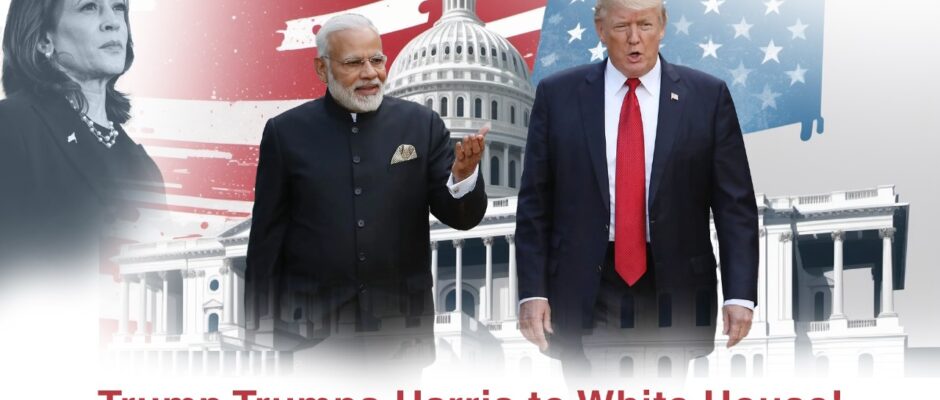
Choices made at this critical juncture will undoubtedly shape future of US and Bharat, global order. World watches with keen interest as these two powerful democracies cruise ahead. Rahul Pawa In a stunning political slugfest marked by fervent debates and impassioned rallies, Donald Trump emerged victorious in United States presidential election reclaiming White House. Even as Trump romped home, widespread anticipation and speculation about implications for both United States and its global relationships continued far and wide.  As dust settles from a heated, nerve wracking electoral battle, the narrative of Trump’s second term begins to take shape, weaving a complex web of promises and projections that could redefine America’s role on the world stage, particularly regarding its strategic partnership with India. With a renewed mandate, Trump steps back into office bringing with him a resolute commitment to an “America First” agenda that’s loosely designed on lines of ‘India First’ policy framework of Indian government under Prime Minister Narendra Modi. This mantra resonates deeply with Trump’s supporters who yearn for robust American presence in global affairs. His approach to foreign policy is characterized by determination to strengthen ties with India, a country he recognizes as essential to US strategic interests in an increasingly multiplex geopolitical landscape. By sidestepping criticisms of India’s internal matters—particularly concerning Jammu and Kashmir—Trump positions himself as a steadfast ally, respecting India’s sovereignty while forging a deeper partnership. One of the hallmarks of Trump’s presidency is his focus on national security and his victory sets the stage for robust collaboration with India on counter-terrorism. Trump has long championed the importance of addressing security threats emanating from Pakistan, a stance that aligns closely with India’s own challenges. His administration’s commitment to enhancing intelligence-sharing and joint operations signifies serious approach to addressing terrorism. This proactive alignment may fortify both the nation’s defences providing a united front against shared adversaries. As the world grapples with complexities of security threats, this partnership could emerge as a crucial alliance in maintaining stability in the region. Trade relations are another area poised for significant enhancement under Trump’s leadership. His pro-business policies aim to dismantle trade barriers and promote investment, creating a favourable environment for economic cooperation. American businesses are eager to tap into India’s burgeoning market, which promises growth opportunities across various sectors, from technology to agriculture. Trump’s focus on reducing regulatory hurdles could lead to a surge in bilateral trade, fostering economic integration that benefits both countries. This approach stands in contrast to Kamala Harris’s proposed policies, which might have introduced stricter regulations and compliance standards that could complicate trade dynamics. Culturally, Trump’s presidency is likely to strengthen the ties between United States and India. His vocal advocacy for religious freedoms resonates within the context of India’s pluralistic and inclusive society. By condemning religious persecution and supporting rights of Hindus globally, Trump aligns himself with India’s efforts to promote global inclusivity. This commitment could foster goodwill between the two nations, enhancing their cultural exchange and mutual understanding. In contrast, Harris’s approach, while supportive of human rights, may not have addressed the specific challenges faced by different communities in India, particularly Hindus, potentially limiting the depth of the relationship. Geopolitical relations become increasingly competitive especially with Chinese Communist Party’s rising influence in the Indo-Pacific region. Trump administration emphasizes the need for a strong military presence to counterbalance this threat. His advocacy for the Quad alliance—comprising United States, India, Japan, and Australia—demonstrates a commitment to collective security and stability. This alliance represents a strategic partnership that is likely to enhance India’s standing in the region while ensuring that the US remains a significant player in the Indo-Pacific. In contrast, Harris’s diplomatic approach may have leaned towards multilateral engagement focusing on dialogue without same level of assertiveness that many view as necessary in countering regional threats. As Trump navigates complexities of his second term, implications for US -India relations become will become increasingly clearer. His administration’s focus on economic cooperation, security collaboration, and cultural understanding are expected to build a framework for partnership poised to thrive in the coming years. The world watches closely, recognising that the choices made during this administration will resonate far beyond the borders of both nations. In this new chapter, Trump’s victory signifies more than just a personal triumph; it represents a decisive shift toward a more assertive foreign policy, one that embraces partnerships grounded in shared interests and mutual respect. The journey ahead is illuminated by the shared aspirations of two democracies ready to engage with the complexities of a changing world. Looking ahead, the potential for transformative collaboration between United States and India is immense. As both nations navigate the challenges of the 21st century, they stand at the forefront of a new era of global engagement. The combination of Trump’s commitment to economic revitalization and national security, along with India’s ambitions on global stage, creates an opportunity for powerful partnership that can address the pressing issues of our time. As the Trump administration sets its agenda, it is clear that India will play a central role in U.S. foreign policy. The historical ties between the two nations, steeped in shared democratic values and mutual respect, provide a strong foundation for a future characterised by collaboration. The potential for joint initiatives in emerging technology, defense, and climate change is vast, and as both countries seek to assert their influence on the global stage, the U.S.-India partnership will be a critical component of that strategy. Furthermore, Trump’s approach to governance may resonate well with India’s leadership style, fostering a sense of camaraderie that extends beyond mere political manoeuvring. As both leaders navigate the complexities of domestic and international challenges, their ability to forge a strong working relationship could yield significant benefits for their respective countries and the broader global community. As Donald Trump embarks on second term, the implications for US -India relations are profound. The potential for a transformative partnership, built on shared interests and mutual respect is within reach. With a focus on economic growth, national security

Read More

Silent Threat, Spread of Anti-Americanism!

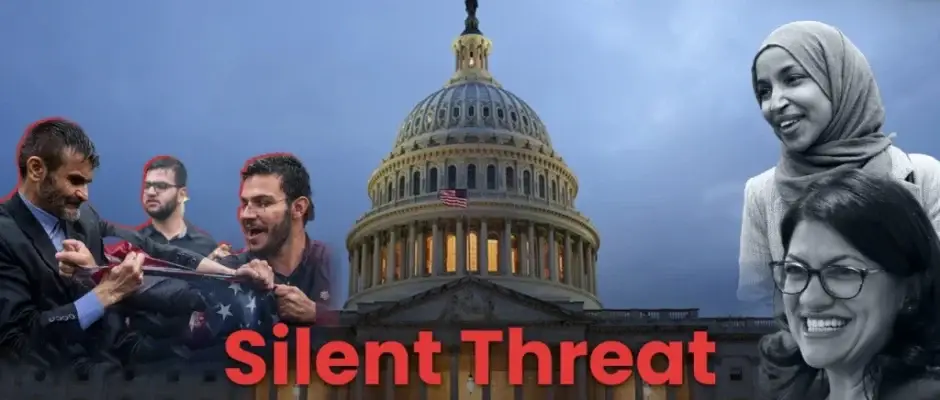
Senators and Congressmen, women funded by foreign lobbies pose a serious threat to America’s security, integrity and its cohesion. Pummy Pandita It’s for United States Congress to defend American values and interests. Nonetheless, existence of senators with questionable ties and conduct imply that they might not put Americans welfare first. Anti-Americanism within US Congress has been a subject of debate for quite some time and of late, there have been reports suggesting some senators were outright “anti-American.” It’s not for the first time that such conversations have happened openly. There have been reports in past as well that politicians in US have harboured anti-American feelings. Claims of disloyalty were common throughout Cold War leading to rigorous scrutiny during McCarthy era. The rise of populism and partisan polarization in recent years has increased interest in priorities and allegiances of legislators. Setting precise standards is essential to identify anti-American senators in an unbiased manner. This can involve opposing important national security legislations through voting, publicly undermining American interests in statements and continue affiliations with groups that disagree with American policies and ideals. Opinions are diverse on senators and representatives in US Congress who are thought to be anti-American and have ties to foreign countries. Congresswoman Rashida Tlaib of Michigan’s 12th congressional district and Ilhan Omar of Minnesota have been discussed in the media to have reportedly harboured ‘anti-Americanism’. Congresswoman Rashida Tlaib During Israeli Prime Minister Benjamin Netanyahu’s speech to Congress, Rashida Tlaib, a member of self-styled “Squad” in US House of Representatives grabbed attention by waving a “War Criminal” placard. This brought out deep political rift about American policy towards Israel. One of the first Muslim women elected to Congress, Rashida Tlaib is a Palestinian-American recognized for her vocal support to Palestinian rights and condemnation of Israeli government practices. Alexandria Ocasio-Cortez, Ilhan Omar, Ayanna Pressley and other progressive lawmakers constitute the so-called “Squad” which includes Democratic congresswoman Rashida Tlaib of Michigan’s 12th congressional district. As one of the first two Muslim women elected to Congress in 2018, Tlaib created history. Robust progressive programs, such as Medicare for All, Green New Deal and substantial changes to criminal justice and immigration systems define her so called political agenda. The Incident • Tlaib’s demonstration was direct reaction to Netanyahu’s acts and policies which she and many others believe to be discriminatory towards the Palestinian people. The placard referred to Netanyahu as a “War Criminal,” a moniker that detractors frequently employ to characterize his involvement in military actions in the West Bank and Gaza. • Tlaib’s act was meant to highlight Palestinians suffering and human rights issues. It was also a critique of American administration’s persistent backing of Netanyahu. • The demonstration highlighted glaring differences in American politics over Israel. While a large majority of Congressmen back Israel wholeheartedly, others—especially progressive Democrats like Tlaib—are growingly skeptical of Israel’s practices and champion rights of Palestinian people. Tlaib’s political remarks and deeds reveal a bias against the United States. These accusations frequently focus on the following issues: Entry of anti-American elements into Congress is a reflection of the country’s wider political and ideological division which has important ramifications. Though some people find great strength in the story of anti-American infiltration in Congress as represented by individuals such as Rashida Tlaib, it is important to examine such assertions critically. A more nuanced picture becomes apparent when the evidence is carefully examined and larger political context is comprehended. Congresswoman Ilhan Oman: Ilhan Omar represents Minnesota’s fifth Congressional District. She is Somali American and second Muslim woman elected to Congress. Omar’s candidature stands out due to her strong opinions on a range of topics such as social justice, immigration and US foreign policy. She is frequently accused of having ties with foreign organizations that could sway her opinions not consistent with American interests. Omar has not shied away from making public her disapproval of American foreign policy, particularly as it relates to Israel and Palestine. US backing Israel was never appreciated by her and charged that lobbies like American Israel Public Affairs Committee (AIPAC) shaped US policy. Her position challenges US support for Israel, a vital ally in the Middle East which has long been established. Allegations of anti-Semitism have resulted from her remarks. In 2019, she implied that pro-Israel lobbyists were purchasing political power when she tweeted that United States political backing for Israel was “all about the Benjamins.” Both sides of the political spectrum strongly condemned this remark which resulted in a House resolution denouncing anti-Semitism. Omar’s reported ties with foreign organizations may have shaped her views against US foreign policy. Her affiliation with controversial Council on American-Islamic Relations (CAIR)—which receives funds from overseas—has been examined. There have also been claims that she has ties to Turkish and Qatari interests though concrete proof of these assertions is still hard to come by. As per reports, some of her opinions coincide with those of rogue governments. Her opposition to sanctions on nations like Venezuela and Iran considered United States’ rivals has been used as evidence of her anti-American inclination. Claim that certain members of Congress do not represent interests of United States is not exclusive to either Ilhan Omar or Rashida Tlaib. It points to broader worries about foreign meddling in American politics and possibility of outside influence on elected officials. Numerous political organizations and media outlets especially those on the conservative side have emphasized this. One major concern in American politics is influence of foreign lobbying. Foreign governments and entity lobbyists frequently try to sway American policy in favour of or against certain interests. Regulated and lawful activity notwithstanding, lobbying always carried the risk of conflicts of interest and improper influence. Source of campaign contributions was yet another concern in American elections.  As per American laws, it is illegal for foreigners to donate in the country’s elections. But, intricate web spun around political contributions makes it difficult to identify actual source of finances. In this backdrop questions have been raised on intentions and loyalty of public servants who

Read More

Propagating ‘Truth’ That Never Existed!

Both, US and China used devious means to force a tilt, influence outcomes of recently concluded Lok Sabha elections in Bharat Vinod Kumar Shukla Cognitive warfare is the new tool deployed by a few global powers to ensure their continued dominance on others throwing ethics and internationally accepted practices to wind. These powers have attempted suppression of fair practices in election of a government especially in countries where there is a vibrant democracy. Among others, India too faced challenges where democratic process was allegedly tried to be influenced by creating false narratives with help of Artificial Intelligence (AI) and Social Media influencers. Most of these falsehoods were not only funded by foreign countries but ideas too were generated on foreign soil. Investigations revealed that STOIC, an Israeli company attempted to interfere in Lok Sabha elections by peddling anti-BJP agenda dubbed as ‘Zero Zeno.’ Efforts were made to manipulate public opinion even in Canada, US, Israel, and Ghana. With help of AI, web articles and social media, comments and content were generated and pushed across Instagram, Facebook, and X focusing on criticizing the BJP and praising the Congress. AI was used to create fictional characters and fake social media accounts with specific variables like age, gender and location. Bogus accounts were created to engage people with such posts that gave the impression of genuine audience interaction. China too was actively involved in this disinformation campaign and escalated its campaign for changing the government in India after People’s Liberation Army was humiliated both in Doklam and Galwan Valley. Artificial intelligence was craftily used to construct propaganda content, images and videos targeting parties and politicians opposed to Chinese hegemonic design. Microsoft had cautioned that China was poised to use generative AI to sway elections all across scheduled for this year. Chinese interference is deeply rooted in its expansive ‘influence operations’ (IO) targeting leaders of other countries with its disinformation campaign to undermine leaders by portraying them as weak and vulnerable. Spamouflage Dragon or Dragon Bridge or Storm 1376, a key Chinese disinformation propagator network has been functioning since 2017-18 on social media. Its activities came to notice when around 9,000 Facebook and Instagram accounts linked to this network were shut down by Meta in August 2023. In November 2023, approximately 4,800 fake Chinese social media accounts impersonating Americans were shut down for disseminating narratives designed to polarise public opinion through biased political content ahead of US elections. The same was done in Australia and the Philippines during 2022 elections. Beyond social media, Chinese IO strategies include both overt and covert tactics involving cultivation of assets like local and independent media, influential personalities, political parties, business figures and NGOs. Preference for particular candidates was subtly communicated not through direct diplomatic utterances but via Chinese state-affiliated media and United Front Work Department (UFWD) which is dedicated to exerting overseas influence. On the parallel, investigation on Chinese funding of NewsClick in Bharat is underway and the matter being heard in the court. Chinese objective of meddling in elections is to ensure that elected candidates or parties should adopt a pro-China stance. These disinformation campaigns aim to sway election outcomes by undermining voters’ confidence in candidates not favoured by China. Recent escalation in Chinese disinformation involves leveraging generative AI technology to prepare propaganda images and videos. These AI-generated materials target parties and politicians critical to China. Initially this technology was used during presidential elections of Taiwan to undermine Taiwan’s democratic framework, promoting a pro-unification narrative, and weakening Taiwan’s ties with the US. In fact, Chinese disinformation campaigns on the national security of various countries have prompted many to ban popular Chinese social media platform TikTok. But, reports indicate that China continues to meddle in foreign elections to emerge as a global power. Besides China and Israel, millions of dollars were spent to impact elections in India. Western interference from European Union and US too were in the game. Media outlets with tacit, explicit funding and a few funded by organizations with background in peddling agenda based narratives through stories on ‘random WhatsApp groups’ by creating heroes out of Pak-sponsored stooges. Recent elections in India witnessed the most intrusive foreign reporting with overwhelming negative and brazen reports about ruling dispensation. All this was done to have a Parliament with leaders who can help impose political agenda of countries which are instrumental in spreading these canards. The objective is to secure a favourable outcome aligning with its strategic interests. Western media was found indulging in mud-slinging to sully the image of select leaders and their party in a sinister attempt to impact voter’s minds. Dangerous narratives were peddled by a so-called Indologist Christophe Jaffrelot as the ‘caste census’ narrative allegedly came from France. Jaffrelot extensively writes on India. The French media had shown special interest in these elections with extensive reporting by Le Monde, Le Soir, France 24, La Croix (International), Le Temps, Reporterre, and Radio France Internationale (RFI) to shape up a particular narrative to impact Indian elections with Jaffrelot as an expert on almost everything in India. With the help of Trivedi Centre for Political Data (TCPD) at Ashoka University, Jaffrelot and his disciple Gilles Verniers aggressively peddled a narrative that ‘lower castes’ had lesser representation in politics, quoting profile of MPs in 2014 Lok Sabha. However, the expert duo immediately changed their stand when the 2019 Lok Sabha had a higher representation from lower castes. In fact, never before was he referred by so many outlets in such a short time. He wrote a paper on ‘need of caste census’, in September 2021. US and China attempted to play dirty in just concluded elections with startling discourse being Caste Census which certainly was not organic. Jaffrelot had allegedly received massive funding from the US-based ‘philanthropic’ organization Henry Luce Foundation (HLF) around the same time. HLF was founded by Henry Luce, the founder of TIME magazine. Lesser known fact about Luce is his alleged deep-state connections. He was born to Presbyterian Christian Missionaries and supported by

Read More

California Civil Rights Report: Hinduphobia is real & kicking!

Civil Rights Department (CDR) of California recently put together a report outlining frequency in cases relating to religious hatred in the California state, USA. As per the report, incidences of anti-Hindu hate crimes accounted for 23.3 per cent of all religious hate crimes reported to Department’s Anti-Hate Hotline in one year. Almost one-quarter of all reported religious hate crimes were directed at Hindu community. The rise in such crimes is a serious concern and necessitates a closer look at the underlying reasons, ramifications and possible remedies to stop this worrying trend. Among the states with most diversity in terms of culture and religion in the US is California. Hindus make up a sizable chunk of the state’s population; they are mostly Indian Americans who enrich the social, cultural and economic fabric of the region. This diversity notwithstanding and the ideals of acceptance, reports of religious hatred and intolerance persist. Verbal abuse, physical assaults, vandalism of places of worship, harassment and other types of hate speech or discrimination against Hindu persons or groups are examples of anti-Hindu hate incidents. Substantive absolute number of incidents suggests that the larger problem of religious intolerance is anti-Hindu hostility.  (Author is head of operations at Centre for Integrated and Holistic Studies, a non-partisan think tank based in New Delhi)

Read More

U.S.-India Relations Forge New Frontiers with Technology and Defense Deals

Prachi Mishra The recent visit of Indian Prime Minister Modi to the United States resulted in several key technology deals, MoUs, and collaborations. With growing penetration of emerging technologies in the socio-economic-political and security fabric of nation states, it is imperative for global leaders to come together and work on challenges that impact everyone. The bilateral ties between the United States and India have taken a significant leap forward with Prime Minister Narendra Modi and President Joe Biden unveiling a series of groundbreaking technology and defense agreements. During his address to the joint session of the U.S. Congress, PM Modi emphasised the global benefits of collaboration on semiconductors and critical minerals, highlighting the role it plays in enhancing the resilience and diversity of supply chains. With defense cooperation blossoming over the years, the United States has emerged as one of India’s key defense partners. Former diplomats and analysts are optimistic about the future of this relationship, foreseeing strengthened ties and more lucrative deals on the horizon. Atul Keshap, President of the U.S.-India Business Council and former charge d’affaires at the U.S. Embassy in New Delhi, expects the expansion to extend to military agreements, heralding positive outcomes for both nations, democracy, and the Indo-Pacific region as a whole. The remarkable scope of the announced deliverables has impressed observers and sparked confidence in the trajectory of U.S.-India relations. Some key highlights are showcased below; Institution building – Both President Biden and Prime Minister Modi agree that as their collaboration grows, technology will become increasingly important.  The founding of the Initiative on Critical and Emerging Technology (iCET) in January 2023 was welcomed by the leaders as a significant turning point for relations between the United States and India.  They urged institutions of higher learning, corporations, and governments to carry out their common goal for the strategic technological partnership.  The leaders reaffirmed their commitment for the United States and India to support an open, approachable, safe, and trust-based digital ecosystem that upholds their shared ideals and democratic institutions. Space – By the end of 2023, NASA and ISRO will have created a strategic plan for working together on human spaceflight. Indian astronauts will receive advanced training at NASA’s Johnson Space Center in Houston, Texas, with the intention of staging a cooperative mission to the International Space Station in 2024. This news was applauded by both the US and India. The NASA-ISRO Synthetic Aperture Radar (NISAR) satellite was sent to the U.R. Rao Satellite Center in Bengaluru, India, and NISAR’s launch from India in 2024 was anticipated.  The leaders praised India’s Space Policy – 2023 and urged greater commercial cooperation between the American and Indian corporate sectors along the full value chain of the space economy, as well as to resolve export restrictions and promote knowledge transfer. The Artemis Accords, which establish a shared vision of space exploration for the benefit of all humanity, were signed by India, and President Biden was very grateful for this.  Tech trade – Both India and the US applauded the interagency-led Strategic Trade Dialogue’s commencement in June 2023 and instructed both parties to make ongoing efforts to resolve export restrictions, look for measures to boost high technology trade, and ease technology transfer between the two nations. Semiconductors and supply chains – A Memorandum of Understanding (MoU) on Semiconductor Supply Chain and Innovation Partnership as a significant milestone in coordinating the semiconductor incentive programs of India and the US was highly talked about. This will support the growth of commercial possibilities, research, talent, and skills. The decision of Micron Technology, Inc. to work with the Indian government to invest up to $825 million in the construction of a new semiconductor assembly and testing plant in India was applauded by the leaders. Up to 5,000 new direct jobs and 15,000 community work possibilities might be created over the course of the next five years thanks to the joint investment, estimated at $2.75 billion. The leaders also praised Lam Research’s proposal to expedite India’s aspirations for semiconductor education and workforce development by training 60,000 Indian engineers through its Semiverse Solution virtual manufacturing platform, as well as a statement from Applied Materials. Telecom – Two Joint Task Forces on Advanced Telecommunications were established by the leaders, with a focus on Open RAN (O-RAN) and research and development in 5G/6G technologies. The Bharat 6G Alliance in India and the Next G Alliance in the United States will be in charge of the public-private collaboration between vendors and operators. With the support of funding from the U.S. International Development Finance Corporation (DFC), both India and the US are collaborating on Open RAN field trials and rollouts, including scaled deployments, with operators and vendors from both markets. The leaders praised Indian businesses’ involvement in the American “rip and replace” program. They supported an ambitious plan for 6G networks that called for collaboration on standards, easier access to chipsets for system development, and the creation of cooperative R&D initiatives. Quantum tech – The creation of a joint Indo-U.S. Quantum Coordination Mechanism to promote cooperation between business, academia, and government, as well as their efforts to reach a comprehensive Quantum Information Science and Technology agreement, was hailed by President Biden and Prime Minister Modi. The Quantum Economic Development Consortium and the Quantum Entanglement Exchange both warmly welcome India’s involvement in order to promote professional and business interactions with other prominent, quantum-minded countries. Programs for quantum training and exchange will be maintained and expanded, and the US and India will endeavour to remove obstacles to cross-border scientific cooperation. The leaders hailed the start of a $2 million grant program under the U.S.-India Science and Technology Endowment fund for the combined research and commercialisation of quantum technologies and artificial intelligence (AI), and they urged public-private partnerships to develop these technologies. Science collaborations – The leaders welcomed 35 creative joint research initiatives in emerging technologies that were supported by the Indian Department of Science and Technology (DST) and the American National Science Foundation (NSF). Together, the NSF and DST will

Read More

Americans Roll Out the Red Carpet for PM Modi

Rahul Pawa | @imrahulpawa Prime Minister Modi’s visit is expected to reinforce the Indo-US ties, which are firmly anchored in the shared values of democracy, diversity, and freedom. As both nations confront common global challenges, their collaboration continues to strengthen, fostering a promising future.Indian Prime Minister Narendra Modi’s ongoing four day state visit to the United States has ignited a palpable sense of anticipation and excitement. Since the Prime Minister Modi’s arrival in New York yesterday to a resplendent reception accorded by a vibrant Indian American  community in New York has amplified the fervour surrounding the visit, infusing it with an electric atmosphere, captivated people’s attention and setting the stage for a series of remarkable moments that have captured imaginations. One such moment that has sparked global enthusiasm was when the worlds richest man, Elon Musk expressed “I am a fan of Modi,” adding to the allure of this momentous occasion. Furthermore, the resplendent reception bestowed upon the Prime Minister Modi by the Indian community in New York has only served to intensify the fervent atmosphere surrounding this momentous occasion. During this sojourn, Prime Minister Modi engage in meaningful discussions with luminous figures, such as Ray Dalio, Neil deGrasse Tyson, Robert Thurman, and Paul Romer, thereby augmenting the already heightened sense of excitement enveloping the visit. The convergence of these extraordinary minds has served to heighten the anticipation surrounding the visit, augmenting its significance and stimulating intellectual discourse. During these interactions, Prime Minister Modi also engaged in comprehensive discussions encompassing policy-making, emerging trends, and accentuated the positive transformations transpiring within India with think-tanks, experts, and leaders in their fields. He emphasised the nation’s progress and sought to explore avenues for further advancements, deliberated on augmenting healthcare capacities within India, delved into strategies to fortify the education sector. Such focused dialogues reflect the Indian Prime Minister Modi’s commitment to enhancing key areas of societal development. In his maiden state visit to the US, Prime Minister Modi’s gracious reception by the American people and the invitation extended by President Joe Biden and First Lady Jill Biden testify to the deepening significance of the India-US partnership within today’s dynamic global landscape. As geopolitical shifts, emerging threats, and shared concerns shape this era, this historic visit places a strong emphasis on fostering cooperation across critical domains. At the same time, showcases India’s rising global stature under Prime Minister Modi and  his positive transformative role in world affairs. Despite having visited the US on six occasions since assuming office in 2014 and engaging with three US presidents—Barack Obama, Donald Trump, and Joe Biden—this state visit holds a special place for Prime Minister Modi. State visits are typically reserved for heads of state, not heads of government, making this invitation by the Biden’s an extraordinary honour that highlights the charisma and allure the Prime Minister  Modi commands. The visit will commence with PM Modi leading the International Day of Yoga celebration at the United Nations Headquarters in New York on June 21. Yoga, an ancient Indian tradition that has become a global phenomenon, serves as a unifying force, fostering compassion and well-being. Its holistic approach, benefiting billions worldwide, brings people together and promotes a balanced mind, body, and soul. This celebration will highlight India’s rich cultural heritage and its profound contributions to the world. In addition to the UN event, PM Modi will engage with business leaders in New York to explore opportunities for enhancing the Indo-US trade and investment relationship while fortifying global supply chains. Recognising the pivotal role played by the Indian-American community in fostering bilateral ties, PM Modi will also meet with the vibrant diaspora at the Ronald Reagan Centre. This interaction will showcase the Indian diaspora’s achievements and contributions to both Indian and American societies, further strengthening people-to-people linkages. The visit’s agenda includes crucial bilateral discussions, delegation-level talks, and press statements, paving the way for significant announcements. On June 22, President Joe Biden and First Lady Jill Biden will host PM Modi at a grand state dinner, an exquisite display of American hospitality. The state dinner, meticulously planned by the White House, marks the pinnacle of the state visit and offers an opportunity for the leaders to deepen their personal bonding and understanding. PM Modi’s itinerary also encompasses a momentous address to the Joint Session of the U.S. Congress on June 22. With a history of bipartisan support for India-US relations, the US Congress serves as a significant platform for PM Modi to share his vision for the future of the partnership. Notably, he will become the first Indian leader to address the US Congress twice, an esteemed recognition that places him alongside revered global leaders like Nelson Mandela. With Prime Minister Narendra Modi’s momentous state visit to the United States on the horizon, the invitation extended by President Joe Biden and First Lady Jill Biden serves as a powerful testament to the growing significance of the India-US partnership in our ever-evolving global landscape. This visit represents a wide-ranging collaboration, from strengthening defense ties to fostering advancements in healthcare, technology, and environmental sustainability. Anchored in the shared values of democracy, diversity, and freedom, the Indo-US ties are poised to be reinforced as both nations confront common global challenges. Through high-level engagements, strategic dialogues, and enthusiastic participation from various sectors, Prime Minister Modi’s state visit promises to leave a lasting impact on the bilateral relationship, opening new avenues for cooperation which  would shape global order. (author is an international criminal lawyer and director of research at New Delhi based think tank Centre for Integrated and Holistic Studies)

Read More
  • 1
  • 2