

Arun Anand
When the Union Finance Minister rises to present the Budget for 2026–27, the speech will be heard not merely as an annual fiscal statement but as a strategic signal of how India intends to position itself in a rapidly re-ordering global economy. This Budget arrives at a moment when trade, geopolitics, and industrial policy are converging in unprecedented ways. At the heart of this convergence lies the India–European Union trade agreement, a long-negotiated pact that has moved from aspiration to actionable reality.
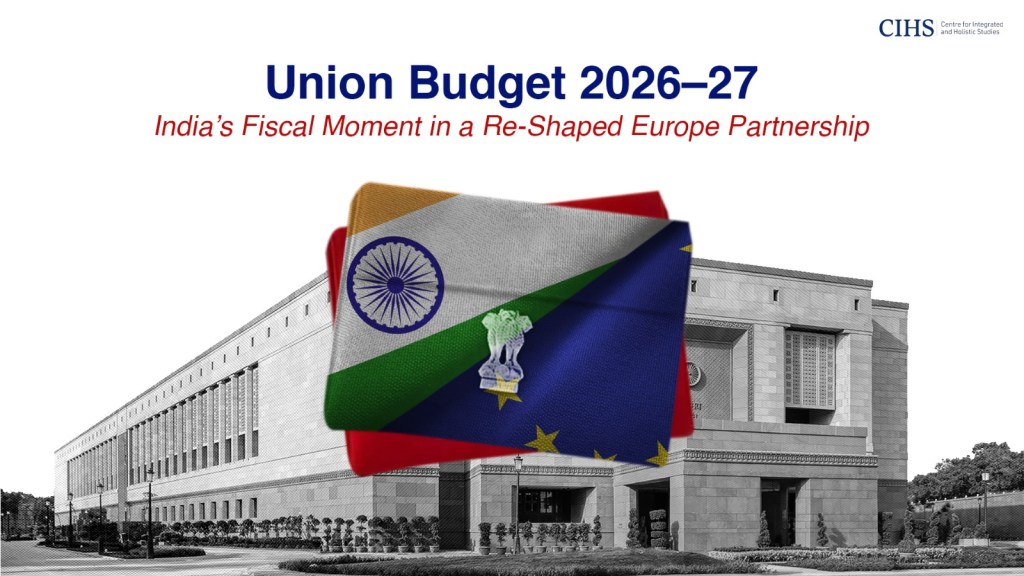
For India, the European Union is not just another trading partner. It represents one of the world’s largest consumer markets, a hub of advanced manufacturing, a leader in sustainability standards, and a regulatory superpower. The conclusion of the trade agreement has altered the context in which fiscal choices will now be read. Budget 2026–27 is thus expected to go beyond accounting for revenues and expenditures; it must articulate how India plans to convert enhanced market access into competitiveness, jobs, and long-term economic resilience.
The global environment in which this Budget is framed is anything but stable. Growth in major economies remains uneven, trade protectionism has not fully receded, and supply chains continue to be reshaped by geopolitical considerations. In this setting, India’s engagement with the EU reflects a strategic bet on rules-based trade, diversification away from over-concentrated markets, and integration into high-value global supply chains. The Budget, therefore, will be scrutinised for how well it aligns domestic policy instruments with this external opportunity.
One of the most immediate expectations from Budget 2026–27 is a clear fiscal roadmap to support export-oriented sectors that stand to benefit from the EU agreement. Labour-intensive industries such as textiles, leather, footwear, gems and jewellery, and processed foods are likely to gain preferential access to European markets. However, access alone does not guarantee competitiveness. Indian firms must meet stringent standards relating to quality, safety, traceability, and sustainability. The Budget is expected to acknowledge this reality by prioritising investments in testing infrastructure, certification ecosystems, and compliance facilitation, particularly for small and medium enterprises.
MSMEs, in fact, sit at the centre of the India–EU trade opportunity and the Budget challenge alike. While large corporations may have the scale and resources to adapt quickly to European regulatory norms, smaller firms often struggle with the costs of compliance and technology upgradation. Budget 2026–27 will be watched closely for targeted tax incentives, credit support, and technology adoption schemes that can help MSMEs integrate into EU-facing value chains rather than be crowded out by larger players.
Another critical dimension is logistics and trade facilitation. Reduced tariffs can only translate into real gains if transaction costs within India are brought down. Delays at ports, fragmented logistics networks, and inconsistent state-level regulations erode export competitiveness. The Budget is expected to reinforce capital expenditure on ports, multimodal logistics parks, and digital trade infrastructure, ensuring that physical and procedural bottlenecks do not undermine the advantages secured through diplomacy.
Beyond goods, the India–EU trade agreement also opens new possibilities in services, digital trade, and professional mobility. Europe remains a key destination for Indian IT services, engineering expertise, and skilled professionals. Budget 2026–27 may therefore carry signals on skilling initiatives, digital public infrastructure, and regulatory reforms that enable Indian service providers to scale up their presence in Europe while attracting European investment into India’s knowledge economy.
Sustainability is another axis along which the Budget’s EU alignment will be assessed. European trade policy increasingly embeds climate and environmental considerations, and Indian exporters will face rising expectations related to carbon intensity, circular economy practices and responsible sourcing. Rather than viewing this as a constraint, Budget 2026–27 has the opportunity to frame sustainability as a competitiveness lever by supporting green manufacturing, renewable energy adoption in industry, and low-carbon logistics. Fiscal incentives in these areas would signal that India intends to meet global standards on its own terms, without compromising growth.
Investment flows form the other side of the trade equation. The EU remains one of the largest sources of foreign direct investment into India, particularly in manufacturing, infrastructure, clean energy, and advanced technologies. The Budget’s approach to taxation stability, dispute resolution, and ease of doing business will therefore be read as a message to European investors. Any steps toward simplifying compliance, ensuring policy predictability, and strengthening contract enforcement would reinforce India’s credibility as a long-term investment destination.
At a broader level, Budget 2026–27 will reflect how India sees its role in the emerging global economic architecture. The India–EU agreement is not merely commercial; it is also strategic, reinforcing India’s positioning as a trusted economic partner amid shifting power balances. Fiscal choices that support domestic manufacturing, innovation, and human capital development will be interpreted as India preparing itself not just to trade with Europe, but to co-shape global norms in areas such as digital governance, supply-chain resilience, and sustainable growth.
There is also a domestic political economy dimension. Trade agreements often create both winners and adjustment pressures. The Budget will need to demonstrate sensitivity toward sectors and regions that may face increased competition, while ensuring that adjustment costs are managed through skilling, social protection, and targeted support. How effectively this balance is struck will determine whether the EU trade agreement is seen as a national opportunity or a sector-specific gain.
Ultimately, Union Budget 2026–27 stands at the intersection of diplomacy and development. It has the potential to serve as India’s first full-fledged “trade-aligned Budget,” one that translates international commitments into domestic capacity. Markets, industries and global partners will look beyond headline numbers to discern the deeper story: whether India is ready to move from negotiating access to delivering outcomes.
As Europe looks for reliable partners and India looks to scale its growth ambitions, this Budget could well define how the partnership evolves in practice. The fiscal choices made on this February morning may determine whether the India–EU trade agreement becomes a transformative economic chapter or remains an unrealised promise in the fine print of diplomacy.
(Author is a senior journalist & columnist. He has authored more than a dozen books)Union Budget 2026–27: India’s Fiscal Moment in a Re-Shaped Europe Partnership