

By N. C. Bipindra
As World Environment Day is observed on June 5, it is worth pausing to ask a fundamental question: why is the world scrambling to rediscover what Bharat (India) has always known?
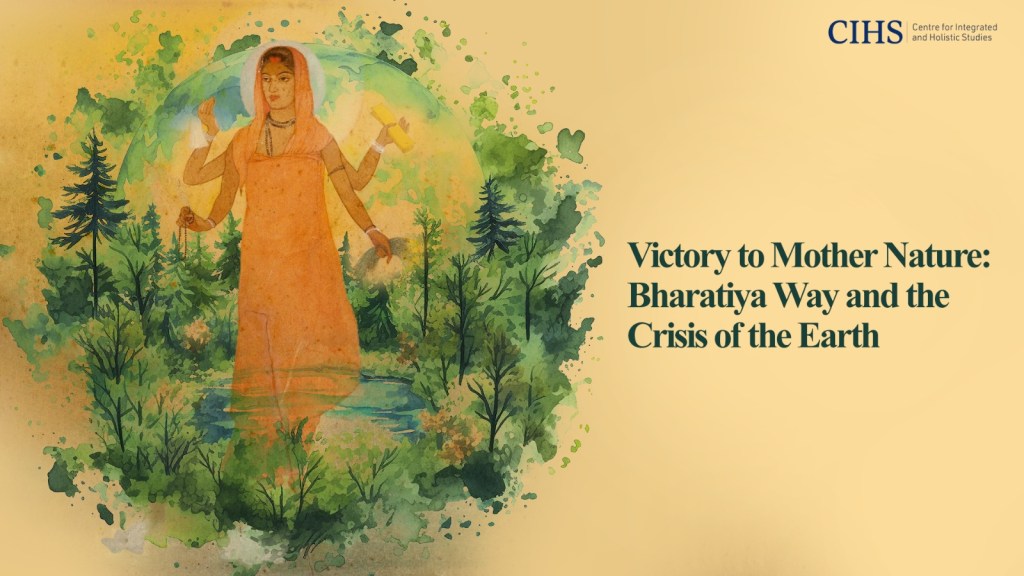
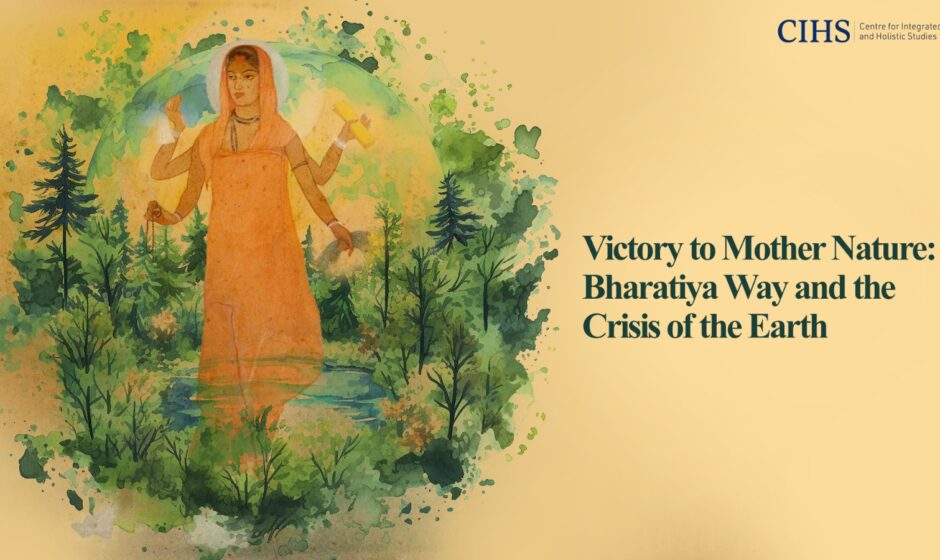
While the United Nations frames environmental protection as an urgent modern challenge, the civilisation that has flourished on the banks of the Sindhu, Ganga, Yamuna, Kaveri and Saraswati has regarded the Earth not as a resource to be extracted but as a living mother to be honoured.
Sanskrit invocation Mata Bhoomi Putro Aham Prithivyah (The Earth is my mother, and I am her son) from the Atharva Veda is not a poetic metaphor. It is a way of life.
Nature as the Sacred: The Scriptural Foundation
Hindu Dharma has embedded environmental consciousness into the very architecture of daily living. Puranas personify every river as a goddess, every forest as an abode of divinity, and every animal as either a vahana of a deity or a manifestation of Brahman itself.
Bhagavata Purana speaks of Prakriti (Mother Nature) as the manifest form of the divine feminine, deserving reverence and protection. Arthashastra of Kautilya, written over two millennia ago, laid down detailed regulations for forest conservation, protection of wildlife, and management of water bodies.
The concept of Panchabhuta, the five elements of earth, water, fire, air and ether, is not an abstract philosophy but a lived framework that reminds every Bharatiya (Indian) that the human body and the cosmos are composed of the same sacred matter.
The tradition of sacred groves, known as Dev Vans, spread across Bharat from Rajasthan’s orans to the sacred forests of Kerala and the jaheras of Jharkhand, long predating any modern conservation legislation.
Every neem tree, every peepal, every tulsi plant carries spiritual significance, and this significance was the original and most effective form of ecological protection. The river was not merely a water source; she was the Mother and to pollute her was not merely an environmental offence but a sacrilege.
Bharatiya Lifestyle as Ecological Practice
The daily routine prescribed by the Shastras (the Dinacharya) is, in ecological terms, an extraordinarily low-footprint way of living.
Early rising in tune with natural light cycles, minimal consumption, food governed by the seasons, zero-waste cooking using every part of a vegetable, the use of clay pots for water and community sharing of resources were not marks of poverty.
These were expressions of a profound understanding that the Earth’s bounty is finite and must be returned to, not merely extracted from.
The Paryavaran Gatividhi (Environmental Action) of the world’s largest volunteer organisation, the Rashtriya Swayamsevak Sangh (RSS), has given this ancient wisdom an organised and modern expression in recent years.
Inspired by the Bharatiya outlook of the RSS, the Ek Thaila, Ek Thali (One Bag, One Plate) campaign, launched during the Prayagraj Maha Kumbh 2025, aimed to make the largest human gathering on earth plastic-free and eco-friendly by promoting the use of steel plates and cloth bags as alternatives to single-use plastics.
The results were not symbolic gestures. According to the RSS Annual Report 2024–25, usage of disposable items was reduced by 80% to 85%, and it is estimated that INR 3.5 crore (INR 35 million) was saved per day through this zero-budget community initiative alone.
The experiment had been tested earlier: the use of pattals (plates made from leaves) was first successfully implemented during the Haridwar Kumbh in 2020, replacing single-use plastic plates entirely.
The Paryavaran Sanrakshan Gatividhi (Environment Preservation Action), inspired by the RSS, recently led a cleanliness and awareness campaign across eleven ghats of the Yamuna in Delhi, with people volunteering on their own initiative and not through official summons or advertisements.
The campaign carries a powerful civilisational message: that environmental protection is not the responsibility of the state alone, but a collective, community-rooted and spiritually motivated act.
RSS’s Panch Parivartan (Five Reforms) programme for its centenary year identifies Paryavaran (environmental awareness) as one of five key pillars of social transformation, alongside social harmony, family strengthening, the insistence on Swa (selfhood) and civic duty.
This is not environmentalism borrowed from Western discourse. This is Dharma, the eternal righteousness, in action.
What the modern West discovered through ecological catastrophe, that nature has limits, that extraction has consequences, that the human being is not the measure of all things, the Dharmic traditions held as first principles, inscribed in ritual, in seasonal worship, in the very grammar of how a farmer addressed the earth before breaking it.
They were articulating a cosmological fact: that the human being is not a sovereign individual standing apart from nature, but a thread woven into a living, breathing whole.
Contrast with the Western World
It is here that the starkest moral and political contradiction of our times must be named without hesitation.
Britain, the United States, Germany, France and the broader Western bloc consumed the world’s carbon budget over two centuries of industrialisation.
These nations built their wealth by relentlessly burning fossil fuels, destroying forests, polluting rivers and colonising the natural resources of the very Global South they now lecture about “sustainable development.”
The Industrial Revolution was not an act of ecological innocence; it was a civilisational choice to prioritise profit over Prakriti (the primordial creative energy, or nature) and the entire planet is now paying for it.
The principle of “Common but Differentiated Responsibilities,” the acknowledgement that countries that have polluted for far longer than others must free up carbon space for poorer nations to develop, has been broadly agreed upon for decades. Yet hard commitment and investment have been consistently lacking from richer countries.
The promise by rich countries to support developing nations with annual financial transfers of US$100 billion annually for climate action, which was supposed to begin in 2020, became a glaring failure, a broken pledge that has undermined global trust.
Developing countries’ climate commitments are explicitly conditional on receiving not only funding but also clean technology from those richer states that will enable them to decarbonise, yet technology transfer remains an unfulfilled promise.
At COP29, the new climate finance goal agreed upon, US$300 billion annually by 2035, still falls far short of what developing countries actually need to respond to climate change.
Least Developed Countries and the Alliance of Small Island States, the nations least responsible for historical emissions and most vulnerable to their consequences, staged a walkout at COP29 negotiations, so thoroughly had the wealthy world betrayed their trust.
The West guards its green technologies behind patent walls and intellectual property regimes, refusing meaningful transfer to developing nations while simultaneously demanding that those nations forgo the very developmental pathways the West itself used to grow rich.
This is not environmental leadership. This is ecological imperialism.
Vasudhaiva Kutumbakam: Bharat’s Answer
Bharat’s answer to this crisis has never been isolationist anger. The ancient vision of Vasudhaiva Kutumbakam (The World is One Family) compels Bharat to lead by example rather than merely demand.
India’s solar mission, its ambitious renewable energy targets and the International Solar Alliance founded on Prime Minister Narendra Modi’s initiative are practical expressions of this ancient ideal.
But Bharat must also speak plainly on the world stage: that the ecological debt owed by the industrialised West is real, measurable and morally non-negotiable.
Bharatiya way of life, its frugality, its reverence for nature, its community-centred ecology and its spiritual rootedness in the Earth, are not a relic of the past.
It is the most relevant model for a planet in ecological crisis. On this World Environment Day, let the world not only celebrate Prakriti but also listen to the civilisation that never stopped loving Mother Earth.
(Author is Chairman, Law and Society Alliance, a New Delhi-based think tank, and guest columnist with CIHS)