
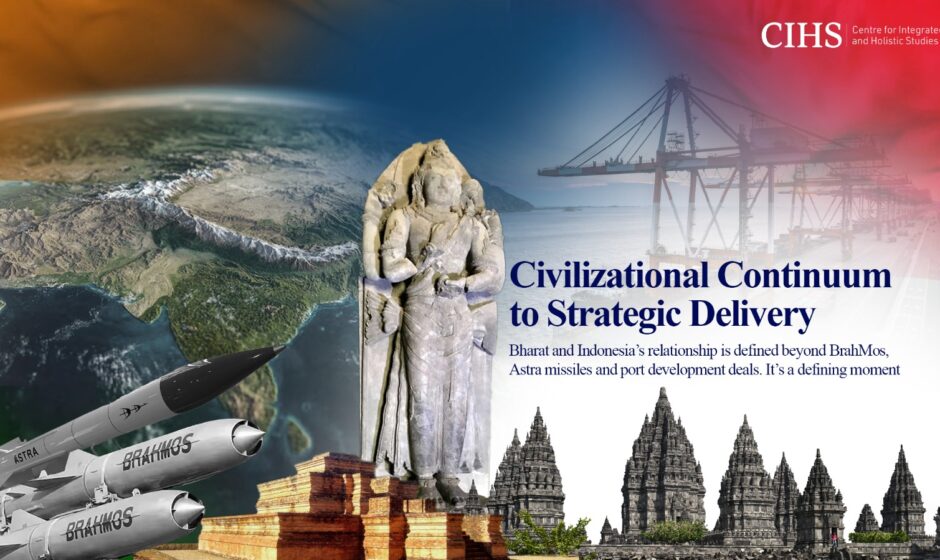

Bharat and Indonesia’s relationship is defined beyond BrahMos, Astra missiles and port development deals. It’s a defining moment.
Dr Gautam Kumar Jha
Prime Minister Narendra Modi’s state visit to Indonesia last week marks a defining moment in evolution of Indo – Indonesian relations. More than another successful diplomatic engagement under Bharat’s Act East Policy, the visit marks beginning of operationalizing one of India’s most consequential strategic partnerships in Southeast Asia.
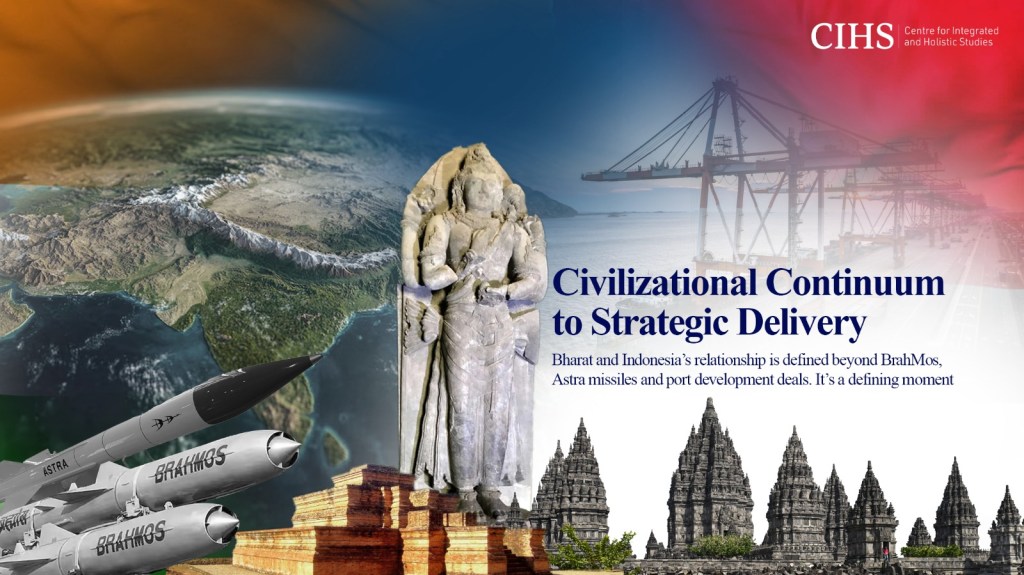
While global attention has understandably focused on Indonesia’s proposed acquisition of BrahMos and Astra missile systems, conferment of Indonesia’s highest state honour, Bintang Adipurna, and fourteen agreements spanning defence, critical minerals, artificial intelligence, higher education, maritime cooperation and food security should not be viewed in isolation.
Collectively, these pacts signify something far more profound: transition of the Bharat – Indonesian Comprehensive engagement from political aspiration to strategic delivery.
One of Asia’s oldest civilizational relationships only separated by waters of Bay of Bengal and Andaman Sea, Bharat and Indonesia have often fallen short of realising full potential of their partnership.
This paradox has long puzzled scholars, raising a fundamental question: why have two major democracies, bound by centuries of shared civilizational memory and ethos, failed to transform this inheritance into a deeper cooperation?
Throughout this period, however, both countries continued to celebrate their common civilizational inheritance through Prambanan, Borobudur, Ramayana, Nalanda and enduring spirit of Bandung. These historical symbols sustained political goodwill and reinforced perception that India and Indonesia were natural partners across the Indo-Pacific.
However, history alone cannot sustain bilateral relationship; rather, it should be transformed into institutional cooperation, policy coordination and long-term implementation.
Prime Minister Modi’s visit represents a defining transition in bilateral ties between India and Indonesia to a partnership driven by concrete cooperation. Rather than interpreting individual agreements separately, they should be understood as components of a coherent strategic architecture built upon three interconnected pillars: civilizational capital, strategic trust and strategic delivery.
Reinterpreting Indo – Indonesian Relations
Evolution of Indo – Indonesian relations can broadly be understood through three historical phases. First phase emerged during the struggle against colonialism and continued through Cold War. Guided by leaders such as Jawaharlal Nehru and Sukarno, both countries championed Afro-Asian solidarity, Bandung Conference and Non-Aligned Movement. Political cooperation during this period was driven primarily by anti-colonial ideals and principle of sovereign equality.
Second phase started following India’s Look East Policy, launched in 1991 and Indonesia’s democratic transition in 1998. During this period, maritime cooperation expanded, defence dialogues became institutionalized, ASEAN assumed greater prominence in India’s regional strategy, and bilateral relations reached a new milestone with elevation of ties to a Comprehensive Strategic Partnership (CSP) during Prime Minister Narendra Modi’s first official state visit to Indonesia in 2018.
However, CSP largely remained an institutional framework awaiting substantive implementation.
Modi’s visit marks beginning of a third phase.
Unlike previous engagements, this visit demonstrated collective progress across defence, maritime cooperation, higher education, artificial intelligence, digital technologies, food security, critical minerals and cultural diplomacy.
Rather than announcing new intentions, both governments began operationalizing existing strategic understandings. The defining feature of this phase is therefore implementation.
Civilisational Capital: Invisible Foundation
Strategic relationship is explained in terms of power, geography, or economics. Indo – Indonesian relationship demonstrates importance of an additional variable—civilizational capital.
This refers to accumulated knowledge, shared historical memory, and cultural inheritance that have evolved over centuries of interaction and mutual adaptation.
Diffusion of Sanskrit learning, Hindu-Buddhist philosophy, maritime commerce, and literary traditions transformed Java, Sumatra, Bali, Sulawesi and Kalimantan without erasing their indigenous identities.
Monuments such as Prambanan, Borobudur and Muaro Jambi continue to symbolise not foreign influence but Indonesian civilisation itself.
Ninth century Prambanan built under Sanjaya (Mataram) dyansty is often described as Indonesia’s largest Hindu temple complex. While factually correct, such a description understates its contemporary significance.
Together with Borobudur, Prambanan has become an icon of Indonesian national identity. It represents remarkable ability of Javanese civilisation to absorb external ideas while creating a distinctly indigenous cultural expression.
Bharat’s commitment to restore the Shiva shrine at Prambanan goes far beyond a simple archaeological conservation project; it reflects a shared responsibility for preserving a common civilizational heritage.
Prime Minister Modi’s assurance that he would return to Prambanan once restoration is completed underscores India’s long-term commitment to engaging with Indonesia through culture, education, heritage, technology and strategic cooperation alike.
Civilizational capital thus became contemporary diplomatic capital.
Strategic Trust: Political Transformation
Conferment of Bintang Adipurna, Indonesia’s highest state honour, upon Prime Minister Modi reflects precisely this political confidence. State honours are frequently interpreted as ceremonial gestures. In reality, they function as strategic signals.
Indonesia’s decision acknowledged not merely Prime Minister Modi’s personal leadership but Jakarta’s confidence in India as a reliable partner in long-term engagement.
Trust becomes particularly valuable in sectors involving advanced technology, defence manufacturing and long-term institutional dependence.
This explains why cooperation has simultaneously expanded into defence production, maritime security, artificial intelligence and digital technologies.
Trust reduces political uncertainty; reduced uncertainty enables technological cooperation and technological cooperation, in turn, strengthens enduring partnerships.
BrahMos, an Outcome
Proposed expansion of BrahMos cooperation has understandably attracted considerable international attention. However, interpreting the visit solely through lens of missile diplomacy overlooks the broader strategic transformation underway across Southeast Asia.
BrahMos should be viewed not as the cause of closer India–Indonesia relations but as one of the consequences.
Indo-Pacific security environment has undergone profound change during past three decades. China’s remarkable economic rise has been accompanied by expanding naval capabilities, an increasing maritime presence, underwater surveillance and more assertive behaviour in the South China Sea and beyond.
Artificial island construction, militarisation of disputed maritime features, fictitious interpretations of Nine – Dash Line and repeated encounters within neighbouring Exclusive Economic Zones (EEZ) have altered regional threat perceptions.
Stephen Walt’s Balance of Threat theory provides an appropriate analytical framework. States respond not merely to concentrations of power but to perceived threats generated by geographical proximity, offensive capability and long-term behavioural patterns.
Indonesia’s strategic choices should therefore be understood within this broader regional security environment. At the same time, Jakarta has consistently pursued a policy of strategic hedging, seeking constructive relations with all major powers while avoiding exclusive military alignments.
Rather than becoming part of bloc politics, Indonesia prefers partnerships that enhance its national resilience without compromising its strategic autonomy. Bharat’s defence cooperation fits comfortably within this approach.
New Delhi neither seeks permanent military bases nor demands alliance commitments. Instead, it emphasises technology cooperation, capacity building and respect for sovereign strategic choices.
BrahMos, therefore, represents credible deterrence without strategic dependence.
Strategic Delivery
The most important outcome of the visit lies beyond defence. Cooperation in critical minerals connects Indonesia’s vast nickel reserves with India’s expanding clean-energy ambitions.
Partnerships in artificial intelligence and digital technologies anticipate future strategic competition in emerging technologies. Agreements covering food security, higher education, maritime cooperation, Blue Economy initiatives and resilient supply chains further broaden the partnership beyond traditional security concerns.
Viewed collectively, these initiatives reveal a significant shift. The relationship is increasingly becoming multi-dimensional and implementation-oriented.
Civilizational capital, strategic trust
If both governments sustain this momentum through disciplined implementation, July 2026 may ultimately be remembered as the historical moment when India and Indonesia transformed an ancient civilizational relationship into one of the Indo-Pacific’s most consequential strategic partnerships.
(Dr Gautam Kumar Jha, Assistant Professor, JNU and guest columnist with CIHS)