

India is building data centres at record speed. Harder question is who owns the intelligence inside these centres.
Dr Nitin Shamra
The first-quarter GDP numbers for FY 2026-27 have done more than beat expectations. They have restored a certain confidence. The economy grew 7.8 per cent. That was much more than Reserve Bank’s forecast. It was one of the strongest starts to a fiscal year we have seen in a while and it came despite tense geopolitical developments and surge in energy prices internationally.
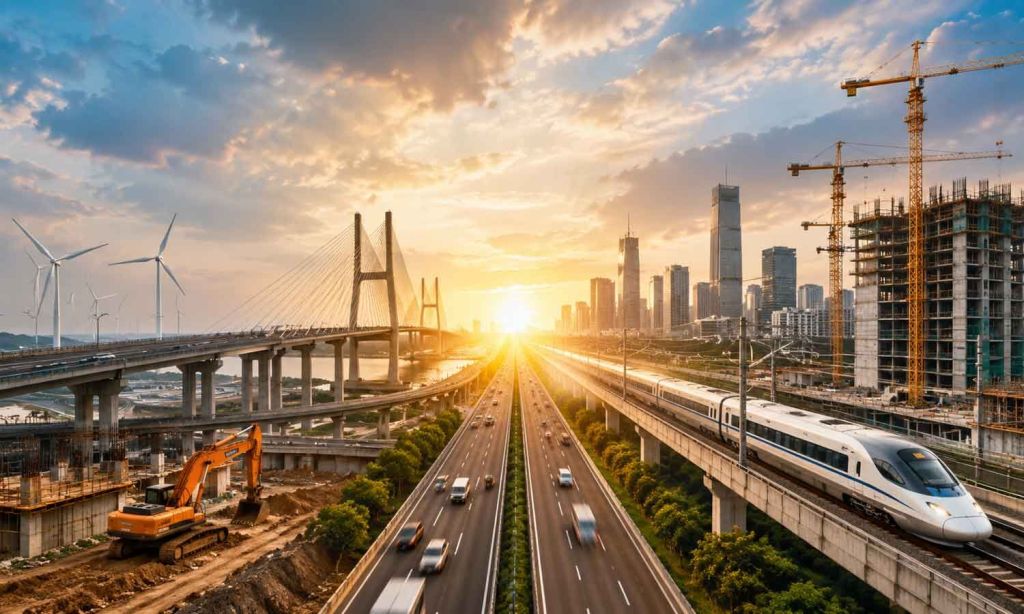
Manufacturing held up. So did services, investment and household spending. The story is familiar now. India keeps growing faster than most large economies. Foreign investors seem to agree. This is manifested in the fact that India drew record $ 94.53 billion in FDI inflows during 2025-26, up 17 per cent on previous year’s performance. But, let’s get realistic. A quarterly number is just an indicator. What matters is the direction. Viksit Bharat is the goal: a developed economy pump primed at $ 30-35 trillion by 2047. And, one most understated part of this edifice is data centre.
For most part of last century, we measured the country’s strength in steel, cement in tonnes and megawatts or gigawatts. Ports moved goods. Railways moved people and cargo. Grids kept the lights on. That has changed. Today a row of air-conditioned sheds full of servers decides where the world’s data lives, how fast it travels, and who gets to control it. Industry estimates suggest data centers and the digital economy they support could push India’s internet economy past $ one trillion by 2030. That figure comes from a widely cited Google-Bain-Temasek projection. It is a real slice of the Viksit Bharat ambition. If the trajectory holds, data centers will not merely support India’s climb. They will drive it from the front.
The numbers
India’s operational data center capacity stands at roughly 1.3 to 1.6 GW today. It is spread across more than 160 facilities. Several hundred more megawatts are under construction. The market was worth about $10 billion in 2025. It is projected to more than double to $21-22 billion in four to five years. It translates to a compound annual growth rate of close to 13.5 per cent. The capacity expansion story is sharper. From under two GW today, India’s capacity is expected to grow four to five times by 2030. Some estimates go as high as eight GW. That ceiling may not hold for long.
Consider AirTrunk. The Australian hyperscale operator, backed by Blackstone and Canada Pension Plan Investment Board entered India in April this year by acquiring Lumina CloudInfra. The deal handed it a pipeline of about 600 MW across Mumbai, Chennai and Hyderabad, with development potential of up to $ 5 billion. Six weeks later it announced something far larger: more than ₹ 3 lakh crore roughly $ 30 billion to build over five GW capacity in India by 2030. Maharashtra has already exchanged a letter of intent for land at Raigad Pen Growth Centre where AirTrunk is planning three GW campus. If even part of that materializes, eight GW starts to look conservative.
Nearly $ 70 billion investment is in motion. Another $ 90 billion has been announced. Those are government figures, released alongside Union Budget’s long-term tax framework for cloud and data centres income. That framework runs all the way to 2047. The intent is twofold: give investors certainty and formally place data centres alongside power and transport as national infrastructure.
Who is building, and where
Mumbai is still the capital of India’s data centre map. It accounts for nearly half of all operational capacity. Chennai follows with about 18 per cent. Delhi-NCR has 11 per cent. The more interesting movement is in the second rung. Hyderabad, Pune, Bengaluru and now Lucknow are climbing fast. Hyderabad alone is expected to add 1,000 to 1,200 MW by 2030. That would rival Mumbai’s own expansion. States are competing hard for the money. Telangana has signed MoUs worth over ₹10,500 crore for AI data centre clusters. Rajasthan is chasing ₹20,000 crore. Uttar Pradesh is courting ₹30,000 crore for eight new data center parks.
The builders are a mix. Indian infrastructure players are laying the physical groundwork: AdaniConneX, Yotta Infrastructure, NTT DATA, CtrlS, Nxtra by Airtel, Sify, and ST Telemedia Global Data Centers, which has partnered with Tata and pledged $3.2 billion for 550 MW. AirTrunk joins them as the newest entrant.
Hyperscalers are writing the biggest cheques. Google has committed $ 15 billion over five years during 2026 – 30, for India’s first gigawatt-scale AI hub, built with AdaniConneX and Nxtra by Airtel. Amazon Web Services has pledged roughly $ 12.7 billion nationally including $ 8.2 billion in Maharashtra. Microsoft has earmarked close to $ three billion.
The largest single development so far is Blackstone and Panchshil Realty’s 500 MW campus in Navi Mumbai. It carries an investment of over ₹20,000 crore, spans 14 buildings and three million square feet and is designed to run on up to 65 per cent renewable power.
The power problem
Here is the part that rarely makes headlines. It will decide everything else. Data centers are enormously power-hungry. India’s grid has never been asked to deliver electricity at this scale, for this purpose, before. Globally, data center electricity demand is projected to more than double by 2030, to roughly 945 terawatt-hours. That is more than Japan’s entire annual consumption, according to International Energy Agency.
AI is the main driver. Training a large model means thousands of GPUs running without pause for weeks. AI servers can draw up to ten times the power of conventional ones. A modern AI-focused facility may need 80 MW or more. A standard one needs about 32 MW. As India moves from under two GW to a possible eight GW, electricity demand rises with it. And most of that supply must be constant. Round the clock. Uninterrupted. This is the catch with renewables. Solar and wind are intermittent. Data centers cannot tolerate intermittency. They need always-on power.
Which is why the conversation is turning towards nuclear.
Speaking at the ET World Leaders Forum in New Delhi, Dr Vivek Lall, Chief Executive of General Atomics Global Corporation, put it simply. Nuclear power, he said, will be a necessary component in driving AI in the future. Digital Realty’s Aaron Binkley has described nuclear as abundant, carbon-free and available 24×7 with a generation profile that closely matches a data centre’s own load. IEA expects nuclear share of data center electricity to rise from around 15 per cent today to perhaps 18 – 20 per cent by 2030. Some estimates suggest that 60 per cent of total consumption of data center power will be renewable and Nuclear by 2030. A bigger jump is expected once small modular reactors or SMRs start commissioning at scale between 2030 – 35.
Conventional nuclear plants take a decade or more to build. Land acquisition and safety clearances are slow. SMRs are a different proposition altogether. They are factory-built and modular. They can be deployed in 24 to 36 months. Some designs need under 50 acres. And they still deliver capacity factors above 95 per cent which renewables cannot match. Technology companies worldwide have committed over $ 10 billion to SMR partnerships. The first commercial SMR-powered data centre is expected online by 2030.
India is not sitting this one out. The government has set a target of 100 GW nuclear capacity by 2047. That is more than twelve times today’s 8.8 GW. Ten decommissioned thermal power sites have been identified for conversion. They already have transmission lines, water access and rail links in place. Whether SMRs become commercially viable in India this decade remains an open question. Regulatory approval, fuel supply chains and a thin pool of nuclear engineering talent are all real constraints. But as a medium-term answer to the power crunch, nuclear is no longer a nice-to-have. It is one of the few realistic ways to deliver clean, dependable, round-the-clock electricity on this scale.
In the meantime, operators will lean on a mix: renewable power purchase agreements, grid supply, and captive gas or diesel backup. Data centres, in other words, will not only push the economy forward. They will pull other industries along with them. Nuclear power is one such lever.
Harder question!
Here the story gets less comfortable. Data localization laws mean that when a global company stores Indian users’ data on Indian soil, India gains something real. Legal jurisdiction. Faster disaster recovery. Lower latency. Freedom from depending entirely on servers in Virginia or Singapore. In that narrow sense, every new facility in Mumbai or Hyderabad is a genuine gain for digital sovereignty.
But location does not lead to control. Look at who actually owns and operates bulk of India’s hyperscale capacity. The names are largely American, Australian and Singaporean. Amazon. Google. Microsoft. Equinix. Blackstone. ST Telemedia. The servers may sit in Pune. The cloud architecture does not. Neither do encryption keys, proprietary software stack, or, often, the final decision.
Anand V and Srinath Sridharan make this distinction in their book Power of Uncertainty. Sovereignty, they argue, cannot rest on data location alone. It depends on who holds underlying code and metadata that give the data its meaning and its use. Owning the building is not the same as owning the human intellect behind computing prowess.
So, India’s real test lies one layer above the data center. Can it build its own cloud stacks? Its own large language models? Its own key-management and governance frameworks?
The IndiaAI Mission and homegrown foundation-model projects are early steps. They are also a fraction of the scale at which Google, Microsoft and Amazon operate globally.
Honest assessment
Data centers are foundational infrastructure for Viksit Bharat. There’s no second thought about it. They will create jobs. They will draw tens of billions of dollars. They will help push India’s internet economy towards the trillion-dollar mark by 2030. They will force a long-overdue modernization of the power grid, and may yet revive India’s nuclear ambitions along the way.
But bricks, steel and megawatts will not ensure India’s digitally sovereign.
That depends on whether we build the software and intelligence layer to match the hardware we are now hosting. In this economy, whoever controls the code, they oversee the data. It does not matter in which country the server sits. India will house the physical infrastructure. Owning the code that runs on it is the part that counts.
(Author is an expert in data centers, technology and director with a prominent global MNC and leading its business in Indian subcontinent)