
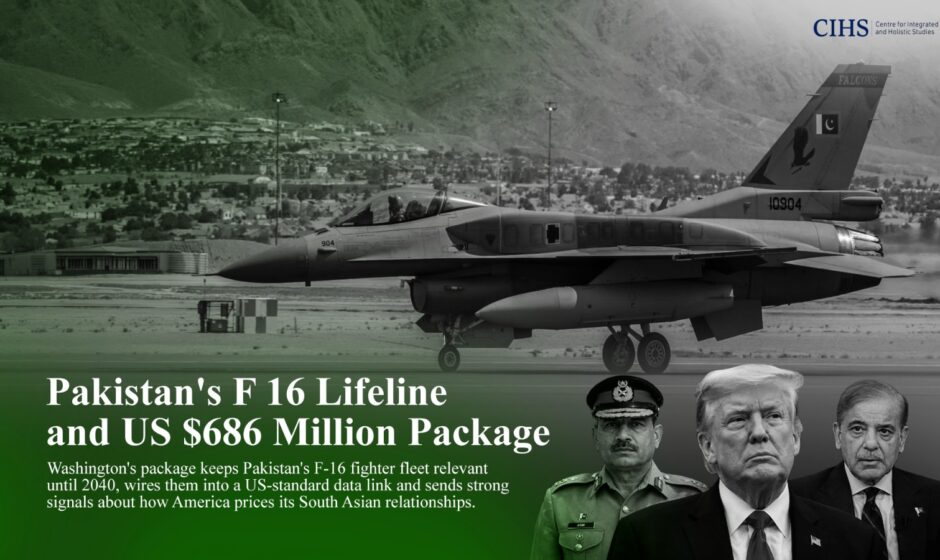

Washington’s package keeps Pakistan’s F-16 fighter fleet relevant until 2040, wires them into a US-standard data link and sends strong signals about how America prices its South Asian relationships.
Brig Brijesh Pandey (Retd)
In December 2025, the US Defence Security Cooperation Agency notified Congress of a proposed $686 million foreign military sale to refurbish and upgrade the Pakistan Air Force’s (PAF) F-16 fleet. The notification cleared the statutory review without obstruction. The details were placed fully in the public domain in September 2026. On 28 October 2026, India’s Defence Minister Rajnath Singh raised the matter directly with U.S. Secretary of War Pete Hegseth on the sidelines of ADMM- Plus meeting in Cebu.
The official framing of US is familiar – play the game around flight safety, counterterrorism and interoperability, with the customary assurance to India that the sale “will not alter the basic military rebalance in the region”. Technically, that framing may not be false. It is incomplete and ambiguous. This is not the sale of new aircraft, and involves just a modest $37 million worth of major defence equipment. But this is not the real value. The real value lies in the fact that the package extends the operational life of Pakistan’s most capable Western platform by 15 years. It also gives that platform a networked US standard architecture, just as the PAF is absorbing a new generation of Chinese weapons.
This argument gives birth to three questions. Can sensitive American technology be protected inside Pakistan’s hybrid governance ecosystem? Does the package give Pakistan capability beyond its stated purpose? And what does it reveal about Washington’s long-term calculus in South Asia?
More than Spares and Servicing
The package is valued at $686 million, of which $37 million is a Major Defence Equipment and $649 million covers other hardware, software, training, a full motion simulator and logistics support. Pakistan pays from national funds and Lockheed Martin is the principal contractor. The aim is to keep the Block- 52 and Mid-Life Upgraded aircraft flying through 2040.
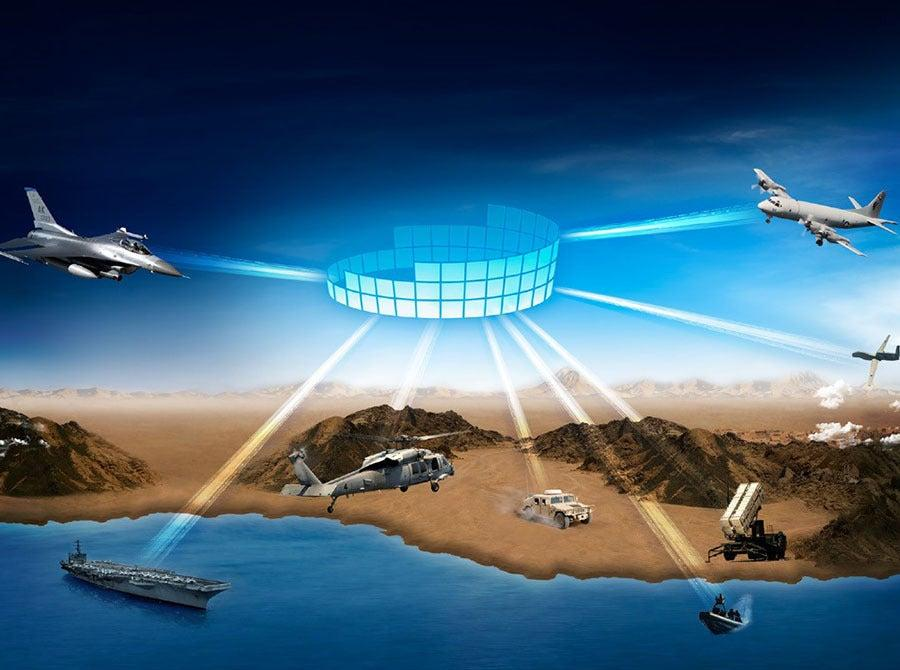
The Major Defence Equipment included in the package are 92 Link-16 tactical data link terminals, six inert Mark-82 bomb bodies for integration testing, operational flight program modification kits, mandatory avionics, updates, cryptographic equipment, and AN/APX-126 Identification Friend or Foe (IFF) system.
Pakistan first sought these upgrades in 2021-22. Despite the notification route being open, the Biden administration sat on the request and did not approve. However, within months of newly infused warmth in the ties, Trump 2.0 administration moved swiftly and cleared the request.
It would be a mistake to dismiss the MDE figures as small because together the updated flight software, modern crypto, Mode 5-class IFF and Link-16 turn a legacy fleet into a network node. Why should a fleet of less than 75 aircraft require 92 terminals unless they are meant to cater for the ground stations and integration with airborne early warning and command nodes. If so, the result will be a kill chain in which the shooter need not radiate. Study of the 2019 engagement over Nowshera will clearly recognise why that matters.
Challenges from Mixed Inventory
Pakistan is not a recipient of only American technology. It’s armed forces operate Western, Soviet-Russian and Chinese equipment side by side. The history of Chinese military industrialisation is replete with examples of Western in general and American technology in particular, getting smuggled to China through Pakistan.
In 1982, despite explicit CIA warnings about its likely proliferation to China, Washington cleared the AN/ALR-69 radar warning receiver for Pakistan’s F-16s. After the May 2011 Abbottabad raid, Pakistan enabled discreet access of the Chinese specialists to the wreckage of American stealth helicopter.
Analysing this package wherein Link-16 is the common tactical network of the US, Japan, Australia, Taiwan and NATO, the IFF logic and signatures will be of great value to the Chinese electronic warfare ecosystem. The F-16 and AMRAAM emitter alongside the performance database remain priced intelligence catch. All of this will now sit within PAF whose J-10CE and JF-17 fleets are sustained with deep Chinese involvement. In Cebu, India flagged precisely this risk of advanced US technology reaching third parties. In this context, India did not shy from naming China and Iran.
Safeguards Promised but never Practiced
It is assumed that Washington has an unusually intrusive monitoring regime around Pakistan’s F-16s. However, implementation is always subject to its preferences and priorities. For instance, Islamabad was required to accept and pay for US technical security teams at Shahbaz and Mushaf, the two bases housing the advanced aircraft. Each team comprises 4 to 5 US Air Force personnel and around 30 contractors on round the clock watch. Their job is to ensure that the aircrafts are used as intended, they are neither modified nor the technology is shared with unauthorised parties.
AMRAAMS are supposed to be stocked only at Mushaf, with restrictions on their use. The end use agreement provides for semi-annual inventories of aircraft equipment, munitions and technical data. In 2019, Washington approved $125 million to support round the clock monitoring. This was, however frozen till February 2025, when $397 million meant to keep its jet confined to counterterrorism and away from India was unfrozen.
Complementing these structural controls exercised on the sensitive US exports, are the measures such as NSA managed COMSEC accounting, US-held key material, US control of mission software and source code, anti-temper design and Congressional oversight. The most powerful element is the sustainment pipeline. The Pressler sanctions of 1990 showed that Washington can ground a fleet simply by stopping space.
Despite these multi-layered controls, the regime has four weaknesses.
- Monitoring is not Denial. Technical teams verify custody in peacetime, they do not control employment in crisis. In February 2019, U.S. supplied F-16s and AIM-120C-5 missiles were used against India, and the American response was muted.
- Enforcement Depends on Political Will. After Operation Sindoor, the State Department simply referred questions on Pakistani F-16 losses back to Islamabad and the Pentagon declined to release its data. Selective enforcement is weak enforcement.
- Leverage Erodes as Pakistan Diversifies. Sustainment dependence constrains a country only it has equipment sourced from one country. In case of Pakistan, F-16s are not indispensable. With J-10CE and PL-15 in service and fifth-generation Chinese fighter under negotiation, the PAF can accept restrictions on one segment of the fleet and fight with another.
- Leakage is Human, not just Physical. Shared maintenance cadres, training pipelines, and intelligence integration with China cannot be monitored from two flight lines.
The safeguards could be tightened. Washington could keep PAF Link-16 terminals cryptographically segregated from US and partner networks outside defined exercises. It could hold Mode 5 keys and enforce frequent re-keying. Sustainment could be tied to automatic suspension upon proven misuse, and with mandatory reporting to Congress after any India-Pakistan air engagement. An explicit bar on F-16 participation in exercises with the PLA Air Force would close another gap. These are reasonable asks for India to place on the table.
Beyond the Stated Purpose
The counterterrorism rationale does not survive a close look at the equipment list. Striking TTP hideouts in north-west does not require 92 Link-16 terminals or modern IFF. In fact, these are the tools meant for contested, networked air battle against a peer adversary. The phrase “future contingency operations” in the US justification also fits Pakistan’s widening Gulf role after its September 2025 mutual defence pact with Saudi Arabia and Mecca Pact of May 2026 with Saudi Arabia and Türkiye.
The assurance about the military balance is technically defensible and strategically misleading. Counting the airframes may not matter as much as the available network sorties. This is the second American package for Pakistan’s F-16s since Indian strikes in May 2025 wherein Pakistani Air Force bases were hit. Does it imply that Pakistan was procuring the refurbishment stores that were degraded. Life extension to 2040 locks the F-16 into PAF planning for another 15 years.
There is a fair counter argument. In 2022, Indian aviation analyst Angad Singh judged that such sustainment packages are not specifically significant in balance of power terms and that the real objection is about signalling. On a narrow count, that holds. On a count of kill chain quality, it does not.
The missile question deserves particular attention. In October 2025, a US contract notice listed Pakistan among customers for the latest AMRAAM variants. The US embassy in New Delhi clarified that the amendment related only to sustainment and spares, with no upgrade to existing Pakistani capability. Pakistan bought 500 AIM-120C-5 missiles in 2007. Any future move to the C-8 variant would be the real red line for the Indian Air Force.
The cumulative effect is a hybrid force. The PAF now fields Chinese fighters armed with PL-15 alongside American F-16s on a US-standard network. It gains two suppliers, two doctrines and built-in redundancy. American monitoring constrains, only half of that force.
AMRAAM Factor
The AIM-120 Advanced Medium Range Air-to-Air Missiles is what makes Pakistan’s F-16 a beyond-visual-range threat. It entered into service with the US Air Force in 1991, replacing older radar-guided missiles. Its defining feature is an active radar seeker. The missile flies its early path on inertial guidance, receives course corrections from the launch aircraft, and switches on its own radar for the terminal phase. The pilot can fire, turn away and engage the next target.
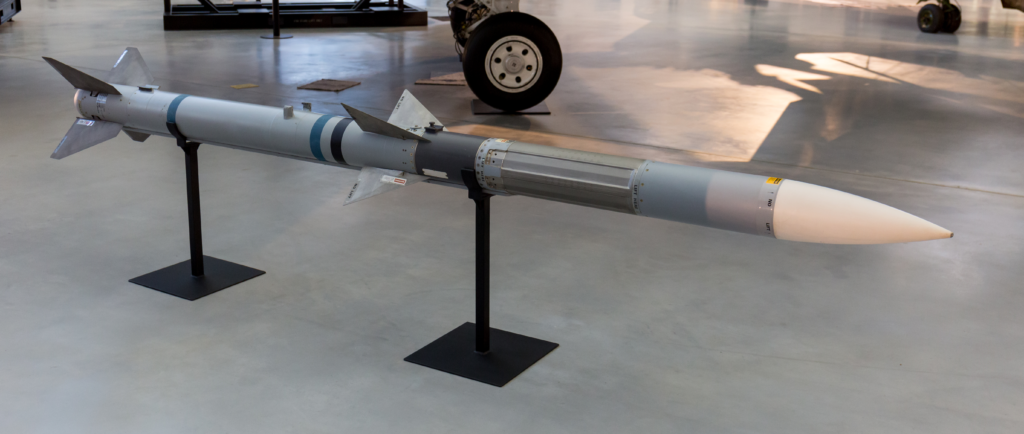
Pakistan holds the C-5 variant. It came from a redesign that shortened the control section to fit a larger WPU-16/B rocket motor, together with improved electronic counter measures. Open source estimates put its effective range at 105 to 120 km. Pakistan bought 500 of these missiles in 2007, alongside the Block-52 aircraft, under the condition that they be stocked only at Mushaf.
The C-5 has already been used against India. After the aerial engagement of 27 February 2019, India displayed the debris that was identified as an AIM-120C-5 as proof that Pakistani F-16s took part, which Islamabad denied. Indian accounts hold that the missile brought down Wing Commander Abhinandan’s MIG-21 Bison. The episode remains the clearest case of US origin weapons being used outside the counter-terrorism purpose Washington cites.
Later variants matter more for the future. The C-7 added better jamming resistance, an upgraded seeker and longer range. The Aim-120D, and its export equivalent the C-8, add further range and, in the D-model, a two way datalink with third-party targeting. Open source estimates place the D-model at 160 to 180 km, while Indian reporting has credited the newest versions with reach up to 200 km. India has reportedly pressed Washington to keep these variants away from Pakistan.
Reading Washington’s Calculus
The package fits a broader pattern. In June 2025, President Trump hosted Field Marshal Asim Munir at the White House. Weeks later, Pakistan secured a 19 per cent tariff rate, lower than the 25 per cent then imposed on India. In September 2025, a $500 million critical minerals framework followed with US Strategic Metals. After mediating in the US-Iran conflict in 2026, Islamabad hired a Washington lobbying firm to convert goodwill into defence cooperation and mineral investment. Pakistan is being valued for what it can deliver now – counter-terrorism cooperation, access to Iran, minerals and reach into the gulf.
There is also a China logic. Sustaining the F-16 is the cheapest way to prevent the PAF from becoming an entirely Chinese-equipped force. It also preserves an American presence inside Pakistan’s premier air bases. Indian reporting suggests Beijing has sought a similar monitoring arrangement for any J-35A sale, out of unease over Pakistan’s American ties. That claim is unconfirmed, but the anxiety it describes is plausible.
None of this amounts to abandoning India. In Cebu, Hegseth reaffirmed American solidarity with India against cross-border terrorism, and the two ministers reviewed progress under the India-US Defence Framework. India also secured a trade deal in February 2026 that capped tariffs at around 18 per cent. Washington’s messages is compartmentalisation. India remains the strategic partner for the Indo-Pacific. Pakistan is a tactical, transactional partner. Neither holds a veto over the other. American officials used the same “not zero sum’ formula in 2022.
The danger for India is creeping re-hyphenation. Taken separately, the F-16 package, the AMRAAM sustainment, the mineral deal and US claims of credit for the post-Sindoor cease fire are each manageable. Together, they rebuild habits of US-Pakistan military cooperation that had largely lapsed after 2018. Should India-US friction re-ignites over trade, Russian oil or strategic autonomy, those habits hand Washington ready leverage.
What should India do
Objection is necessary, but not sufficient to mitigate the challenges posed to India’s National security. India’s response should operate on three planes.
Diplomatic. New Delhi should press for specific verifiable commitments rather than general reassurance. These include Link-16 and IFF segregation, explicit limits on AMRAAM variants, and post-incident reporting. Congress is the only American institution that can condition sustainment, and India should cultivate allies there deliberately.
Military. Planners should assume a networked PAF through 2040, thereby meaning data linked F-16s, J-10CE with PL-15 missiles, airborne early warning and possibly a stealth fighter. India needs to prioritise acquisition of long range air to air missiles, such as Astra Mark2 and Mark3 alongside Meteor, and greater airborne warning density. It needs electronic warfare capabilities for degrading adversary data links and a layered long-range air defence. Above all, counter-air doctrine must target network nodes rather than airframes alone. Operation Sindoor demonstrated the value of that approach.
Evidentiary. The AMRAAM debris recovered in 2019 remained India’s strongest card on misuse. Rigorous collection and documentation of US origin weapon use in any future engagement is the surest way to make end-use monitoring bite.
Conclusion
The $686 million package will not, by itself, tilt the air balance in the subcontinent. Its significance lies in what it sustains, what it connects and what it signals. It keeps Pakistan’s American fleet relevant for 15 more years. It plugs that fleet into US-standard network inside an increasingly Chinese military ecosystem. And it confirms that Washington now treats its two South Asian relationships as separate lagers. India cannot change that calculus. It can, however, insist that the safeguards Washington advertises are enforced, and prepare its forces for the adversary that this package helps preserve.
(Author is a veteran of Indian Army, experienced in planning & executing key operations with an extensive expertise in information warfare and defence strategy. He writes on defence policy for the Nation First Policy Research & Change Foundation. Views expressed are personal.)
References
- IANS, “Trump administration notifies $686 million F-16 upgrade for Pakistan,” 10 December 2025.
- Dawn, “US approves sale of advanced technology and support for Pakistan’s F-16s,” 11 December 2025.
- NewKerala/IANS, “US details $686mn Pakistan F-16 upgrade,” 22 September 2026.
- GKToday, “Rajnath Singh raises concerns over US F-16 package for Pakistan,” October 2026.
- Asia News Network (Dawn), “Washington okays upgrade package for Pakistan’s F-16 fleet,” 24 December 2025.
- Centre for Land Warfare Studies, “USA reprimands Pakistan for misusing F-16 fighter aircraft.”
- NewsBytes, “Rajnath Singh warns US over F-16 support to Pakistan,” October 2026.
- The Week, “How the US continuously monitors Pakistan’s F-16 fighters,” 28 August 2020.
- The Wire, “India-Pakistan crisis: F-16s and the missile mystery,” 2019.
- ThePrint, “Days after Trump-Imran meet, US approves deal to monitor 24×7 Pakistan’s F-16s,” July 2019.
- Business Recorder, “US approves $686mn F-16 upgrade package for Pakistan Air Force,” December 2025.
- Aviation & Defence Universe, “India protests upgrading of Pakistan’s F-16s,” 2022.
- IDRW, “US approves $686 million package to sustain Pakistan’s F-16 fleet,” December 2025.
- The Tribune, “US approves $686-million sale of advanced tech for Pakistan’s F-16 jets,” December 2025.
- Outlook Business, “Why India is unhappy about US renewing F-16 deal with Pakistan,” September 2022.
- The Wire, “US Embassy says it isn’t delivering new AMRAAM to Pakistan,” October 2025.
- Janes, “Pakistan’s AIM-120 stocks to receive sustainment, says US,” October 2025.
- Business Standard, “What Pakistan’s AMRAAM missile deal with US means for its air power,” 8 October 2025.
- The War Zone, “Evidence of Ukraine using AIM-120C-8 missiles emerges.”
- Army Recognition, “AMRAAM AIM-120 air-to-air missile.”
- The Tribune, “US to give Pak advanced missiles for F-16 jets,” October 2025.
- IDRW, “India reportedly seeks to limit Pakistan’s access to AMRAAM-D,” October 2026.
- Carnegie Endowment for International Peace, Grand Tamasha, “Why Washington is wooing Pakistan,” 30 September 2025.
- Manohar Parrikar Institute for Defence Studies and Analyses, “Pakistan on the sidelines of US mineral diplomacy,” 2026.
- The EurAsian Times, “Pakistan hires US lobbyists to restore defense ties with Washington,” July 2026.
- IDRW, “China’s J-35A offer to Pakistan hits snag over US-style monitoring demands,” 2025.
- Indian Defence News, “Rajnath Singh raises concerns over US F-16 support package for Pakistan,” October 2026.
- The Wire, “What does US aid to upgrade Pakistan’s F-16s mean for India?”, September 2022.