


Negating political & payment uncertainties in states, dealing with missed deadlines by companies will help realize both foreign and domestic investments quickly in larger sums.
K. A. Badarinath
Andhra Pradesh chief minister N Chandrababu Naidu, a close ally of Prime Minister Narendra Modi and part of ruling National Democratic Alliance (NDA) mooted bringing in an India Investments Protection Act.
Naidu, himself, will pilot a similar bill in the state to attract both foreign and domestic investments in the three industrial hubs of Vishakhapatnam, Tirupati and Amaravati.
Two key reasons were cited for bringing in an investments’ protection act of 2026 in the ensuing budget session of Andhra Pradesh state legislative assembly.
Vandetta politics and non-payment of subsidies or incentives to industrial investors in the event of change in government has unnerved both domestic and foreign investors.
A draft bill was to not only be piloted in state assembly but circulated amongst NDA allies to muster support for a similar legislation at centre to increase momentum in corporate investments and hit the 10 per cent GDP growth for the country in a couple of years.
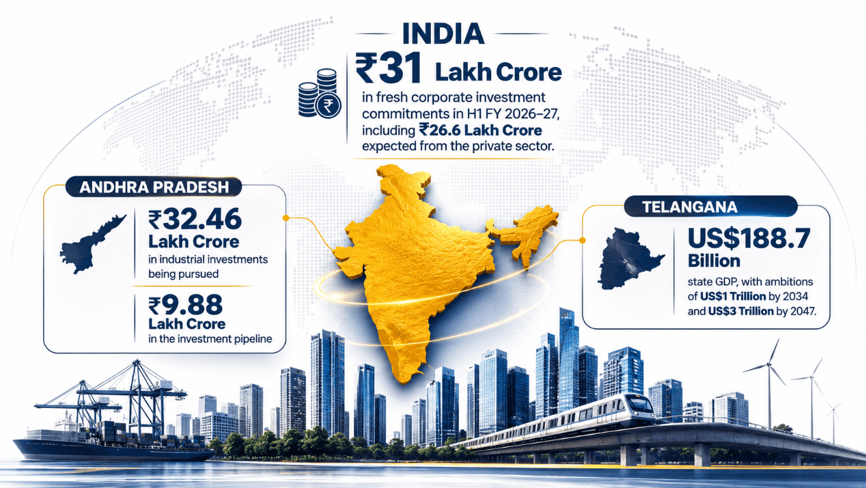
Naidu seems to have made his move after having bagged investments in pipeline worth Rs 9.88 lakh crore at the just ended partnership summit held in Vishakhapatnam port city.
Cumulatively, Andhra Pradesh alone is looking at industrial investments worth Rs 32. 46 lakh crore beginning 2024.A.P. Investments Protection Act can be a good starting point and a template for meeting all government related commitments made to investors bringing in investments. Investments Protection Act could provide a cover against potential political risks taken by companies investing in the country.
Industrial incentives, dues and payable liquid funds against goods and services provided to Andhra Pradesh government will be put in an escrow account with first charge on investing company. This will eliminate cash flow issues during setting up of production facilities and operations of both Indian and foreign corporates.
Escrow mechanism seems to have been borrowed by Chandrababu Naidu from power sector where electricity boards or state-run power companies opened such accounts to ensure timely payments against electricity supplies. Well, this mechanism has its own pitfalls.
But, it provides cushion to industrial investors in different sectors where companies seek timely clearance of bills without taking recourse to corrupt practices reported in the past with commissions that were order of the day.
Investments Protection Act proposed by Andhra Pradesh chief minister can be improvised further. Companies that do not discharge their investment commitments as per statutory agreements may be liable for fines and penalties. Inordinate delays and dragging the investment proposals by companies may also have to be factored into such protection mechanism.
Similar safety provisions and political derisking of investments may have to be attempted afresh.
A policy research paper done by Johannes Boehn and Ezre Oberfield for the World Bank talked about derisking non-enforcement of contracts in several developing countries including Bharat leading to scores of millions of corporate litigations.
Industrial policy framework announced in 1948 and then later amended in 1951 specifically provides for enforcement of commercial corporate contracts. But, litigations in different courts galore with both governments and companies going legal way to resolve contractual disputes. This is yet another grey area that needs to be addressed in India Investments Protection Act, if it were to be adopted by the Narendra Modi government at federal level taking Andhra Pradesh bill design.
Investors Protection Act in United States has become part of the Dodd Frank Wall Street Reforms and Consumers Protection Act of 2009. Various provisions in this act are overseen by Securities Exchange Commission (SEC) of Unite States as it relates to markets related investments.
Similar derisking of market investments was made in Bharat by Securities Exchange Board of India (SEBI) through Investors protection funds maintained by National Stock Exchange and Bombay Stock Exchange. Another India Investors Protection Fund also exists at national level to ensure investors risks covered against market frauds.
Well, if investors in the market can be provided a protective cover why not industrial long-term investors not be provided cover against political risks or non-payment of statutory dues?
At a time when there’s virtual jostling for investments – both domestic and foreign – among states, a protective cover to minimise risks may help the cause. At centre, there have hardly been any political risks given the uninterrupted and stable government headed by Prime Minister Narendra Modi.
While political risks are more in states ruled by different parties, timely payment of dues, investment incentives and liquid cash against consumption of products and services is a serious issue.
For example, Telangana with surplus revenues turned heavily indebted at the end of two terms government headed by Telangana Rashtra Samiti. Now, with a Congress government headed by chief minister Revanth Reddy, payments on time are reportedly an issue due to indebtedness.
When the global and domestic private investors converge in Hyderabad for the investments summit on December 7 – 9, political risks and payments issues are bound to crop up.
Telangana with its state GDP valued at US $ 188.7 billion is seeking investments to turn into a one trillion-dollar power house by 2034 and US $ 3 trillion by 2047.
Madhya Pradesh and Rajasthan are two other states that are in race to make the most out of investments with summits in January 2027. From Rising Rajasthan 2024 to Pravasi Rajasthan Divas on December 10 this year, the state has come a long way to tap investments from foreign sources as well as a battery of its own people settled wealthily abroad.
Every state has been haggling for fresh investments competing with Gujarat that is at forefront in this race with summit level congregations in last one decade.
A Bank of Baroda research report released a couple of days does capture the huge rush to tap investments. Taking cue from CMIE data, Bank of Baroda report talks about a humungous Rs 31 lakh crore fresh investments committed by corporates in first half of 2026-27.
A major chunk of this investment, Rs 26.6 lakh crore worth will come from private sector. Healthcare, Information technology services, Iron and Steel have been identified as major areas for this investment push in six months ending September 2026.
While enthusiasm is too huge, derisking investments is paramount. Let’s try out India Investment Protection Act 2027.
(Author is a veteran journalist, Director and Chief Executive at bipartisan think tank, Centre for Integrated & Holistic Studies based in New Delhi)