


There is an India-vision lesson beyond missiles. Great powers don’t just buy deterrence, they industrialise it, converting national scale into military leverage.
Rahul PAWA | x – @imrahulpawa
Deterrence is capability in motion. It is measured by one brutal test. Can a force still launch after the first attack? Last September, Agni-Prime gave India a clean answer. A missile lifted off from a rail mobile launcher, not a fixed pad. That choice was the message: Mobility is capability.
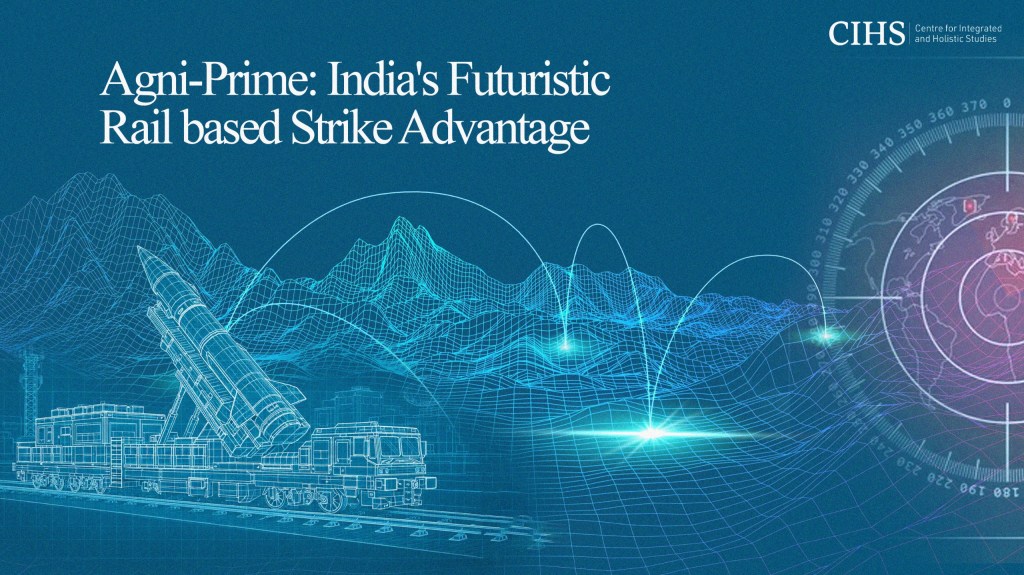
After the flight, the official readout set the tone. The launch was described as a “textbook launch,” with tracking by multiple ground stations. The statement also signalled what the test was meant to unlock. Success would enable the induction of rail-based systems into service. The most telling lines focused on wartime design. The launcher was described as self-sustained, with independent launch features, advanced communications, and protection mechanisms. This was not showcase language. This was readiness language for a battlefield where minutes decide advantage.
Why rails, and why now? Because the contest is increasingly about the kill chain: find, fix, track, target, engage, assess. In a region where warning timelines can be short and intelligence collection relentless, even commercial imagery compresses uncertainty. Mobility is the oldest counter-measure and rail mobility is mobility with mass. A rail-based launcher can reposition across long distances with less logistical drag than heavy road convoys, and it can do so while blending into everyday freight and passenger traffic.
The global contrast is instructive. Rail-mobile missiles are not new in theory; they are rare in practice because they demand heavy engineering, a resilient rail grid, and peacetime discipline to keep strategic movement invisible inside civilian patterns. Cold War basing debates showed why major powers flirted with rail mobility: it multiplies potential launch areas and complicates counterforce targeting. India is not inventing the logic; it is applying it to a harsher surveillance environment where persistent ISR is cheaper, faster, and more widely available than ever.
India’s unique advantage is structural. Its railways are not a niche logistics channel; they are infrastructure at continental scale. Reporting in 2025 put the network at roughly 69,800 route-kilometres, with over 99% electrification achieved by mid-2025 and full electrification targeted ahead of March 2026. That density creates a military benefit that is easy to miss. A strategic launcher can move through yards, loops, sidings, tunnels, and varied corridors without advertising a distinct “military convoy signature” that analysts can learn and exploit.
This is why “short reaction time” and “reduced visibility” are operational claims, not slogans. Capability is measured in minutes: how quickly a system can disperse, receive authenticated orders, appear briefly, and execute. Rail basing shortens long-haul repositioning and reduces the signature of repeated heavy-vehicle movement that can be profiled over time. For an adversary, the challenge is not just spotting a launcher; it is proving, with confidence, where it will be when it matters. Rail mobility attacks that confidence.
Rail mobility also aligns with India’s deterrence posture. Under credible minimum deterrence, India does not need symmetrical numbers; it needs survivable capability. Survivable forces reduce incentives for early escalation because they keep retaliation credible even under pressure. Mobility, therefore, becomes stabilising: it discourages any adversary belief that a first strike could be clean, decisive, or cost-free.
But rail mobility is not magic. Tracks create chokepoints; bridges, tunnels, critical junctions that can be targeted by sabotage or precision strike. Command links can be attacked through cyber and electronic means. The answer is not to romanticise rail basing; it is to treat it as a system-of-systems problem: route redundancy, hardened holding areas, layered security, counter-sabotage forces, encrypted resilient communications, and strict discipline. Even the best launcher is only as survivable as its command-and-control and security architecture.
There is an India-vision lesson beyond missiles. Great powers don’t just buy deterrence, they industrialise it, converting national scale into military leverage. India’s rail grid is one of the few on earth large enough to turn mobility into concealment, and concealment into capability. Rarer still is the combination India is now demonstrating: native missile engineering, a rail ecosystem dense enough to disappear inside, and a command architecture capable of integrating a new basing mode without broadcasting repeatable patterns.
The most revealing phrase is the least dramatic reduced visibility. In deterrence, ambiguity is not confusion; it is deliberate uncertainty imposed on an adversary’s targeting cycle. If an opponent cannot be sure where the launcher is, they cannot be sure they can neutralise it and if they cannot be sure, they must plan for retaliation. That is the quiet mechanics of stability. Agni-Prime, India’s futuristic rail-based strike advantage, is therefore more than a new launcher configuration. It is India converting infrastructure into capability, turning mobility into second-strike assurance, and using geography and scale to harden deterrence through operational unpredictability.
(The author is an international criminal lawyer and director of research at New Delhi based think tank Centre for Integrated and Holistic Studies (CIHS).