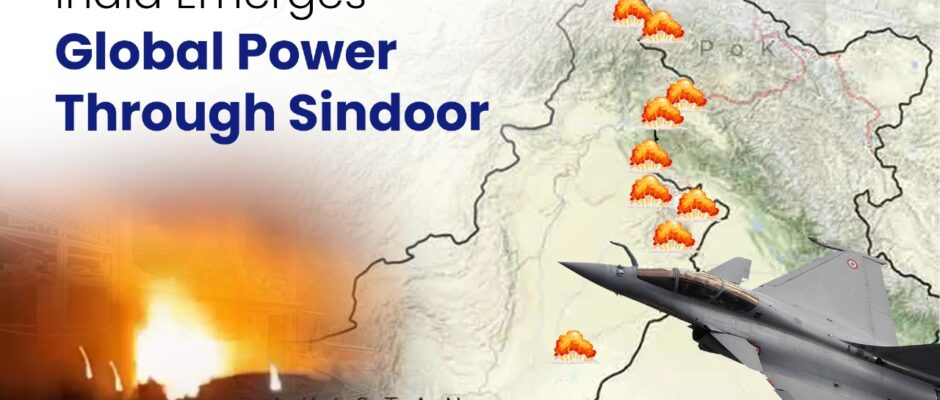
India Emerges Global Power Through Sindoor
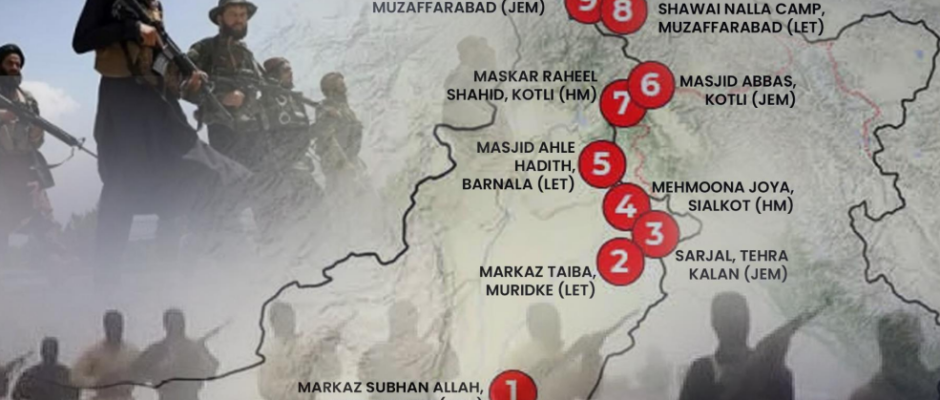
Biggest losers were Pakistan, Turkey & China that sided with the terror state. Bharat came thumbs up, foreign media cut sorry figure. N. C. Bipindra After India’s Operation Sindoor on Pakistan and its terror hubs to avenge Pahalgam terror victims, the overwhelming assessment of global strategic affairs community, military experts and international media is that New Delhi has had a decisive victory over Islamabad. As India began its precision military strikes on nine terror infrastructure sites inside Pakistan and Pakistan-occupied Kashmir, initially global media and think-tanks went overboard to declare an Indian defeat. Their claims were based on unverified Pakistan social media handles’ propaganda that Islamabad was successful in shooting down the Indian Air Force fighter jets. But these claims turned out to be untrue as Operation Sindoor progressed over four days during May 7 – 10, 2025. Now, a post-operation diagnosis has placed their trust in the Indian military declarations that India indeed struck specific targets based on undisputable pieces of evidence provided by Indian establishment. Pakistan, on the other hand, has failed miserably to provide any proof – technical data, satellite images, or otherwise – to back its claims. The New York Times had to grudgingly acknowledge the superiority of the Indian military operations in a piece written on May 14, 2025. Many international media outlets have been running interviews with military experts and analysts to back Indian assertions that they struck at precise locations, resulting in over 100 casualties among the Pakistanis. They have also shown satellite images provided by the Indian government and other international space technology firms to back their judgment on Operation Sindoor. India had struck at nine terror sites inside Pakistan and their occupied territories, apart from taking out 11 military infrastructure sites, including air bases, their runways, hangars, ammunition dumps, and air defence assets in the four-day military operations. Pakistan’s major reliance on Chinese military equipment has proved to be a disaster. Pakistan has been unable to back its claims of shooting down five Indian combat aircraft or bombarding Adampur air base, or even taking out Indian military assets such as the S-400 air defence system. This has resulted in the international community and media backing down on their initial claims, most of which was unnamed sources traced back to unverified social media posts. In the fog of war, news is a casualty. The fragmentation of news is a strategic victory. Untruths become the weapon of mass destruction. News becomes an instrument of war itself. As India woke up to the merciless killing of 26 innocent civilians at Pahalgam in Jammu and Kashmir on 22 April 2025, the media world saw an emotionally weak nation unable to bear the loss. There were no words of solace, no newsprint to waste on sympathy. There was an unspoken rejoicing. What a harsh domain the global media had become! As India responded with military strike on 7 May 2025 on nine terror camps deep inside Pakistan and in Pakistan-occupied Kashmir, the Western media was unable to bear the emergence of a New India that had zero tolerance for terror. What followed was the unleashing of untruths and half-truths that beat their misplaced standards of post-truth. Brandon J. Weichert, a so-called national security editor for the American platform National Interest, rushed in on May 8, 2025, to claim that Pakistanis had won the battle with India during the latter’s Operation Sindoor. It hadn’t even been 24 hours since the Indian military operations had begun, and Brandon jumped into deliver his verdict. Operation Sindoor’s military campaign went on for three more days. Post the cessation of military operations by India, Brandon has yet to revise his assessment or claims. So much for his ethics and credibility! His first article was tweeted by Indian-origin Hotmail founder Sabeer Bhatia, who too is unrepentant on peddling Pakistan propaganda. The Pakistani line was followed by Chinese official state media such as the Global Times and China Daily, and their claims were countered by the Indian embassy in Beijing and by the Indian state-run Press Information Bureau’s Fact Check divisions. China’s concerns were real. Its entire arms export market was in line of fire. And probably this was the first time that Chinese arms were being tested in a real battle with an archrival in India. Lest we forget, China was in an eyeball-to-eyeball military confrontation with India till about six months ago in India’s Ladakh region, yet there were no real military battles that took place between them to force the use of heavier weapons. Under Operation Sindoor, India had ramped up on the escalation ladder by first targeting the terror infrastructure inside Pakistan, then shifting its strategic objective to take out Pakistani military assets. India had changed its warfare doctrine vis-à-vis terror groups supported, trained, armed, and funded by Pakistan forever. Indian Prime Minister Modi detailed New India’s approach to terror and their sponsors. India would follow a zero tolerance for terror strikes inside its territory. The nuclear war bogey would not threaten India from going after terror groups and their sponsors, thereby calling the nuclear weapons threshold bluff. And India would consider every terror attack on its citizens as an act of war, meaning Pakistan would face the Indian military might and fury in case another terror strike happened. The nuclear bluff from Pakistan was amplified by the Americans when President Donald Trump and Secretary of State Marco Rubio claimed they had some alarming intelligence to intervene, thereby implying that a nuclear war between India and Pakistan was in the offing. India also indicated through Prime Minister Modi and the Ministry of External Affairs that they were not buying what the Americans were peddling. India also took a strong, long-term view of its qualms with Pakistan and its self-interest, by keeping the 1960 Indus Water Treaty in abeyance even after the cessation of military operations. This, again, is a strategically important position, as India has for years now wanted to renegotiate the treaty to provide its citizens the