
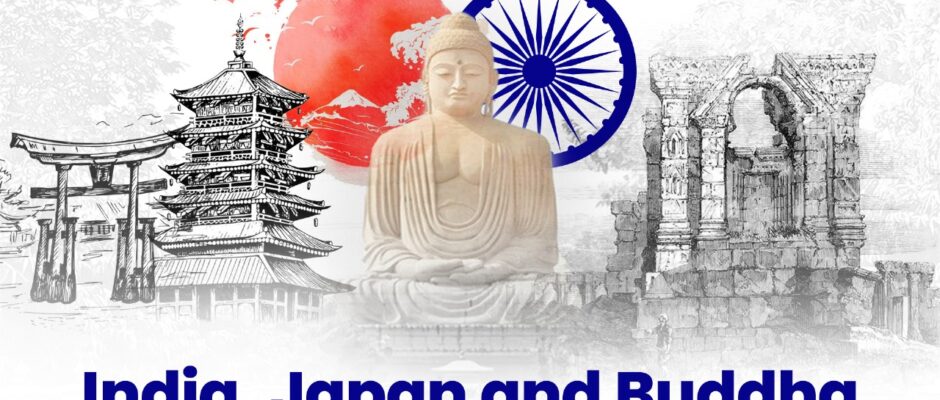
India, Japan, and Buddha
Dr. Jay Prakash Yadav Japan’s National Day embodies a legacy shaped by cultural wisdom and strategic foresight. Since Buddhism’s arrival from India in 552 AD, Japan has integrated its principles into governance. The history of cultural friendship between India and Japan dates to AD 552, the time when Japan was introduced to Buddhism. It was the time when Japan began to drink from the Indian spring of culture, sharing the Buddhist ideals of wisdom and compassion, faith and sacrifice, purity and enlightenment. India resulted in ushering in of a new era. Since then, Buddhism has remained the core and culmination of our friendship and will continue for generations to come. Japan drew its first constitution based on the Buddhist principles of Panchasila, Triratna- Buddha, Dharma and Sangha thus gave a humanized face to the administrative system in Japan. India and Japan have a unique relationship devoid of ideological, cultural, or geographical disagreements. It is distinct and exudes warmth from giving deeds and feelings of support for one another in difficult times. Japanese culture and thinking have been influenced by Indian culture, which has been filtered through Buddhism. This is precisely why Japanese people feel very close to India. A global vision of peace, security, and shared prosperity founded on sustainable development is now shared by Japan and India. The foundation of the two nations’ international cooperation is their shared democratic principles and dedication to pluralism, human rights, open society, and the rule of law. A wide convergence of India and Japan’s long-term political, economic, and strategic interests, aspirations, objectives, and concerns can be seen in their worldwide relationship. Japan and India see each other as partners who can and should respond to regional and global issues in a way that is consistent with their global cooperation. Thus, India’s strength, prosperity, and vibrancy are beneficial to Japan, and vice versa. It has been determined to strengthen the strategic focus of Japan-India’s global collaboration in light of the given circumstances and the state of the world. With a shared interest in and complementary roles in furthering global peace and equitable development as well as the security, stability, and prosperity of Asia, India and Japan are peace partners. In April 2005, during the then-Japanese Prime Minister Junichiro Koizumi’s visit, it was decided that the two nations would deepen their cooperation and work toward a comprehensive and all-encompassing development of their bilateral relations, with a specific and pressing emphasis on bolstering economic ties by making the most of their economies’ potential and current complementarities. It was determined that both nations will work to establish stronger communication and cooperation in order to safeguard peace, stability, and prosperity in Asia; advance democracy and development; and investigate a new framework for tighter regional cooperation in Asia. Taking advantage of and expanding upon existing strategic convergences, two nations also decided to increase collaboration in a variety of fields, including energy, disarmament, non-proliferation, security, and the environment. In the context of globalization and the growing concern over the use of military power for achieving foreign policy objectives, the importance of soft power has increased considerably, and Buddhism offers many advantages. Buddhism has international appeal and is highly conducive to spreading among all nations, cultures, and civilizations because of its core teachings, which include equality, non-violence, and its dialogical approach. Furthermore, there is no more effective soft power tool for Asian nations that share a Buddhist spirituality. Buddhism has played a significant role in Japanese culture and religion for over 1500 years, despite its foreign appearance. It is currently Japan’s soft power diplomacy’s most enduring tenet. Through several private and government agencies, Japan has been from time to time at the forefront in restoring the Buddhist relics, developing the major Buddhist pilgrim sites in various countries including India. Japan has thus rendered a great service to Buddhism and the land of its birth by rediscovering, reclaiming, and keeping alive the ‘wonder that was India. India has now woken up and is using Buddhism as the focal point of its soft-power campaign throughout Asia to highlight its strong Buddhist credentials. During the past one-decade, Indian policy-makers are making conscious efforts to utilize its allure for fostering deeper engagement with Asian countries – especially in the east and southeast, as part of its “Act East” policy. This involves not just sprucing up and showcasing Buddhist sacred sites and monuments, but also establishing people-to-people contacts and promoting cultural exchanges via tourism. (Author is Assistant professor at Dr. B.R. Ambedkar University of social sciences, Mhow, Madhya Pradesh and Scholar of Buddhist Studies.)