
By N. C. Bipindra
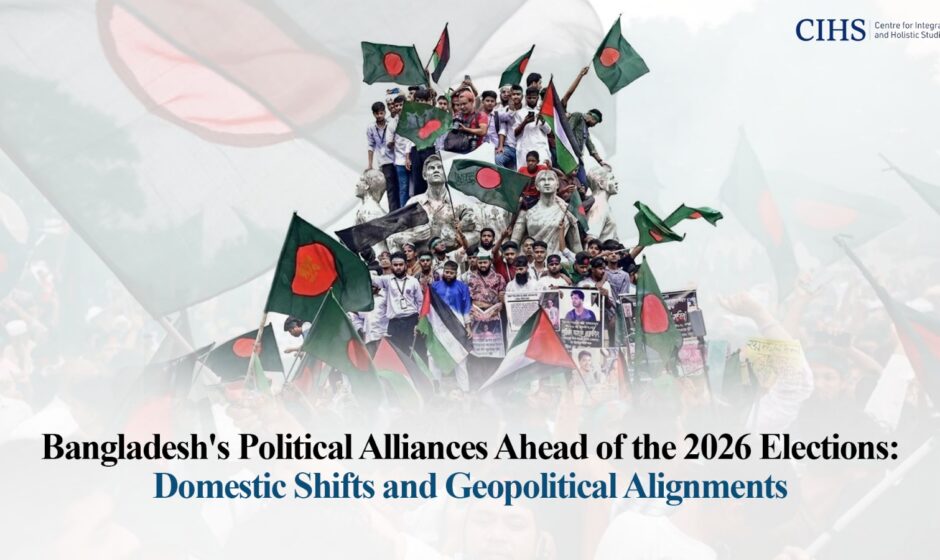
As Bangladesh moves toward the general elections scheduled for February 2026, the country is experiencing its most far-reaching political realignment in decades.
The collapse of Sheikh Hasina’s long-entrenched Awami League dominance following the 2024 mass uprising has dismantled the familiar two-party framework and given rise to a fragmented, competitive political arena.
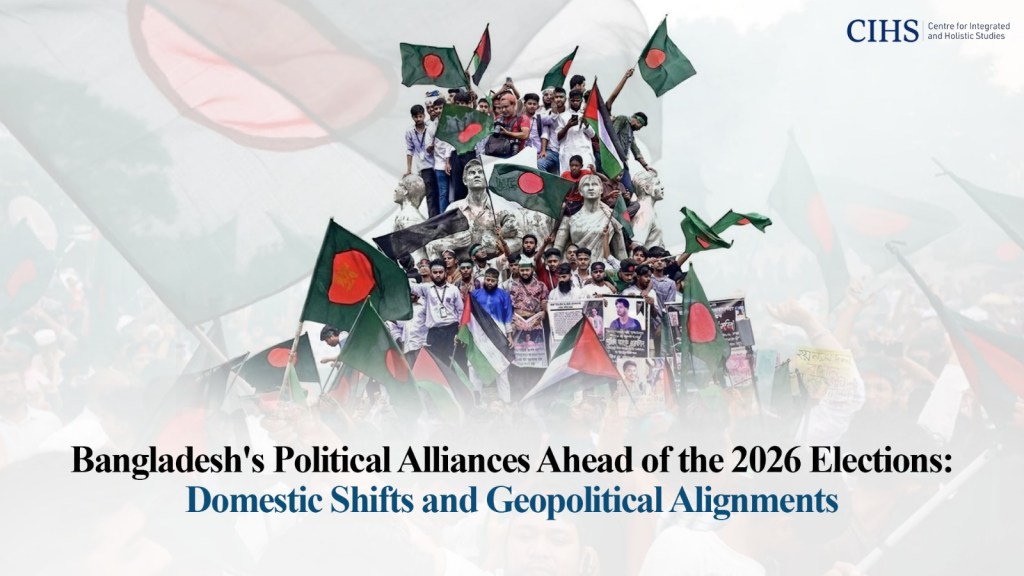
New coalitions, revived Islamist forces and youth-driven political platforms are all vying for space, and their manoeuvring is unfolding amid intensifying regional and global interest.
For India, China, the United States and Pakistan, the choices Bangladeshi voters and parties make in 2026 will shape not only domestic governance but also Dhaka’s strategic orientation in South Asia and the wider Indo-Pacific.
From Awami League Dominance to Political Fragmentation
For more than a decade, Bangladesh’s political and foreign policy trajectory was closely associated with Sheikh Hasina’s Awami League. Domestically, the party presided over a strong centralised system that delivered economic growth while constricting political competition.
Internationally, it cultivated a close strategic partnership with India, maintained extensive economic and infrastructure engagement with China and managed an increasingly strained relationship with the United States over issues of democracy, elections and human rights.
The upheaval of 2024 abruptly ended this equilibrium. The interim administration under Muhammad Yunus pledged institutional reform and credible elections, but it also left the Awami League politically marginalised, creating a vacuum that rival forces are now racing to fill.
BNP: Strategic Balancer with a Nationalist Tilt
In this transformed landscape, the Bangladesh Nationalist Party (BNP) has emerged as the most significant electoral contender. Long the principal opposition to the Awami League, BNP now sees itself as the natural governing alternative in a post-Hasina order.
Its campaign narrative centres on restoring democratic norms, recalibrating economic policy, and reasserting civilian political authority.
The death of party chairperson Khaleda Zia in December 2025 has accelerated a generational shift within the BNP, with her son Tarique Rahman assuming a central leadership role and directing alliance-building efforts ahead of the polls.
This transition has infused the party with renewed urgency but also heightened scrutiny of its internal cohesion and strategic direction.
Geopolitically, a BNP-led government would likely pursue a more balanced and less India-centric foreign policy than the Awami League.
While ties with New Delhi would remain important, BNP has historically been more cautious, sometimes sceptical, of India’s influence and would seek a relationship framed more explicitly around reciprocity and sovereignty.
At the same time, BNP is open to deepening economic engagement with China, viewing Beijing primarily as a source of investment and infrastructure rather than an ideological partner.
Relations with the United States are expected to improve relative to the later Awami League years, as Washington sees BNP as more receptive to competitive politics, though US support would remain contingent on credible elections and limits on Islamist influence.
Any warming of ties with Pakistan under a BNP government would likely be symbolic rather than transformative, constrained by historical sensitivities and limited economic incentives.
Islamist Bloc: Ideological Identity, Strategic Ambiguity
Alongside BNP’s resurgence, the return of Islamist politics has added a new layer of complexity to the electoral contest. The reinstatement of Jamaat-e-Islami has allowed it to rebuild an Islamist-leaning bloc drawing on conservative rural constituencies and religious networks.
Although Jamaat is unlikely to dominate nationally, it is well-positioned to influence outcomes in a fragmented parliament. Its re-entry into mainstream politics has unsettled secular and centrist forces, raising questions about Bangladesh’s ideological trajectory after years of enforced secularism under the Awami League.
From a geopolitical perspective, Jamaat’s participation is viewed with unease by both India and the United States. New Delhi associates Islamist political mobilisation with potential risks to border security and counter-extremism cooperation, while Washington remains wary of Jamaat’s ideological orientation and historical baggage.
Pakistan, by contrast, sees a degree of ideological affinity in Jamaat’s worldview, though this does not automatically translate into strategic alignment.
China has taken a more pragmatic stance, showing little concern for Jamaat’s ideology so long as political stability is maintained and economic engagements remain intact.
In this sense, Islamist influence complicates Bangladesh’s external relationships without clearly anchoring the country to any single power.
National Citizen Party (NCP): Reformist Politics, Geopolitical Ambiguity
Another significant player in the evolving political landscape is the National Citizen Party, a youth-led formation that emerged from the 2024 protest movement.
The NCP articulates a reformist agenda centred on institutional accountability, anti-corruption measures and generational change in politics. Its rise reflects widespread public fatigue with dynastic politics and entrenched elites.
However, the party’s limited grassroots organisation and inexperience have constrained its electoral prospects, pushing it toward alliance calculations that have sparked internal divisions, particularly over potential cooperation with Islamist groups.
Internationally, NCP’s discourse resonates most strongly with Western actors, especially the United States, which views its emphasis on transparency and civic rights as aligned with democratic norms.
The party has not articulated a clear or consistent stance toward India or China, reflecting both its novelty and its focus on domestic reform rather than foreign policy.
Over the longer term, NCP represents a potential new political elite that could tilt Bangladesh toward stronger engagement with Western institutions, but in the immediate electoral cycle, its influence is likely to be indirect, mediated through alliances.
Awami League Remnant: Pro-India, Diminished but Not Irrelevant
Although the Awami League has been largely sidelined, its residual networks within the bureaucracy, business community and local governance structures continue to matter.
Any partial rehabilitation of the party would be welcomed in New Delhi, which still regards the Awami League as its most reliable partner in Bangladesh.
However, strained relations with the United States and deep hostility toward Pakistan would remain defining features of an Awami League foreign policy orientation, limiting its room for manoeuvre even if it regains political relevance.
Democracy, Stability, and Strategic Competition
For the United States, 2026 election represents a test of process rather than personalities. Washington’s primary concerns revolve around electoral credibility, political pluralism and the containment of violent extremism.
A BNP-led or broadly technocratic coalition would be viewed favourably if it delivers a legitimate mandate, while heavy reliance on Islamist partners would complicate engagement.
China, by contrast, stands out as the most adaptable external actor. Beijing has cultivated ties across Bangladesh’s political spectrum and is likely to expand its influence in any scenario marked by coalition politics and fragmented authority.
Ultimately, February 2026 elections are unlikely to produce a decisive or ideologically uniform outcome. Instead, they are set to yield a coalition equilibrium that reflects Bangladesh’s internal diversity and external pressures.
The configuration that emerges will shape how Dhaka balances its relations with India, China, the United States and Pakistan, and whether it leans toward strategic autonomy, renewed alignment or pragmatic hedging.
In a region increasingly defined by geopolitical competition, Bangladesh’s domestic alliances are poised to have consequences far beyond its borders.
(Author is Chairman, Law and Society Alliance, a New Delhi-based think tank, and guest columnist with CIHS)