

R K Raina
India’s engagement with the world has never been guided solely by strategic calculations or economic interests. For millennia, the country’s outlook toward humanity has been shaped by a deeper civilisational ethic Sharanagata Rakshanam, the sacred duty to protect those who seek refuge. Rooted in the philosophy of Vasudhaiva Kutumbakam, the world is one family, this principle has repeatedly guided India’s actions across history.
India’s recent humanitarian gesture toward the Iranian naval vessel reflects the principle that offering protection in times of distress transcends political differences. It demonstrates that India’s approach to international engagement remains rooted in compassion, restraint, and moral responsibility.
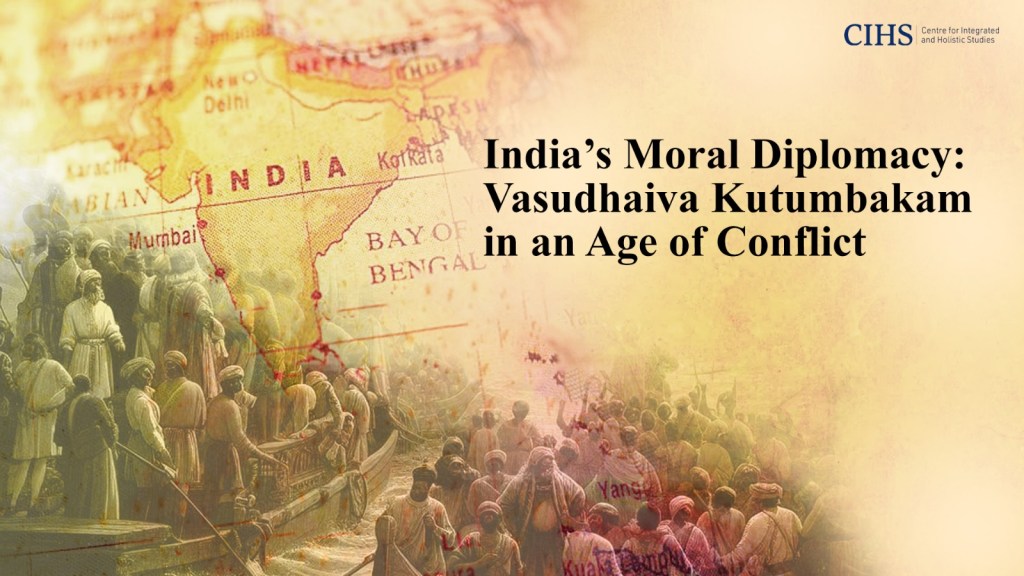
Leadership Anchored in Civilisational Values
In recent years, India’s leadership has increasingly emphasised the Bharatiya ancient civilisational ethos as a guiding principle of its global engagement. Concepts such as Vasudhaiva Kutumbakam, prominently articulated during India’s global diplomatic initiatives, reflect the continuity of this worldview.
By reaffirming these values in practice, the present government has highlighted that India’s foreign policy cannot be separated from its cultural and civilisational foundations. Actions rooted in humanitarian responsibility reinforce India’s credibility as a nation that combines strategic strength with moral conviction.
Rather than acting as a power seeking dominance, India has often positioned itself as a bridge-builder, encouraging dialogue and stability while maintaining a high moral ground.
At a time when conflicts and geopolitical rivalries are destabilising many regions, India’s civilisational values provide a moral compass that continues to shape its foreign policy and humanitarian responses. The recent decision to provide shelter to an Iranian naval vessel in Indian coastal waters during heightened regional tensions reflects not merely a diplomatic gesture but a continuation of a long-standing moral tradition.
A Tradition Older Than the State
India’s civilisational memory is filled with examples that emphasise the protection of those who seek refuge. Historical texts and folklore highlight that safeguarding a person who comes under one’s protection is a sacred duty.
One of the most powerful illustrations of this ethos is the legend of King Shibi, who chose to sacrifice his own flesh to save a dove that had sought refuge from a pursuing hawk. The story symbolizes a moral ideal deeply embedded in Indian consciousness, the obligation of the protector toward the protected.
This civilisational ethos later translated into real historical practice. Over centuries, India became a sanctuary for communities fleeing persecution and displacement.
The Syrian Christians, escaping religious persecution in the Middle East, arrived on the Malabar Coast between the first and fourth centuries and were welcomed by local rulers. They were granted land, social recognition, and the freedom to practice their faith while becoming part of the broader cultural fabric of India.
Similarly, Jewish communities such as the Cochin Jews and the Bene Israel lived in India for centuries without facing the systemic persecution that marked their experience in many other parts of the world. Historical documents, including the copper plate grants of the Chera rulers, gave them autonomy and the freedom to maintain their religious institutions.
The arrival of the Parsis in the eighth century offers another powerful example. Fleeing the Islamic conquest of Persia, they sought refuge on the western coast of India. According to the well-known narrative of Qissa-i-Sanjan, the local ruler initially indicated that his kingdom was already full. The Parsi priest responded by adding sugar to a bowl of milk, symbolising that his community would blend peacefully into society while enriching it. The Parsis were welcomed and allowed to preserve their faith while adopting aspects of the local culture, eventually becoming one of India’s most dynamic and respected communities.
These examples reflect a distinctive Indian approach coexistence with identity, rather than forced assimilation.
Modern India and the Continuity of Civilisational Values
Independent India carried forward this civilisational legacy into its modern statecraft. India has repeatedly demonstrated humanitarian leadership during major crises.
During World War II, Maharaja Digvijaysinhji Jadeja of Nawanagar opened his kingdom to more than a thousand Polish children who had escaped the devastation of Europe. He treated them not as refugees but as members of his own family, famously telling them that they were no longer orphans.
In 1959, when the 14th Dalai Lama and thousands of Tibetans fled Tibet following the Chinese crackdown, India granted them asylum and enabled the Tibetan community to rebuild its cultural and religious life in exile. Today, the Tibetan presence in India stands as one of the most remarkable examples of cultural preservation in exile.
Similarly, during the 1971 Bangladesh crisis, India opened its borders to nearly ten million refugees fleeing violence in East Pakistan. Despite severe economic constraints at the time, India provided shelter, food, and humanitarian assistance on a massive scale.
These actions were not merely political decisions but expressions of India’s enduring civilisational ethos of Karuna compassion.
India’s Civilisational Responsibility in Today’s Conflicts
In today’s volatile geopolitical environment, particularly amid tensions involving the United States, Israel, and Iran, India’s role assumes special significance. The region stretching from the Middle East to South Asia has deep historical and cultural connections with India. Instability in this region affects not only geopolitical alignments but also shared civilisational linkages built over centuries.
A Bridge Between Civilisations
India’s engagement with the Middle East and neighbouring regions has historically been rooted in cultural exchange, trade, and spiritual interaction rather than confrontation. In moments of crisis, this civilisational perspective allows India to occupy a unique moral space one that emphasizes dialogue, stability, and the protection of human life.
The expectation from India today is therefore not only strategic but also moral. The region looks toward India as a country capable of combining strategic prudence with civilisational wisdom.
A Message to the World
In a world often driven by narrow geopolitical interests, India’s civilisational philosophy offers a different vision one where compassion, protection, and moral responsibility remain central to international conduct.
The ancient dictum “Udaar Charitanam Tu Vasudhaiva Kutumbakam” reminds us that for the noble-minded, the entire world is one family. India’s long history of sheltering the persecuted and supporting the vulnerable demonstrates that this is not merely a philosophical ideal but a living tradition.
At a time when global tensions threaten regional stability, India’s commitment to its civilisational principles offers hope not only to those seeking protection but also to a world searching for a more humane approach to international relations.
(Author is a former diplomat and policy commentator focused on South Asian geopolitics, Tibet and India’s neighbourhood. He contributes to leading think tanks and policy platforms on regional and civilisational issues.)