

By Rahul PAWA | X – @imrahulpawa
The war began at 02:14 Tehran time on 28 February. Operation Roaring Lion and Operation Epic Fury decapitated Iran’s leadership, gutted its air defence architecture, and announced to the world that the post-1979 regional order was finished. Washington and Tel Aviv pulled the trigger. What followed was not what either capital planned for. Iran did not fold. A regime collapse as anticipated never materialised.
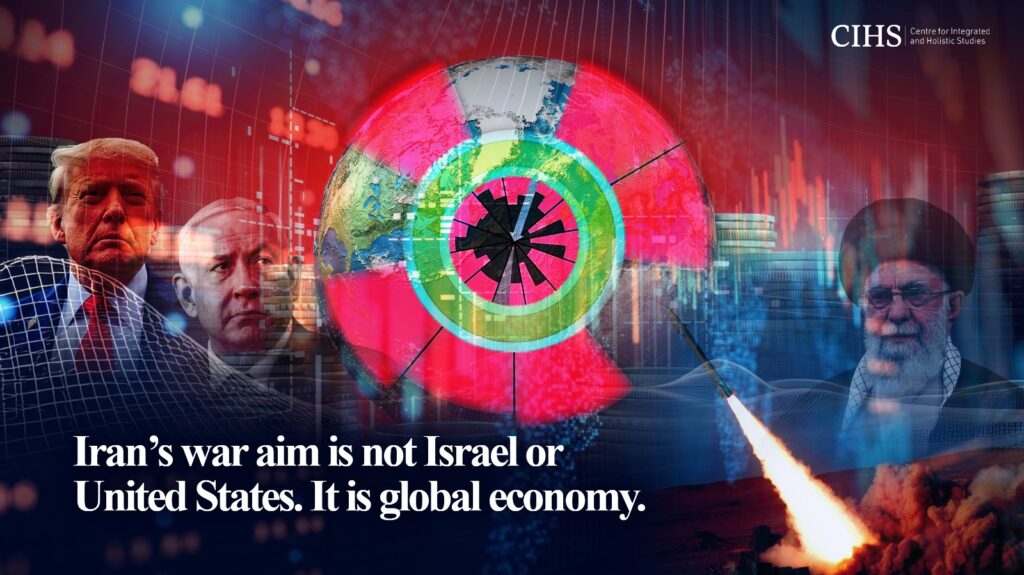
In six days, the Islamic Republic of Iran has fired over 400 ballistic missiles and close to 1,000 drones across the Persian Gulf. The targets tell the story: Dubai International Airport, Jebel Ali port, Ras Tanura refinery, Hamad International in Doha, the US Fifth Fleet headquarters in Bahrain. Israel, by comparison, has absorbed a fraction of that volume. Tehran has made its calculus explicit. This is not a war Iran intends to fight against Israel or US. It is a war Iran intends to fight through the Gulf.
This is not improvisation. It is strategy. Military planners have long understood doctrines where targeting civilian infrastructure to maximise chaos, delegitimise adversaries, and accelerate international pressure for a ceasefire.
Iran has now adopted the same logic. Airports, ports, oil facilities, and luxury hotels are not military objectives in the conventional sense. They are the load-bearing pillars of Gulf economic identity. Iran is not trying to destroy them. It is making them ungovernable under fire, forcing every airline, insurer, and sovereign wealth fund to recalculate their exposure.
The Strait of Hormuz closure clinches the argument. Twenty per cent of global oil and gas passes through that chokepoint. It is now shut. Oil markets have spiked. Bond yields are moving. Iran does not need to win a single air engagement to prosecute this strategy. It needs only to sustain pressure long enough for the global economic cost to exceed Washington’s political appetite for the campaign.
The GCC’s Trilemma
The Gulf states spent three years doing what may seem “everything right”. Qatar mediated. Oman back-channelled. Riyadh quietly denied offensive basing rights to US and Israeli aircraft. These were calculated risks taken at real political cost. None of it mattered.
Iran has now struck every GCC member state within a single operational sequence. This is historically unprecedented. The Gulf’s core brand proposition, stability as a geopolitical product, has been punctured. The GCC faces a trilemma. They cannot retaliate alongside Israel without catastrophic domestic legitimacy costs; the Palestinian cause remains the organising moral framework for Arab public opinion, and any ruler seen fighting Tehran on Tel Aviv’s behalf risks street-level pressure that authoritarian stability cannot easily absorb. They cannot remain passive indefinitely as their cities burn. And they cannot negotiate from visible weakness without undermining the deterrent architecture they have spent hundreds of billions constructing.
Interception is holding for now. But the economics of missile defence are brutally asymmetric. Iran’s Shahed-class drones and short-range ballistic missiles cost a fraction of the interceptors being expended against them. Analysts assess Iran can sustain the current rate of fire for approximately one month. The stockpile problem is real and worsening daily.
The Decentralisation Problem
Iran’s military planners anticipated regime decapitation. The IRGC has shifted to a mosaic defence posture, dispersed launch cells, mobile platforms, decentralised command. B-2 strikes on fixed facilities cannot suppress a doctrine built on mobility and redundancy. CENTCOM claims 17 Iranian naval vessels destroyed and Iran’s conventional air force eliminated. What it has not suppressed is the IRGC’s distributed short-range strike capacity, because that capacity was designed precisely to survive this campaign.
Killing Khamenei removed the supreme decision-maker. It did not remove institutional will. Larijani’s Interim Leadership Council, announced on 1 March, confirmed what analysts feared: the succession mechanism is functioning and signalling continuity, not collapse.
Real Target Was Always the Global Economy
Strip away the operational detail and Iran’s strategy reduces to a single proposition. It cannot defeat Israel or the United States militarily. What it can do is make the cost of this war prohibitive for everyone else.
By striking the Gulf rather than concentrating on Israel or US targets, Tehran has taken the war to the one geography where economic contagion is immediate and globally felt. Dubai going dark sends a signal that no missile hitting Tel Aviv can replicate.
Gulf states are not Iran’s enemy. They are Iran’s instrument of leverage. Tehran is squeezing them to make their pain loud enough to force Washington’s hand. Trump’s contradictory signals on 1 March — simultaneously announcing Iranian negotiation outreach and claiming Iran has no navy remaining — suggest the economic pressure is already registering at the White House.
GCC understands the game Iran is playing. The question is whether they can hold their nerve, sustain their defences, and resist being drawn into a military response that would finally give Iran the regional war framing it needs.
That answer will determine not just this war’s outcome, but the shape of West Asia for a generation.
(Rahul Pawa is an international criminal lawyer and Director of Research at the Centre for Integrated and Holistic Studies, New Delhi.)