CIHS – Centre for Integrated and Holistic Studies

Date/Time:

Explainer: Jammu and Kashmir Sankalp Diwas

In aftermath of India’s independence and subsequent Partition of earstwhile British occupied India, Princely States were vested with the prerogative to decide their accession to either the dominion of India or Pakistan, contingent upon geographical coherence as per Indian Independence Act of 1947. This foundational principle was disrupted on the night of October 22/23, 1947, when Pakistani army along with its rallied tribal raiders initiated a forceful assault on the Princely State of Jammu & Kashmir. Subsequently, Maharaja Hari Singh formally acceded to the dominion of India on October 26, 1947, prompting deployment of the Indian army. Read More….

Read More

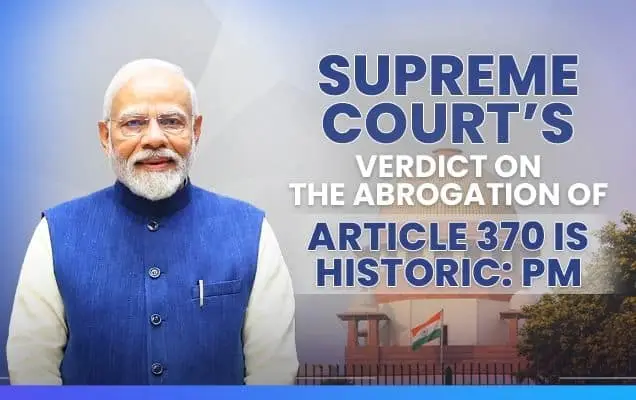
Supreme Court’s Verdict on the Amendment of Article 370 is Historic: PM

Narendra Modi The Prime Minister, Shri Narendra Modi said that the Supreme Court’s verdict on the abrogation of Article 370 is historic and constitutionally upholds the decision taken by the Parliament of India on 5th August 2019. Shri Modi also said that the Court, in its profound wisdom, has fortified the very essence of unity that we, as Indians, hold dear and cherish above all else. The Prime Minister posted on X; “Today’s Supreme Court verdict on the abrogation of Article 370 is historic and constitutionally upholds the decision taken by the Parliament of India on 5th August 2019; it is a resounding declaration of hope, progress and unity for our sisters and brothers in Jammu, Kashmir and Ladakh. The Court, in its profound wisdom, has fortified the very essence of unity that we, as Indians, hold dear and cherish above all else. I want to assure the resilient people of Jammu, Kashmir and Ladakh that our commitment to fulfilling your dreams remains unwavering. We are determined to ensure that the fruits of progress not only reach you but also extend their benefits to the most vulnerable and marginalised sections of our society who suffered due to Article 370. The verdict today is not just a legal judgment; it is a beacon of hope, a promise of a brighter future and a testament to our collective resolve to build a stronger, more united India. #NayaJammuKashmir” (Author is Prime Minister of India)

Read More

Naya Kashmir shines bright on global stage

Tourism, infrastructure development, rich cultural heritage, progress, inclusive growth, transformation & positive change defines ‘nature’s bowl’ Rahul Pawa The third G20 tourism working group meeting is currently underway in Srinagar, Jammu and Kashmir (J&K), capturing global attention as it showcases India’s rich cultural identity and vast tourism potential. This three-day event focuses on promoting sustainable and eco-friendly tourism, with the aim of driving economic growth, preserving cultural heritage, and fostering sustainable development in the region. Amidst the captivating sights of unprecedented development and delightful interaction between the people of Jammu and Kashmir and G20 delegates, certain entities and individuals persist in propagating an unfounded belief that J&K is engulfed in perpetual suffering. However, the reality on the ground reveals a different story. J&K is currently hosting its first grand international event since 2019 after it was designated a Union Territory (UT) following amendment to Article 370 of the Indian constitution. This amendment empowered residents of Jammu and Kashmir, as well as Ladakh, with the same rights enshrined in the Constitution of India and the benefits of central laws enjoyed by citizens across the country. Hosting of this historic international event by Jammu and Kashmir stands as testimony to region’s progress and newfound stability. It showcases the region’s intrinsic, inclusive, and vibrant nature, highlighting its rich cultural heritage, tourism potential, and commitment to sustainable development. As international delegates participate in this event, they witness firsthand the positive impact of the constitutional amendment, dispelling lingering misconceptions and emphasizing the region’s journey towards a more prosperous and harmonious future. Furthermore, this event goes beyond mere tourism promotion. It also places emphasis on creating employment opportunities, developing infrastructure, fostering interdepartmental coordination, and ensuring government’s accountability to the people of Kashmir. Through targeted initiatives and collaborations, the event aims to spur growth, thereby contributing to overall socio-economic progress of the region. The event places strong emphasis on infrastructure development, recognising its significance in facilitating seamless travel experiences, enhancing connectivity, and providing essential amenities for both tourists and residents. The focus is on building robust and sustainable infrastructure that supports the growth of the tourism industry while also benefiting the local communities. Additionally, the event seeks to foster interdepartmental coordination, recognising that effective collaboration among various government departments is essential for the successful implementation of policies and initiatives. By promoting synergy and communication between different entities, the event aims to streamline processes, enhance efficiency, and ensure the optimal utilisation of resources for the development of the tourism sector and related industries. Furthermore, the event underscores the importance of government accountability to the people of Kashmir. It aims to create a transparent and responsive governance framework, where the needs and aspirations of the local population are prioritised. Through open dialogue and consultations, the event seeks to ensure that the government remains accountable to its citizens, fostering trust and strengthening the bond between the authorities and the people they serve. Most importantly, this event goes above and beyond conventional tourism promotion by encompassing a multifaceted approach that reflects a holistic vision for the sustainable and inclusive development of Jammu and Kashmir. It aims to ensure that its people and communities thrive in a conducive environment, where their well-being and aspirations are at the forefront of the region’s growth and progress. Regrettably, there are individuals who persist in their unwillingness to acknowledge the positive transformations taking place in Jammu and Kashmir. However, their efforts are likely to falter when confronted with the prevailing reality on the ground. The G20 event in Kashmir, aptly named ‘Naya Kashmir’ (New Kashmir), stands as a powerful symbol that uplifts the spirits of the local population and sheds light on the remarkable progress achieved in the region. It serves as a testament to the unwavering resilience and determination of the people of Jammu and Kashmir, who have embraced progress and growth as a means to overcome the challenges posed by terrorism and pave the way for a more prosperous and harmonious future. The success of the G20 event in Kashmir extends beyond its ability to showcase the true essence of Jammu and Kashmir; it also lies in its capacity to dispel the unfounded beliefs and narratives perpetuated by a few. This event uplifts the spirits of the local population, instilling within them a profound sense of pride and optimism. Despite the persistence of challenges and the dissemination of misinformation by certain individuals, the G20 event in Kashmir stands as a shining example of the transformative power inherent in positive change. Ultimately, the G20 event in Kashmir serves not only as a celebration of India’s rich cultural identity and the immense tourism potential of the region, but also as a platform to showcase the indomitable spirit, resilience, and unwavering determination of the people of Jammu and Kashmir. It sends a resounding message that J&K is not a region condemned to perpetual suffering, but rather a land brimming with opportunities and possibilities waiting to be realised. (author is an international criminal lawyer and director of research at New Delhi based think tank Centre for Integrated and Holistic Studies)

Read More

Nature’s bowl rolls out red carpet

The G-20 meet may herald a new era for Jammu and Kashmir and bolster its engagement with the international community. Manoj Sinha Third G-20 tourism working group meeting being held in Srinagar over next two days will be a defining moment for Jammu and Kashmir. The multilateral G-20 meet will provide an occasion to host and engage with the international community and offer a window to the world to see this nature’s bowl and a land of opportunities through visiting G20 delegates’ experiences when they return to their respective countries. The mist around Jammu & Kashmir formed due to unrelenting peddling of misinformation will also settle down eventually. The G-20 meet will lend fresh energy and enthusiasm to work towards a new Jammu & Kashmir that is ancient in its wisdom, modern in growth, and rich in its diversities. Transcending history of Jammu & Kashmir demonstrates the unimaginable outcomes that visionary and committed leadership in conjunction with mass effort can deliver. Prime Minister Narendra Modi’s decision to select the Union Territory as venue for the crucial global meet ignoring opposition from some international quarters reflects a confidence change. Union Territory of Jammu & Kashmir, as far as I remember never hosted any multilateral meet of this sort in recent past. India, under leadership of Prime Minister Modi, has shown it’s willing to take a tough stand against interference by any foreign nation or nations in its domestic affairs. We want peace but not at the cost of our unity and integrity. I would not like to drag here futile attempts to manufacture a diplomatic row by a few. Still, the move to disrupt G-20 meeting does not surprise us. Acceptance of Srinagar as venue for meeting by G-20 countries – representing twenty of the biggest economies which together carry 75 per cent global trade, hold 80 per cent global GDP and represent 60 per cent of global population is a setback to adversaries. Jammu & Kashmir people are looking for development and their share in socio-economic transformation in the slowly enveloping Union Territory. Change in Jammu & Kashmir is irreversible. This is not only because we in the administration are committed to confronting untouched challenges and don’t shy away from out-of-the-box solutions for people’s welfare but also because the people have smelt aroma of functional democracy. They dread the mere thought of the past striking back. And that’s defining and motivating for us. Terrorists from across the border have lost local support. Strengthening of grassroots democracy through successful panchayat and urban local bodies elections and responsive delivery mechanism have nurtured hope for a sustained relationship between the people and the administration, which I think, is the harbinger of a new social order. Jammu & Kashmir now wears the crown of Incredible India. Tourism drives the economy that aggregates associated industries such as hospitality and brings jobs. It trickles into people’s earnings and improves their standards of living. Declaration of tourism in Jammu & Kashmir as an industry along with accompanying factors is attracting massive investment. After a long pause of almost four decades, we have revived relationship with Bollywood and launched a film policy in 2021 to attract more investment and to make union territory the most popular film shooting destination. Last year alone, more than 300 movies were filmed in the region which is a sign of peace and prosperity. Tourism contributed seven per cent to the region’s Gross Domestic Product last fiscal. About 18.8 million tourists visited Jammu & Kashmir last year and much of it is due to improved law and order situation and people-friendly policies. We partner with, rather than dictate to, people in tourism sector through our policy initiatives such as homestays and 300 new destinations to ensure that visitors go beyond age-old venues to explore the unexplored Elysian beauty that Jammu & Kashmir offers. In the process, more local communities get enriched and empowered. Prime Minister has reshaped the policy that enables all sections of society to actively participate in Jammu & Kashmir’s growth and gains are more equitably distributed to bring qualitative change in the life of people. The youth no longer finds destructive rhetoric attractive. Young men and women with big dreams are now more ambitious, more aware and working hard to realise their aspirations. Transparent and accountable governance has brought transformational change in the speed and scale of project execution. Our speed to complete the project has gone up by ten times. In 2018, 9229 projects were completed whereas 92,560 projects were completed in financial year 2022-23. In last four years, we have registered 770,000 new entrepreneurs through self-employment schemes which mean that around 527 young people started their entrepreneurial journey per day. These figures are impressive but they do not fully capture the quiet transformation that is taking place at the level of women-led enterprises in the villages. More than 600,000 women entrepreneurs, through self-help groups are reaching global scale in quality and output. Recruitment in government jobs is happening only on merit and through transparent ways to get rid of the culture of backdoor appointments that were the norm during previous regimes. Since 2019, more than 28,467 appointments have been made. Further, out of 12,000 vacancies identified in 2023, 6,000 are under process for referral. In a very short span of time, we are advancing towards building a digital society. We are offering more than 450 public services online. G-20 is a tribute to the people’s willingness to come out of the trap of violence engineered by an immediate neighbour. The G-20 meeting is also a symbol of resurgent India. (Author is Lieutenant Governor of Jammu and Kashmir. Views expressed are personal. This write up was first published in Hindustan Times)

Read More

Truth behind lies!

NYT breaks bread with terror supporters, spreads mischievous, malicious & fictitious propaganda on press freedom in Kashmir Zero tolerance to violence, subversion or terrorism has been the steadfast policy of Indian Government across her provinces including Union Territory of Kashmir which is non-negotiable. Past governments to an extent and the Narendra Modi-led regime in particular have implemented this policy in letter and spirit. Ignoring the sovereign right of a lawfully elected Government’s right to frame its policies towards terror, its handlers and supporters, The New York Times has provided its space to Anuradha Bhasin, executive editor of The Kashmir Times that worked in geometrically opposite ways. “Modi’s final assault on press freedom has begun” published as guest essay in opinion pages of The New York Times edition of March 8, 2023 is proof of this new found sweet heart ties between terror supporters and the American media establishment against India and her government. Bhasin, notorious for having peddled misinformation in the Kashmir valley lending support to subversives that were part of Pakistan’s K2 – Khalistan & Kashmir project – has the gumption to question Narendra Modi government and India’s commitment to press freedom. The New York Times seems to have fallen into the trap of anti-India forces campaigning globally to derail its famed growth and development story that’s beyond blemish. The Kashmir Times founder editor Ved Bhasin’s proclivity with terrorists supported, abetted and financed by Pakistan’s dirty tricks department, Security Establishment and ISI are known beyond doubt. Having supported terrorism and anti-India forces, today Anuradha Bhasin seems to be crying wolf on suppression of press freedom. If that was true, her write up that’s a figment of fertile imagination would not have been read, seen or viewed in India or elsewhere. Hence, her arguments are either flawed, erroneous or driving a pre-set agenda based narrative in the international media networks. The New York Times seems to have become a willing partner in this ‘fake-narrative’ push. In later part of her write up, Anuradha Bhasin admits to proliferation of media outlets in Kashmir. If repression were to be true, how do media flourish or expand in any part of the globe? Citing tax surveys on BBC to derive support to her argument again is laughable. Neither BBC’s operations have been restricted nor their reporting teams restricted. All that India stated was asking the British Broadcaster set up through an act of British Parliament to adhere to Indian rules and regulations. If press freedom was a threat, then how’s it that more than 300 active foreign and Indian scribes work for global media organizations? India has well established judicial system, policing and independent media apart from the executive as well as the democratic institutions that have defined the country’s governance structure in a federal format. First fallacy peddled by Anuradha Bhasin – who in person, family and her media empire benefited from the previous governments’ largesse – that Article 370 was abruptly withdrawn. Modi’s party, BJP election manifesto clearly outlined its policy of zero tolerance towards foreign funded terror groups of all hues and shades, their handlers and supporters. The elected government in 2014 went about to implement its agenda as people’s mandate that include abrogation of article 370. Intermittent internet shut downs is a common grouse of a few people in the Kashmir valley so much so the terror groups, their handlers and financing hands. Most of stone pelting, violence incidents have happened via the messaging apps generously used by Pakistani establishment. None can dispute the fact that internet connectivity improved and grassroots democratic process has begun to take shape ignoring violence, bids to subvert Kashmir and disintegrate the Kashmiri society. Making charges that Indian government forced judiciary to bend backwards or supressed press freedom has any basis or true.

Read More

Brief: Seven Exoduses and the Ethnic Cleansing of Kashmiri Hindus

In the late 1980s and early 90s, the Kashmir Valley was engulfed by terrorism aided and funded in the name of ‘Islam’ by Pakistan as part of its neferious K2 (Kashmir and Khalistan) policy by initiating ‘Operation Tupac’, which aspired to foster successionist movements in India. As a result, several radical Islamist factions, Pakistan-based terrorist organisations and their local Kashmiri sympathisers joined hands to nurture an Islamist separatist movement in Kashmir that would be both religious and political depending on convenience and timing. The campaign was hinged on its brutal aggression against Kashmir’s minority Kashmiri Hindus, who were considered infidels and labelled as Indian agents by Pakistan backed Islamists, terrorists and their sympathisers in the valley of Kashmir. In the years following, Pakistan-sponsored terrorists and their local collaborators organised a terror campaign of targeted killings, rape, threats, inflicted systematic damage and destruction of Hindu homes and places of worship. Faced with imminent threat and persecution by torture, crimes against humanity and systematic elimination of the minority community in Kashmir. Kashmiri Hindus were forced to flee their native homeland in the seventh mass exodus of Kashmiri Hindus from the valley of Kashmir.

Read More

Kashmiri Community in Fear and Insecurity

Decades ago, when terrorism engulfed the valley, Kashmiri Hindus, an indigenous ethnic-religious group in Kashmir-now a minority, were forced to leave their ancestral home. The growing Islamic extremism transformed rapidly into terrorism. Much of the weapons and trained terrorists poured in by neighbouring Islamic republic of Pakistan. They, along with other Kashmiri Muslims sympathisers called for murder, loot, rape, and abductions of native Kashmiri Hindus. Left with no choice but to save themselves, over 0.4 million Kashmiri Hindus migrated to different parts of the country. In such adversity and betrayal, Makhan Lal Bindroo, a Kashmiri Hindu pharmacist in Srinagar, chose to stay back and serve his homeland Kashmir. On Tuesday, however, he was paid for his service and trust by The Resistance Front (TRF). Terrorists of the Resistance Front (TRF) shot and murdered Makhan Lal Bindroo. TRF is a Lashkar-e-Taiba front organisation (LeT). LeT an international terrorist group designated by the United States and United nations which is backed and supported Pakistan. The trigger? He was a Hindu, a reminder of Kashmir’s indigenous non-Islamic history that the Islamists desperately want to erase. Seemingly inspired by the recent cleansing of Hindus and Sikhs in Afghanistan. TRF has began a gory repetition of the 90s massacre of Hindus in the valley. In sixteen days, eleven civilians, a majority of whom belong to the Hindu minority communities have been butchered in the Valley of Kashmir by Pakistan backed Islamic terrorists. In the recent spree of killings. Terrorists targeted Hindus, Sikhs and government employed muslims. In addition, non-locals workers a d wagers from the rest of the country, who have built and sustained Kashmir crisis after crisis were targeted. Evidence suggests that these organised killings are planned and organised by Pakistan backed terrorist groups, following the footprint of the 1990s genocide of Kashmiri Hindus. The revival of Kashmiriyat- Kashmir’s distinct pluralism- after recent sustainable development in Kashmir, has been a sore in the sight of Pakistan-sponsored Islamic terrorists in Kashmir. The roots of this planning lead to Pakistan as is evident from the series of events that replicate the 90s genocide. The day TRF’s Pakistan-sponsored terrorists killed Bindroo, two others were also killed, a poor Dalit street food hawker, Virender Paswan who was killed within an hour of Bindroo’s shooting for being a harmless non-Kashmiri, and a Muslim resident that terrorists killed because of suspected links to security forces. All these people were killed for not adhering to the terrorist ideology against Hindus. In fact, it did not stop there. Three days later, terrorists murdered two educationists: Supinder Kour- the Kashmiri Sikh principal at a school in Srinagar and Deepak Chand- the Kashmiri Hindu teacher at the same school. The terrorists singled them out from the staff, ordered the Muslims to go out and shot those two. If this isn’t ethnic cleansing and genocide, then what is, ask the minority communities in Kashmir. The terrorist attacks and killings have launched the minority community in Kashmir into a hysteria of fear and insecurity. Many have fled their homes overnight, in a horrifying repeat of events of the late 1990s. After the last great exodus of the Kashmiri Hindus in 1999, there are barely any Hindus left in the valley, many of whom were those who returned after government’s efforts to resettle them back in their homes. However, clearly, nothing has changed for Hindus and other minorities of Kashmir and it likely won’t as long as Pakistan-sponsored terrorism continues in the valley. There is no doubt that a large part of this renewed genocide of Hindus in the valley also stems from the international aid that is given to Pakistan that it pumps back into its terrorist operations in Kashmir. While India scrambles to take control of security in Kashmir, international community can step up and support by immediately sanctioning Pakistan so that another irreversible genocide of a minority doesn’t happen on our watch.

Read More
  • 1
  • 2