CIHS – Centre for Integrated and Holistic Studies

Date/Time:

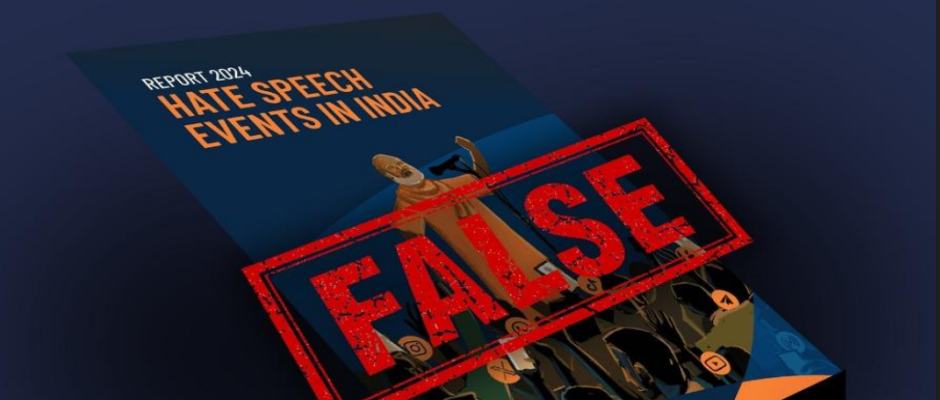
India Hate Lab’s Flawed Report Lacks Credence

India Hate Lab’s Flawed Report Lacks Credence

The report smacks of selective amnesia, prejudiced frameworks, overlooks rising crimes on Hindus, seeks to bring about divisiveness. India Hate Lab’s (IHL) 2024 report on Hate Speech Events claims that hate speech incidents increased significantly in the country and Hindu nationalist organizations, ruling Bharatiya Janata Party (BJP) were behind these crimes. A closer examination however throws up methodological flaws in the ‘agenda’ based study laced with prejudices, dubiousness of the publishing institute. The report’s inconsistent data collection, selective incident framing, turbulent agenda of IHL and its parent group, Center for the Study of Organized Hate (CSOH) have to fore.

Read More

Boys Play Big in Muddied Waters!

US, China with diverse agendas coupled with religious extremist forces in Islam and evangelists may shrink open space to operate for Bharat that has big stakes in Bangladesh K.A.Badarinath The big boys are at play. Bangladesh government under Nobel laureate Muhammad Yunus is bound to be pulled apart by both United States of America seeking to establish a military base in South Asia and Chinese Communist Party led by President Xi Jingping that’s seeking unquestioned dominance in Asia. Jamaat-e-Islami and Bangladesh National Party (BNP) led by Khalid Zia would play willing tools in the big boys power play with Pakistan reduced to a lackey of minor variety. There’s denying that Muslim Brotherhood that’s globally dreaded would complicate the equation with its Islamist – Jihadist agenda on Bharat’s Eastern frontiers. ‘Razakars’ would become handy frontline private army in the hands of jihadist Muslim leadership internationally. There have been reports that already these Razakars have taken over civic policing as an occupational army of zealots. Well, tasks for Bharat are cut out after Sheikh Hasina’s government fell last week, Awami League purged, safe exit to her provided in a swift deal and Army took reins in a coup. Though interim government headed by Yunus and a battery of over dozen advisors have taken charge, nothing seems to have changed on the ground while Army calls the shots. Bangladesh’s under-belly has several layers that must be understood before Bharat gets to the drawing board to establish a working relationship with the new Army controlled, Yunus fronted regime given that Chinese, US and Pakistan deep state haggling for their pound of flesh. The ‘transitional’ Yunus regime got legitimacy as Democratic White House was first to recognise the government. Secretary of State’s spokesperson was drafted to convey that US was ‘ready and looked forward’ to working with Dhaka under Yunus. St Martin Island also known as ‘Narikel Jinjira’ (Coconut Island) or ‘Daruchini Dweep’ (Cinnamon Island) off-the-Chittagong coast may be eyed by US to set up a military base to lord over both Bharat and her expansionist neighbour China. Direct US presence in the region may not be encouraged or welcomed by Bharat given the strategic implications. Also, Bharat would get cut off virtually from entire South East Asia in terms of trade, investment and services. Church driven ‘Project K’ to carve out an artificial autonomous region christened as ‘Kukiland’ will come to the forefront. Church’s fancy idea of a separate Christian state encompasses parts of Bangladesh, Burma and Bharat’s Manipur and Mizoram. This Christian agenda is expected to get complete backing of White House under President Joe Biden or his possible successor Kamala Harris. Even if Donald Trump upstages the democrats and gets elected in November 2024 elections, this agenda may get going. Even if general elections in Bangladesh were to be held anytime now, a pliable government in Dhaka is what Washington DC may expect to see in the saddle given that Awami League is virtually out of power play. On the other hand, China would try and get Teesta River Project and other infrastructure ventures that provide Beijing proximity to India’s ‘chicken neck’ area. Weeks before Hasina government fell, US $ two billion worth interest free, concessional, commercial loans apart from grants were reportedly promised by China after a meeting that Bangladesh Prime Minister had with President Xi. On face of it, funding infrastructure projects either directly or through Asian Infrastructure Investment Bank (AIIB) may not just be limited to investment push. Instead, it will result in strategic issues for Bharat giving China advantage at her doorstep. Third dimension to Bangladesh story is the Jamaat-e-Islami backed by Pakistan and part of larger Muslim Brotherhood going berserk would pose serious challenges to Bharat. Jamaat pursuing genocide of Hindus in Bangladesh has been widely reported. CIHS has meticulously documented these grave crimes. Jamaat is popular as ‘congregation of Muslims’. Known as the largest Muslim formation founded in 1975, Jamaat was banned from political participation by Bangladesh Supreme Court in 2013 citing its opposition to religious freedom or practice of faith. Within its ambit were other organizations like Al – Badr, Al – Shams and self-styled peace committee that formed the jihadist network. All these are pronouncedly anti-Hindu, Buddhists and Christians in Bangladesh. Evangelists and Islamist forces are expected to be on collusion course given their extremely divergent agendas for Bangladesh. Bid to carve out an autonomous Christian area by extreme evangelists with backing from US may be at odds with ‘theocratic’ ‘Islamist’ state that Jamaat may like to evolve Bangladesh into. Conflict between evangelists and Muslims may turn rough reported from several cities in European countries. Contrarian geo-political forces in China, US and religious extremism donned by evangelists and Jamaat leaves very little space for open, flexible and forward thinking democratic agenda in Bangladesh. This is a heady mix in which India will have to tread carefully to safeguard her geo-political and strategic interests apart from that of Hindus and Indian origin people living in Bangladesh. Rightly, Prime Minister Narendra Modi has emphasised that Yunus government in Bangladesh must take steps to protect Hindus lives, properties, businesses especially women that have been targeted by Jihadists. For Bharat, dealing with influx of Bangladeshis fleeing the violence torn country may be a big priority apart from safeguarding her people in Bangladesh. Secondly, New Delhi may have to swerve through muddy waters that have become playground for both US and China apart from minions like Pakistan. Thirdly, recalibrating equations with Dhaka given an array of forces from far-left extremists, religious jihadists to military establishment may pose a big challenge. Fourthly, pursuing her agenda of peace, tranquillity and prosperity in South Asia may not be easy for Bharat. Fifthly, smoothening relations with Bangladesh may turn tricky while former Prime Minister and senior Awami League leader Sheikh Hasina continue to be respected state guest in Delhi. Sixthly, working with likeminded stakeholders to ring in democracy with all forces in tact may be a tall order. Seventhly, relatively tension free

Read More

Hindu Genocide Unfolding in Bangladesh

Hindus, Buddhists, Jains and Christian bear brunt of unprecedented violence unleashed by uncouth Islamists & their handlers. Rahul Pawa Today, Bangladesh faces critical juncture as Prime Minister Sheikh Hasina resigned amidst escalating unrest with an interim government now set to take charge under the military’s supervision. This comes as the country is engulfed in violence with the Hindus and other minority communities bearing brunt of what is rapidly becoming genocide of unimaginable proportions. As the world watched Bangladesh in horror, a systematic campaign of terror was fueled by Islamist extremists’ targeting Hindu homes, businesses, temples and lives. The unrest that began in June over a government job quota system has spiraled out of control. Initially seen as a movement for fairness, the protests quickly devolved into a pretext for Islamist factions including Jamaat-e-Islami, Hefazat-e-Islam and Jamaat Shibir to launch brutal attacks against Hindu and other minority community. The violence has been widespread and systematic: in Moulvibazar, the Notun Kali Temple was desecrated and Hindu homes were set ablaze displacing most families. In Chittagong’s Hajari Goli, Sri Krishna Temple was attacked and mobs attempted to break into Hindu homes specifically targeting families with young girls. These are not isolated incidents but part of a coordinated effort to annihilate Hindus in Bangladesh. Strikingly, the violence against Hindus in Bangladesh bore hallmark of genocide under international law. Genocide is defined as acts committed with the intent to destroy, in whole or in part, a national, ethnical, racial, or religious group. The targeted killings, such as the murder of Hindu police constable Suman Kumar and lynching of Hindu Awami League leader Haradhan Roy and his nephew are clear indicators of a calculated effort to eliminate this minority group. Furthermore, systematic attacks on religious sites including ISKCON and Kali temples and destruction of Hindu homes and businesses point to an organised campaign with genocidal intent. This is not random violence but sheer number of incidents reflects deliberate and coordinated effort to eradicate Hindus from Bangladesh. It is pertinent that the international community must recognize these signs and act before it is too late. For those closely monitoring events in Bangladesh, rapid spread of violence against Hindus following military takeover comes as no surprise. Bangladesh Army Chief held meetings with Jamaat-e-Islami and Hefazat-e-Islam leaders. But, there’s not a word on organised targeting of Hindus. The message is univocally clear, Hindus in Bangladesh are now under siege. In Feni Bash, Parsta Hindu Temple was attacked while riots have engulfed Hindu areas nationwide. In last two days, Islamists murdered two Hindus in Rangpur town and three more were killed by Jamaat Shibir protestors. Entire families have been wiped out, leaving survivors in fear and despair as Hindu temples, homes and businesses are systematically destroyed. The international community cannot remain passive while an entire population is being targeted for destruction. Moreover, Pakistan and China’s involvement in this crisis adds a dangerous dimension to the violence. Both nations have a vested interest in destabilising Bangladesh, and by backing Islamist factions like Jamaat-e-Islami, Hefazat-e-Islam, and Jamaat Shibir, they are advancing their geopolitical agendas while exacerbating the humanitarian crisis. Pakistan, known for supporting Islamist extremism and terrorism, has reportedly provided financial and logistical support to these extremist groups. China, leveraging its influence in the region, has further destabilised the situation, turning a blind eye to the atrocities committed against the Hindu population. This geopolitical strategy has made the situation far more complex, demanding global attention. The violence in Bangladesh is not merely an internal issue; it is part of a broader strategy that threatens the lives of millions of innocent people. The involvement of these two nations must be scrutinised and they should be investigated for their role in this unfolding genocide. The global community, including the United Nations, human rights organizations, and nations that believe in democracy, especially India, the regional super-power must take immediate action to prevent further atrocities. Diplomatic pressure should be applied to ensure the protection of Bangladeshi citizens, and an independent investigation into the crimes against Hindus must be initiated. The world has seen too many genocides in the past; one cannot afford to let history repeat itself. Immediate action is needed to halt the bloodshed and to ensure that justice is served for the victims of these heinous crimes. The time to act is now, before the situation escalates further and another dark chapter is written in the history of human rights violations. (Author is Director – Research at CIHS in New Delhi)

Read More

American Paradox: Campus Protests in U.S. Universities

This unfolding scenario in U.S. campuses, casts a sobering light on the United States, a nation that brands itself as a global proponent of human rights and freedom of expression, underscoring the imperative for the U.S. to embody the principles it espouses, lest its credibility, be called into question.  Rahul Pawa             Nearly seven months have passed since Operation Al-Aqsa Storm—a military-grade terrorist attack carried out by sunni Islamist terror outfit Hamas and supported by four other Palestinian terrorist groups. This dreaded terrorist attack resulted in tragic deaths of approximately 1,200 Israelis and foreign nationals, and more than 240 people were taken hostage into Gaza from Israel, marking it as Israel’s deadliest day since its founding in 1948. In response to the terrorist attacks, Israel vowed to annihilate Hamas, launching a series of airstrikes and subsequent ground operations inside Gaza. According to the latest reports from the Hamas-controlled health ministry in Gaza, at least 34,596 individuals have been killed in Gaza since then. Fast forward to today, in the aftermath of the attack and Israel’s subsequent response, universities across the United States have become epicentres of heated debate, discord, and violence characterised by anti-Semitic and anti-Israel rhetoric. In the past month alone, escalating contentions at US universities have led to the arrest of over 1500 protesters across 30 U.S. campuses. This unfolding scenario casts a sobering light on the United States, a nation that brands itself as a global proponent of human rights and freedom of expression, underscoring the imperative for the U.S. to embody the principles it espouses, lest its credibility, be called into question.  (Author is Director – Research at New Delhi based think tank, Centre for Integrated and Holistic Studies) 

Read More

BBC Revamps, ‘Collective Newsroom’ Takes Off In Bharat

Former BBC professionals float Indian media firm, run BBC six languages news operations along with Youtube channel  Rupa Jha A few colleagues and I working with the BBC in India decided to start our own venture, ��Collective Newsroom’, an independent media company. But, it was not the most obvious and easy choice. It came out of a very real and difficult situation that our employer BBC in India faced. Foreign Direct Investments in India will have to be capped at 26 per cent for digital news outfits. So far, over 99 percent of BBC India shares were owned by UK-based British Broadcasting Corporation. This meant that the BBC could not operate the way it has for so many years in India. It meant hundreds of employees in India could lose jobs and space to do independent and credible journalism. The thought itself was very demoralising. Why should I quit journalism or leave my country to do journalism. At end of the day, we wanted two things – continue to do trustworthy journalism and be in India. It became evident that this needed a very out of box thinking, courage and sense of entrepreneurship. Four of us decided to quit The BBC and launch Collective Newsroom. We got five others as shareholders. As a fully owned independent Indians owned media company, Collective newsroom secured BBC as its first client. It was a historic moment for us all and we embarked on this new venture with a clear vision to be home to India’s most credible, creative and courageous journalism. The journey to our launch that happened on April 10 this year has not been without challenges. While we had to seek answers to previously unasked questions, work imaginatively and innovatively, I am proud that working collaboratively and closely with all those journalists working in different language in India; we have reached this milestone. The level of commitment, dedication and aspiration that the staff members have shown in recent months is evident. Starting April 10, 2024, Collective Newsroom is the sole producer and publisher for BBC content in six Indian languages – Hindi, Tamil, Telugu, Gujarati, Punjabi and Marathi. We also run BBC Youtube channel in English for Indian audiences. It’s historic for the BBC to give a third-party license to operate its platforms. Therefore, I call this as a project in trust and innovation. On personal front, it’s a huge learning curve for me. Being chief executive officer of Collective Newsroom, I’m certainly in a space which is very new, different and male dominated but what could be more exciting than breaking the glass ceiling!! The fear of unknown stops us from taking an uncharted route. Is this scary? Of course it is!!  But with my team, I feel everything is possible. Do I fear? Yes, I do, but I will also overcome it. The Courage is resistance to fear and faith is a fundamental part of life and I lean on the faith that together with my team, we shall overcome. I believe we have the skills and expertise to make Collective Newsroom a standout success in the market. As we say in our mission, we will lead with facts and bring audiences diverse voices through innovative and impactful journalism in public interest. It’s a formidable offer. In a world inundated with breaking news updates, sensational and misleading headlines, Collective Newsroom is committed to authenticity, depth and empathy in storytelling. Collective Newsroom is committed to a digital-first strategy for modern newsrooms, producing superior quality stories spanning a myriad of platforms and formats, ensuring our reach are as diverse as communities that we serve. What sets us apart is our unwavering focus on going beyond the headlines. We delve deep into the heart of stories, bringing in-depth ground reports and human narratives brimming with empathy and clearly marked by fairness and impartiality. Our skilled, experienced and brave reporters go where many dare not—within India and around the world—all in pursuit of facts from the ground. Our fearless approach to storytelling ensures that we amplify voices of those often overlooked, putting humans at the centre of every narrative. Our explainers and analysis make sense of the intricate tapestry of local, national and international events and offer valued reach for a meaningful growth trajectory. We use cutting-edge technology and innovate with media to produce unique stories you are not likely to see elsewhere. The accolades we’ve garnered, national and international   serve as a testament to our unwavering dedication to excellence. Yet, more than any shiny trophy, it is trust of the audience that remains our greatest honour. This trust is reflected in the fact that our client, BBC has its largest international audience in India. Such recognition is testament to our shared commitment to truth, integrity, and the power of storytelling. (Author is chief executive officer, Collective Newsroom, BBC News Indian languages)

Read More

Bangladeshi Hindus Face Religious Persecution

The book brings to fore sexual assault, rapes, extreme inhuman discrimination perpetuated by Muslim vandals on minority Hindus. Prakhar Sharma “Being Hindu In Bangladesh” is documentation of a narrative often sidelined in mainstream discourse. Authored by Deep Halder, an esteemed editor and Avishek Biswas, a seasoned professor, this publication offers first-hand account of the lives of Hindus in Bangladesh, transcending mere secondary research to provide a grassroots perspective. The book cover serves as a powerful prelude to the content within. Adorned with stark red blood sign, it commands attention and sets tone for the narrative. This imagery resonates deeply evoking visceral responses and hinting at harsh realities faced by Hindus in Bangladesh. It captures author’s experiences in Dhaka. Within the pages of this tome lie two prevailing sentiments that encapsulate plight of Hindus in Bangladesh. Firstly, there is the pervasive fear that under the rule of opposition Bangladesh Nationalist Party (BNP), the already precarious situation of Hindus would deteriorate further with murderous mobs threatening their very existence. Secondly, even under governance of the Awami League, Hindus continue to harbour concerns about their future, uncertain about what awaits them beyond the tenure of Sheikh Hasina. Halder and Biswas meticulously unravel these beliefs, presenting a harrowing portrait of challenges faced by Hindus in a predominantly Muslim nation. They delve into grim reality of unprovoked violence, where Hindus routinely lose not only their land and livelihoods but their homes and daughters to marauding mobs. These incidents, occurring year-round and predominantly in rural areas, remain obscured from journalistic scrutiny, compelling the authors to undertake a journalistic odyssey akin to war reporting. In “Being Hindu In Bangladesh,” Halder and Biswas have not only shed light on a marginalized narrative but have provided a platform for voices that often go unheard. Their work stands as a testament to resilience of a community grappling with adversity, urging readers to confront uncomfortable truths and advocate for change. “Dalit – Muslim Unity is a false Narrative” Yes, you have read it correctly. Deep Halder, the book’s author, ventured to Mandal’s house in Bangladesh, gathering evidence and first-hand information for his narrative. The book meticulously unravels the story behind “Jai Bhim – Jai Mem,” a narrative that has been romanticized over decades. Halder skilfully captures life of Jogendranath Mandal, Pakistan’s first Law Minister and a towering figure in pre-partition dalit leadership. Mandal, who opted for Pakistan over India, envisioned harmonious coexistence between dalits and muslims in newly-formed nation. However, as communal tensions escalated, Hindus began fleeing East Pakistan for India in large numbers with Mandal eventually following suit. Few in Mandal’s lower-middle-class neighbourhood now recall that this very house was host to the eminent leader during his twilight years. Mandal, disillusioned and broken, spent his final years here, perhaps reflecting on his shattered dream of Hindu-Muslim unity in East Pakistan. He passed away in obscurity in Bongaon, North 24 Parganas, West Bengal, in 1968. The house, adorned with blue windows and nondescript outer walls, is owned by Bharat Chandra Adhikary. Adhikary extended refuge to Mandal upon his return to India in 1950, offering solace to a man who had resigned from the Pakistani cabinet in despair. In his resignation letter to Pakistan’s Prime Minister Liaquat Ali Khan, dated October 8, 1950, Mandal expressed his belief that economic interests of Muslims and Scheduled Castes in Bengal were aligned. However, disillusionment with Muslim League and scepticism towards Indian National Congress and Hindu Mahasabha eventually led him to accept unpopularity of his decision to support Pakistan. Halder’s exploration of Mandal’s life and choices offers readers a nuanced understanding of complexities surrounding identity, politics, and communalism in tumultuous era of partition. Through meticulous research and poignant storytelling, Halder brings to light the untold story of a man whose ideals and aspirations were ultimately overshadowed by harsh realities of history. “Noakhali Horror” In a poignant interview reminiscent of haunting tales depicted in “Pather Panchali,” Deep Halder met with Smritikana Biswas, a 90-year-old witness to horrors of Hindu – Muslim riots in Noakhali in 1946 and subsequent atrocities in 2021 which included attacks on Hindu temples and homes. Biswas recounted a chilling memory of her father’s desperate attempt to save her sister during the 1946 pogrom, where violence threatened their village located hours away from Dhaka. It was a haunting decision but the only means to safeguard the girl. Even now, the trauma of witnessing mutilated bodies and stench of blood still lingers, as Biswas confessed to Halder, reflecting on tragic events that have left an indelible mark on her life. Each time I revisited this chapter, I found myself recoiling in horror. Through first-hand account of Purnima Rani Shil, detailed in “Horror In The Countryside,” the grim reality of plight faced by Bangladesh’s Hindu population came into stark focus. Shil’s harrowing experience on the night of October 8, 2001 where she was brutally assaulted and violated until losing consciousness, serves as a reminder of unfathomable brutality endured by countless individuals. Even worse, the perpetrators and their associates continue to torment her with incessant harassment. Why This Book is ‘Different’? What sets “Being Hindu In Bangladesh” apart from other contemporary literature is its distinctive focus on a narrative often overlooked in discussions of war and history. While numerous books delve into broader themes of conflict and violence, this publication stands out by addressing a significant gap in partition literature which has predominantly been shaped by a selective narrative favoured by left historians. Moreover, Partition of Bengal and its aftermath remain underexplored topics, lacking the attention it rightfully deserves. Authors Deep Halder and Abhishek Biswas seize the opportunity to rectify this oversight. They embark on a unique journey into lives of Hindus in Bangladesh, traversing the country to document their experiences, challenges, and broader socio-political landscape. By shining a spotlight on this overlooked aspect of history, the authors offer readers a more comprehensive understanding of complexities inherent in post-partition societies. Hindu American Foundation’s report revealing that 11.3 million Hindus have fled Bangladesh due to religious persecution

Read More

‘Terror is anti-humanity’

Bharat’s strategic independence was displayed while it rejected Hamas terror on Israel but extended support to free, viable Palestine with a message to friends & foes alike K.A.Badarinath Strategic independence has been the key to Bharat’s foreign policy formulation while engaging with global powers. And, furthering Bharat’s offensive and defensive interests is primacy to this policy. Globally, zero tolerance to expansionist, jingoistic political thought and rejecting every form of terror irrespective of caste, creed, gender, region, religion, faith and colour is something Bharat feels strongly about. Concept of ‘Vasudaiva Kutumbakam’ – entire humanity as one big global family – has been the corner stone to Narendra Modi government’s engagement internationally in last nine years. These three basic tenets of foreign policy have worked reasonably very well when Bharat stayed away from joining the pro or anti-Russian fronts. Instead of joining the NATO forces blindly or going Russia way whole hog, Bharat espoused its own line. Strategic independence in thought and actions saw Bharat condemning the violence and bombardment by Russian forces that invaded Ukraine. Bharat did not join hands with European Union or for that matter US to single out Russia. In the same vein, Ukraine was given all possible humanitarian assistance and extricated Indians that were stuck in the war zone. Such independent line is expected to deliver results for Bharat in dealing with Islamist terror outfit Hamas attack on neighbouring Israel, home to Jews. In a week, the conflict between Islamist terrorists and Jews has escalated into full war having adverse impact in the gulf region and beyond. War between Jews and Hamas terrorists is expected to heighten further with no end in sight anytime soon. It was important for New Delhi to get its act right in dealing with the situation given that her interests in middle-east are too huge and Israel has been a dependable partner in half a dozen areas. Within first few hours, Prime Minister Narendra Modi described the Hamas campaign as ‘terror attack’ and condemned unequivocally in two tweets. Prime Minister Modi’s telephonic conversation with his Israeli counterpart Benjamin Netanyahu fortified India’s position against terror, terrorism and terrorists that wreaked havoc on Israel and Jews. At G-20 Parliament Speakers conclave that’s underway in New Delhi, Prime Minister Modi elaborated further and said ‘terrorism was against humanity’. Second part to Bharat’s policy on Hamas – Israel war was unveiled at a foreign media briefing this Thursday. India reiterated its decades old position for ‘an independent, viable and sovereign’ Palestine state that co-exists peacefully with Israel’ in West Asia. While Bharat does not tolerate, terror, terrorism and terrorist outfits like Hamas, it is not against carving out a Palestinian state. Drawing distinct differentiation between Hamas and Palestine is a significant point in Bharat’s Middle-East policy. This differentiation is conceptually and strategically significant vis-à-vis the Western powers and European nations. Subrahmanyam Jaishankar led foreign policy team seems to have sent out clear signals to both friends and foes alike by reiterating its support for Palestine state. The message from Bharat is straight and simple. The US and its partners in NATO cannot take Bharat for granted on the issue as was the case in Russia – Ukraine conflict. Coming out strongly in favour of a ‘free, independent and viable’ Palestine state and rejecting Hamas is also important given that Muslims rallied in country after country either in support of Hamas or advocating Palestinian cause. In the fast evolving situation, Bharat recognized her responsibility towards Middle East Muslims that seek a ‘peaceful’ Palestine state and at the same time stood like a rock with Jews in Israel. Bharat’s position is in continuation of its historic association with the Palestine movement. This policy has however taken twists and turns, evolved over the years in light of ‘terror’ outfits like Hamas posing serious threat to humanity. Bharat’s continued engagement with both Sunni and Shia dominated nations on political and economic fronts seem to have dictated her nuanced position. This policy also factors in the importance of aligning with Jews in Israel, US and Europe while rejecting Hamas ‘in toto’. By extending support to independent Palestine state via bilateral negotiations, Bharat has been pragmatic in finding lasting solution for peace in Middle East. It may not have been a cake walk for Bharat to evolve her position on Israel – Hamas conflict given her recent engagements with United Arab Emirates, Saudi Arabia, players in the Gulf and North Africa including Egypt, Iran, Qatar, Kuwait, Bahrain etc. Even the Muslim world is divided in the middle on terrorist organizations like Hamas. For instance, UAE and Bahrain that are party to Abrahams accord with US have limited to extending tactical support to cause of Palestine and not toed the Hamas ‘terror’ line. Similarly, Saudi Arabia has been muted in its responses to Hamas terror. Egypt is not with Hamas. Jordan and Qatar have different positions vis-à-vis Palestine state and Hamas. Organizations like Hezbollah from Lebanon and Islamic State fighters may have extended their unqualified support to Hamas. Iran’s supreme leader Seyyed Ali Hosseini Khamenei is yet another significant figure that stood behind Hamas terror act. But, Muslim world as such is not united completely. Apart from the fault lines among Arab nations, Bharat being home to over 210 million Muslims – both Sunnis and Shias – cannot ignore the impact of conflict within its own minorities. Isolation and elimination of terror outfits like Hamas, ISIS, Hezbollah, Taliban or such religious fundamentalists should be the global priority. For this to happen, a common definition of ‘terror’ may have to be achieved internationally without ‘ifs and buts’. (Author is Director & Chief Executive of New Delhi based non-partisan think tank, Centre for Integrated and Holistic Studies)

Read More

Chinese Puppetry on Show!

Probing charges of money laundering, peddling of Chinese propaganda by NewsClick is not suppression of press freedom  K.A.Badarinath Noise on suppression of press freedom and free speech has not yet reached a crescendo. This noise has just begun in India with Left parties, their frontal organizations and anti-Modi political alliance partners going for the kill. Few activists from these political formations hit the streets on Wednesday protesting a probe against alleged China funded portal ‘NewsClick’ that reportedly laundered  money to bankroll the dragon’s ‘propaganda’ vehicle. Portal’s founder Prabir Purkayastha and his human resources head were rounded up by special operations unit of Delhi Police after having questioned over a dozen journalists, consultants and later seized their devices for further investigation. Big question therefore is why all the noise on purported suppression of press freedom in India? Well, this is not the first time that such false narrative was peddled or reported in domestic and foreign media outlets in last ten-odd years. Two big charges against ‘NewsClick’ and its front-enders is that the organization worked as ‘propaganda vehicle’ for China. And, second serious charge is that foreign funds were routed through a millionaire businessman Neville Roy Singham to take forward nefarious Chinese Communist Party agenda in India. Well, only an in-depth investigation will bring out the facts and stick out separated from the organized noise of fringe Left parties that claim to protect, cherish and embellish Mao’s jinxed political thought. Firstly, is it a crime to investigate possible wrong doing by anyone concerned with ‘NewsClick’? The probe was launched by Delhi Police, Enforcement Directorate and other agencies only after having filed a detailed first information report against the accused on August 17 taking cognizance of ‘Chinese Propaganda machine’ related reports that appeared in The New York Times. These very political formations and self-styled proponents of ‘free press’ that hit the streets have had sworn by NYT on more than one occasion to hit out at the Modi government. Now, what’s wrong in investigating ‘NewsClick’ based on newspaper reports and Enforcement Directorate’s own research? The New York Times had pointed to a global web of Chinese propaganda that involved American non-profits which stretched from Chicago to Shanghai. This web as per NYT had NewsClick as an active participant.   Now, why can’t the law enforcement agencies do their job of enforcing probity in public life, negate possible China propaganda campaign and stem laundering of foreign funds that made their way into ‘NewsClick’ during 2018 – 21 and used ‘against the Indian state’?  Does this tantamount to suppressing press freedom? Or, is initiation of an inquiry anti-democratic by any stretch of imagination? It’s rather surprising that newspapers like ‘The Hindu’ and ‘Indian Express’ that were at forefront of investigating Bofors scam in early ‘80s and ‘90s editorialized the police action on ‘NewsClick’ as smacking of supressing press freedom. And, it is rather laughable. Crackdown against suspected crime by elements inimical to Bharat’s interests or exposing ‘NewsClick’ handlers in US and China cannot be equated with Smt Indira Gandhi’s decision to suspend basic citizens’ rights, impose internal emergency and curb press freedom in 1975 after an adversarial verdict of Allahabad High Court. Wouldn’t Ramnath Goenka, founder of Indian Express and Kasturi Ranga Iyengar of ‘The Hindu’ turn in their graves at the suggestion of curbing press freedom for investigating against ‘NewsClick’ management and their handlers? As in case of any individual or organization, don’t journalists have basic responsibility to submit before law enforcement agencies seeking to get at the truth? Making hue and cry of a probe may not drown the truth about irregularities at ‘NewsClick’. At best, NewsClick is a scrappy outlet that used invectives and propaganda to try and corner Narendra Modi government. And, it gained prominence only after The New York Times investigation linked it to a network that funded pro-China campaigns. Similar noise and public outrage was on show after BBC India operations were scrutinized for violation of Indian taxation laws. Tax sleuths assessment forced BBC to admit that it had under-reported revenues, profits and thereby evaded taxes. Reuters, The Hindustan Times and The Mint newspapers reported that BBC under-reported incomes worth Rs 40 crore to evade taxes. Well, income tax assessment of UK government funded BBC accounts was blown out of proportion and several of these very propagandists had jumped in to cite suppression of press freedom. There was no plausible explanation on how enforcement of domestic tax laws was same as suppression of press freedom. In the first place, big question was how did a foreign government funded media organization gather courage to evade taxes? Certainly, India is neither a banana republic nor subservient outpost of the erstwhile British imperialist rulers. When news laundry, yet another website were surveyed by Income Tax officials in 2021, similar charges of ‘intimidation and press freedom’ were heaped against the law enforcement agencies. Rule of law is what matters. Whether it is Bharat Samachaar or Dainik Bhaskar, media organizations need to be upfront given their distinct responsibility to readers, people that go by what appears in the media and the country. If thousands of websites, newspapers, TV Channels, social media handles owned by Indians, domestic corporates and foreign collaborations have been freely undertaking news operations, then where’s this suppression of press freedom? Seeking accountability is not equivalent to suppression of press freedom and rights. Newspapers, magazines and other media outlets in India like elsewhere have taken an independent editorial line in sync with their beliefs, understanding and assessment of a government, its policies and political ideologies. Editorial positioning of a media organization is distinctly different from resorting to irregularities, wrong doing, anti-India propaganda or joining flanks with the enemy. Let’s not equate press freedom with irregularities and anti-India tacit operations. Freedom comes with responsibility. (Author is Director& Chief Executive of New Delhi based non-partisan think tank, Centre for Integrated and Holistic Studies)

Read More

Maldivian Mirage, China Political Tightrope!

Maldives stands at a crucial juncture with President-elect Muizzu’s apparent tilt towards China signalling potential tectonic shift in regional alignments. While the allure of Chinese investments is evident, past patterns suggest that such engagements often come with strings attached, risking economic independence with potential threats to sovereignty. The historical bond with India rooted in mutual respect and shared interests, has ensured stability and growth for the Maldives. As the Maldives navigates its diplomatic path, it’s imperative to recognise the long-term implications of these choices. Over-reliance on China, given its track record, might provide short-term gains but could lead to long-term vulnerabilities, threatening Maldives autonomy, regional harmony and its historically enriched and etched relationship with India.

Read More

‘Mother India’ Noise for Votes May Not Work

Congress will have to rejig its strategy to take on Prime Minister Narendra Modi. No confidence motion was lost opportunity for grand old party. K.A.Badarinath Who killed ‘Mother India? Was it the Narendra Modi government as alleged by Congress leader Rahul Gandhi or the grand old party that held the country’s reins for over five decades? Well the answer is quite obvious and straight. Feigning ignorance on ignominious and corrupt 50-odd years Congress rule post-independence may not help make out a case for the party with diminishing returns. A party that virtually turned ‘pigmy’ due to its own making and misrule has launched a desperate bid to resurrect itself in conjunction with 13-other splinter political groups run by ‘dynasties’ like the one that Rahul inherits. It was rather valiant for Rahul Gandhi to make a sweeping charge against Narendra Modi government holding it squarely responsible for turmoil in Manipur or communal flare up in Haryana. To deduce that Modi government was responsible for killing ‘Mother India’ or ‘Bharat Mata’ was chivalrous for a leader whose party oversaw the partition of India, conceded Aksai Chin to China and its leaders sought referendum on Kashmir like Brexit vote that was held in United Kingdom.  Congress ecosystem seems to get a high by referring to ‘Bharat Mata’ or mother India often used by right wing forces with reference to this millennia old Hindu centric society that absorbed people from all faiths, modes of worship, denominations, religion. Reference to ‘Bharat Mata’ may be Congress way of staking claim on this very wholesome conceptualization of Hindus that the country and its people have a soul, spirit and distinct way of living. The claim also reflects the rudderless Congress political formation’s machinations to pursue a soft Hindutva line to negate the BJP-led National Democratic Alliance (NDA) influence among vast Hindus that believe in cultural nationalism. Now that Congress has made its move,will majority Hindus buy Rahul Gandhi’s schizophrenia and vote for the party in legislative assembly elections in Mizoram, Madhya Pradesh, Rajasthan and Chhattisgarh followed by Lok Sabha polls in 2024? Alienation of majority Hindus due to unabated appeasement of Muslims and Christians is something Rahul Gandhi seems to be working on. Will this ploy work is something Congress strategists have to think? Weaning away nationalist ideological base and ardent Hindus from right wingers may not happen like heaping charges of corruption and corporate dealing on Modi government did not work. But, Rahul Gandhi seems to take on NDA, BJP and Narendra Modi on this plank. It may be a grave mistake that Rahul committed even before campaign for the 2024 elections began. Grand vision of ‘Bharat Mata’, ‘Virat Bharat’ or ‘Akhand Bharat’ of Hindus may be beyond comprehension of Congress and its leader Rahul Gandhi who may be looking to poach into BJP-led alliance votes. A thriving society that’s unique in its way of life and spread virtually across South Asia with cultural ethos as one common thread may not be an easy fact to accept by left-leaning Congress that lost its moorings of pre-independence days and fell into the trap of sectarian politics of divisive variety. Rahul or Priyanka Gandhi Vadra showing up for ‘aarti’ at temples to garner a few votes cannot be Hindu way of life or what Hindus believe this country as a ‘living entity with spirit and soul’. Otherwise, Congress has till date not offered plausible explanation for its government’s decision to pull back the Indian Army in 1971 war after the forces had Pakistan territory till Lahore. Was it not that Congress then Prime Minister Indira Gandhi hailed as leader of 1971 war with iron fists, who did not pursue India’s West Pakistan agenda finalized in consultation with the Indian armed forces? Does Rahul Gandhi even have an inkling of how this played out? Did Rahul Gandhi suffer temporary memory lapse on how his own party government forgot Pakistan Occupied Jammu Kashmir and now his party people have the cheek to seek referendum on Article 370 of Indian Constitution?  A part of this Indian Territory was usurped by China in a 1963 deal with Pakistan, but did Congress remember ‘Bharat Mata’ then? When Aksai Chin was occupied by China and Congress twiddled its thumb in New Delhi, can it now claim that ‘mother India’ was sliced into pieces in Manipur and elsewhere by Modi government? Chinese People’s Liberation Army (PLA) was given a free pass in 1950s and 1962 war to takeover Aksai Chin almost the size of Bhutan and was hitherto part of India’s Ladakh and never reflected in Chinese maps. Giving a staged outrageous twist to Manipur issue by claiming that the state has been divided will not work for Congress given that recent violence was handiwork of a combination of forces including the Church, drug mafia, insurgents from across Myanmar border apart from divisive tukde tukde gangs. Like corruption and corporate deals charges did not stick to BJP, separating ‘Bharat Mata’ from Hindutva forces may not happen in a jiffy. Rahul Gandhi has to think rejigging substantive Congress strategy to take on Modi, BJP that emerged as largest political party globally and NDA. (Author is Director & Chief Executive, Centre for Integrated and Holistic Studies, a non-partisan think based out of New Delhi)

Read More
  • 1
  • 2