
CIHS – Centre for Integrated and Holistic Studies

Date/Time:

Think Different, Do Differently

Modi 3.0 may have to extricate itself from incremental expansion of on-going projects, if it were to lead Bharat to exalted developed nation status K.A.Badarinath Prime Minister Narendra Modi is expected to form a government for record third term in a row with comfortable majority after a tumultuous eight-week long Lok Sabha elections campaign. While Modi 3.0 begins mid-June, there’s huge interest globally on the agenda for the new government. There’s already some spadework done by the present regime on what would perhaps be rolled out in first 100-days of freshly minted National Democratic Alliance government. Once the new government takes charge with a reconstituted team under Prime Minister Modi, political stability at centre and 20-odd states ruled by BJP or its coalition partners is assured.  Unlike several countries that are in the midst of wars, conflicts or political instability, Bharat would stand out as a nation of 1.4 billion people to emerge as the global economic powerhouse and a beacon of hope for global communities. The eight per cent plus growth coupled with stable interest rates and reined-in inflation levels at 4 per cent will serve as backdrop for Bharat to emerge as third largest economy globally surpassing Germany and Japan. After US and China, Bharat will emerge as third largest economy and a hub for agricultural produce, industrial manufacturing, providing services and export cost-effective quality goods and services. In first three years of Modi 3.0, Bharat will not only be valued as US$ five trillion economy, but would well be on way to move up market capitalisation in stocks sweepstakes. Already, both BSE and NSE have reported that market capitalization in Bharat have crossed a whopping US$ five trillion serving as a leading indicator on what’s in store for the economy. First big task for new finance minister to occupy the corner room in North Block would be to present a full regular budget in three months along with blueprint for making Bharat a developed economy by 2047. Opposition parties, especially the Congress, may have scoffed at the idea of ‘developed nation’ tag for Bharat, but putting in place nuts and bolts to go big is something inevitable. A commendable job done by Nirmala Sitharaman is what would come handy for Modi 3.0 while charting its course for attaining the exalted ‘vikasit bharat’ status which is both a commitment and conviction for Team Modi. Cash surpluses of over Rs. three lakh crore, RBI dividend of Rs 2.1 lakh crore and record foreign exchange reserves of US$ 648.7 billion as on May 25 serve as positives for new government to rollout short term measures in its long journey to becoming a developed nation. Even if interim budget expenditure projections of Rs 47.65 lakh crore and gross tax collections target of Rs 38.2 lakh crore are retained, borrowings through bonds and bills may be pruned by third edition of Modi government. Alternatively, retaining gross borrowings at Rs 14.13 lakh crore in 2024-25 will provide enough leeway for the new government to introduce new elements to economic expansion and put it on high growth trajectory of over 10 per cent growth on continuum for three years. A big push to capital spending to create assets across infrastructure areas at Rs 12 lakh crore may become focal point to further Modi government’s campaign to evolve New India along with new jobs, services and opportunities, cater to the aspirational youth that backed BJP-led NDA in the seven phase Lok Sabha elections that ended today. Sticking to fiscal prudence strategy that involves reduced fresh borrowings, lower accumulation of debt and interest payments outgo coupled with serious recalibration of food, fertilizer and oil subsidies may have to continue without any let up. On the parallel, deepening and broad-basing famed growth paradigm with focused development interventions in education, healthcare, housing, water and farm support is what the Narendra Modi government in its new avtar may have to continue. Real challenge will be to lay firm foundation for a ‘new developed’ Bharat. Out of box thinking may propel diversified economic expansion that’s inclusive and target oriented. For instance, can the new government think of 20 new growth centres to take Bharat’s economy to next level? What does that mean? Say for instance, can Sandeshkhali in West Bengal’s Sunderbans area where women faced violence and sexual abuse become new growth centre for women-centric development project? Three crore ‘lakhpati’ didis scheme be housed in Sandeshkhali and spread across Bharat as women’s economic empowerment project of Bharat. Local skills, opportunities and fresh ideas from different states apart from development of eco-sensitive Sundarbans waterfront can be weaved into this signature project of Prime Minister Modi. Comprehensive economic uplift project for tribal communities can be centred in Bastar or Narayanpur in Chattisgarh where both Left extremism and rampant religious conversion of vulnerable tribal communities happen routinely. Can a growth centre be planned and implemented for fisheries development with coastal Kerala or Andhra Pradesh being its headquarters? Should fisheries be managed and regulated from Delhi? A fresh economic growth model around fisheries and coastal areas development can be evolved to give thrust to these areas. If Hyderabad is developed as defence technologies and original manufacturing hub, can’t ports based economic development model be designed in Odisha? No new project, scheme or public sector company should be allowed registration in national capital region or the metropolis. Twenty-odd new thematic growth areas can be considered to spread development projects to nook and corner of Bharat. If required, some ministries, departments, state-run companies, autonomous bodies may have to be located away from Delhi. Modi 3.0 can even design twenty hubs with spokes and spines each for start-ups, different financial services etc as decentralized economic growth centres. Why not relocate agriculture ministry to say Amritsar or Ludhiana without making hue and cry about it? Should comprehensive hills development project not be run out of Uttarakhand or Himachal Pradesh? There’s very little utility in keeping environment and forests ministry housed in Paryavaran Bhavan located at posh Jor
Read More

Bharat, An Evolving, Chaotic but Vibrant Democracy

From being ‘gana rajyas’ to going high-tech in campaigns & voting, Bharat has covered huge space and willing to experiment with spiritual democracy Dr Aniruddh Subhedar Like people, nations too have a distinct nature, character and history of their own. Bharat is no exception to this and has its own uniqueness in all these three aspects. Studying Bharat diligently and objectively, one will find that ideal of democracy and freedom to choose leaders has been ingrained in her ethos since times immemorial. No doubt the modern democratic institutions of Bharat took their form after British colonization but roots of democracy in Bharat are as old as it gets. When Greece was enjoying its city states, in Bharat there were Gana-Rajyas. Ganas means the people making up a state and Gana-Rajya translates to “rule of people”. Scholars tell us that even before Gana-Rajyas, during evolution of Bharatiya civilization, in Vedic period we find existence of assemblies like Sabha, Samiti and Vidath, which used to administer people and whose leaders were elected by the people only. The Ganas were basically units as cohesive as families or clans. Later when monarchy became the norm in Bharat, it was not too far away from this basic ideal. The word ‘praja‘, which means people / subjects, literally translates to ‘offspring’ or children. In essence, Raja (King) was supposed to take care of his people as his own children. And, even during that era of monarchy, at the village level panchayats or village assemblies, usually made up of community elders, were thriving in Bharat; respected and accepted by the State. Therefore, transition to modern democratic political setup was not too hard for Bharatiyas. As soon as Bharat freed itself from colonial clutches, it made universal adult franchise one of the defining characteristics of its political system. In Letter & Practice In modern times, democratic ethics are too well entrenched in Bharat’s polity in letter and practice. Preamble of Bharat’s Constitution pledges to constitute the country into “a democratic republic”. Free and fair elections are bedrock on which this democratic systems stands upon. The Constitution ensures that there is a permanent and independent body- ‘Election Commission of India’ (ECI) which has the power to control and regulate elections to parliament, state legislatures, office of president and vice-president. Measures relating to elections are so stringent that once ‘Model Code of Conduct’ is implemented by the Election Commission, the government is prohibited from making any announcements or policy decisions that could potentially influence people’s voting choices. This means government cannot start any populist scheme and even government bodies cannot start any recruiting process. Provisions of Constitution are not a dead letter. In fact, it’s followed quite strictly. General elections in Bharat are not some run-of-the-mill affair; it is of gigantic proportions. General elections in 2024 Bharat will be the largest exercise ever in the world surpassing even the one held in 2019. Total 90 million people are eligible to vote in this election. It will be the longest-held general election in Bharat (except for the first general election of Independent Bharat in 1951-52) spanning over 44 days. One of the reasons Bharat’s democracy has endured test of time is the seriousness about voting rights and fair elections. Otherwise in Bharat’s neighbourhood there’s hardly a country which can pride itself as a true democracy. In fact, in Bharat’s west, it is hard to find a truly functioning democracy till one crosses the Middle-Eastern countries. Being one of the most populous and diverse countries in the world, Bharat plays a major role in ensuring that democracy and human rights are secure in South East Asia. Bharatiyas take their right to vote seriously and don’t like anyone meddling with it. The closest Bharat came to dictatorship was during 1975-77 emergency imposed by then Prime Minister Indira Gandhi. But what preceded and followed this 21-month stint with dictatorship is worth mentioning here. Among the other reasons, the immediate cause of Indira Gandhi implementing emergency was that the courts concluded that malpractices were used in her election and declared it as null and void. Indira Gandhi paid the price for imposing the Emergency when she and her party Congress were wiped out in elections post-emergency. Interestingly enough, she was re-elected by the people again and later her son Rajiv Gandhi won highest number of seats in Bharat’s political history owing to sympathy wave caused by Indira Gandhi’s assassination by Khalistani terrorists. It shows that Indira Gandhi always had a political stature but even Prime Minister of her standing wasn’t spared by Bharatiya people when she tried to curb their freedom. Credibility of Election Process Given the vast geographical area and size of the electorate, ECI has modernized the process by using Electronic Voting Machines (EVMs) for polling and counting votes for more than two decades. Making the process more credible and faster, EVMs were first used in 1980s, and they are used in general elections since 2004. In 2017 many Opposition parties like Congress, Bahujan Samaj Party, Aam Admi Party harboured doubts on credibility of EVMs after they lost elections in some states. It was alleged that BJP is tempering with EVMs. The allegations went as bizarre as claiming that EVMs (a self-contained, stand-alone machine, lacking any networking capability) is being hacked via internet. A leader of AAP even brought a machine to the Delhi Assembly which looked like EVM and demonstrated how it could be hacked. All this hullabaloo was silenced when in May-June 2017 the ECI invited these parties and gave them the real EVM to prove that it could be hacked. Parties like AAP did not even participate in the challenge, while other two other parties, CPI (M) and NCP, who sent their representatives said that “they just came to understand how EVMs work”. Even without going into technical know-how the allegations against EVMs could be easily dismissed by looking at the fact that even in these 2017 elections, BJP lost in Punjab and Congress won. AAP won Punjab state

Read More

China Spins Jingoistic Narrative

Bharat hits back on Chinese Communist Party’s false claims on Arunachal Pradesh. Global community including US recognize the dragon ploy. Rohan Giri There’s something innate in China that cannot change. It’s in its DNA to encroach on others. As part of its grand plan to usurp others land, properties and expand its hegemony, China and its ruling Communist Party of China (CPC) have tasted success in few areas while they eagerly look at grabbing neighbours’ territories. Tibet is one area where Chinese Communist Party has had large success in altering names of places, assert control on large swaps of land and change, culture, languages and life of ordinary citizens. Through coercion, China constructed certain structures to also advance on its border regions through coercive means. Similar attempts have been made with Bharat’s territories especially Arunachal Pradesh to assert its dominance in the region. Communist Party of China and its life time General Secretary Xi Jingping announced Chinese names to places in and around Arunachal Pradesh. Latest in the Chinese ploy of old and deceitful rhetoric is evidenced by statements made by People’s Liberation Army’s Senior Colonel Zhang Xiaogang, spokesperson for Chinese Defense Ministry. By intention, he claimed that southern region of Xizang, the Chinese nomenclature for Tibet, was integral component of China’s territory.  This was obvious reference to Arunachal Pradesh which China thinks is its own territory. Chinese Defense Ministry raked up the bogey on Bharat’s north-eastern state of Arunachal Pradesh after Sela Tunnel was constructed to enhance civic and military connectivity and capabilities in the state. The latest overtures by China expose the Chinese Communist Party ploy to initially seize Tibet and subsequently move in on Arunachal Pradesh. Bharat along with 17 other countries, mostly neighbours, has experienced adverse consequences of persistently making unsubstantiated claims by Chinese Communist Party. Henry McMahon, then foreign secretary of Britain drew an 890-km border between Bharat and Tibet in 1914. Arunachal Pradesh was formerly referred to as North Eastern Frontier Agency before the establishment of the McMahon Line. On one side of McMahon, Tibet existed as an autonomous region while on the other Arunachal Pradesh was an Indian state. Chinese communist party falsely maintains that Tibet is one component of China and refuses to acknowledge this demarcation. China’s aspirations for territorial expansion had begun to gain momentum at this point. The act of manipulating maps to include some regions of Bharat has been observed since ancient times, hence its innate to its nature. Bogus claims of Chinese communists were undermined when Japanese forces launched an invasion of Arunachal Pradesh, north-eastern state of Bharat during Second World War. Additionally, emergence of Chinese expansionism posed an enormous threat to Bharat’s territorial integrity. During that period, the British-led Indian Army provided protection to Tawang of Arunachal Pradesh. Bharat has had consistently maintained a firm stance against China’s claims and Arunachal Pradesh residents have historically rejected  China’s expansionist aspirations and unsubstantiated assertions. Latest PLA statements on Arunachal Pradesh have come after Chinese Communist Party misleading names of 11 locations in Arunachal Pradesh. In addition to expressing their outrage, local populace actively engaged in peace marches on the roads, demonstrating their opposition to China. The protesting people were holding placards that read, “We stand by India” and “Arunachal is not part of China.” The posters in their possession had the message, “Don’t we know… How China is oppressing the people of Tibet and is always engaged in looting it? At any cost, we would not like the condition of Arunachal Pradesh to become like that of Tibet…” Individuals hailing from Arunachal Pradesh, holding tricolor flags, asserted that similar demonstration were held when China changed the names of six locations in 2017 and 15 locations in 2021. The misleading names were in the Chinese and Tibetan languages. In 2023, the controversy over stapled visas gained attention as Indian Wushu players were granted such visas by China. New Delhi-based think tank Center for Integrated and Holistic Studies, at that time, had reported that the “Stapled visas incident is seen more as one step further in China’s grand expansionist plan and communist vision to occupy others’ land disregarding international treaties, pacts and ‘gentlemen’ agreements to not change on-the-ground goal posts. Only way to put an end to this psycho-warfare like stapled visas is to firmly retake ‘Aksai Chin’ under its ‘illegal’ occupation since 1950s and held after the 1962 war.” Bharat and its government always said that Arunachal Pradesh was, is, and will remain integral to the country. China’s illegal expansionist strategy extended much beyond Arunachal Pradesh, Tibet, or Nepal. Countries and international communities need to be alert to such machinations and not succumb to mechanisms like debt trap, infrastructure development or other forms of avarice. (Author: Rohan Giri is a journalism graduate from Indian Institute of Mass Communication (IIMC) New Delhi, and Manager Operations at CIHS.)

Read More

Dr Hedgewar: Rare Gem, True Leader & Visionary

Dr. Aniket Pingley Every time I visit Reshim Bagh Karyalaya of Rashtriya Swayasevak Sangh in Nagpur, I pay my tributes at the Smriti Mandir. Firmly nestled, there is a statue of Dr. Keshav Baliram Hedgewar, carved in black stone, depicting a sentinel of this great nation of Hindus. In his chiselled form, ‘Doctor ji’ as he’s popular, appears calm and resolute, watching over the swayamsevaks who are expanding the work of RSS in every realm possible. To say that the statue stands as a symbol of inspiration is an understatement, as is saying that the man was an institution. When man first landed on the moon, the whole world believed that it was a giant leap for mankind. Dr. Hedgewar also took one such giant leap for mankind, albeit a few decades earlier, when he founded the RSS. But unlike many visionaries, he put everything into action through ‘Shakhas’, basic units of Sangh and created a universal roadmap for ‘Vyakti-Nirmaan’ (personality development) that would diligently serve not only Bharat but humanity transcending borders. More than a dozen biographies of Dr. Hedgewar have been written thus far; perhaps the most remarkable one is in Marathi by Shri Nana Palkar, titled ‘Dr. Hedgewar Charitra‘. Shri Palkar, writer and poet himself was also a lifelong pracharak of RSS. Dr. Anil Nene recently translated his book into English under the title ‘Man of the Millennia: Dr. Hedgewar.’ It was released on March 2, 2024. Almost a century since RSS inception, its key figures remain the most under-researched and bordering on enigmatic, but amply vilified, mostly due to a lack of due diligence that often stems from malicious intent. For the English-dominated intellectual space in metropolitan regions of India and the global audience, ‘Man of the Millennia: Dr. Hedgewar’ is a ‘go to’ book as it was originally authored by a Pracharak who not only had opportunities to meet Dr. Hedgewar personally but also internalized the vision-in-action laid down by the fountainhead of the RSS. The book takes us through many notable incidents in Dr. Hedgewar’s life. Since his childhood, the signs of a freedom fighter, a revolutionary and a leader have been evident. From refusing to celebrate Queen Victoria’s birthday in school to raising slogans of Vande Mataram which eventually led to his rustication from school, Dr. Hedgewar’s moral compass was palpable. He went to Kolkata for higher studies. With revolutionary moorings, he played an active role in movement of fellow revolutionaries in Bengal and assisted with supplying them ammunition. To readers, it may come as a shock that before founding the RSS in 1925, Dr. Hedgewar was an active member of Indian National Congress! His speeches against colonial rule as a grassroots’ organizer of Congress led to British charging him with sedition and imprisoning him for almost a year in 1921. When he was released from jail, he was not only met with a rousing welcome from the Congress cadre, but senior leaders like Motilal Nehru felicitated him in a public gathering. Dr. Hedgewar was imprisoned second time for leading ‘Jungle Satyagraha’ during Civil Disobedience Movement in 1930. Dr Hedgewar truly believed in collaboration without any consideration for recognition. Not just with Congress and Anushilan Samiti, he aworked closely with a spectrum of leaders like Dr B.S. Moonje, Shri Babarao Savarkar, followers of Shri Lokmanya Tilak, who also had revolutionary tendencies but deep rootedness in the cultural and civilizational position of Bharat. There must be no doubt that Dr. Hedgewar not only believed in an independent and self-reliant Bharat but made solid contributions to freedom struggle. Through all learning of working at grassroots with people holding divergent view points and methodologies, Dr. Hedgewar also experienced that sporadic passion among people and a sentimental up-tick in emotions for the freedom struggle would fade away quickly. He also saw that Hindus were divided due to narrow considerations of language, caste, region, etc. He realized that being disciplined and organized is fundamental to having lasting conviction for a unified nation. This led him to change gears and steadfastly focus organizing Hindus via the instrument of a ‘Shakha’. Now, in its 100th year since inception, the RSS has expanded to sphere of national life. Dr. Hedgewar’s genius lies in selflessness. He did not create anything for himself. Instead, through genuine affection and razor sharp focus on the goal, the world’s largest brotherhood of volunteers stands before humanity ever ready to do the needful without personal considerations. Dr. Hedgewar is a legend in his own league who continues to live on through the generations of swayamsevaks he inspires. A lot of people talk, some walk the talk, very few walk more than they talk and the rarest of the rare create a roadmap for others to walk. Dr. Hedgewar is that rare gem—a true pathfinder who once walked alone, leaving footprints in Bharat’s history. (Author is an accomplished computer scientist, educator, and holds expertise in media content strategy)

Read More

Smear And Non-Stop Campaign Against Sanatan Dharma!

Do political upstarts understand sanatan dharma and idea of Bharat? Or, their smear campaign is designed to push for linguistic subversion? Vinod Kumar Shukla Diversity, dialogue, disagreement and harmonious co-existence have been eternal values of Bharat and its Sanatan way of life. But, disrespect, threats and abuses is what they have been getting all long. Sanatan have always been subjected to onslaught in the past by those active with anti-Sanatan and anti-India narrative ecosystem in the contemporary times. Apparently, those resorting to abuses against Sanatan, Hindutva and Bharat have actually run out of arguments to put forth their views with logic, reasoning and rationale. Hence, they seem to have unleashed a smear and non-stop campaign against Sanatan, Hindutva and Bharat. This eco-system of anti-sanatan include constituents of the political alliance that they bracket themselves to be I.N.D.I.A. Also, attempts have been made to cause artificial divide between north and south. These elements however appear to be puppets in the hands of dismantling Bharat brigade active within and outside the country. Balkanisation of Bharat is a global project that some organisations within the country are also part of. Stirring regional and linguistic sentiments, Dravida Munnetra Kazhagam (DMK) leader and former Union minister A Raja claimed that India is not a nation but a subcontinent where states like Kerala, Tamil Nadu and Odisha have their unique identity. He has threatened that these states will secede. His party colleague Udayanidhi Stalin, son of Tamil Nadu chief minister M K Stalin forcefully argues to eradicate Sanatan dharma and likens it to Dengue, Malaria and AIDS. Udayanidhi Stalin seems to have enlisted support of yet another disrupter in Priyank Kharge, Karnataka minister and son of Congress President Mallikarjuna Kharge. Even senior Kharge spoke against Sanatan on an earlier occasion A Raja likened the ‘Sanatana Dharma’ to HIV and leprosy. DMK Member of Parliament DNV Senthilkumar S contemptuously said in Parliament, “The power of this BJP is only winning elections mainly in the heartland states of Hindi, what we generally call the ‘Gaumutra’ states.” Rahul Gandhi too spoke the same language when he described Bharat as a Union of States which means it is not a nation. He made valiant efforts to differentiate Hindutva and Hinduism. This is contrary to Justice J S Verma’s ruling that described Hindutva as a way of life. Communists that have largely become irrelevant in Bharat and elsewhere seem to be seeking to re-establish their relevance by peddling India as a state with multiple nationalities. Interestingly, parties with Sanatan abusers found some traction in Karnataka, Tamil Nadu or West Bengal having 84.00 per cent, 87.58 per cent and 71 per cent Hindu population by inciting regional and linguistic subversion. When Indian Prime Minister Narendra Modi talked of decolonising Indian minds, he’s well aware of the narrative fed for ages that replaced ‘Varna’ with ‘Caste’ introduced by Portuguese. English education system that drove Indians from their Sanatani ethos to certainly an alien knowledge system if one hesitates to call it superficial as India respect every knowledge system. Fortunately, people of Bharat have begun to reclaim their civilisational and cultural glory. Though India that came into being on January 26, 1950 as a political entity, its civilisational predecessor, Bharat existed for millennia. Bharat intrinsically celebrates diversity since ages in the geographical entity and has been identified as Sanatan from civilizational point of view. Vishnu Puran aptly described Bharat as: उत्तरं यत् समुद्रस्य हिमाद्रेश्चैव दक्षिणम् । वर्षं तद् भारतं नाम भारती यत्र सन्ततिः ।। It means, “The country that lies north of the Ocean & south of the Himalaya is called Bhārat and there dwell the descendants of Bharat.” Apart from trashing Bharat periodically, Lord Ram is targeted by a few leaders to hog headlines or seek relevance. DMK leader Raja said that his party was not concerned if they were dubbed as “enemies of Ram”. C Rajgopalachari (Rajaji) in preface to his book ‘Ramayana Retold’ wrote, “In presenting this English version (of Ramayana) to a wider circle of readers spread all over the world, I think I am presenting to them the people of Bharat just as they are, with all their virtues and their faults. Our classics really embody our national character in all its aspects and it is well the world sees us as we really are, apart from what we wish to become.” And, most Sanatan scriptures in East, West, South and North India are written in Sanskrit which for them is a language of the divine. Languages evolve over a period and henceTamil, Kannadiga, Malyalam and Telugu etc evolved in southern states while Hindi or Hindavi became prevalent in northern states with more Arabic and Persian effect due to Islamic invasion. Trinamool Congress leaders in West Bengal brand themselves as Shakti worshipers that have nothing to with Lord Ram. Why do political minions forget that Ram Krishna Paramhans in West Bengal was initially named Gadadhar Chattopadhyay. Gadadhar was in reverence to Lord Hanuman. So, nothing could be more ignorant than to say that Ram only belongs to North India. ‘Dravid’ in Sanskrit obliquely means ‘the land with water on three sides’ – a peninsula referring to peninsular Indians as Dravidians and not a race by any stretch of imagination or definition. Adi Shankaracharya was called Dravida Sishu who travelled length and breadth of Bharat to set up ‘Maths’ in four corners of the country in Sringeri of Karnataka, Jyotir Math in Garhwal, Kalika Math in Dwarka and Govardhan Math in Puri. But, political lightweights of today fail to appreciate Bharat’s essence. While addressing a public gathering at Thiruvananthapuram in February 2021, Wayanad Member of Parliament, Rahul Gandhi said, “For the first 15 years, I was an MP in the North. I had got used to a different type of politics. For me, coming to Kerala was very refreshing as suddenly I found that people are interested in issues and not just superficially but going into detail in issues.” Minister in Karnataka government Priyank Kharge was quoted as saying

Read More

Wins Hearts, Pitches for Prosperity in Kashmir

Kashmir people resoundingly dismissed notions of a divided stance; unequivocal support for Modi’s vision of a ‘Naya Kashmir’. Rahul Pawa During his maiden visit to Srinagar after having ended an era of discrimination by landmark amendment of Article 370, Prime Minister Narendra Modi encountered a reception that left critics and skeptics astounded. Anticipation for his visit had been building for several days with throngs of Kashmiris flocking to Srinagar, the summer capital of Jammu and Kashmir. Driven by a desire to glimpse Modi, a leader whose popularity has surged across what was once known as a turbulent state. This fervent public display signifies a pivotal shift in socio-political landscape of Jammu and Kashmir. It marks beginning of a period that could redefine its history ushering in significant changes and reimagining Jammu and Kashmir’s future. This visit not only punctuates Modi’s magnetic appeal with people of Jammu and Kashmir but also signals potential evolution of a territory poised to embark on path to peace and prosperity. At today’s ‘Viksit Bharat Viksit Jammu Kashmir’ programme in Srinagar, people of Kashmir resoundingly dismissed any notion of a divided stance on Jammu and Kashmir sending a clear message to global community their unequivocal support for Modi’s vision of a ‘Naya Kashmir.’ In the event at Srinagar’s Bakshi Stadium, Lieutenant Governor Manoj Sinha extended warm welcome to Prime Minister Narendra Modi who was  cheered by thousands of followers and supporters joining online from all districts of Union Territory and around the world. Modi, engaging in dialogue with Viksit Bharat beneficiaries from several J&K districts including Shopian, Jammu, Kupwara, Srinagar, Ganderbal, Bandipura, Kathua, and Kishtwar, showcased inclusive reach of the initiative. Amid scenic backdrop of Bakshi Stadium, Modi then unveiled an ambitious slate of 53 projects, cumulatively valued at Rs 64 billion. These ventures go beyond just infrastructure projects; they are beacons of hope and engines of progress for Jammu and Kashmir. PM emphasised the transformative impact these projects are poised to have on the UT’s development trajectory. Modi’s visit was not only about projects, it was genuine urge to outreach to Kashmiris whom he addressed as his parivar or larger family. Echoing sentiments of Syama Prasad Mukherjee whose sacrifices laid the groundwork for this new vision of Jammu and Kashmir, Modi reiterated the symbiotic relationship between development in the valley and broader pillar of India’s progress. Modi also empathized on evolving travel trade making Srinagar, as a focal point in India’s burgeoning tourism industry pivotal to Bharat’s development story by launching ‘Dekho Apna Desh People’s Choice Tourist Destination Poll’ and  ‘Chalo India Global Diaspora’ campaign. Reflecting on his visits post-2014, Modi shared, “Whenever I came here after 2014, I have always said that I am making all these efforts to win your hearts and I am seeing that I have been able to win your hearts. I will keep trying hard. This is Modi’s guarantee…” It was a moment of reassurance, emphasise his commitment to winning over people of Jammu and Kashmir through sincere efforts and dedication. Prime Minister Narendra Modi didn’t shy away from addressing the political landscape taking aim at Congress party and its allies, along with regional opposition parties for misleading people regarding Article 370. Striking a stern note, Modi highlighted how Article 370 had disproportionately benefited certain families in the Valley challenging the earlier prevailing narratives surrounding its amendment. Furthermore, PM announced the Valmiki community now qualifies for Scheduled Caste (SC) benefits with the Vidhan Sabha reserving seats specifically for SCs. Additionally, the Pattari tribes, Pahadi groups, Gadda Brahmin and Koli communities have been newly included in the ST list. Modi turned the spotlight on tangible progress emphasizing historic milestone of railways reaching the Kashmir Valley. This infrastructure development is not just about laying tracks; it symbolizes connectivity, economic growth and prosperity for the region. In a moment of optimism, Modi expressed his unwavering faith in the youth of Jammu and Kashmir. Their potential, he asserted, is the bedrock upon which the future prosperity and vitality of the region will be built.   In a striking demonstration of political acumen and visionary leadership, PM Modi’s first visit to Srinagar has marked a turning point for J&K, signaling radical departure from its tumultuous past. The overwhelming reception that he got reflects a watershed moment in the region’s history, illuminating a collective desire among the people of J&K to embark on a journey of peace, prosperity and closer integration with the country’s developmental story. Modi’s initiatives, skillfully intertwining development agenda with efforts to connect on a personal level, have laid the foundation for a comprehensive socio-economic revival. Modi’s ability to draw unprecedented crowds in a region once beset by strife speaks volumes about his popularity and the shifting sentiments among its people. By directly addressing longstanding grievances and proposing a vision of progress and inclusivity, Modi has not only reinforced his political dominance but charted a bold path towards the realisation of a ‘Naya Kashmir’. This journey, underpinned by aspirations for stability and growth, could redefine the future of Jammu and Kashmir, setting a precedent for inclusive and development-driven governance. (Author is Research Director at New Delhi based non-partisan think tank, Centre for Integrated and Holistic Sudies)

Read More

Beyond Brick and Mortar!

Opening of magnificent Hindu mandir in Abu Dhabi mark tectonic shift in India – UAE friendship that’s transcended commercial, diplomatic & strategic issues BAPS Hindu Mandir that rose majestically in Abu Dhabi is a symbol of Middle Eastern tolerance of different faiths and cross-cultural mosaic. This architectural wonder represents harmony and understanding across cultures and is much more than just a place of worship. When Pramukh Swami Maharaj visited United Arab Emirates in 1997, he floated the idea of building a temple in Abu Dhabi that would unite two “countries, closer together by cultures, and religions.” This is how journey to the temple began. In August 2015, UAE government declared that land for a Hindu temple (mandir) would be provided in Abu Dhabi. The land was gifted for mandir (temple) by Sheikh Mohamed bin Zayed Al Nahyan who was then crown prince of Abu Dhabi & Deputy Supreme commander of UAE Armed force.

Read More

Unique Art & Science That Awes!

Gone are the days of coalition politics where regional parties held the sway that led to protracted policy paralysis? It’s Prime Minister Modi’s leadership that stands out post-2014 Amritpal Kaur/New Delhi Prior to 2014, modus vivendi of Indian electoral politics centred in multiparty coalitions. No single party with all India presence had won a clear majority since 1989. There seemed to be a tacit agreement among political parties on respective regional and national electoral sphere with clear vote-banks and core cadre. India was said to be living in an era of ‘coalition politics’ with sway of regional parties to become ‘kingmakers’ in the national politics. On the one hand this led to increase in regional voices at national level and on the other, it led to what was touted as policy paralysis as then Prime Minister Dr Manmohan Singh had to become a prisoner to coalition dharma. The chaos that coalition politics created for governance and central administration was acutely visible at policy implementation level. A number of promising policies were held hostage at the hands of regional political leadership which lacked specialization and orientation to fathom national interests beyond petty political gains. This intransigence turned into a nightmare as national parties failed to bring forth accepted leaders in whom people across regions could reposit their faith. This tricky transient situation changed with 2014 general elections. Prime Minister Modi rose on the national horizon with a clear mandate and secured comfortable majority, a feat that had almost became subject matter of electoral lore of a bygone era. This feat was achieved mainly due to a fundamental difference between Prime Minister Modi and his competitors i.e. the conviction and perception of Modi in the minds of people. He has successfully put forth the image of an efficient and honest administrator and a reformer with the concern for public at heart. What is refreshing about Prime Minister Modi is the fact that he exuberate confidence and reinstates it in general masses about India’s future. At policy level, a few commentators put Modi’s politics to the left of right wing on political spectrum. This was reached derived due to his unequivocal clarity on policy reforms. After all being said and done, what matters is development and reforms done on the ground that directly impacts people’s lives and is not just ‘business as usual’. Prime Minister Modi has been able to achieve it. What has helped him is the clear majority in both houses of Parliament. Pressure of ‘coalition dharma’ is not on his shoulders and it has allowed him to streamline governance, its aims and goals far more clearly. This phenomenon coupled with his track record as an administrator has enabled Prime Minister Modi to build his own political capital which has stood in good stead for him in consecutive general elections. There is no pied piper effect here but a genuine belief of majority Indians that given the variety of leaders in the present generation Prime Minister Modi is primus inter pares. The faith reposited in the present government is unprecedented, probably to be matched only by the premiership of Pt. Nehru or Smt Indira Gandhi. However, the crucial difference between Nehru and Modi is that Nehru rode on latent political capital of Indian National Congress that came fresh out of British colonial rule. On the contrary,  Modi had generated his political capital in part from his days as a ground level political activist and three-term tenure as chief Minister of Gujarat and partly on the account of the severe anti-incumbency effect for the previous regime. Last ten years have been watershed era for Indian administration as much as Indian politics that revolves around regional parties and national coalitions. The Government under Prime Minister Modi has brought in a number of long-pending reforms in different facets of Indian political economy with far reaching impact. Goods and Services tax (GST) is a good example of success of Prime Minister Modi’s regime. Though the work for the unified and harmonized pan Indian tax system was in the pipeline for over two decades, yet this revolutionary tax regime could not see light of the day simply because there was no clear majority for any one party or likeminded parties in the Centre. From modified value added tax to GST has been a long and arduous journey because it directly addressed the issue of fiscal federalism, the Centre and the states needed to work in tandem. The GST also entailed a complex interplay of rules at various levels of governance, which in a frank assessment was a Himalayan task for any government in best of the circumstances. That central government under Prime Minister Modi was able to achieve it, speaks volumes about its acumen to overcome policy paralysis, a quality essential to ensure overall development of the country. It is said that proof of the pudding is in eating and in many ways Indian economy is reaping benefits of the GST system. As the latest data shows, in December 2023, GST collection rose year-on-year by 12 per cent with record monthly collection of Rs 1.66 Lakh crore.  Initial modest projection of achieving Rs 100,000 crore monthly was surpassed big time. The data makes a couple of irrefutable claims. One, the initial hiccups in indirect taxes system in India is now over and we are looking at a well-oiled machine. Secondly, the country realized one nation one tax system. The unified economic structure will enable Indian economy to escape the systemic velocity of a diffused and myriad tax structure. Another outstanding feature of Indian economic reforms in last decade is introduction of JAM trinity which became the conduit of digitization of Indian economy. In six years, JAM trinity which includes Jan Dhan Yojana, Aadhar Card and Mobile phone has changed the contours of India’s retail economy in the context of money transactions. The feats that it achieved includes financial inclusion of various segments of population especially women who hold 260 million accounts under Jan Dhan Yojana

Read More

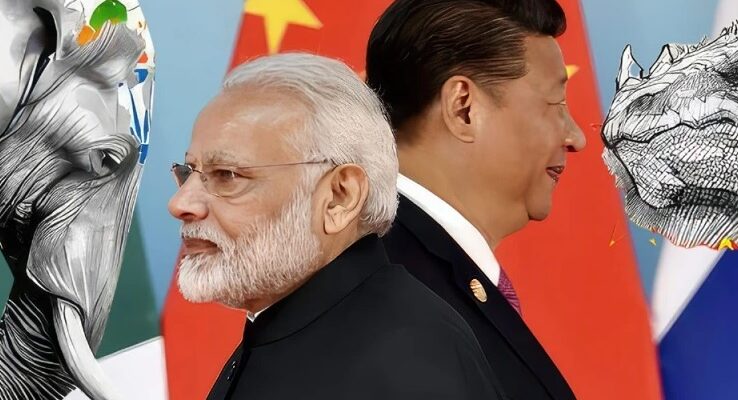
Indian elephant outpaces Chinese Dragon

Beijing’s ambivalence came to fore at BRICS and engagement with New Delhi while India showed promise, responsibility and capacity to lead Rahul Pawa In this reshaping of the BRICS landscape, India has assertively stamped its diplomatic and strategic acumen under Prime Minister Modi, outpacing the Chinese dragon with the calculated grace of an elephant—focused, powerful, and increasingly influential. In the years since its inception over a decade ago, BRICS — Brazil, Russia, India, China, and South Africa — has matured as an influential conglomeration for majority world. Engaging in dynamic interactions with the developed world, this ensemble stands on the cusp of potentially challenging G7’s dominance in global affairs. Yet, the trajectory it charts—be it one of constructive collaboration or divisive contention—will hinge heavily on the vision the forum holds. As Asian heavyweights, India and China have to jostle to sway BRICS their way as their strategic contest will shape 21st-century geopolitics. BRIC birthed on sidelines of the 2006 UN General Assembly as a grouping of large developing countries. Goldman Sachs economist Jim O’Neill has been credited for evolving the acronym in 2001 that captures zeitgeist of an era smitten with emerging markets. Those days, Brazil, Russia, India, and China were seen as newest frontiers of investment. By 2011, with South Africa coming on board, the acronym matured to BRICS. Today, the group no longer represents mere buoyant markets. It symbolises a collective intent to recalibrate the equitable global order historically skewed towards Western hegemony. Yet, for all its promise, BRICS stands at an inflection point. Skeptics question its cohesion, pointing to underlying rifts among member nations and ambiguity on its very purpose and membership. Yet, BRICS believes in the adage ‘strength in numbers’ as it quests towards a multipolar world order where developing countries have more influence, in line with their contributions to the global economy.  Even as BRICS nations represent an overwhelming 41 per cent of world’s population, the bloc accounts for 31.5 per cent of global GDP, eclipsing the G7’s 30.4 per cent. It also commands a combined economic output valued at an astonishing $ 26 trillion, around 60 per cent of what the seven most industrialized nations generate.  The staggering figures notwithstanding, a glaring inconsistency exists: the bloc’s modest voting power in the International Monetary Fund and limited decision-making in World Bank. It does not commensurate with the global influence BRICS commandes. Such disjunction magnifies a substantial source of apprehension among developing nations that have for long been seeking corrective measures to democratize these international financial and governing institutions. More than 40 heads of state gathered for the Johannesburg summit and the event marked a significant pivot in global affairs. Hosted by South Africa, the year’s rotating president following China, the theme—”BRICS and Africa: Partnership for Accelerated Growth and Inclusive Multilateralism”—spoke volumes. Notably, South African President Cyril Ramaphosa revealed that the forum had drawn intense global interest, with numerous nations seeking membership. However, amidst this diplomatic panorama, the magnetism of two Juggernauts stood out: India’s Prime Minister Modi and China’s President Xi, whose talks generated media frenzy. Correspondingly, the two leaders did have an “informal conversation” at the leaders lounge in backdrop of a pending request from the Chinese side for a bilateral meeting with India. India – China relations are etched in history of mutual reservations. Recently, tensions flared anew between the two Asian giants in 2020 when China ramped up its aggression along the Line of Actual Control (LAC), a move met with formidable resistance by India. The saga of China Pakistan Economic Corridor (CPEC) traversing through Pakistan occupied Indian regions of Gilgit-Baltistan and Jammu and Kashmir further complicates matters. These areas, occupied by Pakistan, are consistently contested by India as it persistently voices its objections on the International forums against the corridor.  But Beijing’s ambitions don’t stop at terrestrial borders. It aims to shape the BRICS bloc – as a cornerstone of its own global strategy. From pushing the Belt and Road Initiative (BRI), China seeks to recalibrate the world’s economic compass. On the contrary, steering clear of China’s political choreography, India zeroes in on bolstering regional economic collaborations and pushing for a recalibration of international monetary institutions to ensure the developing world isn’t left out. This nuanced strategy became increasingly transparent when India’s Foreign Minister, S. Jaishankar, dispelled notions of a nascent BRICS currency, electing instead to underline the importance of fortifying Indian Rupee in July this year. As BRICS itself stands at a crossroads and appears to positioned for a transformative global narrative, India navigates these waters with discerning caution. It remains vigilant to shifts that could potentially reconfigure this 16-year-old alliance in favour of a single, dominating power, effectively altering the multi-polar balance that has long characterised the consortium. As the gavel struck to signal close of the 15th BRICS Summit at Johannesburg’s Sandton Convention Centre, a renewed world order seemed to crystallize before the global community. The seismic pivot came courtesy South African President Cyril Ramaphosa, who announced the summit’s agreement to extend membership invitations to six emerging powers—Argentina, Ethiopia, Egypt, Iran, Saudi Arabia, and the United Arab Emirates. This dramatic enlargement, scheduled to take effect in January 2024, would make the bloc represent approximately 30 per cent of the global GDP, a financial heft rivaled by few. Amid this climate of heightened anticipation and future promise, India’s Prime Minister Narendra Modi emerged as the summit’s lodestar, charting the bloc’s course with a visionary range of proposals that struck a stark contrast to China’s mysterious reticence. Modi did not just navigate intricacies of the summit; he orchestrated them. India’s domestic and international roadmaps were laid out with compelling clarity. Whether articulating his ambitious aspiration for India to graduate to a developed nation by 2047 or laying bare his robust advocacy for key reforms in the United Nations Security Council and the World Trade Organization, Modi’s leadership radiated across multiple vectors. This was further illuminated by India’s pitch in the digital payments sphere, notably the Unified Payments Interface (UPI)

Read More

A Resolute Goal

Reform, transform and perform is the mantra that will fuel India’s grand standing as a developed nation by 2047 Rohan Giri India’s Independence Day holds immense significance as it commemorates the nation’s liberation from British colonial rule while embodying its journey to realize 1.4 billion people’s dreams. Prime Minister Narendra Modi address on this special day unveiled a plan to put India on high growth trajectory. Modi painted a compelling portrait on India’s future drawing inspiration from her classical civilizational roots. He set a resolute goal for India to attain developed nation status by 2047. On 77-th Independence Day, Prime Minister began his address by referring to the turmoil and violence in Manipur and its impending resolution. He emphatically stated, “The country stands with the people of Manipur… Resolution is possible only through peace. The Centre and the state government are making all efforts to find a solution, and will continue to do so.” While the state was limping back to normalcy, a lot more needs to be done for making Manipur home to diverse tribes living in harmony moving away from conflict, violence, women’s abuse, pain and suffering of various tribes. Narendra Modi moved on to point the pivotal significance of undertaking economic reforms to fortify India’s global standing. As evident, India’s economy, valued at a staggering $3.5 trillion surpassed that of United Kingdom last year securing its place as fifth-largest in the world. With unwavering conviction, he declared India’s resolute trajectory to ascend into the elite club of top three global economies in next five years. Prime Minister heralded a noteworthy accomplishment – uplifting over 130 million individuals from strangle hold of poverty. He emphasized that India’s burgeoning prosperity serves as a compelling opportunity not only for the nation itself but for entire global community. Modi’s persistent emphasis on these aspects underscores his unequivocal dedication to harnessing India’s demographic dividend and steering it to transform into an economic powerhouse. India is swiftly advancing on development path, garnering significant global recognition for its burgeoning expansion. Modi as Prime Minister, it is both commendable and imperative to nurture aspirations for a resplendent future. Contemplating the trajectory of India’s future, Modi affirmed, “I am confident that in 2047 when India marks 100 years of its Independence, it will be a developed nation. I say this on the basis of the capability of my country and available resources…” Realizing the vision for a fully developed nation demands collective effort necessitating certain sacrifices from each citizen. Prime Minister emphasized, “We have to fight three things now — corruption, family rule, and appeasement. These create impediments to people’s aspirations while corruption has badly affected India’s capability. Modi has rightly targeted fighting against corruption as a key area. While politics of appeasement has inflicted most harm on social justice, the country has to resolve not to tolerate corruption in any form. Global arena not only acknowledges ingenuity of Indian leadership but recognizes strength of the country’s core philosophy. Rooted in India’s philosophical moorings, this perception of entire humanity as one family stands out differently. In the aftermath of the Covid-19 pandemic, India presented a resonant principle: “One earth, one health.” This principle acted as a beacon of hope for afflicted nations. In the aftermath of Covid-19 pandemic, the imperative for comprehensive healthcare has come to the forefront. This need has sparked a noticeable surge in the global embrace of traditional Indian healthcare practices such as indigenous medicine, yoga and meditation. Notably, yoga, an amalgamation of physical, mental, and spiritual practices rooted in ancient India has seamlessly woven itself into the daily routines of people across the globe. Moreover, India’s healthcare systems including Ayurveda, Yoga and Naturopathy, Unani, Siddha, Sowa Rigpa and Homeopathy, progressively garnered global recognition. Presently India is leading the G-20 as the Chair and espoused a grand vision encapsulated by the mantra “One Earth, One Family, One Future.” This profound perspective serves as comprehensive remedy to current challenges like war in Ukraine and forms the bedrock for harmonious and prosperous global coexistence in times to come. The landscape of world order and geopolitics is undergoing swift transformations. New Delhi has engaged with the world powers in new ways by building alliances, strike trade deals and increases defence cooperation. On reshaping global order, Narendra Modi underscored, “In shaping a changing world, Indian people’s capabilities are evident… India’s biggest capability is trust — people’s trust in the government, the country’s bright future and the world’s trust in India. The ball is in our court, and we should not let go of opportunity; no ifs and buts on anyone’s mind about India’s capabilities.” Prime Minister’s 90-minute address also delved into subjects like democracy, women-driven progress and space technology to novel schemes and pressing concern of terrorism. His speech was a clarion call for people to embrace principles of Reform, Perform, and Transform. His vision for a reformed, efficient, and self-reliant India reflects well with aspirations of millions of Indians. As the country navigates its path to progress and prosperity, the roadmap in Modi’s speech provides a framework to guide India’s journey into the future. (Author is Operations Manager at Centre for Integrated and Holistic Studies, a New Delhi based non-partisan think tank)

Read More