CIHS – Centre for Integrated and Holistic Studies

Date/Time:

Hindu Manifesto 2024

On Saturday, June 8, the British Hindu community officially unveiled the Hindu Manifesto 2024. A long-overdue manifesto will emphasise a shared commitment to the advancement of not just British Hindus but the entire nation. Rohan GIRI             With the United Kingdom’s (UK) general election set for July 4, 2024. British Hindus are at a critical juncture. Due to its historical unwillingness to engage in political discourse, the community frequently regarded politics as a taboo subject. Many people do not vote, whereas some vote without thinking about the long-term consequences for themselves, their community, and the nation at large. According to the 2021 UK Census, British Hindus make up about 1.7% of the UK population, or approximately one million people. Despite their small numbers, their contributions to the British economy are unparalleled. As a community, they are among the top taxpayers, and their contributions to UK’s National Health Service (NHS) are imperative, with a large number of doctors, nurses, engineers, and other professionals. Additionally, Indians employ tens of thousands of individuals. British Hindus are a well-educated community that is self-sufficient, independent, and prosperous. Their commitment to prosperity and the rule of law reflects their extremely low numbers in British prisons, accounting for less than 0.3 percent of the total prisoners. Despite the community’s alignment with British values and society, it has minimal influence in British politics. This arena, where policies are formulated, laws enacted, and narratives established, demands a significant voice to shape the future. Unfortunately, British Hindus are often underrepresented or misrepresented in education, academia, media, and politics, both locally and nationally. They frequently face attacks, vilification, and maligning, with no substantial collective response to defend their interests and set the record straight. The next general election presents a crucial opportunity for the community to voice their thoughts. Parliamentary candidates must understand that British Hindu votes cannot be taken for granted. The community seeks fair representation and recognition of its contributions, highlighting Sanātan Hindu Dharma as an asset to Britain. The next general election presents a crucial opportunity for the community to voice their thoughts. Parliamentary candidates must understand that British Hindu votes cannot be taken for granted. The community seeks fair representation and recognition of its contributions, highlighting Sanātan Hindu Dharma as an asset to Britain. It is time for British Hindus to claim their seat at the table, shaping and influencing the country’s future. This involvement is not just a right but also a duty, or Dharma. The Hindu Manifesto 2024, launched by the British Hindu community, contains seven crucial pledges that the community expects from parliamentary candidates and future governments. These assurances are designed to ensure the protection, promotion, and progress of Hindu values and interests within the broader British society. The Seven Assurances of the Hindu Manifesto UK 2024: “Recognising Anti-Hindu Hate as a Religious Hate Crime: This expectation demands the identification and prosecution of groups and individuals that perpetrate anti-Hindu hatred. Recognising such acts as religious hate crimes will ensure that they are taken appropriately and addressed accordingly. Protecting Places of Hindu Worship: Ensuring the safety and purity of Hindu temples and places of worship is critical. This promise aims to preserve these precious areas from damage and attacks. Access to Fairer Education: This involves advocacy for an education system that accurately represents Hindu culture and contributions, as well as ensuring that textbooks are inclusive and unbiased. Equal Representation and Opportunities for Hindus: This protection aims to address Hindus’ underrepresentation in numerous sectors by struggling for equal opportunities in employment, politics, and other areas. Streamlining Immigration: The need for fair and efficient immigration laws that make it easier for people looking to join family in the UK or contribute to the British economy. Healthcare and Social Care: Encourage and enhance access to healthcare and social care services for Hindus while also addressing their special needs and concerns. Acknowledging and Protecting Dharmic Values: It aims to understand and respect the Hindu Dharmic way of life by consulting with the community while legislating on intra-community issues affecting the UK Hindu community, by facilitating infrastructure for religious ceremonies such as marriage and cremation, by commissioning a memorial for Hindu soldiers who served and died for the UK, and by understanding that the connection between UK Hindus and India (Bharat) is spiritual rather than political.” The Hindu Manifesto is a call to all parliamentary candidates and political parties to engage with and support the Hindu community in their respective areas. It has already received endorsements from various parliamentary candidates who have declared their support for the manifesto and its goals. As the general election approaches, the Hindu Manifesto will act as a guide for British Hindus, reminding them of their ability to shape the political landscape and ensure their community’s interests are reflected and safeguarded. This election is a critical opportunity for British Hindus to establish their presence, demand fair representation, and contribute to determining the future of the UK in a way that recognises and appreciates their substantial contributions. The election is an opportunity for British Hindus to turn their contributions, concerns, and expectations into legitimate political influence. The substantial participation and widespread support for the Hindu Manifesto 2024 can demonstrate to political leaders that the community is a force to be reckoned with, worthy of representation and consideration in policies. The ramifications of this participation will extend far beyond election day, potentially ushering in an era where British Hindus’ voices are fundamental to national conversations, their needs are met, and their values are upheld in the halls of government. (Author: Rohan Giri is a journalism graduate from Indian Institute of Mass Communication (IIMC) New Delhi, and Manager Operations at CIHS.)
Read More

Propagating ‘Truth’ That Never Existed!

Both, US and China used devious means to force a tilt, influence outcomes of recently concluded Lok Sabha elections in Bharat Vinod Kumar Shukla Cognitive warfare is the new tool deployed by a few global powers to ensure their continued dominance on others throwing ethics and internationally accepted practices to wind. These powers have attempted suppression of fair practices in election of a government especially in countries where there is a vibrant democracy. Among others, India too faced challenges where democratic process was allegedly tried to be influenced by creating false narratives with help of Artificial Intelligence (AI) and Social Media influencers. Most of these falsehoods were not only funded by foreign countries but ideas too were generated on foreign soil. Investigations revealed that STOIC, an Israeli company attempted to interfere in Lok Sabha elections by peddling anti-BJP agenda dubbed as ‘Zero Zeno.’ Efforts were made to manipulate public opinion even in Canada, US, Israel, and Ghana. With help of AI, web articles and social media, comments and content were generated and pushed across Instagram, Facebook, and X focusing on criticizing the BJP and praising the Congress. AI was used to create fictional characters and fake social media accounts with specific variables like age, gender and location. Bogus accounts were created to engage people with such posts that gave the impression of genuine audience interaction. China too was actively involved in this disinformation campaign and escalated its campaign for changing the government in India after People’s Liberation Army was humiliated both in Doklam and Galwan Valley. Artificial intelligence was craftily used to construct propaganda content, images and videos targeting parties and politicians opposed to Chinese hegemonic design. Microsoft had cautioned that China was poised to use generative AI to sway elections all across scheduled for this year. Chinese interference is deeply rooted in its expansive ‘influence operations’ (IO) targeting leaders of other countries with its disinformation campaign to undermine leaders by portraying them as weak and vulnerable. Spamouflage Dragon or Dragon Bridge or Storm 1376, a key Chinese disinformation propagator network has been functioning since 2017-18 on social media. Its activities came to notice when around 9,000 Facebook and Instagram accounts linked to this network were shut down by Meta in August 2023. In November 2023, approximately 4,800 fake Chinese social media accounts impersonating Americans were shut down for disseminating narratives designed to polarise public opinion through biased political content ahead of US elections. The same was done in Australia and the Philippines during 2022 elections. Beyond social media, Chinese IO strategies include both overt and covert tactics involving cultivation of assets like local and independent media, influential personalities, political parties, business figures and NGOs. Preference for particular candidates was subtly communicated not through direct diplomatic utterances but via Chinese state-affiliated media and United Front Work Department (UFWD) which is dedicated to exerting overseas influence. On the parallel, investigation on Chinese funding of NewsClick in Bharat is underway and the matter being heard in the court. Chinese objective of meddling in elections is to ensure that elected candidates or parties should adopt a pro-China stance. These disinformation campaigns aim to sway election outcomes by undermining voters’ confidence in candidates not favoured by China. Recent escalation in Chinese disinformation involves leveraging generative AI technology to prepare propaganda images and videos. These AI-generated materials target parties and politicians critical to China. Initially this technology was used during presidential elections of Taiwan to undermine Taiwan’s democratic framework, promoting a pro-unification narrative, and weakening Taiwan’s ties with the US. In fact, Chinese disinformation campaigns on the national security of various countries have prompted many to ban popular Chinese social media platform TikTok. But, reports indicate that China continues to meddle in foreign elections to emerge as a global power. Besides China and Israel, millions of dollars were spent to impact elections in India. Western interference from European Union and US too were in the game. Media outlets with tacit, explicit funding and a few funded by organizations with background in peddling agenda based narratives through stories on ‘random WhatsApp groups’ by creating heroes out of Pak-sponsored stooges. Recent elections in India witnessed the most intrusive foreign reporting with overwhelming negative and brazen reports about ruling dispensation. All this was done to have a Parliament with leaders who can help impose political agenda of countries which are instrumental in spreading these canards. The objective is to secure a favourable outcome aligning with its strategic interests. Western media was found indulging in mud-slinging to sully the image of select leaders and their party in a sinister attempt to impact voter’s minds. Dangerous narratives were peddled by a so-called Indologist Christophe Jaffrelot as the ‘caste census’ narrative allegedly came from France. Jaffrelot extensively writes on India. The French media had shown special interest in these elections with extensive reporting by Le Monde, Le Soir, France 24, La Croix (International), Le Temps, Reporterre, and Radio France Internationale (RFI) to shape up a particular narrative to impact Indian elections with Jaffrelot as an expert on almost everything in India. With the help of Trivedi Centre for Political Data (TCPD) at Ashoka University, Jaffrelot and his disciple Gilles Verniers aggressively peddled a narrative that ‘lower castes’ had lesser representation in politics, quoting profile of MPs in 2014 Lok Sabha. However, the expert duo immediately changed their stand when the 2019 Lok Sabha had a higher representation from lower castes. In fact, never before was he referred by so many outlets in such a short time. He wrote a paper on ‘need of caste census’, in September 2021. US and China attempted to play dirty in just concluded elections with startling discourse being Caste Census which certainly was not organic. Jaffrelot had allegedly received massive funding from the US-based ‘philanthropic’ organization Henry Luce Foundation (HLF) around the same time. HLF was founded by Henry Luce, the founder of TIME magazine. Lesser known fact about Luce is his alleged deep-state connections. He was born to Presbyterian Christian Missionaries and supported by

Read More

Fresh Set of Challenges for Modi 3.0

Khalistanis, Naxalites, Kashmiri subversives gaining legitimacy in Parliament demands fresh thinking and strategy K.A.Badarinath As Bharat’s Prime Minister Narendra Modi readies to take reins at centre for a third consecutive term, challenges, known and unknown may have to be dealt with on priority basis. Commentators of every hue and shade have written copiously on Prime Minister Modi’s tenacity or lack of it to run a coalition government with Telugu Desam and Janata Dal (United) and half a dozen others in tow. Challenges identified here are different and mostly new to tackle right away. For a year, Amritpal Singh, a Khalistani extremist who waged a war on Punjab Police has been put away in Dibrugarh jail of Assam. Waris Punjab De chief who hitherto owned a logistics company in Dubai is being tried for crimes including possible treason after having led a mob on Ajnala police station in Punjab. He’s being tried under National Security Act (NSA) from April 2023. His reported linkages with Pakistani spy agency, ISI to source weapons to spill violence on streets of Punjab are some of the allegations against Amritpal Singh. The 31-year old radical Khalistani separatist will have to be dealt with by Modi government when eighteenth Lok Sabha opens for newly elected members of Parliament to take oath. From Khadoor Sahib in the Punjab, Amritpal Singh was elected a member of Lok Sabha after having trounced his Congress rival. Security forces that laid trap in and around Punjab after the Ajnala incident will now have to provide security cover to the ‘Honourable Member of parliament’. Singh was successful in recent elections with highest majority of 1.97 lakh votes in Punjab. Member-elect from Khadoor Sahib will have to be respectfully escorted by the very security forces from jail to Parliament. Election Commission of India (ECI), Lok Sabha Speaker and the new government apart from courts will have to bear with his idiosyncrasies on Khalistan, the imaginary separate Sikh state. One big positive however is that the avowed Khalistani will have to take a pledge as per Bharat’s Constitution and work within the country’s governance system. Protocols to deal with him will change overnight. Second case will be Sarabjeet Singh Khalsa, son of Beant Singh who killed then Prime Minister Indira Gandhi following Operation Blue Star. Sarabjeet is the new Member of Parliament elected from Faridkot and a fundamentalist. Though an independent candidate, hitherto Sarabjeet Singh Khalsa was with Siromani Akali Dal – Amritsar. This party has had Simranjit Singh Mann as its member in Lok Sabha from Sangraur previously represented by Chief Minister Bhagwant Singh Mann. Sarabjeet Singh Khalsa’s plank as an independent in Faridkot was to seek justice for desecration of Guru Granth Sahib in October 2015. On October 12 that year, Sikhs’ holy book was desecrated in Behbal Kalan and a couple of days later two sikh youth were killed. This very is part of Faridkot constituency. Even after election, Khalsa and Mann along with several Khalistani separatists shouted slogans for a separate Sikh state at Golden Temple, the highest seat of Sikh Panth in Amritsar. While Sarabjeet is regarded a fundamentalist, his election and allegiance to Bharat’s Constitution as a Parliament Member may ring in some positivity. But, there’s denying that going forward Sikh panthic politics has come here to stay and traditional Sikh parties like Shiromani Akali Dal will have to make way for new alignments and forces especially aligned with extremist and terror elements globally. Modi government will have to redraw its Punjab strategy in sync with new realities. Third member who could turn tricky for Narendra Modi government is Sheikh Abdul Rashid who’s serving his term in Tihar jail. He’s been elected to lower house from Baramulla after trouncing former Chief Minister Omar Abdullah of National Conference. Popularly known as engineer Rashid, he’s been in high security Tihar jail for over five years in cases relating to money laundering and funding terror in the Kashmir valley from across the border and elsewhere. Oppression, revenge and jail term were emotionally put forth by his sons to garner votes for engineer Rashid. While Rashid’s swearing in as Lok Sabha member would turn an eyeball event, abrogation of Article 370, Jammu and Kashmir assembly elections may come back to focus. Courts have to take a call on his interim bail to facilitate his swearing in. After a gap of 25-years, Communist Party of India – Marxist Leninist (Liberation), Left extremist group will enter the parliament with two  of its members in Rajaram Singh from Karakat constituency. His comrade, Sudhama Prasad defeated BJP minister and high profile R K Singh from Arrah. Both these constituencies are in Bihar. The party that draws inspiration from one of left extremist movement, Charu Mazumdar, has moved into public space from arms struggle and is part of the opposition, Indi alliance. CPI-ML Liberation shifted gears and moved away from Kondapalli Seetaramaiah faction’s Peoples’ War group that still is in the midst of waging a war against the state.  Mainstreaming of naxalites with entry into Parliament and state legislatures is a tribute to Bharat’s democracy. But, spread of Left extremist political ideology overtly may demand a fresh strategy from Modi government. Chandrashekhar Azad alias Ravan is yet another figure from Uttar Pradesh that BJP-led alliance that needs to watch out for.  Chandrashekhar will represent Nagina Lok Sabha constituency in the lower house after having won the seat with a margin of over 1.51 lakh votes. He is regarded as a self-established Dalit leader after having setup the Bhim Army. His activism extends to a decade. On March 15, 2020, Chandrashekhar launched Azad Samaj Party (Kanshiram) to mainstream his political activism overtly. Initially, he looked at a tango deal with Akhilesh Yadav’s Samajwadi Party (SP). But, Chandrashekhar felt let down when his party was offered just two seats in the Lok Sabha elections by SP. Azad’s direct involvement in Saharanpur violence led to his arrest under National Security Act by the Uttar Pradesh government. Delhi Police denied him

Read More

Reforms Should Go Beyond Economy, Touch Every Facet of Life

Let’s leverage strengths for global good, meet aspirations of Bharat’s citizens as we progress to become a developed country by 2047 Narendra Modi The biggest festival of democracy, the 2024 Lok Sabha Elections, is concluding today in our nation, the Mother of Democracy. After a three-day spiritual journey in Kanniyakumari, I have just boarded the plane for Delhi. Through the day, Kashi and numerous other seats have been in the midst of voting. My mind is filled with so many experiences and emotions… I feel a boundless flow of energy within myself. The 2024 Lok Sabha elections are the first in the Amrit Kaal. I began my campaign a few months ago from Meerut, the land of the First War of Independence of 1857. Since then, I have traversed ac-ross the length and breadth of our great nation. The final rally of these elections took me to Hoshiarpur in Punjab, the land of the great Gurus and a land associated with Sant Ravidas Ji. After that, I came to Kanniyakumari, at the feet of Maa Bharti. It is natural that the fervour of the elections was echoing in my heart and mind. The multitude of faces seen in rallies and road shows came in front of my eyes. The blessings from our Nari Shakti… the trust, the affection, all of this was a very humbling experience. My eyes were getting moist… I entered into a ‘sadhana’ (meditative state). And then, the heated political debates, the attacks and counter-attacks, the voices and words of accusations which are so characteristic of an election… they all vanished into a void. A sense of detachment came to grow within me… my mind became completely detached from the external world. Meditation becomes challenging amidst such huge responsibilities, but the land of Kanniya Kumari and the inspiration of Swami Vivekananda made it effortless. As a candidate myself, I left my campaign in the hands of my beloved people of Kashi and came here. I am also grateful to God for instilling in me these values from birth, which I have cherished and tried to live up to. I was also thinking about what Swami Vivekananda must have experienced during his meditation at this very place in Kanniyakumari! A part of my meditation was spent in a similar stream of thoughts. Amidst this detachment, amidst the peace and silence, my mind was constantly thinking about the bright future of Bharat, the goals of Bharat. The rising sun at Kanniyakumari gave new heights to my thoughts, the vastness of the ocean expanded my ideas, and the expanse of the horizon continuously made me realise the unity, the Oneness, embedded in the depths of the universe. It seemed as if the observations and experiences undertaken in the lap of the Himalayas decades ago were being revived. Kanniyakumari has always been very close to my heart. The Vivekananda Rock Memorial in Kanniyakumari was built under the leadership of Shri Eknath Ranade ji. I had the opportunity to travel extensively with Eknath ji. During the construction of this memorial, I had the opportunity to spend some time in Kanniyakumari as well. From Kashmir to Kanniyakumari… this is a common identity that is deeply ingrained in the heart of every citizen of the country. This is the ‘Shakti Peeth’ (seat of Shakti) where Maa Shakti incarnated as Kanya Kumari. At this southern tip, Maa Shakti performed penance and waited for Bhagwan Shiva, who was residing in the Himalayas at the northernmost parts of Bharat. Kanniyakumari is the land of confluences. The sacred rivers of our country flow into different seas, and here, those very seas converge. And here, we witness another great confluence – the ideological confluence of Bharat! Here, we find the Vivekananda Rock Memorial, a grand statue of Saint Thiruvalluvar, Gandhi Mandapam, and Kamarajar Mani Mandapam. These streams of thought from these stalwarts converge here to form a confluence of national thought. This gives rise to great inspirations for nation-building. This land of Kanniyakumari gives an indelible message of unity, especially to any person who doubts Bharat’s nationhood and the sense of unity. The grand statue of Saint Thiruvalluvar in Kanniyakumari seems to be looking at the expanse of Maa Bharti from the sea. His work Thirukkural is one of the crown jewels of the beautiful Tamil language. It covers every aspect of life, inspiring us to give our best for ourselves and for the nation. It was my great fortune to pay my respects to such a great figure. Swami Vivekananda once said, “Every nation has a message to deliver, a mission to fulfil, a destiny to reach.” For thousands of years, Bharat has been moving forward with this sense of meaningful purpose. Bharat has been a cradle of ideas for thousands of years. We have never considered what we have acquired as our personal wealth or measured it purely by economic or material parameters. Therefore, ‘Idam-na-mama’ (this is not mine) has become an inherent and natural part of the character of Bharat. Bharat’s welfare benefits our planet’s journey to progress as well. Take the freedom movement as an example. Bharat gained independence on Aug 15, 1947. At that time, many countries around the world were under colonial rule. Bharat’s independence journey inspired and empowered many of those countries to achieve their own freedom. That same spirit was seen decades later when the world came face to face with the once in a century Covid-19 pandemic. When concerns were raised about the poor and developing countries, Bharat’s successful efforts provided courage and assistance to many nations. Today, Bharat’s governance model has become an example for many countries around the world. Empowering 25 crore people to rise above poverty in just 10 years is unprecedented. Innovative practices such as Pro-People Good Governance, aspirational districts, and aspirational blocks are being discussed globally today. Our efforts, from empowering the poor to last-mile delivery, have inspired the world by prioritising individuals standing at the last rung of society. Bharat’s Digital India campaign is now an example for the entire

Read More

Has Economic Inequality Risen in Bharat?

World Inequality Lab report methodology, databases deployed are questionable & biased. It does not stand rigour of academic scrutiny. Chaitanya Khurana Over past several years, Bharat has made remarkable progress in ending poverty and hunger. In July 2023, United Nations has said that 415 million people have been brought out of extreme poverty within just 15 years spanning from 2005 – 21. These numbers were mentioned in absolute as part of global multidimensional poverty index which was released by United Nations Development Programme (UNDP), Oxford Poverty and Human Development Initiative (OPHI). Surjit S. Bhalla & Karan Bhasin, renowned commentators on poverty and economic issues recently reviewed latest official consumption expenditure data for 2022-23 which has shown an unprecedented reduction in rural and urban inequality. The inference from this latest released official data is that Bharat has achieved a remarkable feat of ending extreme poverty and there are suggestions for upward revision in poverty line and redefining existing social protection programmes for better targeting of beneficiaries so that few people who might have been left behind are uplifted. On the contrary, World Inequality Lab report, “Income and Wealth in India, 1922-2023: The Rise of the Billionaire Raj” (Pikketty et al, 2024) has made some claims that may not be tenable as per data points available in public domain. As per World Inequality Lab report, inequality levels declined post-independence but after early ‘80s, income and wealth inequality spiked and increased at rapid pace from early 2000s. The report claims that in terms of Income and Wealth, India’s top one percent holds 22.6 per cent and 40.1per cent respectively. The report added that India’s top one percent holds the highest income and wealth as against their peers in any other country and higher than South Africa, Brazil and USA. This is not the first time that Western Think Tanks and self-proclaimed intellectuals tried to defame India’s rising economic growth and success the country had in uplifting its poor. They seem to harbour unfounded fears in Bharat’s rise, dominance as an economic power and leader of the changing world order. The report has so many flaws and deficiencies that it may not stand academic scrutiny of its Data and methodologies used. On both the metrics, World Inequality Lab is flawed and found deficiencies. This whole analysis regarding Bharat’s wealth inequality is more propaganda and less of reality. First limitation in the World Inequality Lab arises out of combining data sets. Usually, Different databases use different methodologies to collect and estimate data. It is not an acceptable academic practice to combine two datasets just for the sake of an analysis. For instance, the report uses forecasting techniques of interpolation and extrapolation which can give you biased and inconsistent results as these are estimates and forecasts, not actual data. Instead of using latest consumption expenditure data, the study uses Generalized Pareto interpolation techniques for extracting which in itself shows that the data has been generated which can be inconsistent and biased because all forecasting techniques have limitations. The two datasets PLFS and HCES used in the report are not comparable so therefore claims of rising inequality are false. The reliance on PLFS data of the past which has been red flagged by India, International Labour Organization and giving this information in the footnote explains the hidden agenda. Secondly, tax collections database cannot be the basis to justify its claim on rising inequality. Higher tax collections imply that over the years, tax compliance has become better, more and more people are coming into the tax net with taxable incomes. Taking the tax database from 1920 and concluding that top one per cent earned less before 2010 and 1990 eras pre-supposes uniform tax compliance over the years which is absolutely false. Thirdly, focus of the authors was solely on top one per cent income earners in India. Over past many years, many foreign think tanks and intellectuals have had problems with Indian billionaires but if the billionaire was from a western developed economy, then it is not a crime. The report has cherry picked top one per cent earners and ignored emerging middle class that expanded considerably over past many years and constitute 31 percent of the population. Fourthly, the report has attempted to focus on perceived inequality aspect which is a very uni-dimensional approach to poverty. Many development economists now use multi-dimensional poverty index (MPI) to measure poverty and inequality which is more appropriate for analyzing the reduction in poverty for any country. Niti Aayog’s report on MPI has shown that 248 million individuals in India have overcome multi-dimensional poverty between 2013-23 and this holds greater significance for the typical ambitious Indian than count of billionaires in the nation. Reduction of Poverty is the ultimate goal and reduction inequality is its consequence.  Fifth, the Report considers market capitalization or stock market wealth as part of net wealth. This is a very debatable assumption which has been considered in the report. Top one percentile income earners’ companies are listed on the stock market and with their valuations increasing related stock prices on the boom, suggestion has made that it translated to higher wealth for these income earners. On the contrary, if the stock prices fell and valuations dipped, their wealth would decrease and inequality shrinks. Taking this as a parameter to comment on India‘s inequality is completely inconsistent with good academic data driven rigor. This is not the first time that Piketty’s work has been criticized by economists and related commentators for its use of erroneous methodologies and inconsistent results.  Geloso, Magness, Moore and Schlosser wrote in 2003 that in the Paper titled.  “How Pronounced is the U-Curve? Revisiting Income Inequality in the United States, 1917–60”, inequality for United States of America has been overstated. Hence, the Inequality Lab report does not stand academic scrutiny, inconsistent and flawed with its methodologies and results which shows that this is just propaganda and nothing more. (Author is a doctoral scholar in finance at Indian Institute of Management, Indore)

Read More

West’s Supremacist, Colonial Mindset Gets Exposed

Bharat does not require dictates in democratic principles from US, Germany or other European powers. West’s misguided, outdated and conceited assumptions must be abandoned outright. Rahul Pawa April and May 2024 will be etched as ‘decisive months’ in Bharat’s modern history as the country prepares for yet another dance of democracy, a five-yearly feature. It also unfolds the grand electoral exercise when an estimated 970 million voters would exercise their franchise to elect a new government. Bharat’s citizens spanning geographic landscape from the mighty Himalayas in the north to vast Indian Ocean in the south and from Thar Desert in the west to the Mishmi Hills in the east would queue up to vote and elect the new government for next five years. As per Election Commission of India, the electorate this year includes 20 million young first-time voters and 14.1 million newly registered female voters amongst 1.4 billion population, indicating a significant uptick in youth and female participation in Bharat’s democratic process. Hosting the world’s most expansive, inclusive and resilient proven democratic exercise may not have been fully appreciated by Western powers. And, Bharat finds itself as the target of unsolicited interventions by her Western counterparts like United States Commission on International Religious Freedom (USCIRF), German Foreign Office, US State Department and United Nations (UN). These actions portray an arrogant presumption, a misplaced sense of superiority and a lingering colonial mindset that presupposes Western democratic models as the pinnacle of governance, undermining the sovereignty and integrity of Bharat’s electoral, legislative and constitutional workings.   West have had often cited Athens as cradle of democracy, a system born from the union of the Greek terms ‘demos’ (people) and ‘kratos’ (power). This narrative positions Athenian model established under Cleisthenes in the fifth century BCE as the archetype of people-powered governance. Yet, this Eurocentric perspective overlooks profound democratic ethos embedded within the ancient civilization of Bharat, predating Greek democracy by centuries. Bharat’s engagement with democratic principles is not a borrowed concept but a homegrown tradition that finds its roots in the Rig Veda, estimated to be composed around 1500 BCE. This ancient text reveals a society where governance was not the dominion of a singular ruler but a collaborative effort involving the collective wisdom of the Sabha (assembly) and Samiti (council), indicative of an evolved and sophisticated understanding of democratic governance far before emergence of Greek Athenian model. Vedic texts including both the Rig and Atharva vedas, detail existence of assemblies where decisions were deliberated in the presence of kings, ministers and scholars. Such gatherings were characterized by inclusive discussions and integration of diverse viewpoints embodying the essence of democratic dialogue. Approval of these assemblies led to electing or identifying a leader or ‘rajan’ unlike in the west. The very concept of a leader or ‘Rajan’ was neither divine, absolute nor hereditary. Systemic checks and balances resonate with current democratic ideals.  The invocation of ‘Samjnana’ in the Rig Veda symbolizing collective consciousness furthers intrinsic democratic spirit of ancient Bharat. This term, representing unity of thought and purpose among the people, was foundational to Vedic concept of governance where decisions were made through consensus reflecting a commitment to communal harmony and mutual respect. Moreover, historical records of Mahabharata and governance models described in Kautilya’s Arthashastra reveal a continuum of democratic practices through various epochs including republican systems of Licchavi and Vaishali where leaders were elected rather than born into power. Such examples affirmed that principles of democracy—participation, deliberation and representation—are not new to Bharat but are woven into the fabric of its society. Considering this wealth of historical evidence, the notion that Bharat requires dictates in democratic principles from a Western standpoint is not only misguided but perpetuates an outdated and conceited assumption that ought to be abandoned without delay.  Bharat’s democratic and judicial frameworks are subjected to proliferated patterns of interference from international organizations necessitating a detailed examination of the motives and potential impacts of such foreign meddling. United States Commission on International Religious Freedom (USCIRF) established by Christian missionary groups concerned with the alleged persecution of Christian missionaries worldwide has positioned itself as a self-appointed global arbiter of religious freedom. Over years, it has regularly vocalized, often misleadingly, about Bharat’s society and governance. Since 2013-14, USCIRF’s stance towards Bharat has been significantly influenced by its interactions with Indian American Muslim Council (IAMC), an organization linked to the Islamic Circle of North America (ICNA), an offshoot of Jamaat-e-Islami (Pakistan), particularly regarding Citizenship Amendment Act. This relationship, uncovered by independent research from an Open Source Intelligence (OSINT) firm indicates a strategic campaign to influence US policy and public opinion against Bharat highlighting a complex network of influences that questions USCIRF and other such US based entities and their impartiality in evaluations concerning Bharat. Recent machinations to portray Bharat in a negative context magnify apprehensions regarding international discourse surrounding Bharat’s internal matters. Germany’s criticism of lawful arrest of Indian politician Arvind Kejriwal and remarks by UN Secretary-General Antonio Guterres questioning integrity of its electoral process not only encroach upon the principles of sovereign equality and non-interference but also reveal a pattern of biased and agenda-driven scrutiny. Strikingly, Germany’s observations, juxtaposed against its role in hosting Nuremberg trials which aspired to set global legal precedents and ensure legal accountability at the highest levels of governance particularly stand out. United Nations bound by its charter to respect the sovereignty of its member states, seems increasingly influenced by growing financial contributions of Communist Party of China (CPC) indicating a shift in the dynamics of international power play. These developments do not merely affect the mechanisms of global governance but hint at complex strategic maneuvers, acknowledging resurgent Bharat as a principal contender in this global maze. Bharat advances towards electing her representatives to 18th Lok Sabha which is essentially a celebration of democracy that is unparalleled in scale and tradition, Unwarranted overreach by West into Bharat’s sovereign affairs and internal matters casts a long shadow over their intent and interest. This external curiosity cloaked in the guise of

Read More

Changed Foreign Policy Stems from Bharat’s Cohesive Leadership

‘Why Bharat matters’ is a wonderful and compact rendition of the dynamic policy matrix by S. Jaishankar while being in corner office! Dr Amritpal Kaur When the realist External affairs Minister present a clinical picture of the world affairs in a compact book, it should be read with all the care. It’s because the analysis of a career diplomat is palpable and it also gives a sense of the minds that work at the helm, in the control room, assiduously at work of foreign policy making and execution. As the book unfolds, it reveals to the reader nuances of International relations from contemporary Indian vantage point from the actors end to the influencers arena, to general people who more often than not, are at the receiving end. Broadly, the book deals with various stakeholders of Indian Foreign Policy, past and present. It discusses the government’s account of international issues as well as the take of people sitting inside the power corridors or outside it. Sardar Patel, Syama Prasad Mookerjee and Dr. B R Ambedkar’s views on foreign policy issues which were not mainstreamed by the then Government of India are discussed. The point that Jaishankar is driving home in this book and his earlier publication, The India Way is that many problems of today have their roots in yesteryear’s regimes. These issues have over the years become soar points for India, territorial disputes and strategic-tactical missteps taken by Indian dispensation are the glaring examples. Why Sardar Patel or Mookerjee matter today, in part, is because they tried to warn about these mistakes and had the Government taken their suggestions on board, the picture might have been different today. There is also a shift in the approach to International relations within Indian government since the last decade and this shift comes through the book as well Nationalist foreign policy, in place of third world internationalism, open ended multipolar world order with greater role for countries like India. Jaishankar calling out the double standards that dominant powers use for similar situations are some of the examples of this shift.  In many ways, Why Bharat Matters is a book that announces to the world that India has arrived, again! It goes beyond the usual standard academic analysis, into the fields of real time variables with direct impact on contours of policy making. For example, how Government of India responded to crises like COVID 19, Ukraine war, Afghanistan crisis are some issues dealt with in the book on a first person account basis. What also contribute to its salience is that Jaishankar has a deep and detailed knowledge about International relations and the games that nations play and it is this knowledge which peeps through the book. As much as it is a written word, it is also a policy statement of Government of India, its approach and stakes in international relations. In that sense, it is not a dated analysis, rather an up-to-date, in-the-moment picture of the events that have happened in the past decade and are transpiring as we write and read. What sets this analysis apart is not just frankness of Jaishankar in offering his perspective on issues, but the cool matter-of-fact assertion of strategic elbow room that India is claiming in foreign relations under mounting pressure from various parties. That India needs to take into account its own unique predicaments and opportunities to accomplish its own national goals are according to Jaishankar its raison d’etat. Though the world is still coming to terms with this changed attitude on the Indian side, but the change itself came about with the cohesive leadership under the present dispensation. Interestingly, for Jaishankar India’s arrival is not a new-kid-on-the-block phenomenon, rather it was coming for a long time. India’s rise in the past decade is the central argument of the book. There are certain fixtures of Indian foreign policy, which has remained constant in the analysis too, that is, centrality of Prime Minister in terms of Foreign Policy making, the neighbourhood policy emanating from Gujral Doctrine and the impact of foreign policy on general public. A chapter dedicated to Prime Minister Modi, his world-view and approach to foreign policy is a telling example of how Prime Ministers keep foreign policy as their own prerogative domain. It can be argued that centrality of Prime Minister in foreign policy formulation emanates from the fact that as the leader of the country, he or she has a direct hand in how the world sees us and how should the world be dealt with. Jaishankar argues in the book that on all occasions, it has been crystal clear vision of Prime Minister Modi that led the way for clearer formulations in foreign policy. That the book declares India’s arrival on the world stage as a  fait accompli, not as a third world country, but as a frontline state with increasing stakes in the outcomes of international politics can also be attributed to confidence of leadership in standing up and owning responsibility in precarious situations. The book is a telling story of how the shift in confidence of leadership impacts the policy outcomes and Prime Minister as the prime example of this evolution. Dr. S Jaishankar’s experience as a seasoned Diplomat is palpable in the book he put together. The depth and crux of issues pertaining to India’s international relations are visible in his analysis. In certain ways, his style reminds one of Henry Kissinger, with crisp, assertive language and a punch in the end. However, the problem with the work is that it reads more like a diplomat’s manual than a foreign policy analysis. For an amateur reader, with no background in the foreign policy analysis the book is somewhat difficult to follow due to the insufficient information given. For example, in discussing the Afghan crisis and its outcome for USA, an indepth analysis would have been a more impactful. Issues that the book raises are pertinent in their own right, their salience could be accentuated by additional

Read More

Interview – RSS Pursues Five Grand Transformative Ideas

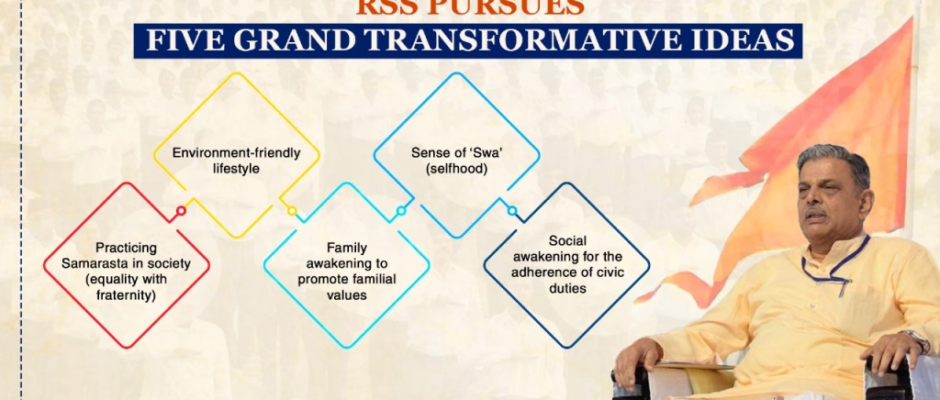
It is beyond doubt that the work of the RSS is progressing steadily. Bharat is fast assuming a distinct and powerful identity on the global stage. Rashtriya Swayamsevak Sangh has contributed significantly towards social enlightenment by championing the aforementioned truth, and also by countering the challenges posed by demonic detractors of Bharat. To proliferate nationalistic thoughts at an even greater pace and to deepen and expand its work, the Sangh is now ready with the idea of ‘Panch Parivartan’ (Fivefold Transformations). On the occasion of the Akhil Bharatiya Pratinidhi Sabha held in Nagpur from March 15 to 17, 2024, decisions have been made to work on dimensions that will mark the completion of a century of the Sangh’s existence. This year, the number of representatives present in the Pratinidhi Sabha seems to have suddenly increased. How did this happen? It is not true that the number has suddenly increased; it has happened gradually. With the expansion of our work, the number of Swayamsevaks was bound to jump, and as a result, the number of representatives also increased. When the Shakhas grow, the number of active Swayamsevaks automatically increases, and based on that, the number of representatives also increases. Additionally, a large number of invited brothers and sisters are also present in this Pratinidhi Sabha. Several inspired organisations were also invited to send representatives in Nagpur. Finally, due to the COVID-19 pandemic in the past three years, there were some restrictions on the number of representatives. We had to keep the number limited, so we didn’t invite some groups as expected. For example, in a certain year, the Vibhag Pracharaks were not expected, and in another year, workers from various fields were not expected. This is the reason why the number was low at that time, and now it seems to have suddenly increased. What special goals and objectives have been set for the centenary year of the RSS? In the context of the centenary year, we have identified two goals from an organisational perspective—increase the number of Shakha units and the qualitative improvement in the activities. All the members are expected to have this common goal in mind. By increasing the quality of work, its impact will increase too. The thrust is on qualitative growth along with the quantitative expansion. Secondly, from a social perspective, we have put forth the subject of Panch Parivartan (Fivefold Transformation). Our objectives include changing the intellectual narrative  from a national perspective, and to mobilise the sajjan shakti ( righteous power of the society) for social change. Therefore, in the centenary year of the RSS, we have made plans to take initiatives on all these subjects at both organisational and societal level. How do you propose to explain this entire concept of Panch Parivartan to the common masses and what challenges do we see there? When times are favourable and circumstances are conducive, extra caution, more effort, and deep contemplation become all the more necessary. Today, the time seems favourable for the dissemination of national thoughts. However, this favourability is not for sitting idly and enjoying the good time; it is a time to reach the very zenith of endeavours. The idea of Panch Parivartan is to deepen our approach to fundamental reforms by making the workers of the Sangh and various organisations its torchbearers. Anyway, today, Panch Parivartan is the need of the society in general. Panch Parivartan includes dimensions such as the insistence of practicing Samarasta in society (equality with fraternity), environment-friendly lifestyle, family awakening to promote familial values, inculcating sense of ‘Swa’ (selfhood) based on Bharatiya values in all aspects of life and social awakening for the adherence of civic duties; all these issues concern the society at large. Secondly, these topics need to be addressed to individuals, families, and the areas in the vicinity of Shakha. It needs to be taken to a wider society. We have kept these topics in front of the Swayamsevaks in general. Therefore, there should be an effort to bring about change through self-examples. This is not just a subject of contemplation and academic debate, but one of action and behavior. Also, we hold meetings of social leaders on social harmony and goodwill. We have contacts in wider society. So, we will take this subject among them and appeal from this perspective. In this year’s Pratinidhi Sabha, there was a special mention of Devi AhilyaBai Holkar. Do we have special programmes planned for her tercentenary year? The name of the Devi Ahilyabai Holkar, a symbol of valour and Shakti, appears in our Ekatmata Stotra with reverence. If we analyse her history properly, she has presented several excellent examples in various fields—from society, religion, governance, to administration. Today, on her tricentenary (300th birth anniversary), we have identified two to three objectives. Generally, in Hindu society, there is a flawed perception that the deprived sections of society did not get any opportunity to contribute towards nation building. Similarly, there is a distorted perception about women. However, if we delve deeper, Devi Ahilyabai Holkar’s life provides a precise answer to all such flawed perceptions. From a social perspective, the way she emerged from her community, and the way she set a shining example of administration, even after her husband’s untimely demise, present a powerful statement in Hindu society. Secondly, there is a lot of discussion about the empowerment and participation of women in present society. This year as well, our sisters in the Rashtra Sevika Samiti and Mahila Samanvay of other organisations have organised more than 400 conferences across the country, ensuring the participation of more than five lakh women. From this perspective, Devi Ahilyabai’s tercentenary is a good opportunity to further that good work too. Instead of organising programmes specifically by the Sangh, a Celebration Committee will be formed under a comprehensive plan, which will organise celebrations along with other women’s organisations and other members of society. We have plans for lectures and discussions on various dimensions of the great lady, including  publishing literature. “Panch Parivartan is the need of the society in general. Panch Parivartan includes dimensions such as insistence of practicing Samarasta

Read More

Bharat’s Civilizational Democratic System Has Evolved!

Methodological inaccuracies & biases adopted by V-Dem apart from experts enlisted to evaluate Bharat’s democratic credentials is questionable Pummy Pandita The encroachment of selective and biased methodologies into the arena of international rankings and surveys has raised serious questions about their integrity. Far from being an anomaly, this issue permeates a broad spectrum of indices. Among them, the Varieties of Democracy (V-Dem) Institute’s eighth annual report on democracy, entitled “Democracy Winning and Losing at the Ballot.” Purportedly known for its deep dive into state of democratic governance around the globe, this report seeks to provide an exploration into complex dynamics of democracy in various nations, with India receiving particular emphasis. India, the world’s largest democracy, stands at the forefront of discussions on democratic health and vitality. The nation’s democratic journey is distinguished by its commitment to regular electoral engagement, a robust multiparty system and a steadfast embrace of diversity and pluralism. Yet, V-Dem’s labeling of India as “one of the worst autocratisers” casts a long shadow, provoking thorough scrutiny of the methodologies and criteria V-Dem employs. Such a characterization not only stirs discussion but demands a more nuanced understanding of the factors influencing these assessments. As observers and analysts scrutinize these rankings, the debate underscores need for transparency and rigour in evaluative methodologies employed by V-Dem and other indices around the world. Alarmingly, implications of such rankings extend far beyond mere numbers; they significantly influence a nation’s access to resources, financial implications, opportunities, and its global reputation. Consequently, when integrity of these methodologies is called into question, it can precipitate disagreements, escalate into diplomatic strains, or necessitate shifts in policy. Varieties of Democracy Institute, anchored at University of Gothenburg in Sweden, stands as the source behind V-DEM rankings. This report includes a suite of indices such as Liberal Democracy Index, Electoral Democracy Index, Liberal Component Index, Egalitarian Component Index, Participatory Component Index, and Deliberative Component Index, each contributing to a understanding of democratic health and governance globally.  The methodology and approach adopted by V-Dem Institute have raised considerable concerns particularly in their evaluation of India’s democratic credentials. A detailed scrutiny of indices and sub-indices utilised by V-Dem reveals a mixed picture: India scores well on objective measures such as the proportion of the population with voting rights and the percentage of direct popular votes. However, a noticeable decline is observed in areas heavily reliant on ‘expert opinion.’  V-Dem’s reliance on “innovative methods for aggregating expert judgments” to derive “valid and reliable estimates” for concepts that are inherently challenging to observe is a point of contention. The field of social science research is well-acquainted with the biases and limitations inherent to such methodologies. Despite this, V-Dem’s acknowledgment of potential biases in its operations appears cursory at best, quickly passing the buck to ‘experts’ and claiming to mitigate these biases through a so-called ‘measurement model’. This approach raises questions about the institute’s commitment to academic rigour, as it seems to prioritize self-promotion over methodological integrity. The transparency and accountability of V-Dem’s evaluation process are also under scrutiny. The institute reportedly relies on around roughly 25 “Country Experts” across five categories to assess each country, with the identities of most of these experts remaining concealed. This small group of experts is tasked with making judgments on the democratic status of nations, a stark contrast to the democratic ethos upon which countries like India are built. India, for its part, has established a democratic system that allows its citizens to shape their destiny through participatory elections, rather than deferring to the opinions of a select few.  Moreover, V-Dem’s approach to updating its methodologies and assumptions appears uninspiring. While it claims to regularly review its methods, actual adjustments are made only “occasionally.” Criticisms from countries in the Global South, which highlight the biases and ideological leanings inherent in V-Dem’s methodologies, have been persistent. These critiques often point out the alignment of such evaluations with the interests of influential figures and the lack of significant efforts by V-Dem to address or amend its flawed methods. This ongoing resistance highlights not only concerns about the transparency and accuracy of V-Dem’s methodology but also about the competence and intentions behind the reports it publishes. The portrayal of democratic performance in V-Dem’s reports also seems to echo a familiar narrative found in Western literature and analysis, where Western nations—primarily the United States, Canada, Europe, and Australia—are consistently depicted as outperforming the rest of the world. This narrative perpetuates a simplistic and often misleading view of global democratic landscapes, further complicating the trust and validity of such assessments. The persistent reluctance of V-Dem to revisit and revise its evaluative processes suggests a deeper problem than mere methodological transparency. It hints at a fundamental disconnect between the institute’s proclaimed objectives and its operational ethos. This steadfast adherence to a disputed methodology, in the face of widespread critique, underscores a concerning lack of competence or, more troublingly, suggests potential ill-intentions behind the production of these reports. In conclusion, the approach of the Varieties of Democracy (V-Dem) Institute towards evaluating global democracies, with a notable focus on India, underscores a deeply troubling confluence of methodological shortcomings and apparent biases. While V-Dem positions itself as a standard-bearer of academic integrity, leveraging innovative methods and expert judgments, its persistent neglect in addressing and amending the inherent biases within its methodologies significantly detracts from the trustworthiness of its evaluations. This steadfast stance not only erodes the credibility of its reports but also casts doubt on the objectivity and underlying motives of the institute. Particularly glaring is V-Dem’s indifference towards engaging with the sustained critiques from countries across the Global South, which points to a broader disregard for the multifaceted expressions of democratic governance beyond the Western paradigm. The institute’s assessments of India bring these issues into sharp relief, highlighting a potential bias and even anti-India sentiment that seems to overshadow the nation’s democratic achievements and complexities. India’s democratic journey, marked by its vast electoral processes, dynamic multiparty engagements, and commitment to pluralism, stands in stark

Read More

Bangladeshi Hindus Face Religious Persecution

The book brings to fore sexual assault, rapes, extreme inhuman discrimination perpetuated by Muslim vandals on minority Hindus. Prakhar Sharma “Being Hindu In Bangladesh” is documentation of a narrative often sidelined in mainstream discourse. Authored by Deep Halder, an esteemed editor and Avishek Biswas, a seasoned professor, this publication offers first-hand account of the lives of Hindus in Bangladesh, transcending mere secondary research to provide a grassroots perspective. The book cover serves as a powerful prelude to the content within. Adorned with stark red blood sign, it commands attention and sets tone for the narrative. This imagery resonates deeply evoking visceral responses and hinting at harsh realities faced by Hindus in Bangladesh. It captures author’s experiences in Dhaka. Within the pages of this tome lie two prevailing sentiments that encapsulate plight of Hindus in Bangladesh. Firstly, there is the pervasive fear that under the rule of opposition Bangladesh Nationalist Party (BNP), the already precarious situation of Hindus would deteriorate further with murderous mobs threatening their very existence. Secondly, even under governance of the Awami League, Hindus continue to harbour concerns about their future, uncertain about what awaits them beyond the tenure of Sheikh Hasina. Halder and Biswas meticulously unravel these beliefs, presenting a harrowing portrait of challenges faced by Hindus in a predominantly Muslim nation. They delve into grim reality of unprovoked violence, where Hindus routinely lose not only their land and livelihoods but their homes and daughters to marauding mobs. These incidents, occurring year-round and predominantly in rural areas, remain obscured from journalistic scrutiny, compelling the authors to undertake a journalistic odyssey akin to war reporting. In “Being Hindu In Bangladesh,” Halder and Biswas have not only shed light on a marginalized narrative but have provided a platform for voices that often go unheard. Their work stands as a testament to resilience of a community grappling with adversity, urging readers to confront uncomfortable truths and advocate for change. “Dalit – Muslim Unity is a false Narrative” Yes, you have read it correctly. Deep Halder, the book’s author, ventured to Mandal’s house in Bangladesh, gathering evidence and first-hand information for his narrative. The book meticulously unravels the story behind “Jai Bhim – Jai Mem,” a narrative that has been romanticized over decades. Halder skilfully captures life of Jogendranath Mandal, Pakistan’s first Law Minister and a towering figure in pre-partition dalit leadership. Mandal, who opted for Pakistan over India, envisioned harmonious coexistence between dalits and muslims in newly-formed nation. However, as communal tensions escalated, Hindus began fleeing East Pakistan for India in large numbers with Mandal eventually following suit. Few in Mandal’s lower-middle-class neighbourhood now recall that this very house was host to the eminent leader during his twilight years. Mandal, disillusioned and broken, spent his final years here, perhaps reflecting on his shattered dream of Hindu-Muslim unity in East Pakistan. He passed away in obscurity in Bongaon, North 24 Parganas, West Bengal, in 1968. The house, adorned with blue windows and nondescript outer walls, is owned by Bharat Chandra Adhikary. Adhikary extended refuge to Mandal upon his return to India in 1950, offering solace to a man who had resigned from the Pakistani cabinet in despair. In his resignation letter to Pakistan’s Prime Minister Liaquat Ali Khan, dated October 8, 1950, Mandal expressed his belief that economic interests of Muslims and Scheduled Castes in Bengal were aligned. However, disillusionment with Muslim League and scepticism towards Indian National Congress and Hindu Mahasabha eventually led him to accept unpopularity of his decision to support Pakistan. Halder’s exploration of Mandal’s life and choices offers readers a nuanced understanding of complexities surrounding identity, politics, and communalism in tumultuous era of partition. Through meticulous research and poignant storytelling, Halder brings to light the untold story of a man whose ideals and aspirations were ultimately overshadowed by harsh realities of history. “Noakhali Horror” In a poignant interview reminiscent of haunting tales depicted in “Pather Panchali,” Deep Halder met with Smritikana Biswas, a 90-year-old witness to horrors of Hindu – Muslim riots in Noakhali in 1946 and subsequent atrocities in 2021 which included attacks on Hindu temples and homes. Biswas recounted a chilling memory of her father’s desperate attempt to save her sister during the 1946 pogrom, where violence threatened their village located hours away from Dhaka. It was a haunting decision but the only means to safeguard the girl. Even now, the trauma of witnessing mutilated bodies and stench of blood still lingers, as Biswas confessed to Halder, reflecting on tragic events that have left an indelible mark on her life. Each time I revisited this chapter, I found myself recoiling in horror. Through first-hand account of Purnima Rani Shil, detailed in “Horror In The Countryside,” the grim reality of plight faced by Bangladesh’s Hindu population came into stark focus. Shil’s harrowing experience on the night of October 8, 2001 where she was brutally assaulted and violated until losing consciousness, serves as a reminder of unfathomable brutality endured by countless individuals. Even worse, the perpetrators and their associates continue to torment her with incessant harassment. Why This Book is ‘Different’? What sets “Being Hindu In Bangladesh” apart from other contemporary literature is its distinctive focus on a narrative often overlooked in discussions of war and history. While numerous books delve into broader themes of conflict and violence, this publication stands out by addressing a significant gap in partition literature which has predominantly been shaped by a selective narrative favoured by left historians. Moreover, Partition of Bengal and its aftermath remain underexplored topics, lacking the attention it rightfully deserves. Authors Deep Halder and Abhishek Biswas seize the opportunity to rectify this oversight. They embark on a unique journey into lives of Hindus in Bangladesh, traversing the country to document their experiences, challenges, and broader socio-political landscape. By shining a spotlight on this overlooked aspect of history, the authors offer readers a more comprehensive understanding of complexities inherent in post-partition societies. Hindu American Foundation’s report revealing that 11.3 million Hindus have fled Bangladesh due to religious persecution

Read More