CIHS – Centre for Integrated and Holistic Studies

Date/Time:

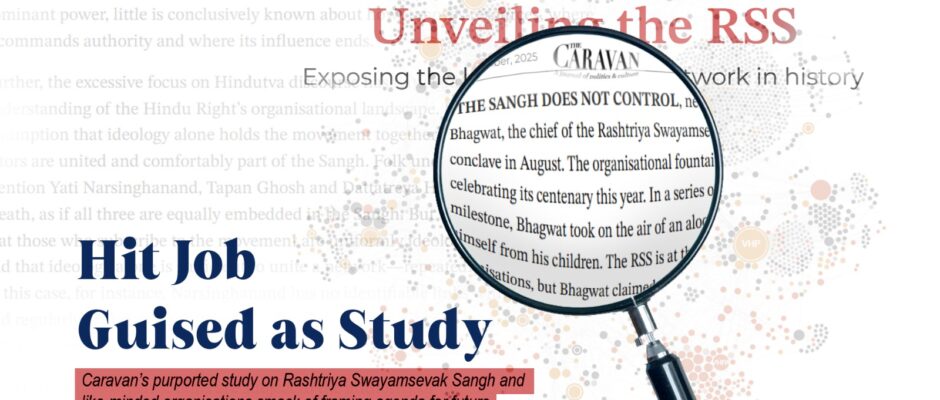
Hit Job Guised as Study

Caravan’s purported study on Rashtriya Swayamsevak Sangh and like-minded organisations smack of framing agenda for future Dr Aniket Pingley “A plausible explanation is not necessarily a true one.” Dr. Richard Feynman, American Physicist & Nobel Laureate  Synopsis: The Caravan published a study on December 17, 2025 titled “Unveiling the RSS – Exposing the largest far-right network in history”. Its central hypothesis can be summarized as follows: The RSS is not a loose family of ideologically inspired but autonomous organizations, as claimed. Rather, it functions as a single, centrally coordinated political organism that strategically uses thousands of legally distinct civil-society entities as proxies to expand power, evade accountability, and manufacture the illusion of an organic grassroots movement. The study repeatedly asserts that what appears as decentralization has in fact concealed bureaucratic control and that RSS maintains a dual narrative: public denial of control and internal acknowledgment of centralized authority. The central hypothesis smuggles in multiple unstated claims that radically escalate its meaning. Here is what the study actually posits: The study advances several interlocking claims: This is not the first, nor the last, “study” that “attempts” to “demystify” RSS and a large bouquet of organizations with shared ideals. Keeping my subjective opinion about the intention behind this study aside, let us put it to an objective, rational and fundamental test. The test has three questions: “Suspicion, however strong, cannot take the place of proof.” Supreme Court of India, February 2021 Mapping Caravan’s Claims Against Four Postulations The afore-stated verification framework which includes first-hand verification, evidentiary validity and inferential necessity, will be applied to all postulations. P1: “Claims of autonomy are intentionally deceptive; RSS is consciously lying.” This is an accusation of intentional deception and not mis-description. Here are Caravan’s claims. Failure on Verification Test: Caravan’s Proof #1: Caravan states that RSS public material states that it “runs” other organizations as well. The books by Rakesh Sinha and Ratan Sharda are used as a proof of RSS own public material. It also hand wavingly states, “It is, however, common knowledge that the RSS’s influence extends far beyond this limited circle.” Counter-questions for Caravan: What is the basis to qualify a certain literary work as RSS own public material? Does RSS own a publication or on the contrary publicly denies owning a publication? Are even the authors cited holding any official position in RSS? Did Caravan meet an RSS top-level functionary to ascertain if the authors in-fact officially represent RSS? How does Caravan define and measure extent of RSS’s circle of influence? Failure: By asserting and concluding, before offering any evidence, that any literary work by an RSS sympathizer, well-wisher or volunteer is automatically RSS public material, Caravan demonstrates that it treats its own conclusions as proof, rather than seeking actual substantiation. Caravan has accused RSS of obfuscation while it being blurry about the mechanism to measure RSS influence by making use of hand waving statements. Caravan’s Proof #2: Caravan states, “the RSS, as has been repeatedly noted, is —not registered—not as an NGO, not as a religious trust, nor as any other legal entity.” And, that “ … lack of traceability on paper allowed it to set up a headquarters in the heart of the national capital without having to disclose its sources of funding, or even who its members are.” Failure: Legalese, clearly, is not of Caravan’s botheration. RSS is legally recognized in India as a “body of individuals” under the Income Tax Act, 1961, Section 2(31). This means that RSS, as a BOI, can be assessed for income tax purposes as a separate entity. Headquarters of RSS are built and operated under Dr. Hedgewar Smarak Samiti, an independent society registered under the Societies Act. Both these facts are (purposefully?) left-out from the study. A cursory reading on Internet shows several legal notices, defamation suits, sedition charges etc. levied against Caravan by a variety of individuals and entities. Perhaps, it is due to lack of rigour for the legalese. Counter questions for Caravan: Which legal obligation is actually being evaded by RSS? Provided its disregard for legal facts, should anything that Caravan states related to legality be taken seriously? Closing remarks: The “evidence” by Caravan supports an alternative explanation: a culturally networked movement with loose (or strong) coordination but no unitary legal control, since RSS is presented to be “not” a legal entity. If not legally backed, how is control defined or measured? P2: Decision-making authority flows from a central node; affiliates lack discretion Here are the claims made by Caravan: Failure on the Verification Test: Caravan’s Proof #3: I will take one example among a few similar ones. Caravan states “the Maharaja Pratap Singh Ved Vidyalaya was established by a Pune-based organisation, Maharshi Ved Vyas Pratishthan, whose founder, Govindadev Giri, is an RSS member, the treasurer of VHP-controlled trust Ramjanmabhoomi Tirth Kshetra and also sits on the advisory board of the Nagpur hospital Madhav Netralaya, named after former RSS chief Madhav Sadashiv Golwalkar. According to RSS mouthpiece, Organiser, Govindadev Giri’s “initial samskars as RSS swayamsevak are manifested in” the Pratishthan.” Counter-questions for Caravan: Is it being posited that Govinddev Giri (Maharaj) takes orders from RSS on how to conduct his activities? Even if Maharaj is advisor to Madhav Netralaya, does the eye hospital run on whims of RSS through him? If so, can the chain of command be established and proven to be enforced?   Counter-example for Caravan:  The creative director at Caravan happens to be alumni of the same University as many members of UK-based Conservative Party, so Caravan must be peddling Conservative views. Is there any apparatus to measure degree of ridiculousness of this “proof”? Failure: The establishment and operational excellence of Maharishi Ved Vyas Pratishthan is not being considered as a meritorious position of Govinddev Giri’s national influence; but his early association with RSS is posited as his de facto qualification. Caravan’s Proof #4: “Pracharaks are trained in central RSS mission and, upon qualifying, sent out to Sangh appendages to maintain and consolidate control over the network,

Read More

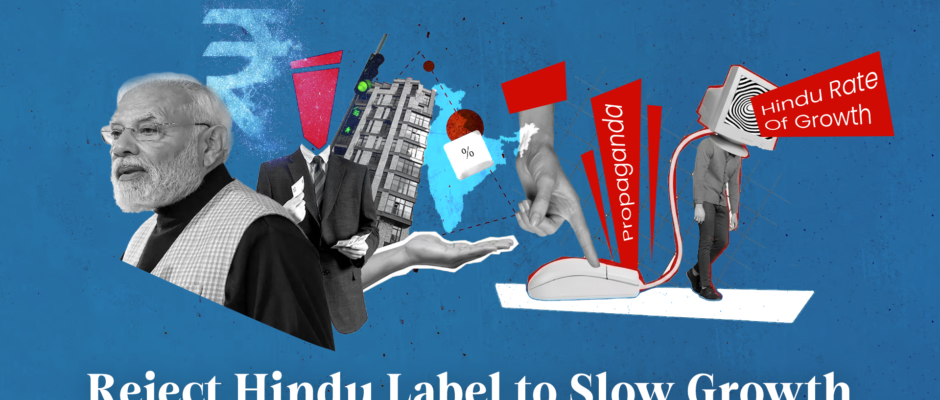
Reject Hindu Label to Slow Growth

Hinduphobia, colonial enslavement led certain intellectuals, socialists to frame Hinduness for tardy progress. Real culprits are socialists and their handlers! K.A.Badarinath It’s a colonial era slur. None has the right to deride about two billion Hindus living in 100 countries on some pretext or the other. Debunking Hindutva as being somehow responsible for Bharat’s tardy progress or sub-optimal GDP growth of 3.5 per cent in 1950s and 1980s era reeks of hatred. At last week’s Hindustan Times annual leadership summit, Prime Minister Narendra Modi rightly pointed to colonial mind-set for framing Hindu faith with tardy economic growth. Big question is why does one attribute slow economic progress and development to Hindutva? Why do some scholars make derogatory remarks and prejudiced framework to point fingers at Hindu people? Why do self-proclaimed intellectuals and economists ignore Bharat’s seven to eight per cent growth in last two decades was precisely due to these very Hindus? Colonial overhang and socialist underpinning of some intellectuals may have led to bracket low growth with Hindutva. As per The Oxford Companion to Economics in India, economist Raj Krishna made an attempt in 1982 to link the then 3.5 per cent economic growth to an inherent cultural phenomenon. Raj Krishna, a faculty member with Delhi School of Economics, blamed Hindus for not thinking big, staying reticent sans ambition etc. Well, Raj Krishna or his disciples’ arguments are not tenable. He may have grossly erred on intent and by design. Economic progress and development models hitherto adopted during Smt Indira Gandhi or Pandit Jawahar Lal Nehru were largely socialist in orientation and governance. Till, economic reforms were unveiled in 1991, state controls were overbearing and stifled growth. In pre-liberation era, strangulating free enterprise, spirit of Bharat’s businesses and individuals was the norm. Even the governance model was socialist in nature with most power concentrated in Prime Minister like the communist oligarchy. Most annoying was accusing Hindus of strangulating socio-economic development in Bharat and slowing down fight against poverty. It’s rather well documented that economist Raghuram Rajan had revived the debate on linking Hindutva to slow growth rates in 2023. In last quarter ending September 2025, Bharat’s economy reported an expansion of 8.2 per cent with about 65 crore people going to work. Similarly, Bharat was the top major economy to report growth of 7.3 per cent globally, highest amongst G-20 nations with China and Indonesia at second and third position with 5.3 per cent and 5.1 per cent respectively in 2024-25. Countries like Italy and Canada reported contractions in their economies during some quarters. Germany reportedly was at bottom of the pyramid with a feeble 0.2 per cent growth. Stellar economic performance by Bharat was not given a cultural, civilizational or Dharmic label? If it’s not Hinduphobic mind-set, why did self-proclaimed intellectuals bring in Hindu angle to lack of or slow economic progress? Consequence of this Hinduphobic mind-set was that ‘Hindu rate of growth’ gained credence internationally amongst academics and audience thereby driving wrong notion and reinforcing that Bharat and Hindus was incapable of development. Attaching a civilizational label or wrongly portraying Hindus as lethargic or not being innovative may be rejected lock stock barrel. In fact, socialist policies adopted in first four decades put Bharat’s economy on a slumber. Unleashing the potential in a free, flexible and predictable policy paradigm would allow Bharat to realize its potential and emerge the ace. Getting out of colonial mind-set and rejecting out-dated socialist doctrines is pre-requisite to further hastening growth the Bharatiya way. (author is Director & Chief Executive at New Delhi based non-partisan think tank, Centre for Integrated and Holistic Studies)

Read More

Analysis: From Siege to Staccato Strikes: 26/11 Mumbai Attack to 10/11 Red Fort Blast

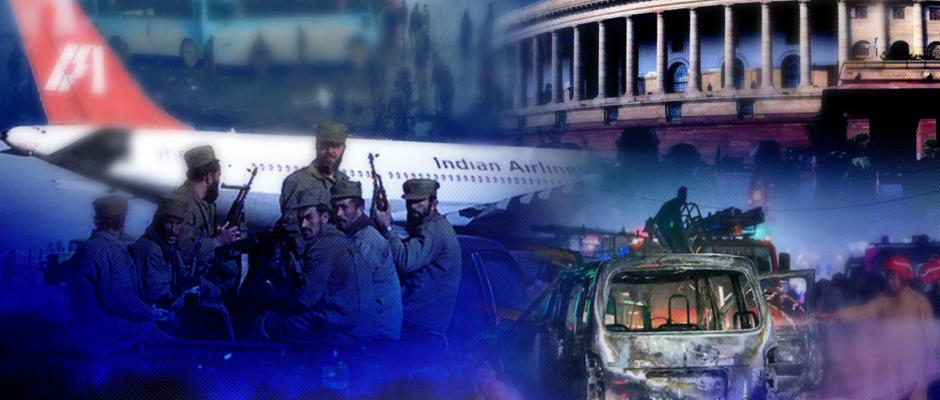
From foreign-directed, 26/11-style mega-operations to low-signature, micro-cell, digitally inspired strikes like 10/11 and the foiled ricin plot, India’s terror landscape has changed. Through community monitoring, hardened cities, quick forensics and sharper intelligence India has reduced incidences significantly. In order to combat terror ecosystems at their root, world must now embrace India’s zero-tolerance policy and modernise international counter-terrorism frameworks.

Read More

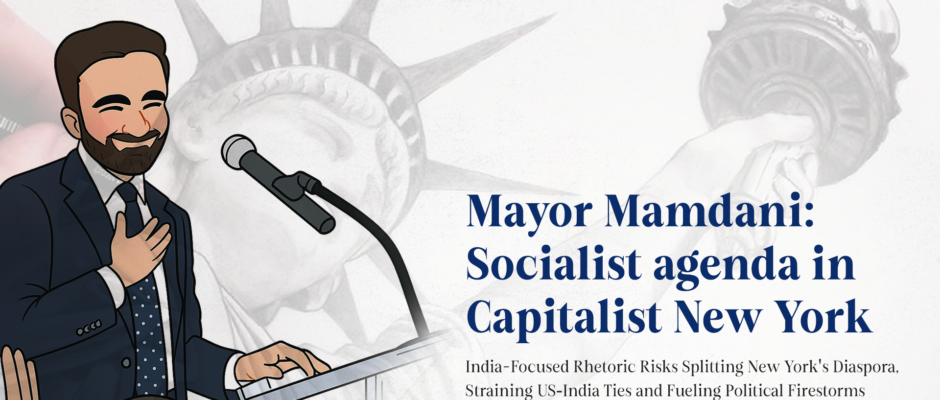
Mayor Mamdani: Socialist agenda in Capitalist New York

India-Focused Rhetoric Risks Splitting New York’s Diaspora, Straining US-India Ties and Fueling Political Firestorms N. C. Bipindra Zohran Mamdani’s victory marks a striking moment in New York politics: a young, Muslim, democratic socialist, son of filmmaker Mira Nair and Mahmood Mamdani, will lead US largest city at a time of heightened identity politics and global polarization. His biography helps explain ferocity of the debate around him. It’s his stance on India-related issues, Kashmir, Palestine, criticism of Prime Minister Narendra Modi and pointed public comments about Gujarat that has transformed what might otherwise be a municipal governance story into a transnational political flashpoint. This is not just about ideology; it is about how rhetoric issued from City Hall can fracture diaspora coalitions, complicate diplomatic ties and provide political fodder for opponents at home and abroad. Mamdani’s critics, ranging from conservative commentators to influential diaspora organizations argue that some of his statements are one-sided, factually shaky and politically inflammatory. Misinformation on Gujarat Row over his remarks about Muslims in Gujarat is instructive. Opponents in India and beyond called out a claim he made suggesting a dramatic demographic or social shift in Gujarat’s Muslim population; fact-checkers and Indian commentators quickly disputed that account, saying it mis-states census data and on-ground socio-economic diversity of Muslims in the state. Whether these were careless rhetorical flourishes or substantive errors, they gave immediate ammunition to critics who charge Mamdani with repeating misleading narratives about India. No Sympathy for Israelis, Kashmiri Pandits On Palestine and Kashmir, Mamdani’s record reflects unmistakable activism. His vocal support for Palestinian rights, his positions on settlement funding and public statements criticising Modi government’s purported human rights record have resonated with some New Yorkers particularly youngsters and left leaning advocacy networks. But these positions have alarmed others. Jewish social groups and centrist constituencies have warned that his rhetoric can blur lines between legitimate criticism of Israeli policy and statements that some interpret as insufficiently condemnatory of extremist violence; that perception has hardened a political fault line in a city with world’s largest Jewish population outside Israel. Jewish Reactions to Mamdani Several mainstream Jewish organizations issued cautious, measured statements after the election, underscoring their vigilance about anti-semitism while also acknowledging internal divisions over Israel policy – a reflection of broader tension Mamdani now inherits. Importantly, most stinging critiques do not simply target Mamdani’s policy preferences; they attack his credibility. Opponents say his India-related assertions sometimes rely on sweeping narratives rather than granular, verifiable evidence. In public fora and on social media, detractors frame those statements as kind of moralising shorthand that, in a globalised information environment, can be magnified into misinformation or selective history-telling. Indian Americans Call Him Biased For New York’s diverse South Asian community that encompasses people with attachment to India, Pakistan, Bangladesh and beyond: such simplifications risk alienating those who do not see their lived realities reflected in Mamdani’s public claims. The result is a fractured coalition: socialist base that propelled him to victory and diaspora groups who feel caricatured or dismissed. Another dimension is geopolitical optics. Mayors generally have limited formal capacity to change US foreign policy, but New York’s Mayor remains a global figure whose words carry diplomatic weight. Misinformation as a Weapon Critics warn that incendiary or ill-substantiated claims about India could complicate US–India municipal and cultural ties, from sister-city arrangements to trade and philanthropy, and could be seized upon by political actors in New Delhi eager to paint American democrats as biased or hostile. That risk is magnified because India has a politically active and often transnational diaspora that reacts swiftly to public statements by prominent figures; controversy can therefore ripple back to New Delhi and become a bilateral talking point. Indian American community in New York has sharply criticised his comments on India, as “bigotry and bias” against Indian communities, and called him “divisive, discriminatory, and unbecoming.” Fanning Domestic Polarisation Domestically, Mamdani’s India-focused controversies also feed a very immediate vulnerability: nationalised political polarisation. President Donald Trump and conservative pundits have already shaped a narrative casting Mamdani as dangerously radical, a framing Trump used in the campaign to argue that federal funds should be withheld should Mamdani assume office. That nationalisation of a municipal election transforms local disputes over housing and transit into existential fights over patriotism, security and cultural loyalty. In a hyper-partisan media environment, claims about “misinformation” on issues like Gujarat riots or about Pakistan/India politics can be weaponised to de-legitimize policy initiatives, no matter how pragmatic their intent. Keeping Governance Promises Policy implications matter. If Mamdani wants to deliver on his agenda, rent stabilisation, transit relief, childcare expansion, he must secure broad administrative cooperation, funding and buy-in from constituencies that feel threatened by his rhetoric. That requires the kind of political translation that sanctified rhetoric rarely achieves: careful, evidence-based communication; clear sourcing for claims about international events; and consistent, unequivocal condemnations of violence and extremism coupled with nuanced critiques of state policies. Failing that, even feasible policies will be cast through the prism of identity and foreign-policy controversy, making compromise harder and governance costlier. Gujarati Muslim Father, Punjabi Hindu Mother There is, however, an opening: Mamdani’s background and family story provide him with a platform to reframe the debate. His parents’ Indian origins, public intellectualism, and filmmaking sensibility give him rhetorical gifts that could be used to de-escalate rather than inflame. By commissioning independent fact-finding on contested claims, clarifying past statements and engaging directly with South Asian and Jewish community leaders not as adversaries but as partners in city governance, he could shift the narrative from cultural combat to municipal competence. That won’t please hardliners on either side, but it could blunt attacks that center on his credibility rather than his policies. Fueling Identity Politics Finally, case of Zohran Mamdani is a cautionary tale about modern urban leadership: global identity politics are now inseparable from municipal governance. Mayors must navigate local service delivery while managing transnational reputations and diaspora sensibilities. For Mamdani, pragmatic path is clear even if politically costly: root his public statements

Read More
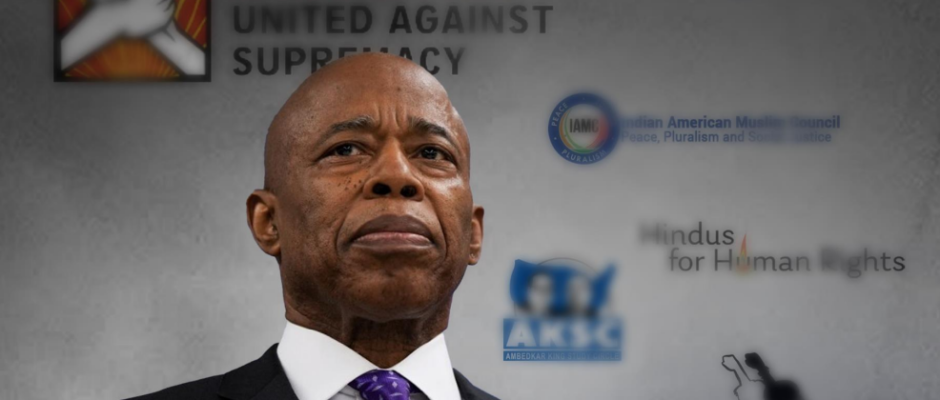
Open-source intelligence (OSINT) reveals that the Savera coalition and the groups that countersigned its 10 July 2025 letter are not a loose assortment of concerned New Yorkers; they constitute a disciplined advocacy network that fuses three streams of ideologies: 1. U.S.–based Muslim-Brotherhood-adjacent infrastructure led by CAIR-NY and the Indian American Muslim Council (IAMC); 2. A newly-minted “progressive-Hindu” and anti-caste façade (Hindus for Human Rights, Ambedkar King Study Circle, Dalit Solidarity Forum) that supplies anti-Hindu normalisation; 3. Legacy left-wing, church and labour partners (e.g. The Riverside Church, Rabbis for Ceasefire, ASAAL, DRUM) that amplify messaging inside “legacy left wing circles” circles. These entities repeatedly collaborate under banners such as Reclaiming India and the Alliance for Justice & Accountability, run coordinated social-media campaigns, and target three policy nodes in Washington: Congress, USCIRF and the State Department. Their operational goal is to brand Indian government positions, and increasingly mainstream Hindu events in America, as “supremacist”, thereby normalising an equivalence between Hindutva and violent extremism. While most are registered 501(c) organisations, multiple red-flag indicators emerge: historic Hamas-related designations (CAIR), documented Jamaat-e-Islami overlaps (IAMC), Soros-funded BDS-style campaigning now redirected from Israel to India (HfHR), opaque fiscal disclosures, and revolving-door leadership across the network. The pattern warrants Treasury, DOJ and IRS scrutiny for potential FARA non-compliance, foreign in-kind support and grant-making that masquerades as purely humanitarian work.

Understanding Savera, 31 co-signatories that petitioned Mayor Eric Adams

Open-source intelligence (OSINT) reveals that the Savera coalition and the groups that countersigned its 10 July 2025 letter are not a loose assortment of concerned New Yorkers; they constitute a disciplined advocacy network that fuses three streams of ideologies: These entities repeatedly collaborate under banners such as Reclaiming India and the Alliance for Justice & Accountability, run coordinated social-media campaigns, and target three policy nodes in Washington: Congress, USCIRF and the State Department. Their operational goal is to brand Indian government positions, and increasingly mainstream Hindu events in America, as “supremacist”, thereby normalising an equivalence between Hindutva and violent extremism. While most are registered 501(c) organisations, multiple red-flag indicators emerge: historic Hamas-related designations (CAIR), documented Jamaat-e-Islami overlaps (IAMC), Soros-funded BDS-style campaigning now redirected from Israel to India (HfHR), opaque fiscal disclosures, and revolving-door leadership across the network. The pattern warrants Treasury, DOJ and IRS scrutiny for potential FARA non-compliance, foreign in-kind support and grant-making that masquerades as purely humanitarian work.

Read More
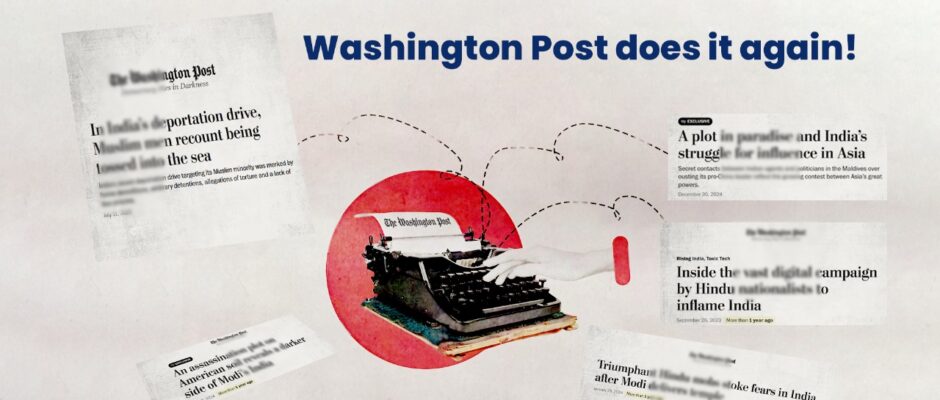
Washington Post Does It Again!

Washington Post Does It Again!

Agenda based biased reportage from Bharat seems to never end. Latest story is with regards to illegal infiltrators from Bangladesh. CIHS Several global media representatives operating out of India or those descending in New Delhi on behalf of organizations like Washington Post seem to have been adequately briefed on their agenda. And, these uncouth operators who carry press cards may have in reality been sold out to ‘anti-Bharat’ lobbies globally. Otherwise, there’s no reason why Washington Post does time and again only seek to debunk the India story through its editorial and news columns. Latest in a series of ‘anti-India’ despatches appeared in July 11, 2025 edition of Washington Post under the headline, “In India’s deportation drive, Muslim men recount being tossed into sea” put together by Pranshu Verma, Tanbirul Miraj Ripon and Sahal Qureshi. Their claim through the write up is simple from the word ‘go’. They claimed with obviously little or no-evidence that Indian Muslims with valid documents were either thrown into the sea or pushed across Bangladesh borders. Detentions, demolitions and torture purportedly perpetuated by Indian security personnel have been written about. Even a cursory online search puts the number of illegal migrants and Bangladeshi infiltrators as more than 20 million turning India into being the country with largest number of illegal migrants in the world. As per Ministry of Home Affairs, Bharat, Delhi and Mumbai, apart from coastal states like Gujarat and Goa have become centres of illegal migrants especially from Bangladesh and Pakistan. These numbers in no way bother Washington Post reporters with an ‘agenda’ to paint Bharat black and dirty as it expands its growth story, spreads prosperity and remains open, largest and a bustling democracy. Washington Post management decision to run an anti-India tirade through its editorial and news pages may not surprise many. In recent past, WP published two anti-India stories that turned out to be blatantly false if one were to go by Indian government. One WP report made a sensational claim that India made serious attempts to impeach Maldivian President Mohamed Muizzu. Second big claim made by WP was that Indian agents attempted to eliminate certain terror elements in Pakistan. Well, both reports were denied by Indian government and bracketed them as ‘compulsively hostile’ in nature, spirit and content. In fact, Washington Post had to publicly apologise for mocking at Bharat’s mars mission with ‘frugal budgets’ and turning it blatantly racist. Well, WP management, under owner Jeff Bezos of Amazon who purchased the media house through Nash Holdings in 2013 for reported US $ 250 million, may have overstepped in its editorial and news policy towards India. Otherwise, there’s no reason why Washington Post goes hammer and tongs against Bharat, her interests and her ethos. Leave alone the factthat Bangladeshis form largest chunk of illegal immigrants, WP does not consider significant enough that India is home to over 205 million Muslims as per Pew Research. And, this number would only grow in multiples to become largest Muslim population in the world by 2050. Now, these projections are in contradiction to WP claims of Muslims being targeted or framed by India. Deportation of infiltrators or illegal immigrants from India may not be an outright crime. But then, for Washington Post, it’s a human rights issue. Will Washington Post come up with screaming headline when illegal migrants to America are sent back to their countries of origin? In the deportation of infiltrators, where do Hindu groups figure? What’s their crime? Why portray Hindus as the aggressors? In the process, Washington Post has lost the plot and pursuit to objective reporting of events, developments and ‘news worthy’ issues. If India were to demonize her own Muslim citizens as claimed by Washington Post, how does one explain their socio-economic progression in last two decades in particular? In a campaign against illegal occupation of public spaces also, Washington Post sees a sinister design to dismember Muslims in India.

Read More
A Terrorist Tech Review in Khorasan

A Terrorist Tech Review in Khorasan

Broader implication is that counterterrorism efforts must adapt to an era of synthetic propaganda and AI-assisted operations. This means investing in new detection technologies, updating regulations for AI platforms, and perhaps rethinking how we monitor online terrorist communities without infringing on common people’s privacy. Rahul Pawa In June 2025, an unlikely tech column appeared in Voice of Khorasan, the English-language web terrorist propaganda magazine of ISIS-K (Islamic State Khorasan Province). Amid usual disillusions, Issue 46 featured a detailed comparison of popular AI chatbots; from OpenAI’s ChatGPT and Microsoft’s Bing AI to the privacy-focused Brave Leo and the Chinese bot dubbed “DeepSeek.” The tone resembled a consumer tech review, but the intent was deadly serious. The authors warned fellow jihadists about the risks of these tools, raising alarms about data privacy and surveillance. ChatGPT and Bing, they noted, might log user data or even expose a terrorist’s IP address, a potential death sentence for an terrorist on the run. They cautioned that generative AI could churn out false information or even mimic someone’s writing or speaking style, making it a double-edged sword for propaganda. After weighing the platforms, the magazine gave its endorsement: Brave’s Leo AI, integrated into a private web browser and requiring no login, was deemed the safest option for terrorists seeking anonymity. In essence, ISIS-K selected the chatbot that asks for the fewest questions in return, a chilling reminder that even terrorists prize privacy features. This surreal scene, a terrorist group rating AI assistants illustrates how terrorist organisations are eagerly probing the latest technology for their own ends. If Islamic State’s Afghan affiliate is producing in-house reviews of chatbots, it is because they see potential tools for propaganda, recruitment, and even operational support. And ISIS-K is not alone. Across the ideological spectrum, violent terrorists are experimenting with generative AI, ushering in a new chapter in the long history of terrorists exploiting digital media. From jihadists in remote safe houses to far left extremist cells in Western suburbs, terrorists are testing how AI can amplify their hateful messaging and help them evade detection. It’s a development that has counterterrorism officials on high alert, and for good reason. For decades, terrorist groups have been early adopters of new media. In the late 1990s, Al-Qaeda circulated grainy VHS tapes and CD-ROMs with lectures by Osama bin Laden. By the mid-2010s, ISIS perfected the art of online propaganda: slickly edited videos, encrypted chat channels, and multilingual web magazines reached recruits worldwide at the click of a button. The Islamic State’s media operatives earned a dark reputation as “innovators” in digital terror, leveraging YouTube, Twitter, and Telegram in ways governments struggled to counter. Now, generative AI is the latest technology wave and once again, terrorists are riding it. What’s different today is the power and accessibility of these AI tools. Modern generative AI can produce content that is startlingly realistic and tailored to an audience’s biases or emotions. This opens troubling possibilities for propaganda. Terrorist groups can now generate fake images, videos, and even interactive dialogues at scale, with minimal resources. In recent months, terrorists have used AI-created images and videos to stoke sectarian hatred and amplify conflicts. During the Israel counter strike on Hamas in 2023, for example, Hamas-linked propagandists circulated doctored visuals, including fabricated pictures of injured children and fake photos of Israeli soldiers in humiliating situations to inflame public emotion and spread disinformation. These AI-manipulated images blended seamlessly into the online information ecosystem, making it harder to separate truth from fabrication in the fog of war. ISIS and its offshoots have likewise ventured into deepfakes. Islamic State’s media affiliates reportedly published a “tech support guide” in mid-2023 instructing followers how to securely use generative AI tools while avoiding detection. Not long after, ISIS-K began unveiling AI-generated propaganda videos. Following a 2024 attack in Afghanistan, ISIS-K released a video bulletin featuring a fictitious news anchor, generated by deepfake technology calmly reading the group’s claims of responsibility. The video looked like a normal news broadcast, complete with a professional-looking anchor, except it was entirely fabricated by AI. In another case, after an assault in Kandahar, an ISIS-K propagandist created a second deepfake “Khurasan TV” clip, this time with a Western-accented avatar as the presenter. The goal is clear: lend terrorist propaganda a veneer of credibility and polish that previously required a studio and camera crew. Instead of grainy cellphone martyr videos, we now see digital avatars delivering the jihadists message in high definition, potentially fooling viewers (and automated content filters) that would dismiss overtly violent footage. As one security analyst observed, this marks a stark upgrade from the early 2000s when terrorist videos were rudimentary and “prioritised the message over higher production values” , today’s AI-crafted terror content can closely resemble legitimate media broadcasts. Why are terrorist groups so keen on generative AI? The answer lies in what these tools promise: speed, scale, personalisation, and a degree of deniability. A large language model can produce terrorist propaganda texts in multiple languages almost instantaneously, allowing a group like ISIS-K or al-Qaeda to tailor messages to different ethnic or national audiences without a large translation team. AI image generators can churn out endless visuals for memes, posters, or fake “news” proof, enabling agitators to flood social media with content that algorithmic moderation hasn’t seen before, thereby evading detection by hash-based filters that flag known terrorist photos. As Adam Hadley of Tech Against Terrorism warned, if terrorists manipulate imagery at scale with AI, it could undermine the hash-sharing databases that platforms use to automatically block violent content . In effect, generative AI offers terrorists a way to boost volume and variety in their online output, potentially staying one step ahead of content moderation efforts. Just as importantly, AI lowers the barriers for creating sophisticated lies. Misinformation and conspiracy theories can be mass-produced with ChatGPT-like models, which excel at mimicking authoritative tone or even an individual’s speech patterns. ISIS-K’s magazine explicitly noted this danger that AI can “create false information or mimic specific speech patterns”

Read More
Trump’s Tantrums & Lies!

Trump’s Tantrums & Lies!

Quixotic dealing with strategic allies untenable, US may lose out on India and get cornered as the deep state and left lobbies plays dirty. K.A.Badarinath Overwhelming opinion amongst intelligentsia is that US President Donald Trump is throwing tantrums and lying through his teeth. His repeated claims from Washington DC, Kananaskis – the venue for G-7 summit – and elsewhere have come under close scrutiny internationally. First big claim that President Trump made was to have successfully mediated between Bharat and Pakistan during the week-long conflict to avert a nuclear war. The two countries fought a limited war following daylight murder of 26 tourists in Pahalgam of Jammu and Kashmir by ISI sponsored terrorists in April 25, 2025. Yesterday, Indian Prime Minister Narendra Modi categorically debunked President Trump’s falsified claims from White House and outside. Neither was there any mediation, dialogue nor intervention by President Trump to pause the armed conflict. Instead, ‘Operation Sindhoor’ was paused only at specific and desperate request of Pakistan military establishment through regular channels of communication after Bharat pounded its airbases deep. In fact, Trump had gone ahead and tweeted to claim his leadership role in dissuading the South Asian neighbours from going to a major nuclear war. Yesterday, President Trump went a step further and pointed out that international media did not write about his ‘stellar role’ as peacenik between the arch rivals. On the contrary, in his 35-minutes telephonic conversation with Trump, Modi unambiguously stated that the latter had no role whatsoever. Indian foreign office ‘read out’ by Secretary Vikram Misri clearly dismissed in most certain terms any mediation by President Trump. What’s laughable is that Donald Trump repeated his bombastic claim from Oval office that he stopped the war even after getting a ‘earful’ from Modi. Second big claim of President Trump that trade deal between India and US was used as leverage to bring around Prime Minister Modi. Again, this has been outright dismissed outright by India. President Trump’s suggestion that trade deal in the works between India and US leveraged to prevent a larger war was again billed as ‘preposterous’ and ‘untrue’. To drive home India’s unambiguous position on war with terror infested Pakistan, Modi firmly and politely declined Trump’s invite to stop over in Washington DC for a chat citing ‘prior commitments’.  One cannot recall if American President’s invite was ever declined by Indian leadership in the past. Few things have been stated crystal clear to President Trump in the telephonic conversation whether he liked it or not. India will not and never accept mediation with Pakistan. This is key articulation of the country’s policy as part of its ‘strategic autonomy’ framework. Yet another point made was that funding, sponsoring and abetting terrorism will now on be considered war against India and not Proxy war. And, hence, Bharat reserves the right to hit back in a manner it deems fit. Thirdly, Jammu & Kashmir is non-negotiable, integral to India and only discussion could be on areas under illegal occupation of Pakistan. In last few weeks, India exercised maximum restraint in not taking on President Trump’s claim either directly or indirectly. Yesterday’s phone call between the two leaders reflected clarity in articulation India’s position.  On the parallel, General Asim Munir of Pakistan getting close to White House, having a closed door lunch with President Trump is something that clearly indicates complete disruption in US foreign policy under Republican Presidency. Reports that President Trump promised hitherto denied defence technologies to Pakistan for using its territory to strike against Iran has its own implications. Old foreign policy hands have an independent analysis on the chain of events including President Trump’s claims that have been eventually denied by Indian foreign secretary Misri. Entire rule book in diplomatic niceties have been consigned to dust bin by President Trump and his bunch of policy advisors from corporate world while dealing with Presidents and Prime Ministers. Hosting General Asim Munir has its own nuances and messaging for sure. President Trump seems to have realized that General Munir could be deployed to could push the American agenda in Asia. Using Pakistani airbases and army entry – exit points across 1000 kilometres long border with Iran will only expand the war theatre between Israel and Iran. Courting Pakistan at most critical junctures have had happened even in the past. Hence, Trump – Munir lunch may not have come as a big surprise for some Indian security hawks. Also, Donald Trump may be looking at a defunct and rudderless Pakistan as ‘potential market’ for clinching transactional business deals as well as go down in human history with a ‘peace nobel’ courtesy Islamabad’s leadership. One big suspicion is that American deep state may be playing dirty against Prime Minister Modi’s decisive leadership as it had attempted at  denying his re-election for a third consecutive term. Cosying up of Pakistan military establishment with Republican White House may have come after a successful trade deal hammered out by Trump and Chinese Communist Party’s iron-fisted President Xi Jingping. In ultimate analysis, President Trump comes out as an ‘undependable ally’ for anyone including Bharat. Disruptions in equations with friends and foes may be treated with equanimity by the slippery Trump administration. Rising American societal unrest that has begun to show up in demonstrations and protests may only deepen threatening the very idea of ‘United States of America’. American deep state and Left aligned lobbies entrenched over decades are bound to exploit the churn to their advantage. In the process, there’s huge possibility of President Trump getting cornered. In the process, Trump may lose out on India. (Author is Director & Chief Executive of New Delhi based think tank, Centre for Integrated and Holistic Studies)

Read More
‘Mis-Reporting on War Against Terror’

‘Mis-Reporting on War Against Terror’

India faced serious issues when a few top international media outlets shred objectivity in their reportage on terror, terrorist organizations, their handlers and financiers. Rohan Giri In the dense fog of war against terror unleashed by India after dastardly killing of 26 tourists in Pahalgam, several international media outlets rushed not to inform, but to build slanted opinion in sync with their agenda-based narratives. From manipulated assumptions to selective outrage, recent reportage by outlets like The Independent, Al Jazeera, British Broadcasting Corporation (BBC), The Guardian, The Washington Post and The New York Times raises serious questions not just about journalistic standards but the intent behind this slanted coverage of war on terror. Even global news agency like Reuters fell to prey to such narratives. Between May 7 – 11, India’s Ministry of External Affairs (MEA) and Ministry of Defence (MoD) jointly released evidence and detailed press briefings were held showing how India’s calibrated military actions were in direct response to a spate of cross-border terror attacks traced to Pakistan-based jihadi networks. Indian government provided satellite Intelligence, precision strike data and official press briefings were held. But, the international media houses chose to bury facts, ignore or sidestep India’s security concerns, campaign against terror and gave platform to unverifiable Pakistani military propaganda. One big question was the possible agenda these media houses peddled during the conflict? London-based The Independent carried articles in series on terror attacks, military retaliation by India and the two full days of conflict. One piece suggested that Pakistan shot down three Indian Rafale fighter jets. Reuters went a step further and put the number of fighter jets lost by India at five.  The New York Times even claimed that it had evidence. But then, what’s the basis for these dispatches? Well, an old hand at international news agencies averred that the story was blurted  out by American security establishment sleuths that reportedly kept a watch on India’s precision strikes that led to destruction of nine terrorist sites in Pakistan occupied Jammu Kashmir and deep within Pakistan where over 100 terrorists were neutralised. Another version was that Chinese Communist Party apparatus swung into action. Its agenda that apparently was pushed big time. As per these media analysts, China was keen to portray that its military aircraft and missiles in Pakistani armour shot down the Rafale fighter jets. Beijing’s possible intent was to establish its superiority in tactical and technological superiority in a complex war theatre. The word around was that China was simultaneously looking at testing its fighters capabilities and missiles power as against French Dassault built Rafales and Indian missiles. Well, one wonders on ethical part of media ecosystem that comes under close scrutiny in trying war situation. But then, lobbies with geo-political interests and corporates pushing their defence ware also played out. Unverified claims made by Pakistani military as part of its psychological offensive was taken as ‘fact based’ news copy without third-party verification or forensic satellite imagery. Interestingly enough, the big unanswered question was why several international media outlets failed to pass muster by for not juxtaposing India’s official version or basic checks done with South Block that houses defence ministry on Raisina Hill. A story on similar lines filed by The New York Times team in South Asia with screaming headlines that India lost jets. This is contrary to Indian army version that all aircraft returned safely to their base. If Pakistan had such decisive victories shooting down as many as five Indian jets and global media networks reported this as the ‘absolute truth’ where’s the evidence? Did Pakistan present wreckage or pilot log information? Was evidence sought either from US security establishment, Chinese peddlers or Pakistani machinery? Is this objective ‘war reporting’ or part of the larger misinformation campaign launched by Islamabad, its backers and cahoots? Another write up by Independent claimed that India used Israeli-origin Harop drones against Pakistan in a provocative act insinuating recklessness. Again, no proof was offered, no drone telemetry was shown and no assessment was provided of the Harop’s actual precision capabilities. Were these articles meant to inform the reader—or feed into a broader narrative that paints India as a trigger-happy aggressor, irrespective of facts? Al Jazeera went a step further. It aired emotional testimonies from locals in Muridke who disputed India’s intelligence that a mosque in the town had doubled up as a terror training camp. Civilians deserve to be heard in a war situation. But, why was it that these newsmen with huge track record failed to piece together Muridke’s well-documented history as headquarters of Lashkar-e-Taiba. This is not classified information—it is part of the 26/11 Mumbai terror ATF reports and independent research. Why suppress this reality? Who benefits from painting that Muridke was a “victim”? Moving to the next peddler, The Guardian published a humanizing profile of Pakistan Army Chief General Asim Munir, portraying him as a composed and stabilizing force. What got omitted in the process was Munir’s leadership of Pakistani military that intensified support to jihadist proxies under the guise of “strategic depth”—a doctrine responsible for decades of regional instability. Why romanticize military leadership in a country where elected civilian voices are repeatedly silenced and the army retained unchecked power? Why does The Guardian avoid similar puff pieces for India’s civilian leadership during crisis management? In another article, The Guardian casually reported India’s accusations that Pakistani drones had attacked Indian civilian and military sites. It framed this as part of a “tit-for-tat” cycle—effectively equating defensive action with terrorist provocation. But how can a country’s retaliation after civilian deaths be presented as escalation? Is there no difference between attacking civilians and targeting terror camps based on intelligence? Meanwhile, The Washington Post centered its story on the theme of “misinformation”—but blurred the lines between Pakistan’s unverifiable claims and India’s official statements backed by data and press briefings. Does Washington Post really believe a constitutional democracy’s formal briefings are on par with WhatsApp forwards and anonymous leaks pushed by a military-intelligence complex with a known

Read More