CIHS – Centre for Integrated and Holistic Studies

Date/Time:

77 Years Later: Women, Religion, and Gender Biases in Pakistan

Pakistan’s commemoration of its 76th year of independence ironically highlights the dire situation of its women to the world. Even after seven long decades post-independence, women in Pakistan are still deprived of basic rights like education, freedom of expression, and opportunities for employment. Interactions with these women reveal a bleak landscape of their relentless battles and diminishing hopes, questioning the essence of what independence and empowerment should signify in contemporary Pakistan. The Global Gender Gap Index Report 2022 starkly showcases Pakistan’s lamentable gender disparities. Globally, Pakistan regrettably ranks near the bottom in areas such as economic participation, education, health, and survival. These glaring figures bring to light the deep-seated gender biases corroding Pakistani society. Heartbreakingly, interviews depict that many women, from diverse backgrounds, feel oppressed and frequently persecuted. The glaring lack of women in political leadership roles further accentuates the overpowering grasp of patriarchal norms. As Pakistan grapples with increasing vulnerabilities to climate change, it is the women who suffer most. The evident link between environmental concerns and gender inequities is undeniable, more so when environmental calamities intensify the hardships for women. Disappointingly, Pakistan’s leadership and related agencies seem to disregard the urgent need for gender-sensitive climate policies. Women are forced to grapple with the adverse effects of polluted air, dwindling water resources, and other ecological hazards. Karachi, often hailed as the crown jewel of Pakistan, sadly reflects the country’s deep-seated gender prejudice. Interviews conducted there consistently highlight the harrowing challenges women face daily in their pursuit of fundamental rights. The pervasive issue of harassment looms over many working women, indicating a stark absence of safety and respect in society. Their stories resonate with the perpetual tension between aspiring for basic liberties and the grim reality of a society that denies them. While there are sporadic glimpses of progress in isolated pockets of Pakistan, they are largely eclipsed by overwhelming challenges. Although a section of women is experiencing improved access to education and a shift in societal attitudes, such changes only underline the inconsistent strides Pakistan is making towards gender equality. The societal chasm and economic divides paint a grim narrative: a handful of the educated find better opportunities abroad, while many remain entrapped in their homeland. Regions like Khyber Pakhtunkhwa serve as stark reminders of areas where opportunities for women’s education and employment are scarcely available. For a select few, empowerment is perceived as a state of mind. Yet, such an uplifting perspective is frequently overshadowed by societal constraints. While acknowledging one’s self-worth can be liberating, the overwhelming societal barriers often appear insurmountable. A disheartening reality permeating Pakistani society is that even though education is regarded as a catalyst for change, women’s aspirations are recurrently thwarted. While both genders emphasise the significance of education, it’s clear that education in isolation cannot reform the prevailing norms. A comprehensive transformation is essential. Families, communities, and policymakers must move beyond mere words and take decisive actions to ensure women are accorded their rightful stature in society. Tragically, when evaluating Pakistan’s intricate web of gender inequality, the plights of religious minority women further exacerbate the situation. Hindu, Sikh, and Christian women, already marginalised due to their gender, are subjected to heightened persecution based on their religious affiliations. Reports and personal accounts underscore distressing instances of kidnappings, forced religious conversions, and coerced marriages. These young girls are often brutally separated from their families and pressured into renouncing their faith, further alienating them within their communities. Such heinous acts are not just a violation of religious freedom and human rights but also emphasise Pakistan’s pressing need to address the dual challenges of gender and religious persecution. The commitment to ensuring every woman’s safety and freedom, regardless of her religious beliefs, must be unwavering. Amid these narratives of despair, the question that emerges is – where does Pakistan envision its future in terms of gender justice and religious freedom? With the rest of the world progressing towards more inclusive societies, Pakistan seems to be caught in a time warp, clinging to outdated norms and practices. Yet, it is essential to remember that the situation isn’t bereft of hope entirely. Grassroots movements, led by resilient Pakistani women and their allies, are sprouting across the country. These women, armed with education, determination, and a vision of a brighter future, are challenging the deeply entrenched norms. They are building networks, using both traditional methods and technology, to reach out, educate, and uplift their peers. Furthermore, international attention and pressure could play a pivotal role. Global agencies, human rights organisations, and foreign governments can leverage their influence to urge the Pakistani administration to enforce stronger laws that protect the rights of all its citizens, irrespective of gender or religion. Sanctions, trade agreements, and international treaties can all serve as tools to nudge the nation towards the path of genuine reform. On the cultural front, artists, writers, and filmmakers within Pakistan are pushing boundaries, creating works that challenge societal norms and provide a platform for the oppressed voices to be heard. The role of art and media as a force for change cannot be underestimated, especially in a digital age where content can transcend borders and inspire solidarity and action globally. Pakistan stands at a crucial juncture. The choices it makes in the upcoming years will determine whether it continues its descent into a quagmire of regressive practices or rises, phoenix-like, to create a society that is just, inclusive, and forward-thinking. As the world watches, it remains to be seen if Pakistan will heed the cries of its women, recognise the strength in their resilience, and move towards a brighter, more equitable future.

Read More

‘Mother India’ Noise for Votes May Not Work

Congress will have to rejig its strategy to take on Prime Minister Narendra Modi. No confidence motion was lost opportunity for grand old party. K.A.Badarinath Who killed ‘Mother India? Was it the Narendra Modi government as alleged by Congress leader Rahul Gandhi or the grand old party that held the country’s reins for over five decades? Well the answer is quite obvious and straight. Feigning ignorance on ignominious and corrupt 50-odd years Congress rule post-independence may not help make out a case for the party with diminishing returns. A party that virtually turned ‘pigmy’ due to its own making and misrule has launched a desperate bid to resurrect itself in conjunction with 13-other splinter political groups run by ‘dynasties’ like the one that Rahul inherits. It was rather valiant for Rahul Gandhi to make a sweeping charge against Narendra Modi government holding it squarely responsible for turmoil in Manipur or communal flare up in Haryana. To deduce that Modi government was responsible for killing ‘Mother India’ or ‘Bharat Mata’ was chivalrous for a leader whose party oversaw the partition of India, conceded Aksai Chin to China and its leaders sought referendum on Kashmir like Brexit vote that was held in United Kingdom.  Congress ecosystem seems to get a high by referring to ‘Bharat Mata’ or mother India often used by right wing forces with reference to this millennia old Hindu centric society that absorbed people from all faiths, modes of worship, denominations, religion. Reference to ‘Bharat Mata’ may be Congress way of staking claim on this very wholesome conceptualization of Hindus that the country and its people have a soul, spirit and distinct way of living. The claim also reflects the rudderless Congress political formation’s machinations to pursue a soft Hindutva line to negate the BJP-led National Democratic Alliance (NDA) influence among vast Hindus that believe in cultural nationalism. Now that Congress has made its move,will majority Hindus buy Rahul Gandhi’s schizophrenia and vote for the party in legislative assembly elections in Mizoram, Madhya Pradesh, Rajasthan and Chhattisgarh followed by Lok Sabha polls in 2024? Alienation of majority Hindus due to unabated appeasement of Muslims and Christians is something Rahul Gandhi seems to be working on. Will this ploy work is something Congress strategists have to think? Weaning away nationalist ideological base and ardent Hindus from right wingers may not happen like heaping charges of corruption and corporate dealing on Modi government did not work. But, Rahul Gandhi seems to take on NDA, BJP and Narendra Modi on this plank. It may be a grave mistake that Rahul committed even before campaign for the 2024 elections began. Grand vision of ‘Bharat Mata’, ‘Virat Bharat’ or ‘Akhand Bharat’ of Hindus may be beyond comprehension of Congress and its leader Rahul Gandhi who may be looking to poach into BJP-led alliance votes. A thriving society that’s unique in its way of life and spread virtually across South Asia with cultural ethos as one common thread may not be an easy fact to accept by left-leaning Congress that lost its moorings of pre-independence days and fell into the trap of sectarian politics of divisive variety. Rahul or Priyanka Gandhi Vadra showing up for ‘aarti’ at temples to garner a few votes cannot be Hindu way of life or what Hindus believe this country as a ‘living entity with spirit and soul’. Otherwise, Congress has till date not offered plausible explanation for its government’s decision to pull back the Indian Army in 1971 war after the forces had Pakistan territory till Lahore. Was it not that Congress then Prime Minister Indira Gandhi hailed as leader of 1971 war with iron fists, who did not pursue India’s West Pakistan agenda finalized in consultation with the Indian armed forces? Does Rahul Gandhi even have an inkling of how this played out? Did Rahul Gandhi suffer temporary memory lapse on how his own party government forgot Pakistan Occupied Jammu Kashmir and now his party people have the cheek to seek referendum on Article 370 of Indian Constitution?  A part of this Indian Territory was usurped by China in a 1963 deal with Pakistan, but did Congress remember ‘Bharat Mata’ then? When Aksai Chin was occupied by China and Congress twiddled its thumb in New Delhi, can it now claim that ‘mother India’ was sliced into pieces in Manipur and elsewhere by Modi government? Chinese People’s Liberation Army (PLA) was given a free pass in 1950s and 1962 war to takeover Aksai Chin almost the size of Bhutan and was hitherto part of India’s Ladakh and never reflected in Chinese maps. Giving a staged outrageous twist to Manipur issue by claiming that the state has been divided will not work for Congress given that recent violence was handiwork of a combination of forces including the Church, drug mafia, insurgents from across Myanmar border apart from divisive tukde tukde gangs. Like corruption and corporate deals charges did not stick to BJP, separating ‘Bharat Mata’ from Hindutva forces may not happen in a jiffy. Rahul Gandhi has to think rejigging substantive Congress strategy to take on Modi, BJP that emerged as largest political party globally and NDA. (Author is Director & Chief Executive, Centre for Integrated and Holistic Studies, a non-partisan think based out of New Delhi)

Read More

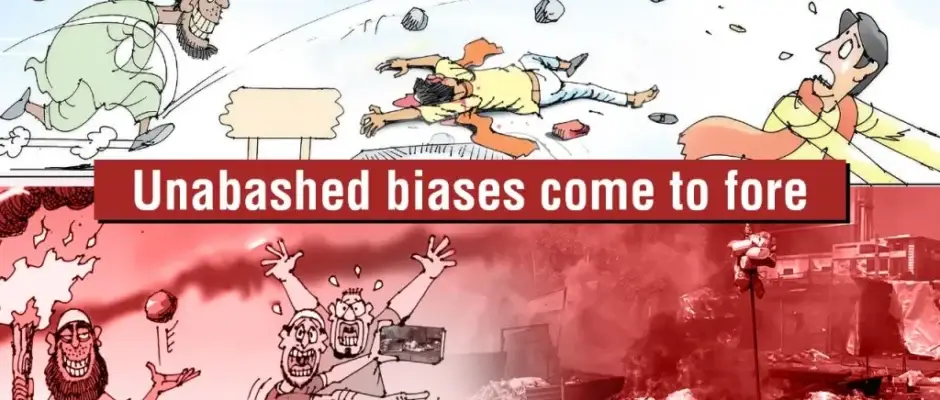
Unabashed Biases Come to Fore

Hindu-phobic reportage during recent violence in Nuh may have actually led in part to escalation in violence, loot and daylight killings Introduction: Biases displayed by global media in reportage of recent violence in India’s northern state of Haryana are unprecedented. Unlike what is written in major global news outlets, it’s important to present the actual and on-the-ground reality to debunk fabricated narratives peddled as the truth. Certain media outlets, which disseminate false stories and mislead readers, not only cause misinformation but also contribute to social conflicts, intended or unintended. Media biases are particularly evident in reporting of communal incidents and political figures in India. Some media outlets and self-proclaimed left liberal ecosystem have faced accusations of taking stand that’s far from truth, engaging in selective reporting and appeasing a few communities as part of a larger well designed conspiracy. This raises concerns about fairness of media coverage during violent incidents or conflicts. While media has been critical in certain cases, it has been silent or biased in others, leading to accusations of double standards. Prevailing narrative suggests a trend of anti-Hindus sentiment in the global media, with increasing number of news portals being critical of right-wing politics and activism. It is worth questioning what happened to those who were once considered flag bearers of ethical journalism post-2014. Historical instances in 1985, 1968, and 1987 highlighted selective reporting on Hindu-Muslim issues in several studies. Some news publications even censor names of Hindu victims and replace perpetrator names to portray Hindus negatively, prompting the need for accountability within the media ecosystem. Haryana violence reportage If we look at the way Haryana’s Nuh violence is being analysed, explained and reported, then blindness of the media becomes apparent. In this whole arson, mayhem and worse, the killing of five people including two policemen, self-styled ‘liberal’ commentators and the intelligentsia failed to see any Islamic connection to it. Pre-mediated violence is evident as it occurred even though Monu Manesar was not part of the Hindu procession. Impulsiveness of the devastation is evident from prearranged amassing of stones and iron rods at the scene. Extraordinariness of the situation further unfolds as the violence erupted within mere 15 minutes of Hindus annual procession commencement, with an unexpectedly armed and well-dressed crowd of approximately 200 people seemingly appearing out of nowhere. According to media reports, the Hindu side initially retreated, but later regrouped and resisted. Now, let’s delve into truth of this incident and examine how the media has depicted it. It is concerning to observe a dangerous trend where incidents are unjustly linked to specific individuals and exploited against them. When all aspects of the violence strongly suggest that it was premeditated and pre-planned, it becomes even more questionable to single out and associate it with any one person. Look at some reportage of media outlets: Source: The New York Times Source: British Broadcast Corporation (BBC) Source: Al Jazeera A Premeditated Event Propaganda notwithstanding, Haryana state chief minister Mannohar Lal Khattar after chairing a high level meeting with state’s home minister along with senior police and administrative officials said “The incident appears to be part of a larger conspiracy, as the Samajik Yatra (societal procession) has been taking place annually for several years. The authorities are investigating the incident to further to find out the underlying causes and potential motives behind it.” Home minister Anil Vij said “the incident does not appear to have happened all of a sudden. The level of violence that took place and also occurred at different points, the way stones were collected, weapons brandished and shots were fired, it does not have happened all of a sudden.” Afzal Ahmed, Member of Legislative Assembly of Haryana from Nuh said “This was a planned act of violence that has been carried out. In the past, there have been trips, but nothing like this ever happened” Chronology of Violence: On July 31, 2023, a ‘Brij Mandal Jalabhishek Yatra’ , a procession held by Hindus annually was obstructed by a group of young Muslims near Khedla Mod area in Nuh district of Haryana. Brij Mandal Jalabhishek Yatra, aimed at rejuvenating sacred Hindu sites, has been an annual event for the past three years. Notably, Nuh, formerly known as Mewat, is believed to house three ancient Shiva lingas, namely Nalhar Mahadev Temple, Jhirakeshwar Mahadev, and Shringeshwar Mahadev Temple. Within mere 15 minutes of the yatra’s commencement at Khedla Mod of Nuh, the situation took a drastic turn as Islamists began pelting stones, and shooting from unlicensed weapons triggering acts of arson. Witnessing the escalating chaos, the devotees attempted to retreat, but they encountered a barrage of stones from behind as well. Amidst the turmoil, petrol bombs were hurled at the devotees, making virtually challenging for some to seek refuge at the Nalhar Mahadev temple. Having cornered the devout Hindus in a dragnet of sorts, the rioters closed in on the temple, surrounding it, and wreaking havoc by setting cars, buses, and various vehicles ablaze, while firing indiscriminately at anyone in their path. Tragically, two individuals were hit by bullets during this rampage. Almost all vehicles were either burnt or severely damaged in the onslaught. Upon arrival of the police, the rioters fled, seeking refuge in the nearby hills, where they continued their assault by firing bullets at women, children and other devotees who had sought shelter inside the temple. With great effort, the administration managed to subdue the rioters and bring devotees out under police escort. Throughout this violent attack, the rioters specifically targeted police posts, temples, shops, and properties belonging to Hindus, leaving a trail of destruction and fear in their wake. The violence that originated in Nuh district quickly spread to the neighbouring areas of Sohna, Gurgaon, and Faridabad. As a consequence, innocent residents of these regions fell victim to rampage unleashed by the Islamic rioters. Hindus faced attacks on their homes and shops, witnessed their vehicles being vandalized, and experienced direct physical assaults. Nuh (Mewat): Muslims dominant! Nuh, a district situated in the

Read More

Bangladesh’s Crossroads: Navigating Rising Extremism and Anti-Hindu Persecution

Rahul Pawa Since its inception in 1971, Bangladesh has borne witness to an alarming trend of persistent human rights violations against the Hindu minority. The initiation of this harrowing journey can be traced back to the Bangladesh Liberation War, which tragically saw hundreds of thousands – some estimates even escalating to 2.4 million – of Hindus losing their lives. In the subsequent two decades, from 1971 to 1991, the Hindu demographic saw a significant drop from constituting 13.5% of the population to a mere 9.2%. As time went by, the situation didn’t improve; the 2011 census data further revealed the Hindu population dwindling to 8.5%, showcasing the grim reality of a consistent Hindu exodus induced by relentless persecution. Instances of violence, particularly the distressing post-election attacks of 2001 where an estimated 200 Hindus were killed, and many more were displaced, serve as stark reminders of this sustained oppression. The history, darkened by the tales of these atrocities, underscores the urgent need for robust and comprehensive action to protect the rights and wellbeing of Bangladesh’s Hindu minority. Recently, the persecution of Hindus has taken an even more disturbing turn with the rise of Islamist extremism, spearheaded by the Bangladesh Nationalist Party (BNP) and their ideological ally Jamaat-e-Islami (JeI). On Friday, July 28, 2023, these radical Islamist factions orchestrated a series of deplorable acts, magnified by a rally staged in the Naya Paltan area of Dhaka city. This gathering, attended by over one hundred thousand Islamists, served as the platform for the announcement of a continuous agitation program, delivered through a video message by BNP’s acting chairman and convicted terrorist, Tarique Rahman. This climate of fear and hostility has effectively marginalised Hindus, relegating them to the status of second-class citizens in their own homeland. Such developments pose serious challenges to Bangladesh’s secular fabric and its commitment to uphold human rights. On multiple instances, a host of leaders from the BNP have fearlessly expressed their intentions to strike back against every member of the Sheikh Hasina lead Awami League. Their rhetoric ominously suggests that the “agents of Awami League,” which includes Hindu supporters and India (Bharat), would be subjected to severe consequences should the BNP regain power. This hostile stance was reflected at the recent gathering as well, with attendees zealously participating in anti-India and anti-Hindu chants. A particularly disconcerting sentiment emerged from the crowd as they proclaimed, “Bangladesh is Muslimstan, Hindus go to Hindustan” – a blatant effort to exclude and marginalise the Hindu community, this sets a dangerous precedent for a potential escalation in an already volatile and strained environment. In stark contrast to the ominous atmosphere generated by the BNP rally, another event, a peace rally organised by the youth front of the Awami League, presented a deeply human and sympathetic face to the issues at hand. The rallying cry came from Purnima Rani Shil, a Hindu woman who suffered an unthinkable ordeal at the hands of BNP members at the tender age of 14, in the Ullapara area of Sirajganj district in 2001. In her moving testimony, Purnima conveyed the stark reality of what a BNP return to power might mean: “If BNP regains control, I fear thousands of Hindu girls may become victims of this notoriously anti-Hindu party. They stole my childhood and my youth. They exiled my family from our village. I found no justice anywhere, as from 2001 to 2006, the country fell into the clutches of Pakistani agents and enemies of humanity. Khaleda Zia is the matriarch of anti-Hindu atrocities, with her son, the convicted terrorist Tarique Rahman, functioning as a marionette of the Pakistanis. They aim to transform a secular Bangladesh into another Pakistan.”  Alarmingly, the Bangladesh Nationalist Party recently declared what they ominously labeled as the “final part of war” against Prime Minister Sheikh Hasina and her governing body, the Awami League. Urging their supporters to make Dhaka city their stronghold until the ruling government is unseated, this call to arms rings a dangerous bell, not just in Bangladesh, but echoes ominously across the globe. What’s particularly disconcerting are the financial streams that the BNP is purportedly benefiting from. Media reports suggest that the party is being showered with millions of dollars from dubious sources. These funds, murkily acquired, are directed towards sustaining a challenge against the incumbent government. Even in the face of severe economic collapse, Pakistan appears to be pumping substantial sums into the coffers of the BNP, raising concerns over its vested interests. Disturbingly, infamous figures such as terrorist Dawood Ibrahim are believed to be aiding the ultra-Islamist party with substantial financial support. This level of global backing raises serious questions about the international networks of radicalism and the ideological hatred driving these alliances. The BNP is also believed to be deploying the power of propaganda to influence minds and fuel divisiveness. It has reportedly poured millions into lobbying activities across the United States and Europe.  Simultaneously, the BNP is staging an alarming media assault against Prime Minister Sheikh Hasina and her government. Utilising the reach of social media and international news outlets, the party is disseminating a narrative steeped in extremist ideologies. This massive propaganda drive seeks to undermine the established peace and unity, as it fuels societal divisions on a large scale, aided and abetted by the malignant forces of Islamist hatred. The dangerous undertones of their activities are a stark reminder of the relentless threats that peace-loving societies face around the world and how nations that fall for such extremist views and ideas are destined to collapse. The persistent plight of the Hindu minority in Bangladesh, marked by rising religious extremism and significant financing of such factions, highlights the pressing challenges to peace, social harmony, and human rights in the region. As Bangladesh continues to grapple with these complex issues, the manner in which it safeguards minority rights and counters religious extremism will be pivotal. These developments, resonating far beyond national boundaries, necessitate vigilant observation and strategic intervention from regional and international stakeholders, underscoring the critical

Read More

Reject European Centric Narratives on India

Reclaiming Indian heritage, knowledge systems, cultural and spiritual vision based on Hindu way of life represent real India Rohan Giri At the launch of “Narrative ka Mayajal” authored by former Rajya Sabha Member Balbir Punj, Rashtriya Swayamsevak Sangh (RSS) Sar Karyavah (General Secretary) Dattatreya Hosabale said “the so-called educated people and media in Bharat have embraced Euro-centric ideas and narratives that got deeply ingrained in our lives, education system, and societal perspective. The narrative cannot transform until we relinquish this colonial mind set.” This view on conversations and public discourse in India held by Hindu centric RSS has kicked off a serious debate in India i.e. Bharat. India narrative and the colonial mindset are interconnected and have a long history dating back to the era of imperialist British rule pre-independence. Understanding this relationship requires examining how colonialism shaped Indian mindset and continues to influence narratives in the country even after 75-years post-independence. Colonial subservient mind-set was conveniently adopted by the elitist few that worked in tandem with their British masters. This mind set always centred on British superiority syndrome and looked down at the Indian way of life or society.  After having destroyed rich cultural heritage, indigenous knowledge systems and ethos, British rulers had systematically perpetuated the inferiority complex through education, media, academics, thinking processes and administrative policies. British portrayed themselves as the civilizing force, claiming to bring modernity, progress, and enlightenment to the “backward” and “uncivilized” Indians aggressively peddled by Lord Macaulay’s education doctrine. Such ideas were propagated to justify British rule and retain its control on Indian people, her resources, assets and destroy her culture, heritage and sanatan dharma. Education played a crucial role in shaping the colonial mindset. The British introduced a Western-style of education system that glorified British culture, history and achievements while denigrating Indian heritage and traditions. This led to devaluing indigenous knowledge systems and cultural practices, making many Indians internalize a sense of inferiority and cultural loss. At the book launch, Dattatreya Hosable said before the British came, Indians never underestimated themselves and fought against their enemies with courage and confidence. But the British created a narrative that made us doubt our own abilities. Also, he said they made us hate ourselves; such a narrative was spread by their agents through academia, universities, think tanks, international media and the judiciary. RSS strongly believes that we need to rediscover true India in the term of Atma Nirbhar Bharat, Hosabale stated.   At the last year customary Vijayadashami speech, RSS Sarsanghchalak (Head) Dr Mohan Bhagwat had said, “We need a Swa-centric approach towards history of India’s freedom movement.” British had primarily written and controlled the narrative during colonial rule presenting India through Euro-centric lens as it did in Africa and elsewhere. Indigenous perspectives and voices were marginalized and Indian history, culture, and achievements were often misrepresented or ignored. After gaining independence in 1947, India began the process of nation-building and redefining its narrative. However, the colonial legacy continued to have profound impact. The colonial mindset left its mark on the education system, administrative structures and social norms, which required conscious efforts to decolonize and reclaim Bharat’s identity. On the same line, Sah-Sarkaryavah Arun Kumar, at launch of the book, “SWA: Struggle for National Selfhood”, written by J Nand Kumar, convenor of Pragya Pravah had said, “It’s not time for blame. It is the time for introspection and self-correction. Instead of blaming leftists and other historians who distorted history, we must put dedicated efforts to bring out the truth. There is need for a positive and constructive approach.”  He had said, “The English-educated Indians who gained control over the institutions post-1911 reduced the idea of independence (Swatantrata) to just self-rule (Swadheenta) and ended up accepting India’s partition.” There is a need to change the fabricated stories that misrepresent India’s picture, culture, identity and rich heritage. RSS call for a positive and constructive approach to bring out the truth reflects the desire to overcome the distorted historical narratives and bridge the gap between the colonial mindset and the essence of India’s identity. Challenging and overcoming the colonial mindset is an ongoing process, and it requires collective effort to promote a more inclusive, diverse, and authentic representation. It is essential to recognize and rectify the impact of colonialism on the Indian narrative and the need for a conscious effort to regain confidence in India’s cultural heritage and true identity. By challenging misrepresentations and embracing a Swa-Centric approach, India can pave the way for a more authentic and inclusive narrative that aligns with its historical, cultural, and spiritual heritage. (Author is Operations Manager at New Delhi based non-partisan think tank, Centre for Integrated and Holistic Studies)

Read More

Academic Research or Hit Job?

Ashoka University paper deviously questions Indian electoral outcomes in the guise of research with very little basis or evidence Vinod Kumar Shukla It took over four years for Ashoka University to come up with 50-page research paper ‘Democratic Backsliding in the World’s Largest Democracy’ by Sabyasachi Das which terms 2019 Lok Sabha polls outcome as electoral fraud. The paper lacks objectivity when it outlines that polls were manipulated in closely contested constituencies. Manipulations at the time of voter registration, voting and counting are other findings that this paper boasts of. Insinuations that Muslims were deliberately de-franchised by removing their names from voter lists too figured in the report as one of the tools of manipulation. The research paper suggests that manipulation has its impact on nine to 18 seats with victory margin of three to seven per cent. Even if one were to believe that the data and findings were on dot, the outcomes would not have been tilted or would have remained unaffected as BJP had won 303 seats out of 543. BJP would have still formed the government even if it had lost all 18 seats as the paper claims. Another twisted argument claims that BJP won a disproportionately higher number of closely contested seats where it was in power. State cadre officers’ credentials have also been questioned in the report, They have been squarely held responsible for votes manipulation by charging that observers from state services of BJP-ruled states were in large numbers. Now, the interpretation that all state level officers resorted to manipulating outcomes to ensure a BJP victory was neither backed with evidence nor data or facts. This conclusion is more imaginary rather than being a fact. It’s libellous too. Let’s do a fact check on closely contested 98 seats with less than five per cent victory margins of which BJP had won 43 seats (roughly 44 per cent). Out of these seats, the BJP won 22 in states that it was in power. The paper in guise of research ignores the fact that BJP won equal number of seats from opposition parties ruled states. Ashoka University paper does not have any plausible explanation to insidious job in the name academic research.   Contrary to what Ashoka University academic claims, 2019 elections were not at all closely contested as BJP led by its mascot Narendra Modi had secured over 50 per cent votes share in 224 seats. This constitutes about 75 per cent seats that BJP garnered. Why does Ashoka University paper set aside a glaring fact that BJP bagged more seats in Uttar Pradesh in 2014 Lok Sabha polls at 71 when SP was in power. This is against 62 seats won in 2019 when it was in the saddle. In 2019, there was a Congress government in Madhya Pradesh but BJP had won 28 seats out of 29; it had won all seats in Rajasthan while nine out of 11 in Chhattisgarh. Karnataka too was ruled by the opposition when BJP and its ally had won 26 seats out of 28 seats. West Bengal, Odisha and Telangana were such states where BJP did well despite opposition governments. The Quint was quoted in the Ashoka University paper to point out variance in votes polled through Electronic Voting Machines (EVMs) and votes counted. The paper claims that there was variance in 373 seats but was able to provide examples of 11 seats where it purportedly found discrepancies. Of these, five were won by the BJP and six by others. Actually the author needs basic lessons in politics and election dynamics as closely contested seats won by any political party by no means suggest manipulation. They have won with organisational strength, social engineering, compatibility of alliance partners, campaign strategy, strength of economic and development agenda, star campaigners and benefits provided to people by the government. In closely contested elections, taking voters to booths on polling day matters the most and BJP is good at it. Election management in BJP is done with such precision that it goes for person to person, door to door contact with volunteers or party people marked to each voter or the family. So, BJP predictions on victory or outcomes made periodically is based on its extensive campaign machinery inputs and not conjecture, predictions made by media outlets or hear say. Asoka University paper also talks about deletion of Muslim votes from electoral lists thereby questioning the very basic electoral credential in India that has been hailed as ‘biggest festival of democracy’ by international agencies as well. The report commits another big blunder by completely ignoring notices given to parties like Samajwadi Party of Akhilesh Yadav to provide proof in support of his allegations on deletion of muslims names from the electoral lists. Actually, the case of Muslim vote banks is the other way round as Bangladeshi and Rohingya infiltrators are illegally getting inducted into voter lists not only changing demographies but are a threat to democracy. So, Ashoka University report is not academic work but a hit job done on behalf of certain political parties.  Report findings or observations in such cases are predetermined and arguments, data points or methodology is designed to such false narratives. Such reports are later amplified by leaders like Arvind Kejriwal and Mamata Banerjee to drive their own nefarious agenda. They have always been questioning Election Commission of India, Electronic Voting Machines and voter verified paper audit trail (VV PAT) whenever they lost elections or people rejected them. If non-BJP parties were to be elected, then these very parties hail such ‘electoral outcomes’ as ‘victory to democracy’.  As if in second thought, Ashoka University meanwhile distanced itself from findings in the paper commission by the institution. But question remains, who assigned the project? Who funded it? The university must come clean as it puts a big question mark on credibility of constitutional bodies of the country like Election Commission of India. Ashoka University in any case is known in academic circles for debunking alternative socio-economic

Read More

Trudeau goes Khalistan, Pakistan way!

Latest reshuffle in his council of ministers may not have addressed concerns on Canadian soil becoming fulcrum of anti-India elements Rohan Giri Canadian Prime Minister Justin Trudeau has recently reshuffled his council of ministers ahead of the upcoming general elections. This reshuffle involved making change of portfolios and work responsibilities of ministers along with four Indo-Canadians. As Canada reconfigured its leadership, discerning and assessing its implications for the country’s partners like India becomes pertinent. Evolving political dynamics in Canada and resulting strategic adjustments warrant careful consideration in the global arena. In specific, four Indo-Canadian ministers’ responsibilities were changed or promoted: Anita Anand, Kamal Khera, Harjit Sajjan, and Arif Virani. Notably, Anita Anand was promoted as President of Treasury Board, transitioning from her previous role as the Minister of National Defense. Similarly, Kamal Khera moved from a senior portfolio to become Minister for Diversity, Inclusion, and Persons with Disabilities. Harjit Sajjan, having served as International Development Minister, now holds the position of Minister for Emergency Preparedness. Arif Virani, another Indian-Canadian and the representative of Parkdale-High Park in Toronto made his cabinet debut as the Minister of Justice and Attorney General. Understanding their influence and engagement within the sizeable Indo-Canadian community and Indian affairs becomes crucial owing to the significant role overseas Indians play in influencing New Delhi’s relations with Ottawa. Professor-turned-politician Anita Anand is particularly vocal about her Indian heritage taking immense pride in her grandfather, freedom fighter VA Sundaram, who worked alongside Mahatma Gandhi during the freedom struggle. Anand’s involvement extended to assisting the panel in investigating tragic 1985 Air India Kanishka bombing. On 35th anniversary of the bombing, she tweeted, “The victims of the bombing of Air India 182 and their families are in my thoughts today and always. I am privileged to know some of you and honour the memories of your loved ones with you.” Anita Anand also held a position on advisory board of the Canada India Foundation, an organisation established in 2007 to bolster bilateral ties. During the cabinet transition, Kamalpreet Khera, representative for Brampton West in the House of Commons has taken on significant role of Minister for Diversity, Inclusion, and Persons with Disabilities. Khera’s Indo-Canadian background goes back to her ancestors from Ropar in Punjab. She is known to have close ties with Navdeep Bains, a former Canadian politician who served as Minister of Innovation, Science, and Industry during 2015 – 21. There have been reports pointing to strong links Navdeep Bains has with Khalistani movement. Bains has allegedly been groomed by World Sikh Organization (WSO), a pro-Khalistan hard line organisation accused of radicalizing Sikh community and fostering divisions apart from piloting anti-India propaganda. Relationship between Navdeep Bains and Kamalpreet Khera is said to be more than just acquaintanceship. Bains is regarded as mentor and guide to Khera. Indian authorities have expressed their concern to the Canadian government multiple times regarding separatist activities on the latter’s soil. Prime Minister Trudeau’s cabinet reshuffle also sparked reports on Harjit Sajjan, his association with Khalistani elements and his tacit support for their radical activities. Hitherto Punjab Chief Minister, Captain Amarinder Singh had publicly ostracised Sajjan as a “Khalistani supporter”. Singh had been a proponent of imposing sanctions on Canada for its ‘open and covert’ support to Khalistani terrorists. Captain Singh had called for global pressure on Canada to prevent the use of its soil for perpetrating terror against India, particularly the Sikh community targeted by Khalistani terrorists. Reports pointed to Harjit Sajjan’s parents, Kundan Singh Sajjan and Vidya Kaur Sajjan’s long term membership of WSO. Another notable Indo-Canadian that figured in the latest cabinet reshuffle is Arif Virani, who spent 15 years as human rights and constitutional lawyer before entering politics. Virani is vocal about purported Islamophobia and remained deeply committed to the trumped up issue. Since his initial election, he consistently advocated against Islamophobia, both on the ground and within the Parliament. Notably, he sought inputs from Muslim groups on how to tackle online hate faced by Muslims before Liberals introduced Bill C-36 in June 2021. Primary objective of this bill was to combat online hate with focus on addressing Islamophobia that Virani thinks is prevalent. Arif Virani was involved in a study on M-103, a non-binding motion in the 42nd Canadian Parliament urging the government to condemn Islamophobia and all forms of systemic racism and religious discrimination. Additionally, he is associated with the Aga Khan Foundation of Canada, an organisation working in various countries. The foundation faced accusations of involvement in money laundering Canadian Prime Minister Justin Trudeau’s decision to include Khalistani and Pakistani jihadist elements in his council of ministers may not go well with New Delhi. Comprehensive research conducted by veteran journalist Terry Milewski titled, “Khalistan: A Project of Pakistan” unequivocally demonstrates that the Khalistan movement poses not only a threat to India but also significant concern for Canada. Prime Minister Justin Trudeau’s undeniable link with anti-India elements underscore the risk it poses to bilateral relations and global security environment. (Author is operations manager at Centre for Integrated and Holistic Studies, non-partisan think tank based in New Delhi)

Read More

Seema Haider, ISI deep cover asset?

Unravelling Seema’s suspicious shades through a probe may throw light on this much publicised cross border love story Rohan Giri & Resham Natt India and Pakistan are hogging headlines yet again. Surprisingly enough, this time, it’s not over Kashmir or terror modules that routinely try to cross over into India to create unrest. Blooming bond of togetherness between two distant lovers living in two conflicting nations has occupied media outlets overtime. Seema Haider and Sachin Meena reportedly found true love while playing PUBG at a time when the whole world was trapped within confines of their homes during Covid- 19 Pandemic. Mesmerized and charmed by the way Sachin conversed, his accent, and way of playing, the couple soon began engaging in long talks via voice calls and video calls, which helped them discover, in early January, that they were meant to be together, leading them to hatch a perfect plan to be together in one nation, which was India. Indians have however been pondering over two questions that in animated discussions that surround ethicality and security. These two prominent issues have attracted a great deal of attention to three very intriguing aspects, (A) Illegal arrival of Seema Haider with assistance from her lover, Sachin Meena, who is a resident of India in the Rabupura district of Uttar Pradesh, all the way from Nepal via Dubai without proper documents. (B) The discovery of her possible links to Intelligence services after she was adamant and expressed wish to stay in India and not be deported back and lastly (C) Over her decision to take her children to other side of the border against wishes of her so-called divorced husband, Ghulam Haider. But who is this fearless woman that dared to walk onto the most dangerous path in her quest to be united with her loved one? Cross border love, prime mover? Seema Ghulam Haider (once a famous tik tok star and popularly known as Seema Haider, Seema Rind and Seema Jhakrani) is a Pakistani citizen with roots in the Baloch Community, born on January 1, 2002 (as per her passport) who has spurred a discussion over her entry in India to meet her lover, along with her four children. Earlier, she was married to Ghulam Haider, a Pakistani resident of Garhi Khairo Taluka of Jacobabad district in the Sindh Province, who currently resides in Saudi Arabia as a labourer. However, it is hard to comment on their current relationship and it is uncertain whether she is already divorced (a year ago using the conventional way of Triple Talaq on call), as she has stated in press interviews, or whether she is yet to divorce him (as stated by Ghulam himself that he hasn’t and will not give her a divorce). Though Ghulam Haider presented some shocking revelations, denying and refuting Seema’s claims of marriage being that of a forced union and a simple one involving the signing of some papers in the court since she was already in love with someone in the village and that relationship was never recognized. Though Seema claimed that her married life was certainly tough with rough patches, Ghulam has been in total agreement that their marriage was certainly a lovey dovey affair and that there was not even a single trace of domestic violence. “Hindustan Zindabad, tha, hai aur Hamesha rahega,” is what Seema Haider has been saying at more than one or more forums.  Seema claims that her profound love for Indian culture and traditions convinced her to change religion and gave her a new reason and hope to stay in India. Her four children, Farhan Ali, Farwa, Fariha Batool have also converted and expressed their happiness over the decision. The four children have also changed names to Raj, Priyanka, Munni, and Pari respectively. But what is concerning here is that (A) Seema’s way of conversing nowhere reflects the Urdu accent though she claims that there have been significant changes in the way she speaks ever since she began staying with Sachin. (B) Seema’s over-exaggerated yet outpouring love for India and its culture as portrayed in her videos showing her without hijab, wearing a Radhe Radhe strap around her neck, vermilion on her forehead, the auspicious marriage thread around her neck, taking blessings from the elders in the good old Indian tradition of touching feet, engaging in Hindu prayers, worshiping the Tulsi plant and adopting a vegetarian lifestyle has consequently hinted at her ill motives. This has sparked debate on her possible involvement with the Pakistan’s dirty tricks department, ISI and its agents. Hhow can someone so quickly get so attached, connected and become a ‘bhakt’ of a particular religion is the moot question? This suspicious involvement with ISI was reported after media investigations found her family including Seema’s brother Asif and her uncle Ghulam Akbar serving in the Pakistan Army and with linkages to spy agency, ISI. One may be convinced that Seema who reportedly studied only till fifth grade has fluent yet evidently polished English -speaking skills, in-depth knowledge on computers usage, gaming and social media applications like Tik Tok and Instagram. This is quite surprising and very intriguing since she interacted with many users from Uttar Pradesh during PUBG. Seema didn’t come with her children, plain and simple love bird. She also carried baggage full of questions, suspicion, and allegations that would put her in a tough spot, raising questions on her past which will decide her fate. Seema’s journey to India not only threatened her life, jeopardized her survival and opened up upon her possible deportation to Pakistan. Ripples in Pakistan Seema Haider seems to have taken the 2001 Bollywood Blockbuster movie, Gadar too seriously! The Seema Haider case (booked under sections pertaining to the Foreigners Act and The Passport (Entry into India) Act for her illegal entry into the country) has sparked a devastating chain reaction sending shockwaves through Hindu minorities in Pakistan’s Sindh region. This appalling incident has set a vile horde of Muslim extremists hell-bent on terrorizing

Read More

Factsheet : Manipur’s Recent Incident

Putting an end to violence, abuse is prerequisite to finding lasting solution to multi-tribe diverse Manipur state On recent undignified assault on Manipuri women and unrelenting ethnic clashes, Indian Prime Minister, Narendra Modi stated that perpetrators of these crimes will not be spared or forgiven. An incident, where two Manipuri women of the Kuki tribe were paraded naked in broad daylight, went viral on social media, exacerbating the on-going turbulence in the region. While there have been significant on-going efforts from the government and civil society to stop these ethnic clashes in last few months, the event triggered widening gap between Hindus and Christians in the region. Historical background Continued violence in Manipur, a north-eastern state in India, has resulted in significant loss of life and property in over two months. This situation has highlighted the delicate social fabric and presence of non-state actors with divisive agendas. For several decades, ethnic clashes among various tribes and religious differences between Hindus, Christians, and Muslims have contributed to the state’s instability. This instability has been exacerbated by factors like infiltration and spread of drug mafias, illegal crossings from across the Myanmar border, circulation of fake currencies and activities of Islamist groups and Church proselytisers. It is important to note that Manipur became a state in India on September 21, 1949 following the signing of Manipur Merger Agreement between the Governor General of India and Maharaja of Manipur. In subsequent years, Indian Government granted Scheduled Tribe status to the Kukis, a large number of converted Christians, while the indigenous Naga tribe also saw significant conversions to Christianity through proselytization efforts. As a result, more than 90 per cent of Nagas are now Christians. On the other hand, Meitei tribe who practise Hinduism was not awarded Scheduled Tribe status and has since struggled to preserve its culture, traditions, customs and beliefs amidst rapid pace of religious conversions. Religious demography of Manipur over the years has been shown in Fig. 1. Fig.1. Religious demography of Manipur, Source: Census 1951-2011; CIHS Analytics. Christian population in Manipur consisting mainly of the Kukis, Nagas, and Meiteis (who are predominantly Hindus) is roughly equal in numbers across the state. The Meiteis have been protesting against their exclusion from Scheduled Tribe status, but these efforts have often faced violence and opposition from Christians affiliated with various denominations. In March this year, Manipur High Court ordered the state government to include Meiteis in the list of Scheduled Tribes within four weeks. This directive of the High Court was fiercely opposed by several tribal organisations including the All India Tribal Students Union of Manipur (ATSUM). These bodies argued that inclusion of Meiteis would be unfair to other tribes, disrupt the state’s social fabric and their own economic and cultural systems. Conversely, the Meiteis firmly believe that without obtaining Scheduled Tribe status and other constitutional protections, they might face ethnic cleansing within a few decades. Inclusion in the scheduled list of tribes would grant the Meiteis access to educational institutions such as schools, colleges, and universities, as well as provide them with socio-economic benefits available to tribal populations from both state and central governments. The Meiteis, also known as Manipuris, reside in resource-rich and fertile valley situated in the heart of Manipur, as depicted in Fig. 2. Towards north of the valley, the Nagas are predominantly concentrated, while the Kukis inhabit the hills in both the northern and southern parts of the state. According to recorded history, the Nagas and Meiteis have been inhabitants of the region for a longer period compared to the Kukis, who are considered migrants and share close connections with the Chins of Myanmar and the Mizos of Mizoram. Timeline May 4th: The incident took place in Manipur’s Kangpokpi district. May 18th: Zero FIR registered at Kangpokpi police station which was later transferred to Thoubal police station where the incident exactly took place. As per the police statement, the FIR was registered against unknown miscreants regarding abduction and gang rape, leading to subsequent investigation. May 27th and May 28th: Chief of Army Staff General Manoj Pande visited Manipur to assess on-ground situation in the state (and region). He interacted with Governor Anusuiya Uikey, Chief Minister N. Biren Singh to discuss internal security situation in the state. May 30th: Home Minister Amit Shah visited Manipur and interacted with civil society organisations, defence personnel, civil servants, and prominent personalities to discuss and address the many ethnic issues in the region. First week of July: As per Manipur Police, a total of 129 nakas / checkpoints were installed in different regions of the state to ensure law and order is maintained. Over 650 people have been detained in relation to the case till now. July 19th: The video clip of these two women paraded naked in the Manipur district of Kangpokpi went viral on social media. July 22nd: Six persons (05 main accused and 01 juvenile) were arrested so far. Over 60,000 security personnel have been deployed in various regions of the state to ensure law and order is maintained. This includes armed forces, paramilitary forces, and police. Aftermath of the incident While most of the media coverage highlighted ethnic conflicts between the Meiteis and the Kukis to be the root cause of the incident, it is also crucial to look into other factors as well.

Read More

Chinese Loan Apps: A Debt Trap to Death Trap

Rohan Chinese loan apps, which offer quick loans with minimal paperwork, have become increasingly popular among Indian borrowers. However, these apps have also been associated with incidents involving threats to borrowers and compromising their privacy. One distressing case occurred in Bangalore involving Tejas, a 22-year-old engineering student. Tejas faced severe torture from an agent due to his loan from a Chinese app named Slice and Kiss, which ultimately led to his tragic suicide. The questionable practices employed by these apps consistently undermine the privacy and security of citizens, while their excessively high-interest rates and lack of regulatory oversight present substantial challenges to the Indian economy. This analysis sheds light on the various aspects of this phenomenon, highlighting the challenges posed by Chinese lending apps in India and emphasizing their potential risks. Perilous for Indian Citizens Chinese lending apps expose borrowers’ personal and financial information to significant risks, potentially leading to severe breaches of privacy. These apps often impose exorbitant interest rates and concealed fees, trapping users in a cycle of debt. Many borrowers, often in urgent need of funds, remain unaware of the predatory lending practices employed, ultimately landing themselves in financial distress. Moreover, these apps are associated with unethical and aggressive debt-collection tactics. Borrowers who fail to make timely payments or encounter financial hardships often face harassment, intimidation, and public humiliation from collection agencies. Such practices can have profound psychological and emotional consequences, driving vulnerable individuals to despair and, tragically, even suicide. Furthermore, inadequate regulatory oversight and accountability for these apps amplify their risks. With inadequate scrutiny, these apps operate with impunity, exploiting the financial vulnerabilities of Indian citizens without facing appropriate consequences. Numerous reports have surfaced regarding representatives of these applications resorting to intimidation, harassment, and threats towards borrowers. Particularly during the Covid-19 lockdown, borrowers facing financial difficulties due to the pandemic have reported terrifying experiences, alleging they were subjected to coercive tactics regarding their debts. These threats often take the form of deceitful letters resembling official documents or the harassment of borrowers’ relatives. These networks facilitating fraudulent instant loans extend beyond Indian citizens, as Chinese youths and students have fallen victim to this practice. China witnessed a wave of incidents related to “loans for nudes,” where numerous cases emerged involving young female college students being coerced into providing explicit photos as collateral to ensure repayment to loan sharks. These instances shed light on China’s pervasive underground banking scandal, exposing the murky realm of loan sharks. The cases exemplify China’s growing consumerism, underdeveloped financial system, and lack of a comprehensive student loan program. The Chinese Underground Banking Scandal The Chinese Underground Banking Scandal sheds light on a disturbing reality that lies beneath the veneer of the financial system. This issue revolves around illicit financial operations conducted outside the purview of established banking institutions, operating clandestinely and evading regulatory oversight. An essential aspect of this scandal is the pervasive presence of underground banks operating as unlicensed and unregulated financial intermediaries. These clandestine institutions play a significant role in facilitating a wide range of illicit activities, such as money laundering, human trafficking, capital flight, tax evasion, and the financing of unlawful transactions. The scandal’s dark reality is characterized by exploiting economic loopholes and manipulating financial regulations. With inadequate regulation and enforcement, underground financial networks flourish, enabling criminals to clandestinely transfer substantial amounts of money across borders, obscuring these funds’ origins and actual purposes. Moreover, the Underground Banking Scandal carries global implications, involving transnational networks engaged in illicit financial transactions. These networks contribute to the challenges faced by international efforts to combat money laundering, terrorism financing, and other forms of transnational crimes. It is important to note that not all Chinese loan applications are directly involved with underground banking, and vice versa. However, an interconnectedness can occur when funds originating from loan applications enter the underground banking system. In such cases, underground banking networks may exploit or utilize loan application activities for illicit purposes, including money flows, money laundering, cross-border transactions, and regulatory challenges. Data Privacy and Security Concerns The rapid proliferation of Chinese loan applications in India has prompted severe data privacy and security concerns. These apps often demand extensive access to personal information, posing threats to users. The loan apps often necessitate comprehensive access to users’ personal information, such as complete names, addresses, phone numbers, social media profiles, bank account details, and even access to the user’s smartphone contacts. The sheer volume and sensitivity of the data collected endanger individuals’ privacy and raise the possibility of it being abused for unauthorised objectives. There have been reports and allegations that certain Chinese lending applications have been involved in misusing and manipulating user data. Data breaches and unlawful sharing of personal information with third parties have been reported. Such activities violate users’ privacy and raise the risk of identity theft, financial fraud, and other forms of cybercrime. As Chinese lending apps are international, cross-border data transfers are possible. User data acquired by these apps in India may be transferred and stored on servers outside India, often in China. This adds to the difficulties of data protection because different jurisdictions may have different data privacy laws and regulations. The Chinese government’s vast access and control over data raise concerns regarding the privacy and security of user data obtained by Chinese loan apps. Users could be subjected to unlawful access or surveillance by foreign entities. The data privacy and security concerns stemming from these loan apps in India are significant issue that demands immediate attention. The Indian government has been actively enhancing data protection and privacy laws to safeguard user information from unauthorized access or misuse. The Personal Data Protection Bill, currently under review, seeks to establish comprehensive regulations and mechanisms for protecting personal data, including stringent obligations on data handling, storage, and consent. Indian Government Actions Recognizing the potential risks involved with Chinese loan apps, authorities have taken steps to protect customers, maintain financial stability, and limit the illegal operations of these platforms. The Indian government has banned 138 betting applications

Read More