
A Europe that wants to survive Trump-proofing will have to spend more, produce more, and de-risk more. An India that seeks lasting global standing will have to convert demographic and economic scale into defence-industrial outcomes that allies can bank on.
Rahul PAWA | x – @imrahulpawa
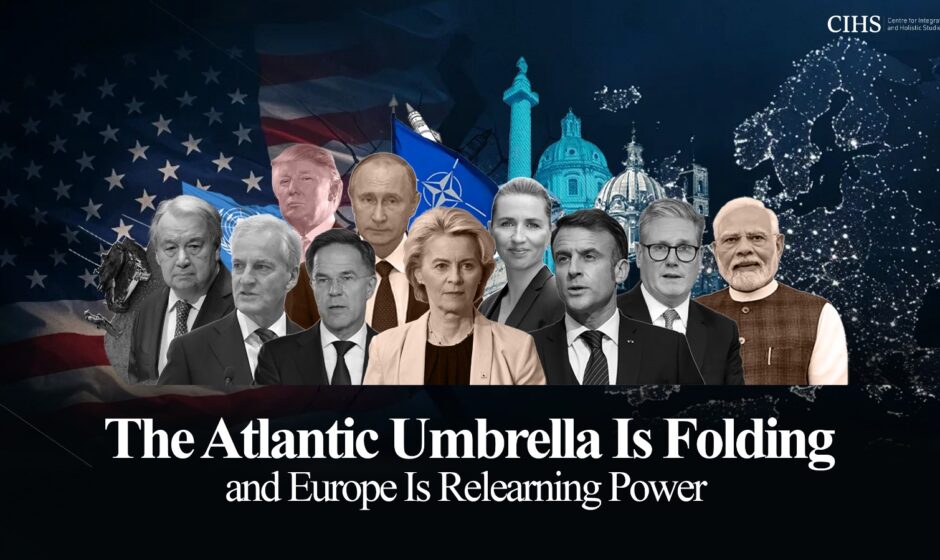
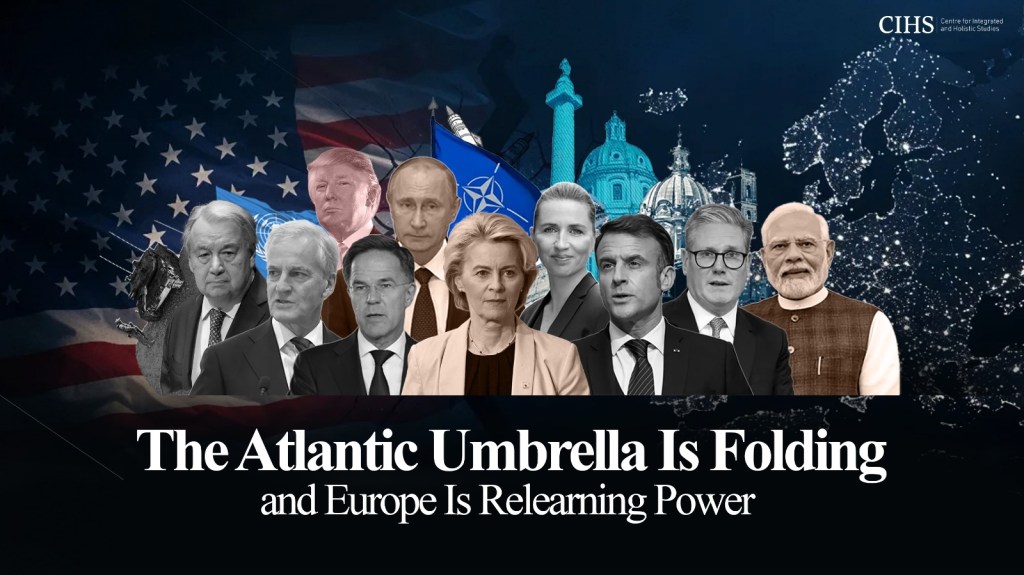
The fracture in the Western security story is no longer subtle. It is loud, transactional, and increasingly personal, driven by the return of Donald Trump to the world’s most consequential bully pulpit. Europe can still pretend this is a temporary mood swing in Washington, but its institutions are behaving like they know better. The continent that once outsourced deterrence to America, cheap energy to Russia, and industrial inputs to China is now discovering what strategic adulthood costs, and how fast.
The war in Ukraine remains the anvil on which Europe’s assumptions keep breaking. For three years, the battlefield has acted like an audit. It has tested whether NATO stockpiles are real, whether European procurement can scale, and whether democracies can sustain willpower when the price is no longer abstract. It is not that Europe has done nothing. It has moved money, missiles, and ammunition. Yet the tempo of the war has repeatedly exposed a deeper weakness: Europe’s defence industry and political cohesion were built for peacetime optimisation, not wartime surge. Even the European Union’s own internal papers and proposals have treated ammunition as a headline requirement, not a footnote, a recognition that industrial mass has returned as a strategic variable.
Over this, Trump has layered a second stress test: alliance reliability. NATO is still standing, but it is being bent into a shape that looks less like shared purpose and more like a subscription service. The 5% defence-spending target that began as a negotiating cudgel has become a psychological ceiling Europe is being dared to hit, with public threats and political theatre attached. In June 2025, NATO leaders endorsed a higher spending goal under U.S. pressure, while Trump openly signalled punitive instincts toward laggards, turning collective defence into a live bargaining arena.
The Arctic question around Greenland sharpened the point. When the leader of the alliance’s dominant power toys with the idea of coercion against territory tied to Denmark, the damage is not merely diplomatic. It is doctrinal. It normalises the language of acquisition over sovereignty, and it teaches smaller allies that Article 5 comfort depends on the mood in the Oval Office. Danish Prime Minister Mette Frederiksen responded in January 2026 by saying dialogue on Arctic security must respect territorial integrity, a sentence that should never have needed repeating inside NATO.
The mood has also infected the broader “rules-based order” that Europe invokes as if it were self-executing law. Consider the case of Mauritius and the Chagos Archipelago. In 2019, the International Court of Justice advised that the UK’s separation of the Chagos Archipelago from Mauritius was unlawful, and the UN General Assembly called on the United Kingdom to withdraw its administration. Yet great-power interests and basing realities, including the military footprint on Diego Garcia, ensured that legal clarity did not translate into clean compliance. The lesson is corrosive: international law is decisive until it collides with strategic utility.
At the United Nations itself, the crisis is even less theoretical. Antonio Guterres warned in late January 2026 of “imminent financial collapse” driven by unpaid dues and structural budget rules, with reporting that the United States is the largest debtor across multiple UN accounts. This is not just a spreadsheet problem. It is a strategic signal: when Washington delays or withholds, the institution’s operational capacity shrinks, and its political centre of gravity shifts.
It is also important to be accurate about the money. The United States remains the largest assessed contributor to the UN regular budget, with China close behind; Russia is not remotely the biggest funder, even if it remains a permanent Security Council veto-holder. On peacekeeping assessments, China is a top payer as Russia sits far lower in the table. Europe’s problem is not that Beijing and Moscow have “bought” the UN with donations. It is that a cash-strapped UN becomes more brittle, more politicised, and easier for hard powers to pressure, while America’s own commitment becomes a variable.
Trump, meanwhile, has turned the symbolism of peace into another performance metric. He has repeatedly argued he deserves the Nobel Peace Prize, claiming credit for “ending” multiple conflicts, a claim that none beyond the oval office back. The pursuit has become so brazen that it has dragged Nordic leaders into his orbit. Reporting around his communications with Jonas Gahr Støre, and commentary from the Nobel ecosystem, illustrates how a prize meant to sanctify moral authority is being treated as a transactional trophy.
All of this lands on a Europe that is trying to rearm while still living inside yesterday’s dependencies. Energy is the most obvious. Before 2022, Russia supplied more than 40% of the EU’s gas. Even after the shock, Russia’s share fell but did not vanish, and the EU has only now finalised a phased ban on Russian gas imports stretching into 2027. Europe lectures the world on strategic discipline while paying, even if less than before, for molecules that help finance the adversary it condemns.
The second dependency is industrial: critical minerals, rare earths, magnets, and supply-chain choke points where China remains dominant. The EU’s own Council materials acknowledge cases of near-total reliance, including heavy rare earths. The European Central Bank has warned that export restrictions and disruptions can feed inflation and strategic vulnerability across key industries. Europe cannot speak credibly about sovereignty while its clean-tech and defence-adjacent manufacturing remains exposed to upstream controls.
So Europe is talking again, sometimes quietly, sometimes theatrically, about what it once treated as taboo: autonomous deterrence. French President Emmanuel Macron said in March 2025 that he would open a debate on using France’s nuclear deterrent to protect European partners, insisting control would remain French. NATO Secretary General Mark Rutte has publicly pushed back on fantasies of a separate European army, warning that real autonomy would demand staggering spending and, inevitably, a nuclear conversation Europe has avoided for decades.
The same realism is visible in how Europe now engages China. Britain’s experience is instructive. In January 2026, the UK approved China’s plan for a massive new embassy in London, a decision framed as part of a shifting Western calculation. Reports suggest that the move helped clear the way for Prime Minister Keir Starmer to visit Beijing, a reminder that Beijing understands leverage and sequences concessions accordingly.
This is where India enters the frame as a strategic exit ramp. Europe’s emerging posture is simple: diversify risk, build industrial depth, and find partners that can carry weight in a fractured order. Under Prime Minister Narendra Modi, that has converged with India’s own ascent, its appetite for defence manufacturing, and its insistence on strategic autonomy. The proof arrived on 27 January 2026, when India and the EU concluded a landmark free trade agreement, with European Commission President Ursula von der Leyen calling it the “mother of all deals.” It was not merely commerce. It was alignment architecture, negotiated in a world where Washington’s reliability is being priced in as uncertain.
Washington’s line that Europe should “guilt” India over Russian oil now sounds selectively moral. Europe itself negotiated its own glide path away from Russian gas, years long, legally cushioned, and politically convenient. It is learning, late, that purity is a luxury and resilience is a system. In that system, India is not being courted because it is perfect. It is being courted because it matters.
The endgame is not romance. It is capability. A Europe that wants to survive Trump-proofing will have to spend more, produce more, and de-risk more. An India that seeks lasting global standing will have to convert demographic and economic scale into defence-industrial outcomes that allies can bank on. The EU-India equation, then, is not a feel-good “values partnership.” It is a hard-headed wager that, in a world where treaties fray, budgets collapse, and alliances become conditional, security will belong to those who can build, deter, and deliver.
(The author is an international criminal lawyer and director of research at New Delhi based think tank Centre for Integrated and Holistic Studies (CIHS)