
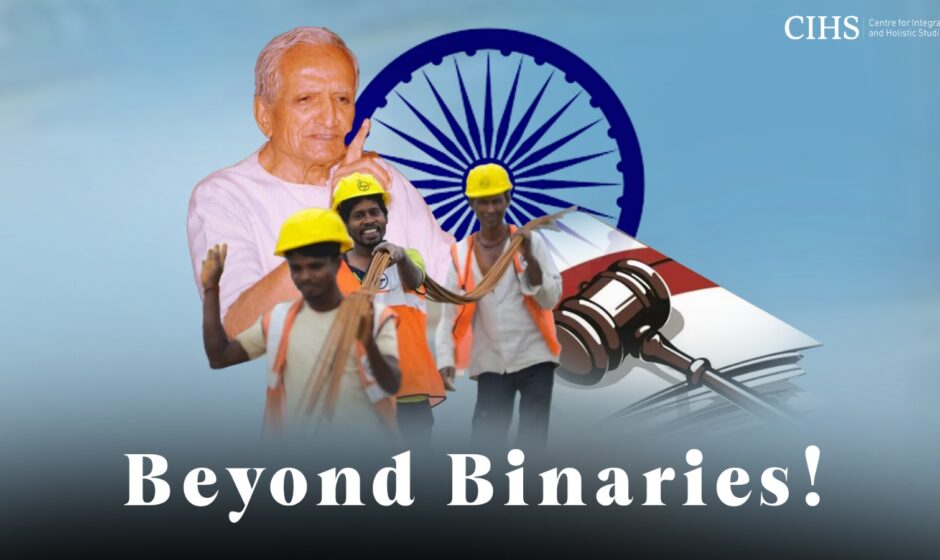

Four labour codes balance economic prosperity spread with workers’ social protection, minimum wages, social security, industrial safety.
Ayadoure Stalin
India’s reforms in labour sector represent one of the most consequential policy transformations of modern times. Public debate has largely framed consolidation of 29 central labour laws into four codes as an exercise in administrative simplification or investor-friendly deregulation.

What’s unfolding is not merely statutory restructuring but reorientation of India’s labour philosophy that seeks to reconcile economic growth with social dignity, flexibility with security and national competitiveness with ethical responsibility.
India’s labour reforms must be situated within a deeper intellectual lineage articulated decades ago byDattopant Bapurao Thengadi, founder of the Bharatiya Mazdoor Sangh, India’s most original labour thinkers.
Thengadi’s vision of “Third Way” rejected binaries that have long dominated labour discourse: capitalism versus socialism, employer versus worker, market versus state. Instead, he proposed a distinctly Bharatiya framework rooted in civilisational values, social harmony and national interest.
Viewed from this prism, India’s four Labour Codes are not an imitation of western neo-liberalism nor a retreat from worker protection but an evolving attempt to institutionalize labour order that Thengadi imagined. Pro-worker without being anti-industry, pro-growth without being socially extractive and modern without being alien to India’s socio-economic realities was what Thengadi professed.
Failure of Imported Models
Since Independence, colonial legacies and imported ideologies have had predominant say in shaping India’s labour regime. British-era labour laws were designed to regulate industrial unrest, not to empower a young nation’s workforce. Following independence, many of these laws were retained and expanded under influence of socialist and marxist frameworks that essentially viewed labour from class struggle lens.
This approach produced paradoxical outcomes. On paper, India had one of the most protective labour regimes. In practice, over 90 per cent of workers remained outside protective cover of the state. A miniscule, organized and vocal workforce cornered all the benefits with strong safeguards, while vast majority—informal, contractual, agricultural, and migrant workers—were denied social security, safety and wage stability.
Thengadi was among earliest critics of this diabolic contradiction. Excessive legalism without universality weakens the entire labour force, he had argued. Laws that protect only a minority foster informality, discourage enterprise growth and ultimately undermine workers’ dignity. He rejected capitalist view that labour protections are obstacles to efficiency and growth. For Thengadi, labour was neither a commodity nor a revolutionary instrument but a key stakeholder in national development and spreading prosperity.India’s labour reforms must be read as an effort to escape this historical trap.
Consolidation & Philosophical Reorientation
Consolidation of 29 central labour laws into four Codes: Wages, Industrial Relations, Social Security and Occupational Safety, Health, and Working Conditions, addresses not only administrative fragmentation but ideological incoherence.
For decades, employers navigated overlapping definitions, contradictory compliance requirements and inspector-driven enforcement. Workers, meanwhile, faced confusion over entitlements and limited security coverage and wages. The result was regulatory fatigue without universal justice.
Four Codes establish a single, coherent legal architecture that replaces multiplicity with clarity. This rationalisation is not abandonment of labour welfare but a prerequisite for its expansion. Thengadi consistently emphasized that justice must be practical, accessible and enforceable. A legal framework that is too complex to comply with is ultimately unjust. Simplification is not a concession to capital, it is a tool to widen protection.
Social Security & Inclusion
Most transformative aspect of India’s labour reforms is Code on Social Security, 2020 that formally brings gig workers, platform workers and unorganised labour within the ambit of statutory social security.
Globally, the rise of platform-based work has exposed inadequacy of traditional labour categories. Many advanced economies remain mired in binary debates: are gig workers employees or independent contractors? India’s approach is notably different. Rather than forcing rigid classifications, Indian framework prioritises coverage over categorisation.
This reflects Thengadi’s ethical orientation. In The Third Way, he argued that social security is not by-product of industrial employment but a societal obligation. The dignity of labour does not depend on contract but work contribution to national economy.
By recognizing gig and platform workers as beneficiaries of social security, they can now avail pension, insurance and health benefits. India signals a global normative shift. In an era where technological change often erodes worker protection, India is asserting that modernity need not mean precarity.
Wage Rationalization & Economy
Code on Wages, 2019 replaces a fragmented system of wage laws with unified framework governing minimum wages, timely payment and bonuses. Historically, India’s wage regulation suffered from sectoral silos and definitional ambiguities that enabled wage suppression and delayed payments.
The new Code establishes a national floor wage while allowing contextual variation in states and sectors. This balance is critical. Thengadi opposed both exploitative wage competition and rigid uniformity. He believed that wages must reflect economic realities while meeting ethical threshold of ensuring livelihood security.
Wages Code advances this moral economy. By ensuring timely payment and transparent definitions, it strengthens the workers’ position without undermining enterprise viability. It reflects a belief that fair wages are not anti-growth but foundational to sustainable growth.
Industrial Relations & Adversaries
Industrial Relations Code, 2020 has been most contested of the four reforms. Critics argue that raising thresholds for government approval in layoffs and closures weakens labour protection. Such critiques, however, often overlook India’s empirical employment landscape. Rigid exit regulations discouraged firms from scaling sizes, incentivizing contracts and informality. Consequence was not workers’ security but job insecurity for millions outside formal employment.
Thengadi rejected the idea of labour being constantly adversarial with companies’ managements. He opposed both managerial authoritarianism and perpetual militancy. For him, industrial harmony and growth were a shared national responsibility grounded in dialogue, discipline and mutual respect.
Industrial Relations Code aims to strike a balance between flexibility and protection. By promoting collective bargaining, streamlining dispute resolution and reducing incentives for informality, it aims to create stable workplaces rather than fragile jobs. Stability, not rigidity is the foundation of workers’ welfare.
Occupational Safety & Trust
OSHWC Code, 2020 modernizes safety standards while introducing risk-based inspections. This marks a shift from inspector-driven control to outcome-oriented governance. India’s earlier inspection regime often produced compliance theatre, frequent inspections without meaningful safety improvements. Thengadi warned against bureaucratic overreach that alienates both workers and employers.
He argued that regulation must cultivate responsibility, not fear. Risk-based oversight enables authorities to focus on high-risk industries while minimizing unnecessary interference in low-risk areas. This enhances worker safety while improving ease of doing business. It also aligns India with global best practices without sacrificing regulatory sovereignty.
Labour Reforms as Strategic Signal
India’s labour reforms must be understood in their global strategic context. As global supply chains diversify and geopolitical risk reshapes production decisions, labour governance has become a critical factor in economic diplomacy. India is not presenting itself as a low-wage, deregulated labour destination. Nor is it replicating European-style rigid protections which are unsuited to its demographic scale.
Instead, India is articulating a hybrid labour modelthat is flexible and inclusive, competitive and ethical. This model enhances India’s credibility as a responsible economic power. It reassures investors of regulatory predictability while signaling to workers that growth will not come at the cost of dignity.
In doing so, India offers Global South an alternative labour pathway one that is neither extractive nor stagnation-inducing.
Implementation, Key Test
Success of Labour Codes will be measured on implementation. State-level rule-making, digital infrastructure, administrative capacity, and worker awareness are decisive variables. Thengadi repeatedly emphasised that laws alone cannot transform society. Institutions must be driven by an ethical commitment and foster social dialogue.
Trade unions, employers and governments must resist the temptation to weaponise reforms ideologically. Labour reform is not a zero-sum contest between flexibility and security. It is an evolving process that requires trust, transparency and continuous feedback.
India’s labour reforms represent more than legislative change by reclaiming labour as a civilizational ideathat is integral to nation-building, social harmony and economic sovereignty.
While the four Labour Codes are not flawless, they reflect an earnest attempt to move beyond borrowed ideologies toward a rooted policy imagination.
This is the essence of Dattopant Thengadi’s “Third Way”: a framework where labour is neither commodified nor politicised, but respected as a partner in development. As India asserts itself on the global stage, its labour reforms quietly articulate a profound message: that modernisation need not erode dignity and growth need not fracture society.
In polarised economic thinking, India’s evolving labour model reminds the world that synthesis, grounded in ethics, pragmatism and national interest, is still possible.
(Author is a Doctoral Candidate at Centre for Indo-Pacific Studies, School of International Relations, Jawaharlal Nehru University)