
Sankalp Singh Chauhan
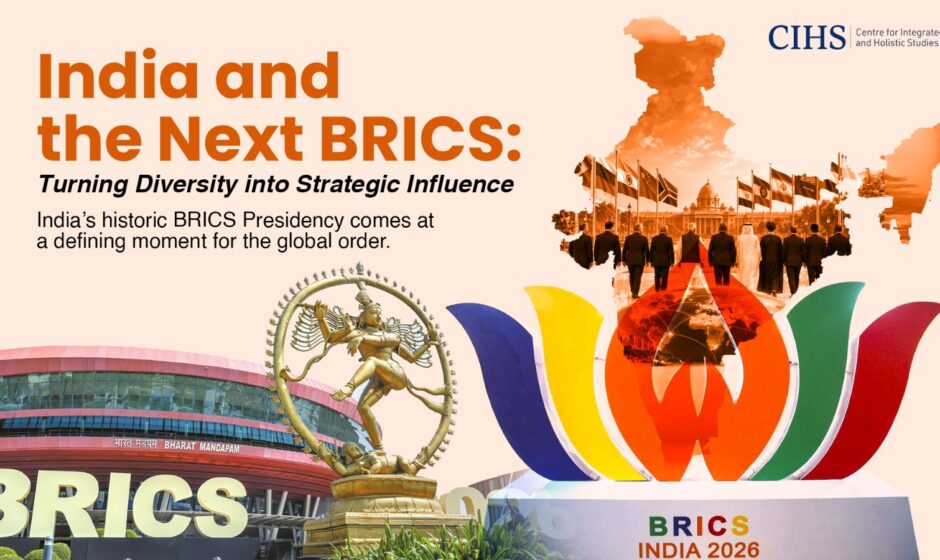
India’s historic BRICS Presidency comes at a defining moment for the global order. Its challenge is not to build another bloc, but to make a more diverse world capable of working together. What began as BRIC, Brazil, Russia, India and China, formally came together at its first summit in Yekaterinburg in 2009, transformed it into BRICS after South Africa’s inclusion.

For more than a decade the five-country grouping steadily developed cooperation in finance, development and global governance. The major expansion of 2024 brought Egypt, Ethiopia, Iran, Saudi Arabia and the United Arab Emirates into the fold, while Indonesia joined in 2025, taking BRICS to 11 full members. India now assumes the chair at a particularly consequential moment: the grouping has evolved from a compact association of emerging economies into a much broader platform representing a significant voice of the Global South.
The world itself is entering an era of profound geopolitical and economic realignment. Wars and conflicts, supply-chain disruptions, economic uncertainty, technological competition and growing dissatisfaction with existing multilateral institutions are reshaping the international system. Against this backdrop, India’s 2026 Presidency is not merely another turn in the rotational calendar; it is an opportunity to shape what the expanded BRICS becomes next. With 11 full members, Brazil, Russia, India, China, South Africa, Egypt, Ethiopia, Iran, the United Arab Emirates, Saudi Arabia and Indonesia, BRICS now has considerably greater geopolitical and economic weight. Its influence is further widened by 10 partner countries viz., Belarus, Bolivia, Cuba, Kazakhstan, Malaysia, Nigeria, Thailand, Uganda, Uzbekistan and Vietnam. This expansion gives BRICS greater reach, but also a harder task: how can countries with different political systems, economic interests and strategic priorities translate diversity into cooperation? That is where India can make a distinctive contribution.
From Expansion to Delivery: India’s presidency has an opportunity to move BRICS beyond declarations and towards practical cooperation. The priorities are clear: trade and investment, resilient supply chains, energy and food security, health, climate action, digital public infrastructure, technology, connectivity and reform of global institutions. The test will be whether these priorities produce institutions and mechanisms that citizens and businesses can actually use. India’s experience with digital public infrastructure offers an important model. Greater interoperability of digital payment systems, cross-border transactions and financial technology could lower transaction costs and strengthen economic ties across the Global South. The ambition should be neither isolation from the West nor confrontation with it. It should be strategic autonomy combined with inclusive multilateralism.
The Currency Question: Few ideas surrounding BRICS attract as much attention as the possibility of a BRICS currency. Yet credibility requires distinguishing aspiration from reality. A common currency is not an established BRICS policy. The more immediate and practical path is the expansion of local-currency trade, payment-system interoperability and alternative cross-border financial mechanisms.
Over time, these could evolve into a broader financial architecture, including a possible common unit of account or other settlement mechanism, without requiring an immediate monetary union. The objective is therefore not simply “de-dollarisation.” It is to create more choice, resilience and efficiency in international finance.
BRICS as an Innovation Platform: The next phase of BRICS should also be defined by technological cooperation. Artificial intelligence, semiconductors, biotechnology, quantum technologies, space, clean energy, agricultural technology and digital commerce offer areas where emerging economies can move from being technology consumers to technology creators. A BRICS innovation ecosystem, supported by research partnerships, start-up networks, technology funds and easier movement of knowledge and capital, could become one of the grouping’s most consequential long-term projects.
Equally important are areas of human security: affordable healthcare, food security, climate resilience, disaster management and sustainable infrastructure.
A Wider Global South: The expansion of BRICS has made its relationship with the wider developing world increasingly important. Partner countries and BRICS Plus outreach can give smaller and emerging economies a greater voice without requiring every country to become a full member. This broader architecture could become one of BRICS’s greatest strengths, provided expansion does not overwhelm decision-making. India’s diplomatic challenge is therefore to build consensus without sacrificing ambition.
What Success Should Look Like: The success of India’s Presidency should ultimately be judged not by the number of declarations issued, but by what changes after the summit.
First, BRICS should deliver measurable progress in trade and investment, including easier market access, stronger supply-chain resilience, greater MSME participation and mechanisms that make South-South commerce faster and less costly.
Second, it should advance a genuinely connected digital and financial architecture. Interoperable payment systems, greater use of national currencies and more efficient cross-border settlements could provide an immediate, practical foundation for deeper financial cooperation.
Third, success should mean tangible cooperation in energy, food, health and climate security. In a world vulnerable to energy shocks, food disruptions, pandemics and extreme weather, these are not peripheral development issues; they are questions of global stability.
Fourth, BRICS should create an innovation and technology agenda capable of connecting universities, researchers, entrepreneurs and industries across member and partner countries. Cooperation in AI, semiconductors, biotechnology, quantum technology, space and clean energy could determine whether the Global South becomes merely a larger market or a major source of future innovation.
Finally, India’s Presidency should strengthen the voice of developing countries in global governance. Reform of institutions such as the United Nations, IMF and World Bank should aim at greater representation, legitimacy and responsiveness, not at replacing one hierarchy with another.
Perhaps the most important measure of success will be whether BRICS can demonstrate that geopolitical diversity does not have to produce institutional paralysis. Can countries with competing strategic interests still cooperate on issues of common interest? Can BRICS remain economically ambitious without becoming an anti-Western alliance? Can its expanded membership create wider representation without diluting effectiveness? And can India preserve its role as a bridge between competing centres of power? If the answer is yes, BRICS could move from being primarily a grouping of emerging economies to becoming a credible platform for a more balanced international system. India’s role will be central to that transition.
India has chaired BRICS before, but the 2026 Presidency carries a different historical weight. It comes as the grouping marks two decades of its institutional journey, following its transformation from BRIC into BRICS and its unprecedented expansion to 11 members. India therefore inherits not simply an established forum, but a larger and more complex institution whose future direction remains open. The opportunity is to make this expansion meaningful, to turn numbers into influence, diversity into dialogue, technology into development and strategic autonomy into constructive multilateralism. The world does not need another Cold War. Nor does it need a world without rules. It needs a more representative international order in which multiple centres of power can coexist, compete and cooperate. That is the larger promise of India’s BRICS Presidency. Its ultimate success will not be measured by whether BRICS becomes a rival to the West, nor by whether it creates a common currency or another grand geopolitical slogan. It will be measured by something more consequential: whether India can help turn an increasingly diverse BRICS into a credible institution through which the Global South and the wider world can negotiate its next equilibrium.
(Sankalp Singh Chauhan is an International Relations scholar and former G20 Youth Delegate representing India. He writes on the evolving world order and India’s emerging global leadership.)