

How a colonial boundary drawn in 1893 planted the seeds of war that now threatens to engulf the entire region and why Pakistan is its own worst enemy.
Rahul PAWA | x – iamrahulpawa
On February 26, 2026, Pakistani jets struck targets in Afghanistan’s Nangarhar, Paktika, and Khost provinces. Kabul retaliated. Islamabad declared open war. The international community scrambled for its talking points. But for anyone who has studied the Afghanistan-Pakistan relationship with any intellectual honesty, there was nothing surprising about this moment. It was, in every sense, inevitable, the product of a colonial wound never properly healed, an ethnic identity never properly reconciled, and a strategic miscalculation of historic proportions that Pakistan inflicted upon itself
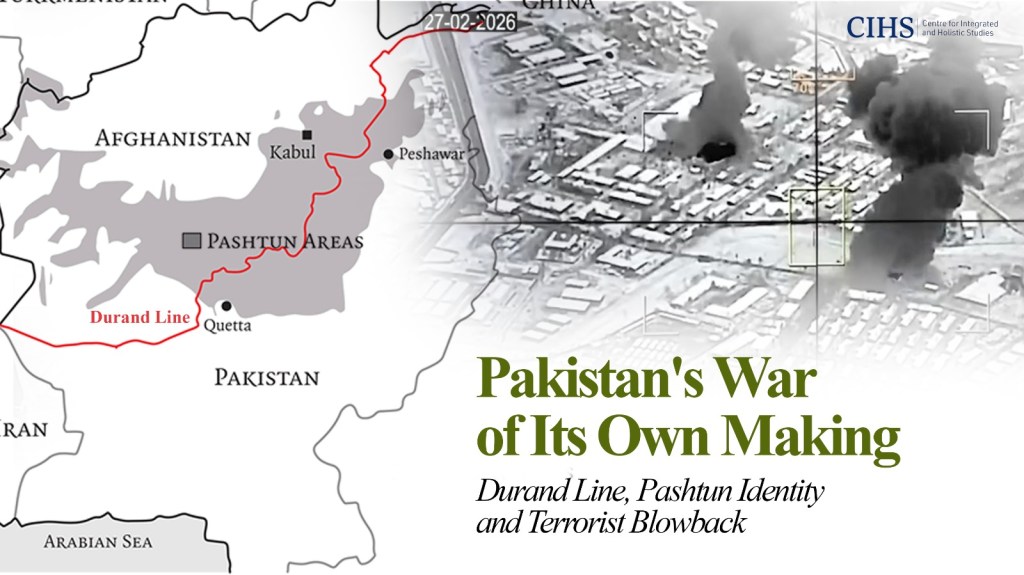
In November 1893, British civil servant Sir Mortimer Durand sat across a table from Afghan Amir Abdur Rahman Khan and drew a line across a map. That line, 2,670 kilometres of mountain, desert, and river became the Durand Line, and it bisected the Pashtun tribal homeland with surgical indifference to the people who lived there. It was a colonial instrument of administrative convenience, not a meaningful border between two nations.
When Pakistan was carved out of British India in 1947, it inherited the Durand Line as its western frontier. Afghanistan refused to accept it. Kabul was, in fact, the only country in the world to vote against Pakistan’s admission to the United Nations that year, a remarkable act of diplomatic hostility toward a nation barely days old, driven entirely by the conviction that Pakistan had absorbed Pashtun lands that had no business being part of a new Muslim state in the subcontinent. Every Afghan government since; monarchy, communist, mujahideen, the first Taliban, the Western-backed republic, and now the second Taliban has refused to formally recognise the Durand Line as an international border. Pakistan has spent 75 years insisting the matter is settled. It is not settled. It has never been settled. And that unresolved dispute is the tectonic fault line beneath everything that has erupted in 2026.
Fifty Million People Who Refuse to Be a Border
Roughly 50 million Pashtuns live across both sides of the Durand Line. They share language, tribe, genealogy, and code, the ancient honour system of Pashtunwali that governs loyalty, hospitality, and revenge in equal measure. To a Pashtun tribesman in Waziristan, the line on Pakistan’s map means little when his cousin lives in Khost. Cross-border movement, cross-border marriage, and cross-border allegiance are not insurgent behaviour. They are culture.
Pakistan’s military establishment has never fully grasped or chosen to accept this reality. Its periodic attempts to fence and fortify the border, most aggressively from 2017 onward, have been met with fierce resistance from tribal communities that view the fence not as a security measure but as a colonial imposition. Skirmishes between Pakistani border forces and Afghan fighters over the fence are practically routine. The current war did not materialise from a vacuum; it escalated from a slow-burning conflict that has been claiming lives along the Durand Line for years.
The Monster Pakistan Built
To understand how Pakistan arrived at this catastrophic juncture, one must understand the doctrine of “strategic depth.” Pakistan’s generals, perpetually preoccupied with the Indian infatuation on their eastern border, became obsessed with ensuring that Afghanistan would never side with India, or worse, open a second front. The solution, as conceived by Pakistan’s Inter-Services Intelligence (ISI) through the 1970s and 1980s, was to cultivate a network of jihadist proxies in Afghanistan that Islamabad could control and deploy. The Afghan mujahideen. The Taliban. Assorted terrorist networks that moved through Pakistan’s tribal areas with impunity.
The Taliban of 1994 were, in significant measure, a Pakistani creation. The ISI funded them, armed them, and provided the political scaffolding that allowed them to sweep to power in Kabul in 1996. For five years, Pakistan had the compliant Afghan government it had always wanted. Then came 11 September. Under intense American pressure, and out of greed for US dollars, Islamabad was forced to publicly disavow the very asset it had spent two decades cultivating.
What followed was perhaps the most cynical double game in modern geopolitical history. Pakistan publicly cooperated with the American-led war on terror while elements of its intelligence apparatus continued to shelter, fund, and facilitate the Taliban through two decades of conflict. Safe houses in Quetta. Sanctuaries in Baluchistan. The Haqqani network operating from Pakistani soil. American generals and CIA directors said it in public, in congressional testimony, with barely concealed rage. Pakistan denied everything, pocketed billions in American aid, and continued.
Blowback: The Reckoning
When the Americans abandoned Afghanistan in August 2021 and the Taliban swept back into Kabul, General Faiz Hameed, Pakistan’s former ISI chief, was famously photographed sipping tea at Kabul’s Serena Hotel. But Pakistan had not fully reckoned with what came next: the Afghan Taliban, now rulers rather than stateless militias, showed little appetite for serving as Pakistan’s instrument. They had decided long ago to govern as Afghans and think as Pashtuns. And they have shown no meaningful inclination to police their eastern border on Islamabad’s behalf particularly not against the Tehrik-i-Taliban Pakistan, the Pakistani Taliban known as TTP. The TTP is, in ideological and genealogical terms, indistinguishable from the Afghan Taliban. They share theology, ethnic identity, and in many cases, blood. The Afghan Taliban’s refusal to launch operations against TTP is not weakness or negligence, it is a deliberate choice rooted in Pashtun solidarity. Pakistan created the militant infrastructure that spawned the TTP. It nurtured the ideology that animates them. It is now being consumed by the very forces it engineered, and it wants the Taliban to solve a problem that Pakistan itself created.
That is blowback in its purest form. TTP has killed thousands of Pakistani soldiers since 2007. It has Pakistani military installations. Pakistan has responded by demanding the Afghan Taliban act, and when they don’t, by launching airstrikes into Afghan territory. Those airstrikes kill civilians. They inflame Pashtun sentiment on both sides of the Durand Line. They validate every Afghan suspicion of Pakistani malice. And they make a political settlement less, not more, likely.
A War With No Exit
What Pakistan faces in 2026 is not an external threat it can bomb into submission. It is the consequence of seven decades of strategic pathology, the Durand Line never accepted, the Pashtun identity never accommodated, and the terrorist infrastructure never dismantled. Airstrikes on Kabul and Kandahar are not a strategy. They are the kinetic expression of a country that has run out of ideas and is substituting firepower for statecraft.
The Afghan Taliban, for all their mediaeval governance, hold the stronger hand in this confrontation. They have legitimacy on their own soil, the moral authority of having expelled two empires, and critically; time. Pakistan is an economically fragile state conducting military operations on two fronts simultaneously, haemorrhaging resources it does not have against an adversary that cannot be conventionally defeated. The Taliban can absorb Pakistani air raids and wait. Pakistan cannot sustain indefinite war. A durable resolution, if one is ever possible, will require Islamabad to do several things it has historically found psychologically impossible: acknowledge the Pashtun identity as a political reality rather than a security threat; engage the TTP through dialogue rather than exclusively through force; and accept that Afghanistan will never be a Pakistani satellite. The alternative; continued military escalation risks metastasising into a conflict that destabilises nuclear-armed Pakistan far more than it damages the Taliban. Mortimer Durand drew his line 133 years ago. Pakistan is still paying for it. And the bill, it turns out, is far higher than anyone in Rawalpindi ever calculated.
(Rahul Pawa is an international public lawyer and Director of Research at the Centre for Integrated and Holistic Studies, New Delhi.)