

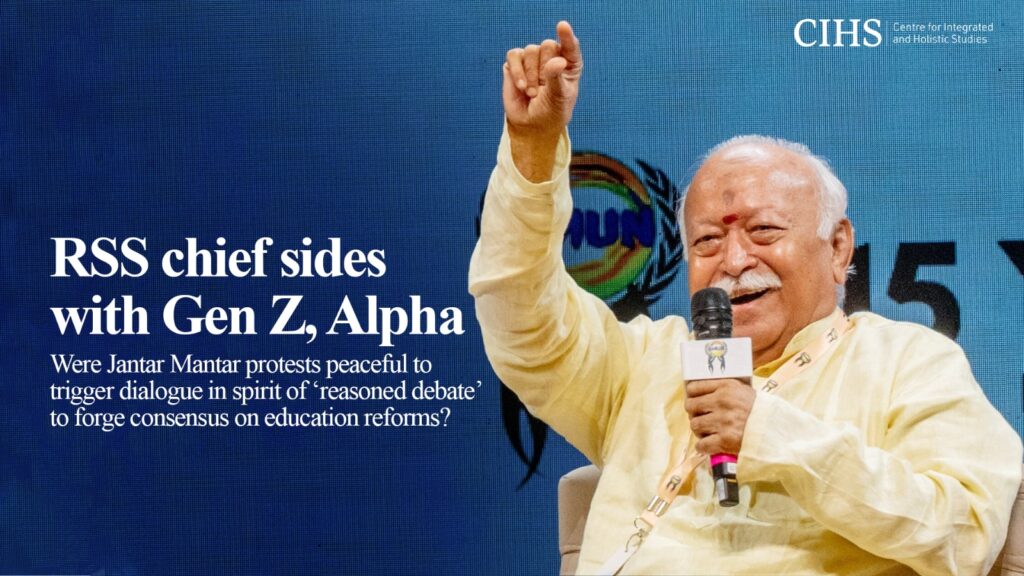
Were Jantar Mantar protests peaceful to trigger dialogue in spirit of ‘reasoned debate’ to forge consensus on education reforms?
K.A. Badarinath
Bharat’s youth who fall under 35-years age bracket total to over 800 million. Only a few thousands of these youngsters joined Cockroach Janata Party (CJP) led Jantar Mantar protests on NEET paper leak last month.
Genuine students, irrespective of their ideological moorings, that sought educational reforms, corrective measures against paper leaks may not be treated as ‘anti-national’. And, they have the right to protest, take to streets in a peaceful formation or even get loud.
Protests are one way of leading to consensus on core education issues in a large diverse democracy like India that’s on path to constant reform. In a democratic polity like India’s, protests are perfectly fine.
Even this instrument of protests has to be used with lots of wisdom and responsibility in forging consensus on reforming education system that may have fallen short of student’s expectations and aspirations of youth.
This seems to be tone and tenor with which Rashtriya Swayamsevak Sangh (RSS) chief Dr Mohan Bhagwat for the first time articulated the organization’s position on recent protests in New Delhi while interacting with thousands of Gen Z and Gen Alpha at an event in Mumbai on Thursday.
The 49-days protests were however not entirely peaceful as envisioned by Bharat’s Constitutional visionary Dr Bhimrao Ramji Ambedkar in several of his writings. RSS chief made a specific reference to Dr Ambedkar’s line on peaceful protests in his public interaction with youth.
Ambedkar held peaceful protests on several occasions unlike violence, hooliganism and stone pelting witnessed in recent Jantar Mantar protests infiltrated by rowdy sheeters, drug peddlers, rapists and criminals.
Dr Ambedkar had led thousands of people in 1927 against caste-based discrimination in accessing drinking water from wells. This protest is easily seen as one of the most unique and popular as ‘Mahad Satyagraha.”
Kalaram Temple entry satyagraha in 1930 was yet another peaceful movement that was held under leadership of Dr B.R. Ambedkar seeking end to untouchability of low caste Hindus. Ambedkar sought equal rights to temple entry in Nashik as an issue of ‘fundamental human dignity’.
In a speech on November 25,1949, Dr Ambedkar had argued stringently against unconstitutional methods and disruptions terming them as ‘grammar of anarchy’.
In fact, Dr Ambedkar wanted communities, citizens groups and stakeholders to take recourse to constitutional means like Parliament and elections for seeking redress to their issues.
When Dr Bhagwat referred to Ambedkar’s line on peaceful protests, not many would have gauged the context and its significance. RSS chief’s messaging seems to be crystal clear. There’s no place for violence unlike what happened during the CJP protests.
Culture of reasoned debate in Bharat was highlighted by the RSS chief in the context of protests held by students. Well, did the protestors trigger a reasonable debate on their issues? It’s a big question.
Second big rider pointed to by Dr Mohan Bhagwat was that protests should not lead to divisions in the society or bring about divisiveness. But, did the Jantar Mantar protests pass this test?
Well no. Only some genuinely concerned students and their families were there seeking changes in education system.
But then, anti-social elements took control of narratives as well as the dais at Jantar Mantar. Stone pelting was resorted to by anti-social elements akin to what we had witnessed in Kashmir valley terrorists backed street incidents.
Students’ issues took a back seat. Instead, protests got politicised with several opposition parties jumping in lending an anti-Modi twist to the protests. Left extremists who joined the protests claiming to be heirs of Dr Ambedkar were in fact seeking relevance as their guerilla war waged against democratic institutions got wiped out.
In fact, the RSS chief brought the conversation back on issues that mean a lot to students and youth. Dr Mohan Bhagwat pushed for setting aside six per cent of GDP for education making it affordable and accessible to all.
RSS has also argued against commercialization of educational institutions as avenues for profiteering at the cost of students and youth. At the same time, RSS chief has pin pointed to ‘collective responsibility’ of entire Indian society for taking education to all and not leaving it in exclusive domain of government.
So, bringing meaningful debate on education engaging students and youth as big stakeholders may be the way forward.
(Author is Director & Chief Executive of Centre for Integrated and Holistic Studies and a veteran newsman)