
Rashtriya Swayamsevak Sangh a vast, powerful Hindu volunteer organization has become target of a counterproductive Western campaign.
Bill Drexel
Mohan Bhagwat idrees mohammed/Agence France-Presse/Getty Images
Mayor Zohran Mamdani found time in his busy schedule to condemn a visit to New York two weeks ago by the head of an Indian nonprofit that almost none of his constituents had ever heard of.
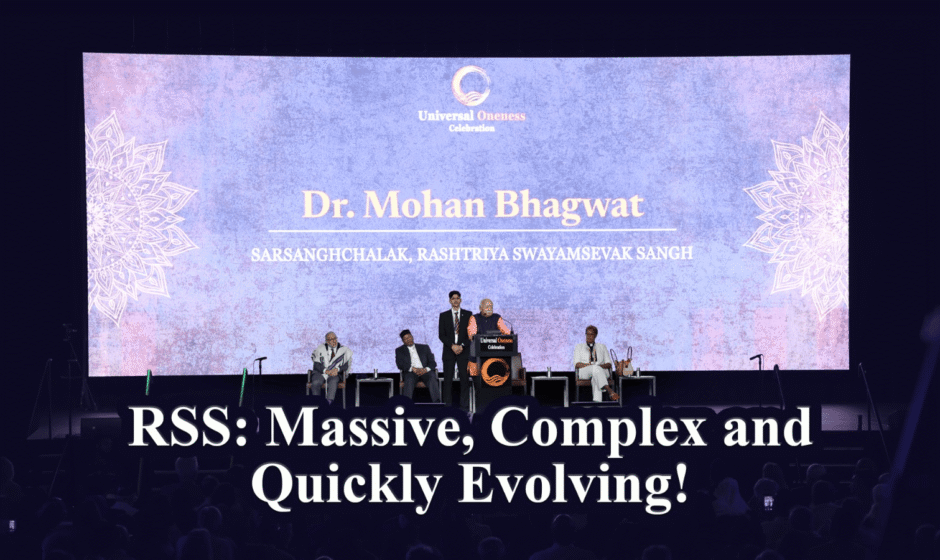
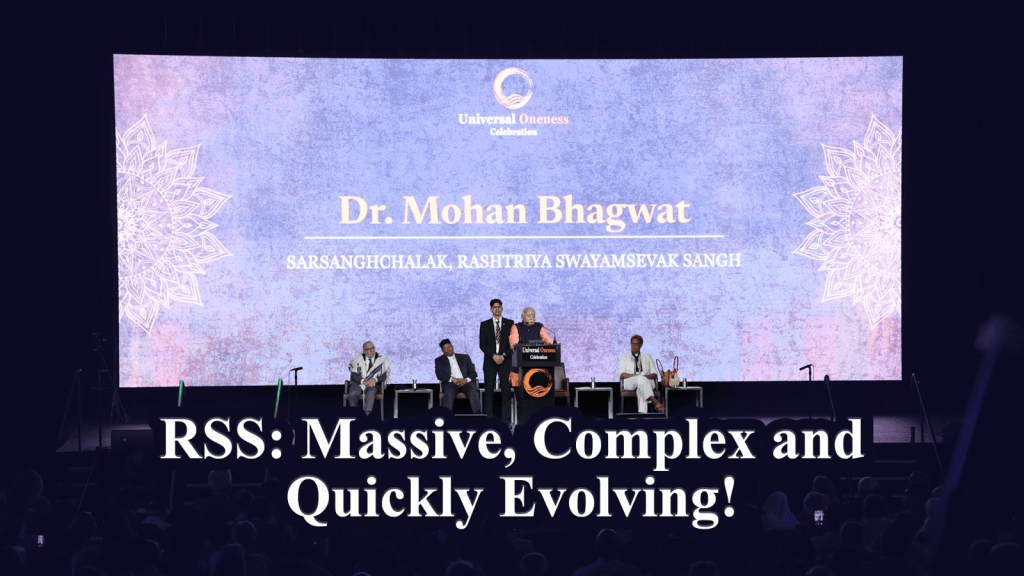
The visitor was Mohan Bhagwat, chief of the Rashtriya Swayamsevak Sangh, or RSS, the vast Hindu volunteer organization that trained Prime Minister Narendra Modi and founded the party he leads. On Aug. 29, Mr. Bhagwat addressed some 5,000 people at Madison Square Garden at an event billed as a celebration of “universal oneness.” Mr. Mamdani, when pressed at a news conference to cancel the booking, called the RSS’s Hindu nationalist vision “exclusionary” and its rise “incredibly troubling,” while conceding the city had no authority over a private event.
Others joined in, too. The federal U.S. Commission on International Religious Freedom, which has sought sanctions against the RSS, called for Mr. Bhagwat’s visa to be revoked. Before his subsequent Toronto appearance, nearly 270 organizations asked Ottawa to bar him and consider designating the RSS a terrorist entity. In London, where he spoke this week, numerous groups asked Mayor Sadiq Khan to deny him any city-controlled venue.
The campaign borrows its playbook from the effort to make a pariah of Zionism—so directly that the anti-RSS protest outside Madison Square Garden turned on itself over Israel, with demonstrators shouting down Brad Lander, a congressional nominee who had come to join them, for being a Zionist.
As with the campaign against Israel, the effort to isolate the RSS damages American interests more than its target.
Founded in central India in 1925, the RSS runs roughly 83,000 regular neighborhood gatherings across India—an hour of physical drills, songs, games and instruction in its account of Hindu civilization, meant to strengthen the character of young Indian men. The atmosphere is something like the Boy Scouts, and nearly all of its roughly five million participants are unpaid, often attending daily before work. These volunteers are motivated by a shared sense of patriotism and see themselves as strengthening their country.
Its influence is even larger than the numbers indicate. The RSS acts as the vanguard of the broader Hindu nationalist movement and has incubated some 2,500 spinoff organizations, including one of Hinduism’s most representative religious councils, India’s largest labor union, and its largest private-school network. The Bharatiya Janata Party, which it founded, has grown to become the largest political party in the world, claiming more than 140 million members. And the RSS and its network act as an accelerator for the BJP’s top talent: Mr. Modi began as a full-time RSS organizer, joining a cadre who vow to forgo marriage and personal wealth. Several of Mr. Modi’s cabinet ministers, state chief ministers and other senior officials were similarly drawn into the BJP through the RSS’s orbit and meet periodically with its leaders.
Western disapproval isn’t going to hamper an organization this large and potent. Slamming the door on India’s most influential civil-society organization accomplishes nothing, save empowering the factions of the RSS to which its critics most object, which tend to agree that there is little conversation to be had.
Critics allege that the organization’s ideology amounts to Hindu supremacy, casting India’s sizable Muslim and Christian minorities as intruders in Indian history and relegating them to second-class citizenship. Mohandas Gandhi’s assassin was at one point an RSS member, and though he maintained he had left the organization in favor of a more assertive approach to activism, the association has marred the RSS’s reputation. Reports of rising violence against minorities in areas of India where the BJP is strongest have dogged Hindu nationalism’s political ascent, and the RSS has been accused of participating, which the organization denies.
But like India itself, the RSS is massive, complex and quickly evolving. Even its sharpest critics concede its outward-facing work largely consists of charity and social-service projects, many of which are extremely popular. India is home to one-sixth of humanity, breakneck modernization and the world’s most ethnically, religiously and linguistically diverse population, so some degree of social friction is unavoidable, however tragic. When social unrest arises, it can be difficult in the chaos to know how much responsibility can be assigned to the RSS or its affiliates, and RSS members frequently claim misattribution from their political adversaries.
Moreover, in recent years senior RSS figures have made public statements about caste and Muslims that are very hard to square with the charges against them and the most objectionable statements of the organization’s early leadership. These may be smoke screens, as critics claim, but may also be signs that the organization is moderating under the responsibilities of leading a social movement that commands political power.
One need not endorse the RSS’s views to know that it is imperative the U.S. engage with it and seek to understand it. India is on track to become the world’s third-largest economy, is indispensable to the balance of power in the Indo-Pacific, and is increasingly consequential in a restive Middle East.
With public appearances like those that drew Mr. Mamdani’s condemnation, the RSS has indicated an interest in greater international engagement. That should be a welcome development to anyone hoping for more productive U.S.-India relations.
(Drexel is a senior fellow at the Hudson Institute, London. This write up was first published by Wall Street Journal on September 7, 2026)