CIHS – Centre for Integrated and Holistic Studies

Date/Time:

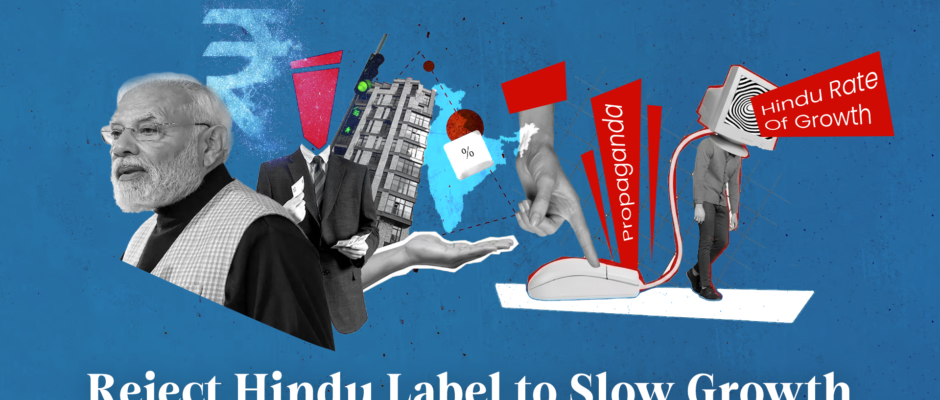
Reject Hindu Label to Slow Growth

Hinduphobia, colonial enslavement led certain intellectuals, socialists to frame Hinduness for tardy progress. Real culprits are socialists and their handlers! K.A.Badarinath It’s a colonial era slur. None has the right to deride about two billion Hindus living in 100 countries on some pretext or the other. Debunking Hindutva as being somehow responsible for Bharat’s tardy progress or sub-optimal GDP growth of 3.5 per cent in 1950s and 1980s era reeks of hatred. At last week’s Hindustan Times annual leadership summit, Prime Minister Narendra Modi rightly pointed to colonial mind-set for framing Hindu faith with tardy economic growth. Big question is why does one attribute slow economic progress and development to Hindutva? Why do some scholars make derogatory remarks and prejudiced framework to point fingers at Hindu people? Why do self-proclaimed intellectuals and economists ignore Bharat’s seven to eight per cent growth in last two decades was precisely due to these very Hindus? Colonial overhang and socialist underpinning of some intellectuals may have led to bracket low growth with Hindutva. As per The Oxford Companion to Economics in India, economist Raj Krishna made an attempt in 1982 to link the then 3.5 per cent economic growth to an inherent cultural phenomenon. Raj Krishna, a faculty member with Delhi School of Economics, blamed Hindus for not thinking big, staying reticent sans ambition etc. Well, Raj Krishna or his disciples’ arguments are not tenable. He may have grossly erred on intent and by design. Economic progress and development models hitherto adopted during Smt Indira Gandhi or Pandit Jawahar Lal Nehru were largely socialist in orientation and governance. Till, economic reforms were unveiled in 1991, state controls were overbearing and stifled growth. In pre-liberation era, strangulating free enterprise, spirit of Bharat’s businesses and individuals was the norm. Even the governance model was socialist in nature with most power concentrated in Prime Minister like the communist oligarchy. Most annoying was accusing Hindus of strangulating socio-economic development in Bharat and slowing down fight against poverty. It’s rather well documented that economist Raghuram Rajan had revived the debate on linking Hindutva to slow growth rates in 2023. In last quarter ending September 2025, Bharat’s economy reported an expansion of 8.2 per cent with about 65 crore people going to work. Similarly, Bharat was the top major economy to report growth of 7.3 per cent globally, highest amongst G-20 nations with China and Indonesia at second and third position with 5.3 per cent and 5.1 per cent respectively in 2024-25. Countries like Italy and Canada reported contractions in their economies during some quarters. Germany reportedly was at bottom of the pyramid with a feeble 0.2 per cent growth. Stellar economic performance by Bharat was not given a cultural, civilizational or Dharmic label? If it’s not Hinduphobic mind-set, why did self-proclaimed intellectuals bring in Hindu angle to lack of or slow economic progress? Consequence of this Hinduphobic mind-set was that ‘Hindu rate of growth’ gained credence internationally amongst academics and audience thereby driving wrong notion and reinforcing that Bharat and Hindus was incapable of development. Attaching a civilizational label or wrongly portraying Hindus as lethargic or not being innovative may be rejected lock stock barrel. In fact, socialist policies adopted in first four decades put Bharat’s economy on a slumber. Unleashing the potential in a free, flexible and predictable policy paradigm would allow Bharat to realize its potential and emerge the ace. Getting out of colonial mind-set and rejecting out-dated socialist doctrines is pre-requisite to further hastening growth the Bharatiya way. (author is Director & Chief Executive at New Delhi based non-partisan think tank, Centre for Integrated and Holistic Studies)

Read More

India Stopped an ISIS-K Bio-Terror Plot the World Needs to Talk About

An ISIS-K bio-terror attack that could have killed over a hundred thousand people was just stopped in India. Why isn’t the world talking about it? Rahul PAWA In a world saturated with headlines of conflict and calamity, an extraordinary victory against terrorism has gone almost unnoticed beyond specialist circles. Indian authorities quietly dismantled a bio-terror plot so chilling in ambition that its success would have rewritten the story of global security. Just days ago, India’s Gujarat Anti-Terrorism Squad (ATS) dismantled an Islamic State Khorasan Province (ISIS-K) cell, the South Asian affiliate of the Islamic State preparing to unleash a mass biological terrorist attack. At its core lay ricin, a toxin so lethally efficient, one of the deadliest known toxins, derived from something as ordinary as the castor bean. It was a scheme as simple as it was monstrous, poisoning the essentials of life itself, and it was stopped just in time. Its story came to light with an arrest that barely drew notice. Acting on specific intelligence, Gujarat ATS arrested Dr Ahmed Mohiyuddin Saiyed, a China-educated MBBS graduate, in Ahmedabad for his links to ISIS-K. Investigators say he had been extracting ricin from castor oil, four litres of which were recovered from his possession and had already procured laboratory equipment and begun initial chemical processing when officers arrested him.  According to police sources, his plan was as insidious as it was horrific: to poison public drinking water supplies and even food (prasad) at Hindu temples, thereby silently killing masses of civilians. Officials estimate the plotters intended to kill “scores of people” and were aiming for catastrophic casualties. In worst-case scenarios, analysts have speculated that hundreds of thousands of lives might have been at risk, had a major water reservoir or a large temple gathering been successfully poisoned. The ambitious reach of this foiled plot underlines why it deserves far more international attention. This was not a lone wolf or a fringe fanatic acting in isolation; it appears to have been coordinated by ISIS-K, working through educated operatives. Dr. Saiyed’s handler, Abu Khadija, was an Afghanistan-based terrorist associated with ISIS-Khorasan, and he potentially arranged arms deliveries for the cell via drones crossing the Pakistan border. Saiyed did not act alone. Two other accomplices, 20-year-old Azad Suleman Sheikh and 23-year-old Mohammad Suhail from Uttar Pradesh, India’s northern state were arrested alongside him. These men had spent the last year conducting reconnaissance on potential targets across India, scoping out crowded public places where a poison attack could yield maximum chaos. Among the locations they surveilled were Asia’s largest wholesale produce market in Delhi (Azadpur Mandi), a bustling fruit market in Ahmedabad, and even the headquarters of RSS, a prominent social organisation in Lucknow. The chosen targets, places of food, water, community life, speak volumes about the terrorist’s cruel intent to strike at the very heart of ordinary society. By targeting temple prasad (food offered to Hindu devotees) and municipal water, they aimed to turn sustenance into a weapon. The depravity is chilling. Ricin itself is a nightmare agent. Tasteless and deadly, it is classified as a Category B bioterrorism agent under the Chemical Weapons Convention. A dose of a few milligrams can kill an adult if delivered effectively, and there is no antidote. Notably, ricin is not a typical weapon in the terrorist arsenal. it has surfaced mostly in fringe plots and isolated incidents (such as poisoned letters addressed to U.S. Presidents Barack Obama and Donald Trump in past years), but never before at this scale. The rarity of ricin attacks is partly why this plot is so alarming: intelligence agencies warn that ISIS and its affiliates have been actively discussing bio-terror tactics in encrypted chats, marking a strategic shift towards unconventional methods. In other words, the very fact that jihadist groups are exploring bioweapons is a worrisome evolution of terror. Unlike bombs or guns, a biological or chemical attack can sow panic far beyond the immediate victims. It contaminates the basic trust we place in our communal resources. As one counter-terror official noted, poisoning a city’s water or food supply would not only kill people but “wreak havoc in the minds of the people”, inflicting psychological trauma on society at large. Had the ricin plot succeeded, it could have easily been one of the deadliest terror attacks in modern history, a silent mass murder stretching over days or weeks as poisoning victims fell ill, and an entire populace plunged into fear. Thankfully, that nightmare never came to pass. Indian security forces acted on a tip and caught the plotters red-handed, seizing their cache of castor oil, weapons (including imported semi-automatic pistols), and digital evidence of their plans. The swift operation, coordinated by Gujarat ATS with central intelligence support, likely saved countless lives. It was, in effect, a major victory in the global fight against terrorism. Yet outside of India, this triumph registered barely a blip. Global media outlets that routinely headline terror incidents offered only cursory reports, if any, on India’s ricin plot bust. Why? One reason may be that success stories simply garner less attention, when disaster is prevented, there are no dramatic visuals of carnage to propel 24/7 news coverage. A bomb that didn’t go off is often a footnote, while a bomb that explodes is breaking news. This asymmetry in coverage creates a perverse situation where we pay more heed to terrorist violence than to vigilance that averts violence. There is also an uncomfortable truth about geographic bias. Had a quarter-million people in a Western city been in danger from a foiled bio-attack, one suspects it would dominate international headlines and talk shows. But when such a plot is foiled in India, it struggles to capture the world’s imagination. This is despite the fact that ISIS’s operations in South Asia are very much a global concern, the ISIS-K module behind the ricin plot has ties spanning Afghanistan and Pakistan, and reflects the same menace that threatens cities from London to New York. Indeed, an Indian investigation report recently

Read More
Britain's Palestine Recognition Hands China the Mediterranean

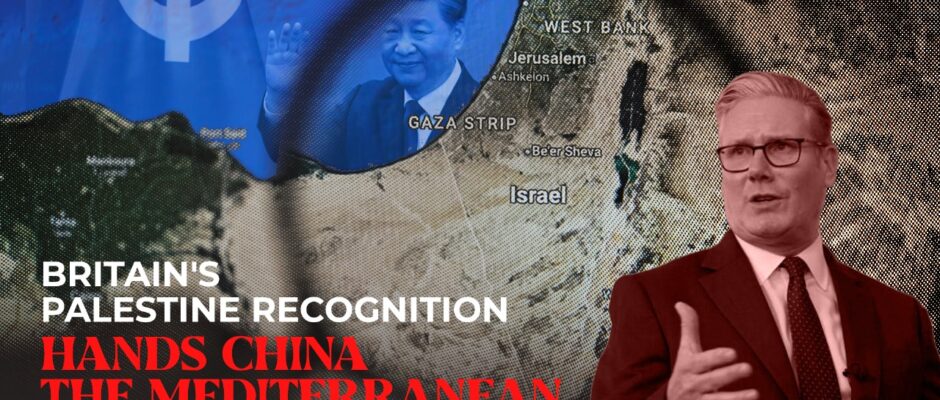
Britain’s Palestine Recognition Hands China the Mediterranean

CCP spent six decades cultivating Palestinian movements, embedding influence in Western activism and positioning itself as the indispensable power in a post-American WestAsia. Britain just made that job easier. Rahul Pawa On 21 September 2025, Prime Minister Keir Starmer broke with decades of U.K. policy formally recognising the state of Palestine. It was Britain’s most consequential West East move since the 1917 Balfour Declaration, made over explicit U.S. objections and Israeli fury. In London’s rush to show moral leadership, one reality was ignored: Beijing had spent six decades preparing for this moment. The CCP’s Palestinian project began in the 1960s. Between 1965 and 1970, Beijing sent small arms, mortars and anti-tank weapons to the Palestine Liberation Army and the Popular Front for the Liberation of Palestine. It trained cadres at the Whampoa Military Academy in Nanning and dispatched instructors to Syria and Algeria. In May 1966 Palestine Liberation Organization Chairman Ahmad al-Shuqairy thanked “Peking” for constant arms and training shipments. After the Six Day War in 1967, Israeli commanders displayed captured Chinese-made AK-47s, 81mm mortars and chemical decontamination gear seized in Gaza and Sinai. Alongside, Beijing also built a diplomatic bridge. In December 1995 it opened a foreign office in Gaza; a de facto embassy to the Palestinian Authority, decades before most Western states considered recognition. Its message to Palestinians was consistent: you can count on us when the West won’t. By Xi Jinping’s era the posture turned strategic. In 2017 the PLA opened its first overseas military base in Djibouti, a Red Sea hub housing thousands of Chinese troops. Beijing secured port stakes from Gwadar in Pakistan to Haifa in Israel, embedding itself along the arteries that supply Europe and the Gulf. A 25-year strategic agreement with Iran in 2021 locked in $400 billion in Chinese investments across oil, gas and transport corridors. CCP’s pattern is clear: first ports, then troops. Djibouti proved it, Hambantota confirmed it, Gaza may be next. Beijing has already demonstrated how commercial access becomes military power, and a recognised Palestine gives it the opening to repeat the same playbook on the Mediterranean. While Beijing built bricks abroad it built narratives at home. State-aligned Arabic media channels and TikTok streams pump out Gaza content at scale. A July 2025 Program on Extremism report mapped how the CCP’s influence runs through Western activism itself. That report details how Shanghai-based tech investor Neville Roy Singham, a onetime Huawei adviser, poured millions into U.S. and U.K. activist groups after Hamas’s October 7, 2023 attack. Groups like the People’s Forum, ANSWER Coalition and “Shut It Down for Palestine” became organising hubs for anti-Israel protests. BreakThrough News, their media arm, live-streamed marches while praising Xi Jinping Thought and Maoist revolution. Investigators concluded the effect was “to project the CCP as a defender of justice while undermining U.S. influence.” In December 2023 the People’s Forum hosted a “China75” event lauding Beijing’s governance model; by early 2024 its funding spiked from under $500,000 to $4.4 million as it expanded pro-Palestinian actions. The same network underwrote protests at Columbia University and in Whitehall, echoing CCP state rhetoric about “imperialist Zionism.” When Starmer spoke to recognise Palestine, Beijing didn’t improvise. Chinese State media instantly framed Britain’s recognition as vindication of the CCP’s “historic” support for Palestinian independence. Chinese diplomats in Ramallah pointed out they had welcomed Mahmoud Abbas to Beijing two years earlier and had pushed a ceasefire plan in 2023. They reminded Palestinian officials who had invested in them when no one else would. With London’s imprimatur, a Palestinian government now has every incentive to turn to CCP for reconstruction finance and infrastructure contracts. Beijing can bolt these onto its Belt and Road Initiative, locking in leverage over a new state at the heart of the Levant. U.S. influence, already eroded by drift and divided Congresses, will shrink further. China’s record speaks for itself. In Djibouti, commercial port access became a PLA base within three years. In Sri Lanka, Chinese loans turned into a 99-year lease at Hambantota. CCP has cultivated a pattern: ports, logistics, security co-operation and then military presence. If Palestine’s future leadership wants investment and security guarantees, CCP will deliver both. Even a small PLA signals unit or intelligence station would tilt the Eastern Mediterranean’s security balance. By presenting any facility as humanitarian or anti-piracy, Beijing can minimise Western backlash while gaining a front-row vantage on Israel, Egypt and NATO operations. Britain’s recognition may have been meant as a rebuke to Israel. However, in practice it is a strategic gift to Beijing. It signals to the Arab world that the West’s will is fractured and that China, not America, not Europe is the constant patron. It creates a diplomatic vacuum China is already moving to fill, from Gaza reconstruction bids to Palestinian security training. This is not hypothetical. Chinese firms dominated Iraq’s post-2003 oil fields; they built most of Africa’s new ports in the last decade. Palestine is a likely next. And unlike the United States or the U.K., the CCP fuses infrastructure with intelligence collection and military access as policy. Starmer’s Downing Street statement marks not the dawn of West Asia peace but a milestone in Beijing’s global ascent. The CCP spent six decades cultivating Palestinian movements, embedding influence in Western activism and positioning itself as the indispensable power in a post-American West Asia. Britain just made that job easier. (Rahul Pawa is director, research at New Delhi based think tank Centre for Integrated and Holistic Studies)
Read More
Keeping The Window Open!

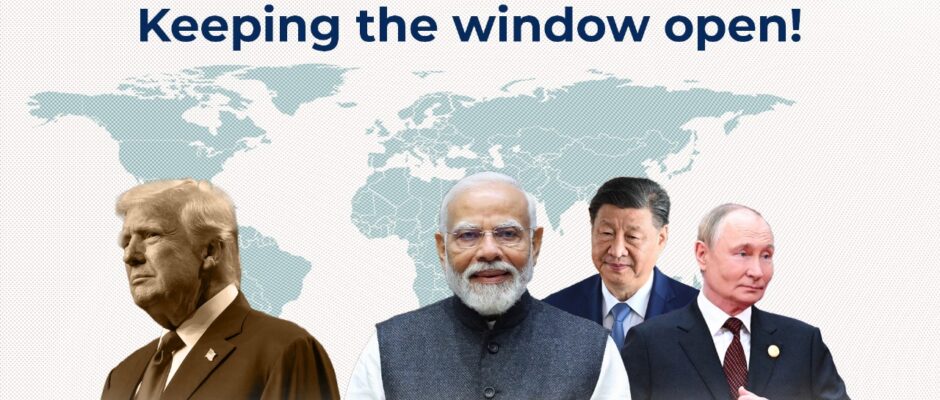
Keeping The Window Open!

Delicate balancing of relations between US, China & Russia is test of Bharat’s foreign policy framework that centres on strategic autonomy. K.A.Badarinath Will there be a huge shift in Bharat’s foreign policy framework? Or, possible tilt towards China, Russia conglomeration, a permanent feature? Will this lead to increased distancing between India and US under Republican White House stewardship? What’s in store on geo-political, strategic and economic engagement for Bharat and the world? There are several unanswered and unsettling questions that pop up in inter-personal conversations and on the information highways as one scans on Google, Weibo to Douyin. Prime Minister Narendra Modi’s visit to China and Japan has set off a flurry of conversations internationally. Both, Beijing and Tokyo are most intrinsic foes that do not have much in common especially after the war leading to Japan’s surrender in 1945. Several questions that analysts, anchors and seasoned newsmen are also awe-stuck given that in the first place he lined up the visits to both China and Japan in one go. Secondly, not only do they keep distance but belong to two diametrically opposite camps but have huge issues in global equations. While China and Russia have had rivalled US-led NATO group, Japan falls into the latter alliance. Thirdly, this visit of Prime Minister Modi is significant in the backdrop of United States President Donald Trump weaponising trade, imposing 50 per cent tariff on Bharat’s goods and services and thereby burning bridges. Fourthly, Prime Minister Modi’s two nation visit gained prominence as the ‘global south’ network seeks to consolidate its position via the Shanghai Cooperation Organization whose twentieth session was held in Tianjin as China holds the rotating chair as of now. Fifth, most analysts think that Bharat’s ‘strategic autonomy’ policy framework is being put to test with re-setting its relations vis-à-vis US and China. Sixth, however, top hawks in Bharat’s foreign affairs department do expect the relations with United States to bounce back to normalcy as had happened in the past after Washington DC imposed unilateral sanctions in aftermath of Pokharan nuclear tests. Seventh, the probability of a ‘delicate balancing act’ that New Delhi would enact with caution but firmness of purpose as its near time posturing without yielding to bullying tactics of US. Eighth, there’s no reason why Bharat should not continue oil trade with Russia or any other country depending on prevailing market conditions. Neither US nor Europe have locus standi to corner Bharat citing oil trade given their own continued ‘lucrative gas deals’ with Russia and its partners. Ninth, Prime Minister Modi’s visit to both Japan and China indicate that Bharat has the depth to manage diversities. For instance, enhancing Japanese investments to US $ 68 billion from $ 34 billion through 170 deals is a big take away for both Bharat and Japan who enjoy strategic and special relationship. This is a firm message for US that sought to dry up the foreign investment pipeline in Bharat to push for a ‘bad trade deal’. By not participating in a significant programme to commemorate China’s victory over Japan is again a big message to Beijing that New Delhi has its friends elsewhere as well. Bilateral summit between Prime Minister Modi and Chinese President Xi Jinping has been regarded as pivotal to ‘resetting relations’ as development partners and ‘not as rivals’. While the intent is good, first step has been taken to normalise relations, there are several challenges especially on borders, Belt and Roads Initiative that brings Chinese projects to the doorstep via Pakistan occupied Jammu and Kashmir. Apprehensions seem to be very high on both over outcome of these meetings even as China and Bharat ready to celebrate 75-years of diplomatic relations. One significant point made by Prime Minister Modi that has gone viral was border peace and tranquillity was like an insurance policy for future enduring relations. Can the dragon and elephant in the room tango seamlessly is a billion dollar question as resetting of relations is attempted. As one Chinese scholar wrote ‘it’s rational choice and shared responsibility for both India and China to reset relations’. A big take away is a meeting between Prime Minister Modi and Russian President Vladimir Putin with carpooling and Ridge Carlton delegation level talks happening in a ‘delightful’ atmosphere. The visuals and videos of Modi, Putin traveling in a Russian made car throwing protocols to winds is not something European Union or US will want to watch. Given that US described Russia and Ukraine conflict as ‘Modi’s war’ has had no impact on the two leaders’ summit deliberations that extended a wee-bit. Also, 2025 marks 15 years of Indo-Russian strategic relationship that would come into full play later this year. From Bharat’s perspective, there have been a few takeaways from 20-members SCO summit. Unadulterated condemnation of Pahalgam attack by terrorists from across the borders is what India expected and achieved. Also, expanding trade relations between different SCO member countries with payments squared off in respective currencies is big. This would also mean that increasingly trade would get delinked from US dollar and euro while Chinese Renminbi, Russian rouble and Indian Rupee would gain in terms of acceptability. While the show in China came to a near close, the implications of new found friendship between Presidents’ Xi, Putin and Prime Minister Modi will result in sleepless nights for those in Trump administration and Brussels, housing headquarters of European Union. (Author is Director and Chief Executive of New Delhi based non-partisan think tank, Centre for Integrated and Holistic Studies)  Keeping The Window Open!

Read More
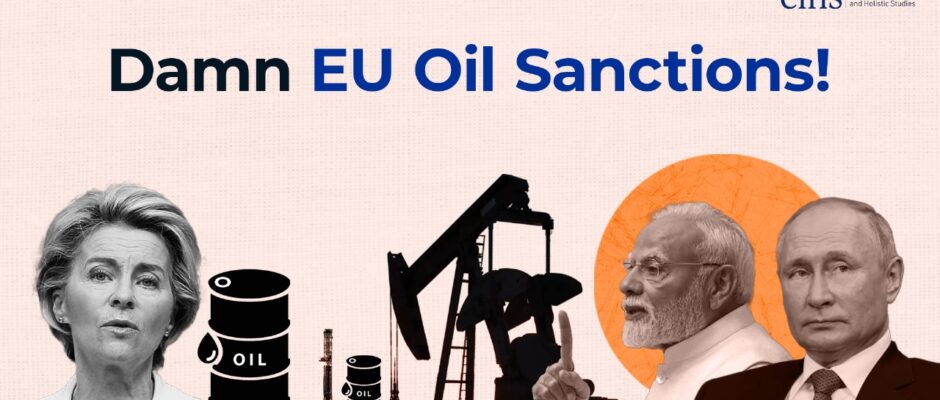
Damn EU Oil sanctions!

Damn EU Oil sanctions!

Strategic autonomy coupled with its right to source crude at affordable prices and quality is non-negotiable. Here’s New India… By NC Bipindra Latest round of sanctions announced by European Union on July 18, 2025, has opened a new chapter in the growing geopolitical standoff between Brussels and New Delhi. For the first time, EU has directly targeted Indian oil trade, specifically naming Nayara Energy’s Vadinar refinery which is majority-owned by Russia’s Rosneft. The EU sanctions, coming as it does within days of NATO Secretary General Mark Rutte’s warning about secondary sanctions on India, are part of these regional institutions’ crackdown on what it calls indirect financing of Kremlin’s war in Ukraine. At the heart of this issue lies India’s continued and unapologetic purchase of discounted Russian crude. India has been refining this oil and exporting resultant diesel and jet fuel, some of which flows back into Europe. While New Delhi views this as a perfectly legal and economically sound strategy, Brussels sees it as a dangerous workaround that weakens Western sanctions regime. What makes this clash more than a bureaucratic quarrel is its broader significance for global energy markets, economic diplomacy and tests limits of Western pressure in a multipolar world. Why Is the EU Escalating Pressure on India over Russian Oil Purchases? EU wants to isolate Russia economically. India, however, is determined not to compromise its energy security and strategic autonomy, the principles it considers non-negotiable. From European perspective, India’s growing role as a refinery hub for Russian crude threatens to undercut its sanctions framework. Eighteenth package of EU sanctions which includes lowering price cap on Russian crude to about $ 47.60 per barrel and sanctioning over 100 tankers in Russia’s so-called “shadow fleet,” is aimed at choking off alternative routes for Russian oil revenue. By focusing on Indian exports and targeting refineries like Vadinar, Europe is sending a clear message that it will go after any actor — state or private — that contributes to propping up Moscow’s war chest. What are Its Strategic Imperatives? But India isn’t taking this lightly. Ministry of External Affairs responded swiftly and sternly, calling the EU’s actions unilateral and unjust. Officials in New Delhi accused the bloc of practicing double standards, pointing to Europe’s own imports of Russian LNG and uranium even after war in Ukraine escalated. Energy security, Indian leaders assert, is not just a matter of policy but a constitutional duty, especially for a developing nation with over 1.4 billion people striving for economic growth and social stability. From New Delhi’s standpoint, its trade with Russia is both lawful and pragmatic. Indian officials frequently cite EU Regulation 833 / 2014, which states that once a good is substantially transformed in a third country, it is no longer considered to originate from the sanctioned country. India’s External Affairs Minister Dr. S. Jaishankar and Petroleum Minister Hardeep Singh Puri have made this argument repeatedly, maintaining that diesel refined in India is legally distinct from the Russian crude it was made from. The economic logic behind this policy is also compelling. Minister Puri has stated that importing discounted oil from Russia has saved India billions of dollars, helped stabilise inflation and shielded consumers from worst of global energy shock. In a world still reeling from economic aftershocks of the pandemic and the war, these savings have helped India remain on a steady growth trajectory while other economies faltered. India’s position is also shaped by deeper strategic calculations. The country has long prided itself on its foreign policy of non-alignment, now recast as “strategic autonomy.” This allows New Delhi to navigate complex relationships with both the West and traditional partners like Russia without being forced to pick sides. India’s close defence and energy ties with Moscow continue, even as it deepens cooperation with the United States and European Union in other areas like technology, trade, and counterterrorism. What are India’s Strategic Options? Rather than cave in to external pressure, India has quietly but effectively diversified its oil imports. Over past year, it has increased purchases from Middle Eastern countries, United States, Brazil and new suppliers in Africa and Latin America. This diversification has enabled India to demonstrate that it is not wholly dependent on Russian oil, even as it defends its right to continue buying it. At the same time, India has expanded its investment in natural gas, renewables and long-term energy security. A 15-year LNG deal with United Arab Emirates’ ADNOC, for example, will bring in one million tonnes of gas annually, supporting the country’s gradual shift toward cleaner fuels. India’s resilience is also built on its ability to conduct trade outside of Western financial and logistical systems. Russia has set up rupee-based trade settlements, used vostro accounts through Indian banks and relied on non-Western insurance and shipping firms. This alternative infrastructure insulates India-Russia energy trade from Western sanctions to a large extent and helps maintain stability despite external disruptions. Even as EU tightens restrictions and hints at possible secondary sanctions, India continues to find new export markets for its refined petroleum products. Africa, Southeast Asia and Latin America have emerged as key destinations where buyers are less concerned about the origins of crude and more focused on price and availability. These regions offer India a buffer against any loss of European markets, keeping its refineries running and export revenues intact. At the legal level, India has pushed back forcefully the very idea of violating sanctions. Indian legal experts argue that under international law, unilateral sanctions not backed by United Nations are not binding. New Delhi has taken this position consistently and has also pointed out hypocrisy of Europe’s own uneven implementation of sanctions where Russian LNG and enriched uranium remain untouched by embargoes. Behind all this lies a larger philosophical question. Should developing countries bear the brunt of economic disruptions caused by conflicts they did not start and do not control? India has answered this with a firm no. It argues that energy access at affordable prices is a matter of global

Read More
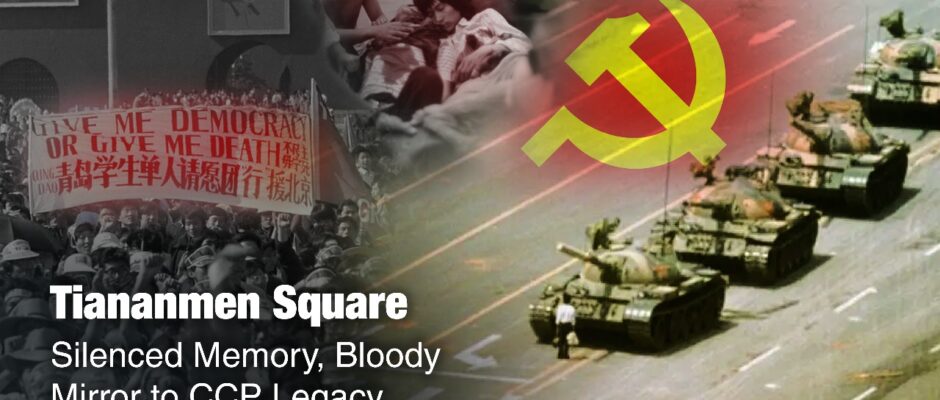
Tiananmen Square: Silenced Memory, Bloody Mirror to CCP Legacy

Tiananmen Square: Silenced Memory, Bloody Mirror to CCP Legacy

History, if buried, becomes a tool of tyranny. Memory, if preserved, becomes a weapon of liberty. The ghosts of Tiananmen still march in silence.  It is up to the world to give them voice. Pummy Pandita On June 3rd and early morning of June 4th, 1989, Chinese Communist Party (CCP) showed its draconian fangs and massacred the country’s youth and workers at Tiananmen Square. Thousands of unarmed workers and students protesting for democratic reforms and freedom from corruption were confronted with tanks, bullets and ferocity. Thirty-six years on, the Chinese dictatorship continues to erase, censor and sanitize that blood-soaked chapter from national psyche. But for the world at large, Tiananmen is still a beacon of defiance and a cautionary tale of enduring authoritarian rule. Although the death toll is veiled by censorship, estimates vary from hundreds to several thousand. What is undeniable is that CCP directed People’s Liberation Army (PLA) to suppress peaceful protests with iron fists and running the tanks over protestors. The iconic image of “Tank Man”, a solitary protester facing a line of tanks, was not mere momentary bravery. It was condemnation of a ruthless regime that perceived students waving placards as a danger to state security. Now, Chinese internet censors even suppress digits “64” and “1989.” Victims’ families, Tiananmen Mothers are subjected to surveillance, harassment and house arrests each anniversary. The attempt by state to rewrite history is a testament to its own fear: that memory is revolutionary and truth is subversive. Tiananmen was not an aberration; it was harbinger of CCP’s authoritarianism that changed but did not disappear. The censorship technologies, surveillance knowhow and suppression tactics that spawned in the wake of 1989 have since metastasized into contemporary surveillance state we witness in Xinjiang, Hong Kong, Tibet and increasingly within mainland China. The party that ran over students in Beijing constructed virtual concentration camps in Xinjiang in the name of “counter-terrorism.” And, the regime that shook at placards in 1989 now shakes at hashtags, virtual dissent and international scrutiny. Tiananmen was the bloody blueprint. Refinement, not remorse, followed. The world witnessed Tiananmen with horror in 1989. But it wasn’t long before trade interests and geopolitical convenience swept the outrage away. Within a few years, China was mainstreamed into global economy. In 2001, it was admitted to the WTO. Western firms poured in, drawn by cheap labour and state-forced exploitation, even as dissidents went missing and Nobel Peace laureates like Liu Xiaobo died in detention. This ideological bankruptcy, where democratic nations get friendly with the totalitarian ones in the interests of immediate gain, has only encouraged Beijing. West’s dependency on Chinese markets has made it an accessory to muffling Tiananmen’s memory. Why recall Tiananmen today? Because China’s political system, techno-authoritarian one-party rule with economic influence, is being shipped out; Chinese young people are coming off age in a state that not only revises the past but eliminates it and the struggle over narrative sovereignty is a battleground in the greater war for liberty in 21st century. Remembering Tiananmen is not about nostalgia. It is about marking the line in red between authoritarianism and civilization. It is about remembering that CCP’s “rise” rests upon coffins of protestors, bones of those it muzzled. The tanks are no longer rolling down Chang’an Avenue, but the infrastructure of fear, censorship and ideological control remains. For a world in which China’s economic influence and digital footprint become increasingly dominant, remembering Tiananmen is not merely historical amnesia—it is geopolitical suicide. It is imperative that governments, civil societies and international institutions not only to remember but act to raise voices that Beijing wants to suppress, to respond to Beijing’s international narrative warfare with unyielding truth and to see to it that those who stood in Tiananmen Square – armed with nothing but ideals and signs – did not die for nothing. (Author is head of operations at Centre for Integrated and Holistic Studies, a non-partisan think tank based in New Delhi)

Read More
Titanic Shifts Inevitable!

Titanic Shifts Inevitable!

Trump’s tariff wars provide a window of opportunity to Bharat for proving its mettle as a global force to reckon with its own economic development model. K.A.Badarinath There’s a huge body of analyses on possible impact of tariff orders signed by US President Donald Trump in last few weeks. Those in favour and against have argued emphatically leaving room for further discussion given that tariffs, trade and economic engagement has gained pre-eminence and a developing story. Several analysts described recalibration of tariffs as trade war. Yet others have attempted to look at implications of the trade centric conflict overflowing into geo-political stratosphere.  Markets – equities, currencies, commodities, bullion and a host of financial products – felt the immediate impact. There has been roil in the market place. Billions of dollars’ worth investors’ wealth either vanished over night or partially restored as tariff orders were released by the White House in quick succession beginning ‘liberation day’ as Trump pompously described. Companies, services providers and logistics firms scurried for cover even as President Trump essentially targeted European Union with whom US has a trade deficit of $ 200 billion and China with deficit exceeding US $ 300 billion. Sixty countries – friends and foes – were treated by Trump with derision and slapped with counter-tariffs to bring down the US trade deficit that piled up to US $ 1.2 trillion. Some economists also pointed to trade surpluses run by US with about 100 countries which were royally ignored by ‘transactional Trump’ administration. Trump’s political agenda in run up to 2024 Presidential campaign centred around correcting the ‘unfair’ ripping of American people, businesses and denying his ‘voters’ the job opportunities thereby shifting manufacturing out of US. This is also the biggest ‘political agenda’ item of Trump that got him into power for a defining second four-year term. Apart from addressing domestic core whites’ constituency that were central to his ‘Make America Great Again’ agenda, Trump’s belief centre’s around ‘lifting the burden of American people’ on whose shoulders the world rejoices. Now that the trade, tariffs, manufacturing and jobs agenda gets to be implemented in US, the signals are ominous for anyone and everyone to pick up and put their counter-offensive in place. A lot of counter-offensive from US trade partners was kept on hold as 90-days window to fast-track trade and economic partnership negotiations began in Washington DC and elsewhere. China, however, has been treated differently after having slapped 145 per cent duties on most goods and services exported to US. China that countered with 84 per cent tariff on US goods and services was not part of the 90-days pause plan announced by President Trump. For now, trade war has turned direct and vicious between US and China while the latter owed ‘fight to finish’ action plan. Trade centric war is evolving and one may not see much hope in bringing this to an early close as negotiations between trade partners and US would be a long drawn process. Even if trade issues are sorted out, the impact would be profound on Western model of ‘globalization’ that got rolled out post-World War II and setting up of Bretton Wood institutions is bound to hit reset button. A fresh look at global trade and economic engagement is something that’s unavoidable or rather inevitable. This re-engagement will have huge bearing on socio-economic development paradigm of global communities especially with larger number of people reeling under poverty. A more America-centric economic policy roll out by Trump and ‘inward’ looking framework would lead to conceding geo-political and economic space to big players like Communist China. Each country – big or small – will have to learn fast to fend for itself and not depend on big brothers in either US, China or European Union. Next four years may also see ‘many more’ socio-economic self-reliance campaigns. It’s in this context that Bharat’s ‘self-reliance’ campaigns being run last eleven years would gain significance as existing value chains get rejigged, decoupling and re-engagement were definitively on the horizon. Bharat’s ‘strategic autonomy’ in terms of foreign policy and by extension, economic engagement, will hold strong. Unwilling to react in a hurry, announce counter-measures in a huff like several members of European Union or China, Bharat fell back on ‘time tested’ autonomous policy postulation. Free Trade Agreements (FTAs) with US, European Union and United Kingdom may have to be reworked with other economic parameters like investments more closely aligned. Secondly, given that Bharat has been treated ‘even handed’ with 26 per cent additional tariff, New Delhi should resist the temptation of falling into anti-US blocks. This should not translate to closing the door firmly on China that offered to align with Bharat to take on US. Thirdly, Bharat may consider making new partners on equitable and respectable terms that’s ‘mutually beneficial’ and ‘long lasting’ while economic engagement takes on new hue and different shade. Fourthly, measured and nuanced approach to trade, economic, development and geo-political engagement may have to be pursued in the spirit of ‘vasudaiva kutumbakam,’ the world is one big family. Fifthly, given that Bharat is on an ascent mode, wading through economic uncertainties globally and achieving its objective of becoming a ‘responsible economic power house’ will have to be carefully crafted. Sixthly, open, flexible, rules and regulations driven economic engagement with a ‘human face’ in reaching out to last man standing in queue should be basis for Bharat’s approach. Seventhly, this is the perfect time and context to present its own model of socio-economic development model that’s not exploitative, solely driven by consumer centric approach and instead push for synergies between nature and human living that’s sustainable in terms of judicious utilization of resources. Eighthly, realignment of global forces, both geo-political and market centric, is inevitable. And, carving out a distinct role for itself with responsibility is what’s recommended. Ninthly, falling back big on indigenous knowledge, development ecosystem based on sanatan Dharmic values for shared prosperity will test Bharat’s mettle. Tenthly, leadership role cannot be played from

Read More
China Extends to Tasman Sea

China’s ‘Gunboat’ Expansionism in Tasman Sea

PLA Navy seeks to expand Chinese Communist control beyond traditional Indo-Pacific areas and change power dynamics vis-à-vis Australia, New Zealand and their Western allies. Ayadoure Stalin China’s recent naval activities in Tasman Sea have caught the attention of many across Indo-Pacific. This unusual move by People’s Liberation Army (PLA) marks a significant display of naval strength, indicating Beijing’s strategic aim to disrupt current balance of power in the region. Considering Tasman Sea’s closeness to Australia and New Zealand countries that have traditionally held sway in South Pacific China’s actions imply a broader geopolitical strategy that could alter security landscape in the area. Tasman Sea has traditionally remained outside China’s naval exercises domain making this recent manoeuvre an unusual and deliberate display of force. PLA Navy’s growing presence in these waters marks a departure from its conventional areas of military operations, primarily concentrated in South China Sea, East China Sea and Taiwan Straits. This geographic shift indicates Beijing’s desire to expand its operational reach into broader Indo-Pacific, demonstrating its ability to project power beyond its immediate maritime periphery which in itself is controversial and expansionist. China’s decision to operate in this region should not be viewed in isolation but as part of its broader maritime strategy which seeks to counter Western presence in the Pacific. While official Chinese statements may downplay significance of these drills, the message to Australia, New Zealand and their allies is apparent: China will assert its presence in waters traditionally dominated by Western powers. Western presence in South Pacific Tasman Sea has typically been outside the realm of China’s naval exercises, making this recent manoeuvre a notable and intentional show of strength. PLA Navy’s increasing activity in these waters departs from its usual military operations which are mainly focused on South China Sea, East China Sea, and Taiwan Straits. This shift suggests that Beijing aims to expand its operational reach into wider Indo-Pacific showcasing ‘communist military strength’ beyond its immediate accepted maritime boundaries. China’s choice to engage in this region should be considered part of its larger maritime strategy which aims to counter Western influence in the Pacific. Although official Chinese statements may downplay the importance of these drills, the message to Australia, New Zealand, and their allies is clear: China is prepared and capable of asserting its presence in waters that have traditionally been under Western control. Provocative Display of Power China’s naval expansion in Tasman Sea is more expansionist as part of a larger plan of President Xi Jingping to alter regional security landscape. Deployment of Chinese warships in this unexpected area goes beyond a simple military exercise; it represents a calculated display of power that fulfils several strategic goals. Firstly, it tests responses of Australia and New Zealand assessing their speed and effectiveness in addressing perceived threats nearby. This gives China insight into Western regional allies’ military readiness and strategic collaboration. Secondly, it conveys a strong message to smaller Pacific nations that China was the ‘big brother’ capable of wielding diplomatic and military influence in their waters. China’s activities in Tasman Sea might not be limited to mere displays of strength. Violation of territorial waters treaties, coercive actions and other aggressive manoeuvres cannot be ignored. Given China’s history of using its naval power for intimidation such as island-building in the South China Sea or conducting military drills near Taiwan these concerns are valid. Shadow of Gunboat Diplomacy China’s naval activities in Tasman Sea reflect its Gunboat Diplomacy, a tactic historically used by it to exert influence through naval presence. This strategy has been apparent in Beijing’s approach to territorial disputes in South China Sea, its assertive stance in Taiwan Straits and its growing resistance to US Pacific Command operations.  China aims to bolster its claims over Indo Pacific waters by employing Gunboat Diplomacy, intimidate rivals and deter outside interventions. Deployment of PLA Navy assets in Tasman Sea extends this strategy, signalling Australia, New Zealand and their allies that western powers may not be able to negate China’s influence in wider Indo-Pacific region. China is contesting supremacy of US Pacific Command. Historically, Washington has maintained a robust naval presence in Indo-Pacific to counterbalance China’s expanding military reach. However, Beijing’s ability to conduct operations far from its shores indicates a growing desire to quickly expand its arc of influence thereby challenge U.S.-led regional security frameworks. Implications for the Indo-Pacific PLA presence in Tasman Sea raises important questions about the future of regional security and strategic balance in the Indo-Pacific. Australia, New Zealand and their allies will likely see China’s actions as a wake-up call, leading to discussions on effectively counterbalancing Beijing’s increasing military assertiveness. Several potential responses could arise: First, strengthening regional alliances Australia and New Zealand may look to enhance their defence cooperation with like-minded partners including US, Japan, and India through frameworks like Quad and AUKUS. Secondly, enhancing maritime surveillance both nations might prioritize increased investments in maritime domain awareness capabilities to monitor Chinese naval activities better. Thirdly, diplomatic pushback Canberra and Wellington could use diplomatic channels to garner support from Pacific island nations, ensuring they do not fall under China’s influence. Fourthly, increased military preparedness expect to see greater defence spending and military exercises aimed at showcasing regional resolve against possible Chinese encroachments. China’s recent activities inTasman Sea are not likely to be a one-off event. Instead, they indicate a more significant shift in Beijing’s military strategy one aimed at challenging the current security framework in the South Pacific. Through economic pressure, diplomatic initiatives and increased naval presence, China is gradually working to reshape the Indo-Pacific to its advantage. China’s PLA navy operations in Tasman Sea represent a notable shift from its usual military focus indicating a bold move into waters traditionally under Western control. (Author is an UGC Junior Research Fellow at Centre for Indo Pacific Studies, School of International Studies, Jawaharlal Nehru University, New Delhi)China Extends to Tasman Sea

Read More
Inside China's Grey Zone Strategy

Inside China’s Grey Zone Strategy

Rahul Pawa In South China Sea, grey zone tactics unfold with laser-focused intent. Watching the PLA Navy’s manoeuvres or the maritime militia’s presence can, at times, feel like staring at a chessboard whose pieces inch forward one measured square at a time. The sight of special barges looming by the docks in Zhanjiang, China, went unnoticed by many who passed them on their daily commutes. To casual observers, these hulking platforms seemed little more than routine maritime fixtures. But for those with their eyes fixed on the shadows of international geopolitics, these barges signalled something far more ominous: a finely tuned exercise by the People’s Liberation Army (PLA) in what appeared to be over-the-shore logistics drills for a future military landing. In hushed circles in Taipei, Washington, Delhi and capitals across Asia, the question was no longer if China was meticulously preparing itself for conflict, but rather how it used the blurred space between war and peace to move closer to its global aspirations. In recent years, Chinese Communist Party (CCP) has demonstrated a distinct flair for “grey zone” strategies—actions that straddle the threshold between open conflict and the calm of peacetime. This approach is not entirely new; historical powers have long tested their adversaries with salami-slicing tactics, never crossing the bright red line that might spark a full-scale clash. Yet what sets the CCP apart is its calculated synchrony of economic, diplomatic, maritime, and cyber manoeuvres, pushing its objectives in precise increments. In effect, Beijing has mastered the subtlety of wrestling advantage while making it appear that the match has barely begun. In South China Sea, these grey zone tactics unfold with laser-focused intent. Watching the PLA Navy’s manoeuvres or the maritime militia’s presence can, at times, feel like staring at a chessboard whose pieces inch forward one measured square at a time. When disputes arise, the CCP often deploys fishing fleets that function like unofficial patrols, creating friction against neighbours like Vietnam or the Philippines. Although these fishing vessels seem harmless at a glance, their real purpose is to project CCP influence and thwart regional rivals from fully exercising their own sovereignty. Beijing’s “nine-dash line” claims—rejected as baseless by a United Nations Convention on the Law of the Sea (UNCLOS) arbitration panel—illustrate its sweeping claim over nearly the entire South China Sea. Yet China treats that ruling as little more than background noise. It has advanced its position through repeated harassment of Philippine resupply missions, demonstrating how a large naval fleet is not always necessary to assert dominance. Last year, when Philippine efforts to resupply the rusted BRP Sierra Madre near the Second Thomas Shoal were impeded by China’s Coast Guard and maritime militia. An agreement to ease tensions was eventually reached, but China then turned its gaze toward the Scarborough and Sabina Shoals, employing a range of coercive tactics that skirted just below the threshold of outright military force. This is precisely the effectiveness of Beijing’s grey zone philosophy: the CCP can repeatedly test the resolve of its neighbours and the broader international community without triggering a major conflagration. Unchallenged, those incremental gains morph into accepted realities—often reinforced by a parallel campaign of disinformation and cyberattacks that sow confusion and shape public perception. Indeed, the hallmark of the CCP’s grey zone strategy is its convergence with information operations. As the world has become more interconnected, data and narrative management have become invaluable pieces on the geopolitical chessboard. Taiwan’s National Security Bureau reported that Chinese agents circulated 60 percent more false or biased information in 2024 than in the previous year, an alarming trend that hints at a steady intensification of disinformation campaigns. It is, in effect, the other side of the same grey zone coin: while the PLA’s warships push deeper into contested waters, Beijing’s narratives undermine trust in democratic processes, making it that much harder for adversaries to mount a united response. Another front where Beijing flexes its grey zone muscles lies in the economic realm—a domain where “carrots and sticks” often speak louder than gunboats. CCP’s massive market provides an enticing lure for many nations, encouraging them to tread lightly on issues Beijing holds dear. At the same time, the CCP is quick to punish countries that challenge its aims. Witness how trade restrictions, investment blacklists, and targeted boycotts are deployed whenever a state brushes too close to opposing CCP’s territorial ambitions or welcoming dissidents. Even patrolling maritime areas in dispute can shut down foreign economic opportunities: by swarming neighbourly waters with large fishing fleets, CCP can intimidate local companies into abandoning lucrative projects such as oil and gas extraction. However, nowhere is the CCP’s grey zone approach more fraught with global tension than around Taiwan. For decades, Beijing has asserted that the island is a “breakaway province”, destined, eventually, for reunification—by force if necessary. Yet mounting a full-scale invasion comes with tremendous risk, both militarily and politically. Thus, CPC’s cross-strait strategy frequently focuses on intimidation and incremental pressure. Having declared its own Air Defense Identification Zone (ADIZ) over much of the East China Sea, the PLA has probed Taiwanese airspace with persistent sorties, testing and teasing the boundaries. Over the course of 2024, the PLA Navy stationed warships near Taiwan’s ADIZ, and by December that year, it conducted large-scale exercises with aviation and naval forces in an elaborate show of force. All of it served dual purposes: normalising frequent PLA military appearances in the region, and demonstrating that Taipei’s backers—chief among them the United States—may not muster the political will to intervene every time. For the United States and its allies, especially Japan, the grey zone creates a double bind. Acting too robustly against each provocation risks an escalation that no one wants, while complacency allows Beijing’s inroads to solidify into indisputable facts on the ground—or, in this case, at sea. The art of Beijing’s game lies in how it calibrates pressure just below that flashpoint. By the time foreign powers muster the will to intervene, the CCP has typically moved on to

Read More