CIHS – Centre for Integrated and Holistic Studies

Date/Time:

Beijing’s Silent Cyber Siege on America

Beijing’s Silent Cyber Siege on America

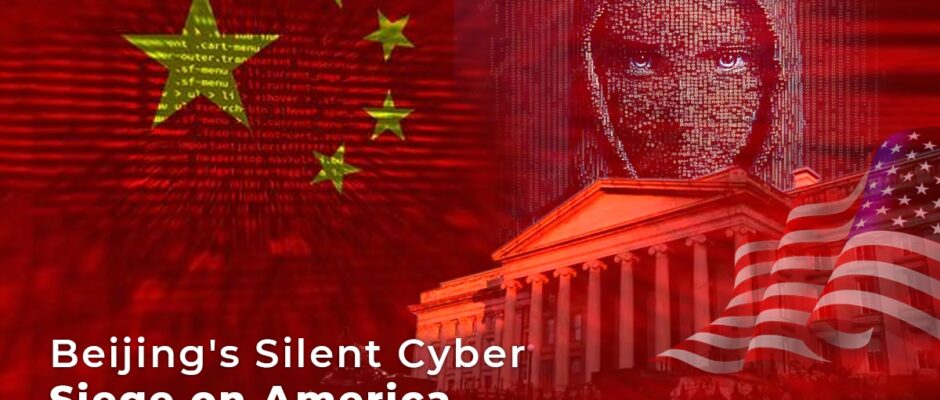
Throughout 2024, Chinese state-sponsored hacker groups like Volt Typhoon and Salt Typhoon orchestrated a series of cyber offensives, targeting everything from U.S. telecommunications to Guam’s critical infrastructure. Rahul Pawa On a December morning in 2024, a silent invasion unfolded—unseen, unheard, yet profoundly destabilising. The U.S. Treasury Department, the nerve center of American economic power, fell victim to a meticulously planned cyberattack attributed to the Chinese Communist Party (CCP). This was no ordinary breach. It was a calculated strike targeting the Office of Foreign Assets Control (OFAC) and the Office of the Treasury Secretary—both critical enforcers of sanctions against Chinese entities embroiled in cyber operations and arms deals with Russia. As the sun rose over Washington, D.C., officials scrambled to assess the damage. Anne Neuberger, the U.S. Deputy National Security Advisor for Cyber and Emerging Technologies, stood before the press, her tone somber but resolute. “This was not just espionage. This is part of a broader strategy to undermine our critical infrastructure and economic sovereignty,” she declared. Behind her words lay months of escalating cyber conflict, a crescendo that had been building since the CCP’s hybrid tactics first gained traction. The December breach was merely the tip of the iceberg. Throughout 2024, Chinese state-sponsored hacker groups like Volt Typhoon and Salt Typhoon orchestrated a series of cyber offensives, targeting everything from U.S. telecommunications to Guam’s critical infrastructure. Volt Typhoon, dismantled in January, had covertly commandeered hundreds of routers across the United States, laying the groundwork for attacks on water treatment facilities, electrical grids, and transportation systems. Meanwhile, Salt Typhoon focused on high-profile targets, infiltrating devices used by key political figures, including Donald Trump and his running mate, Senator J.D. Vance. Salt Typhoon’s activities, described by Neuberger as “an unparalleled espionage operation,” breached nine major U.S. telecom providers, stealing sensitive data and leaving behind dormant malware—a ticking time bomb designed to cripple American defences at a critical juncture. “This is not about immediate damage,” explained Rob Joyce, the National Security Agency’s cybersecurity director. “It’s a long game—preparing to paralyse us when we’re most vulnerable, perhaps during a conflict over Taiwan.” While the United States grapples with the looming specter of a cyber Armageddon, Taiwan stands as the front line of Beijing’s digital onslaught. In 2024, Taiwan’s National Security Bureau reported an average of 2.4 million cyberattacks daily, a staggering escalation from the 1.2 million daily incidents the previous year. These attacks targeted military systems, government networks, and critical infrastructure, all under the shadow of Taiwan’s January elections. Beijing’s strategy is clear: to undermine Taiwan’s democratic process and weaken its defences ahead of a potential invasion. The CCP’s disinformation campaigns, deployed in tandem with cyberattacks, sought to erode trust in Taiwan’s institutions. Yet, as Taiwanese President Tsai Ing-wen reaffirmed her nation’s commitment to sovereignty, the island’s resilience became a rallying cry for democracies worldwide. Compounding the threat is China’s deepening partnership with Russia in cyber and information operations. Ukrainian intelligence reports from 2022 revealed CCP-linked spyware embedded in over 600 Ukrainian defense ministry websites—an ominous precursor to Moscow’s invasion. By 2024, this synergy had expanded to include the exchange of malware and tactics, raising alarms in Washington about the potential for coordinated cyberattacks on the U.S. homeland. “Imagine a cyber Pearl Harbor, but orchestrated by two of our greatest adversaries,” warned Senator Mark Warner, Chair of the Senate Intelligence Committee. His words echoed the growing fears in Washington: that Beijing and Moscow’s digital axis could escalate from sabotage to all-out cyber warfare. The battle isn’t confined to cyberspace. In January 2024, Taiwan’s northern coast faced an economic lifeline’s severance when the Shunxin 39, a vessel with ties to Hong Kong-based Chinese interests, allegedly damaged a vital undersea telecom cable. Weeks later, the Yi Peng 3, a Chinese-flagged vessel, severed cables in the Baltic Sea, raising suspicions of deliberate sabotage. Beijing denies these incidents are acts of war, dismissing them as accidents. However, the frequency and precision of these events suggest otherwise. For Taiwan, already reeling from cyberattacks, these disruptions are a chilling reminder of its vulnerability. As the CCP’s cyber arsenal grows, the United States finds itself in an uncomfortable reality: unprepared for the scale and sophistication of Beijing’s hybrid tactics. The December Treasury hack, focused on intelligence gathering, underscores the need for a robust cyber defense strategy. OFAC, a linchpin in the U.S. sanctions regime, had sanctioned multiple Chinese firms in 2024 for their role in supplying arms to Russia and conducting cyberattacks. By breaching OFAC, Beijing sought to anticipate and counter future sanctions. The broader implications are stark. Guam, home to vital U.S. military installations, has emerged as a prime target. The island’s infrastructure was repeatedly probed in 2024, likely as a rehearsal for disrupting American operations in the Pacific. “Guam is the canary in the coal mine,” Joyce remarked. “If we can’t protect it, how can we hope to defend Taiwan?” As President-elect Trump, takes office, he has vowed to “bring the fight to Beijing.” Yet, the path forward is fraught with challenges. Building a resilient cyber defense infrastructure, forging alliances, and holding adversaries accountable will require a Herculean effort. The Treasury breach is a sobering reminder of what’s at stake. It’s not just about stolen data or disrupted systems; it’s about the erosion of trust in institutions, the weakening of defences, and the existential threat to democratic governance. As Anne Neuberger aptly put it, “Cybersecurity isn’t just a technical issue—it’s a national security imperative. And in this battle, complacency is not an option.” (Author is Research Director at Centre for Integrated and Holistic Studies, New Delhi based non-partisan think-tank)
Read More

China, A Tough Nut to Crack

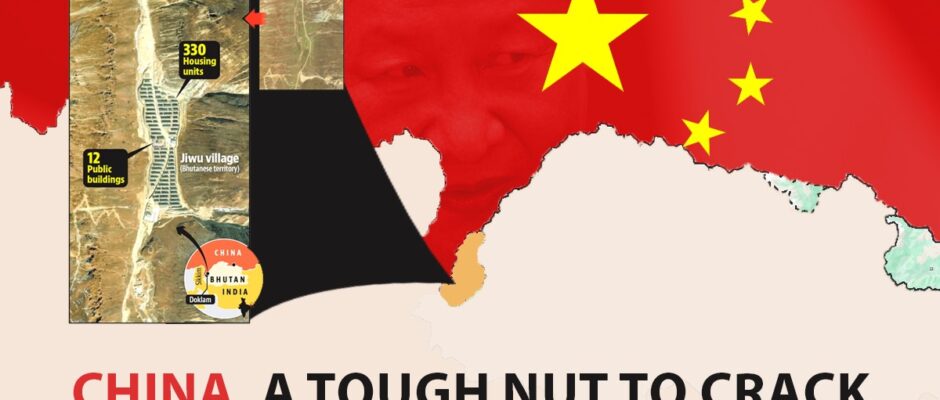
China may not be a dependable ally for Bharat. Reconciliation and reset noises made by President Xi’s hawks could be tactical and unsustainable. Dr Amritpal Kaur Is China a dependable ally for Bharat? Or, is it safe to play a balancing act between China under President Xi Jingping and US where Donald Trump is expected to take charge as President beginning 2025? Both Beijing and Washington DC pose different sets of challenges given Bharat’s 75-years’ experience post-independence from British imperialistic rule. At a time when there has been huge debate on ‘strategic autonomy’ as an instrument of Bharat’s state policy, there have been key developments ranging from threats hurled by US President-designate Donald Trump on tariffs regime to Beijing moving to purportedly normalize relations with Bharat. Undertones of the incoming Republican regime and firmly trenched third-term Chinese Communist Party regimes are different.  At a time when strategists in New Delhi were breathing easy at lasting solution to clashes on Eastern Ladakh front, China opened a new front on Dokolam front with contours of its expansionist face coming to the fore. Reportedly, China encroached into Bhutanese territory, crossed the buffer zone and put up as many as 22 villages in last eight years. Drone images of these villages constructed on Bhutanese territory and splashed on front pages of major Bharat newspapers reflected on the intent of Chinese communist party regime. Parceling away pieces of neighbours’ territory and encroachment by design has been well rehearsed strategy of dragon regime. These images apart from US closing-in that China has never backed out from both Ladakh and Dokolam front came at a time when Bharat’s national security advisor Ajit Doval was in Beijing to attempt ‘normalizing’ relations with President Xi’s hardnosed negotiators. Ramifications of Chinese incursions into Bhutanese territory have strategic and regional security implications. China’s deliberate efforts to alter ground realities and impose a fait accompli are seen in construction of settlements on the Doklam plateau, a region vital to India’s Siliguri Corridor. In violation of 1998 China-Bhutan agreement which explicitly calls for maintaining status quo and refraining from unilaterally altering borders, this makes an absurdity of China’s claims and evasive justifications for the acts. These advances are a flagrant imitation of China’s use of armed force to occupy South China Sea in order to evade its duties under international law and further its expansionist objectives. It’s in this backdrop that cautious attempts made to resolve broader Bharat -China ties have taken place. On October 21, 2024 on sidelines of BRICS summit in Kazan Russia, Indian Foreign Secretary Vikram Misri announced that India and China had reached a patrolling agreement on the Line of Actual Control leading to disengagement in areas where issues had arisen in 2020. This announcement paved way for a brief meeting between Prime Minister Modi and President Xi Jinping on sidelines of BRICS summit, a first in about five years since Galwan clashes of 2020. On November 19, Bharat’s Minister of External Affairs Dr. S. Jaishankar met his Chinese counterpart Wang Yi on sidelines of G-20 Summit in Rio De Janeiro.  He was matter of fact and reiterated that disengagement at two contentious points on Indo-Chinese Border is a ‘welcome step’. There is a long way to go in Indo-China relations and it’s a fact. A day after, on November 20, Defense Minister Rajnath Singh met his Chinese counterpart Admiral Dong Jun on sidelines of Asean Defense Ministers’ Meeting Plus in Vientiane, Laos where he too stressed on need to maintain harmonious relations between the two Asian neighbors. Flurry of meetings indicate possible rapprochement between India and China according to optimists. But, caution is imperative given history of the two Asian giants coupled with present day real politic.  It is hard to miss conspicuous concoction of events and processes happening around which have forced Chinese to even concede that border disengagement was going on, something to their eyes a tactical compromise giving away the psychological advantage to Bharat. Given that Chinese rarely give away the territory they captured after ‘salami-slicing’ the pressure must have been great for Beijing to engage with India in a positive way. The question it begs is, what exactly changed for the Chinese in past two years that from showing off the Commander of Galwan clash as the hero in the National Assembly, which crowned President Xi with unprecedented third term, to a visible attempt at bonhomie with India? It is significant to look beyond South Asia to recent happenings in the world. To begin with, United States elected Donald Trump as its new President. If previous Trump administration is guide to his second term outlook, Chinese have a reason to brace themselves for the ride. Coupled with military maneuvering of PLA in Taiwan Strait to indicate the tensions between China and Taiwan, it makes sense for them to not open another front with India, so that focus remains on its southeast border. Secondly, Chinese ally Russia is fighting war in Europe for more than two years now and another ally Iran is engaged in West Asian conflict with Israel which has potential to spill out into the larger region war creating stress on the Sea lanes of trade and communication, something crucial for China. In strategic parlance, it makes sense to not open another theater of conflict or at least keep other areas peaceful should the push comes to shove, but the sensible would see the game and ask whether underlying structural problems in Indo-Chinese relations have been resolved before we declare the ‘reset’ of ties. If History is the guide to Indo-China relations, beyond early days of Nehru era, relations between the two were never ‘friendly’.  Chinese internal conversations show that even then India was seen as stooge of Imperial Britain and Liberal democracy which is diagonally opposite Communist China. The era of reforms and globalization had given hope to believe that thriving trade and commerce would act as a credible deterrence against any hostilities, but even here the unhealthy trade deficit between the two

Read More
Nepal Falls to Dragon Debt Trap

Nepal Falls to Dragon Debt Trap

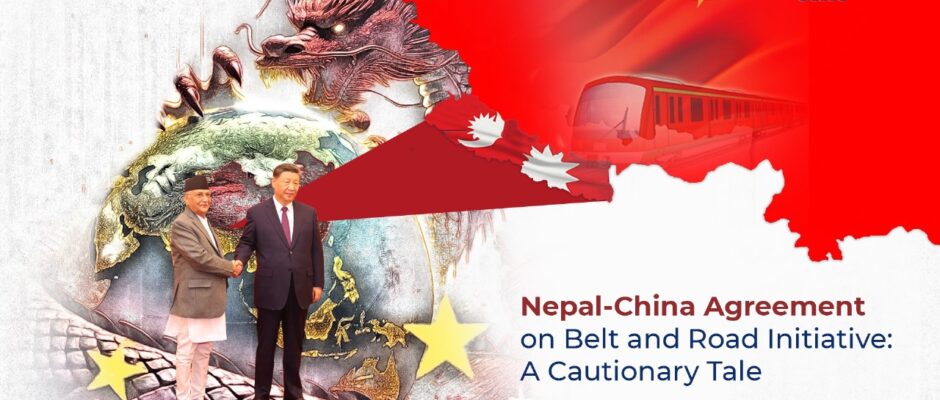
Nepal stares at huge economic costs built into BRI while President Xi pursues his expansionist geo-political interests in South Asia. Rohan Giri Earlier this month, Nepal’s communist regime sealed a deal with China to join ill-famed Belt and Road Initiative (BRI) that pushed several least developed and developing countries into the dragon debt trap. The dragon pact marks a key policy shift for Nepal moving it away from its millennial ally Bharat with civilizational links and signifies : closer alignment with Beijing. While the deal promises economic benefits especially through infrastructure development, it raises significant concerns about Nepal’s sovereignty, financial stability and regional security. More than a bilateral development project, BRI threatens to exacerbate Nepal’s internal challenges and entangle it in China’s geopolitical web. A Faustian Bargain Chinese President Xi Jingping’s signature project, Belt and Road Initiative, has been pushed aggressively as passage to economic growth for the developing nations where much-needed infrastructure would be in place, thereby enhancing trade connectivity and promoting economic growth. For Nepal, being a landlocked country on brink of economic revival, BRI seemed like just the ticket to lift isolation. Beneath the purported economic attraction lies a much darker reality — one of financial vulnerability, political dependency, and loss of sovereignty. The deal, while touted as a historic step by ruling Communist government, is nothing short of a Faustian bargain for Nepal. Prime Minister KP Sharma Oli deciding to go to China as his destination for the first foreign trip after assuming office and subsequently endorsing the BRI, marks a dramatic shift in Nepal’s foreign relations, which were traditionally close cultural and economic ties with India. But, with rising proximity to China — and its growing political and economic influence — comes an entirely new set of dangers that could be disastrous for Nepal. China’s Economic Mirage Behind the BRI lies a worrying financial model which has already ensnared several countries in crippling debt. BRI is mostly financed through huge loans from China usually on terms that put developing countries at risk of default. The countries that embraced the BRI such as Sri Lanka and Pakistan have been saddled with unsustainable debts. A case in point is how Sri Lanka was forced to lease Hambantota Port to a Chinese firm for 99 years following its failure to service the loans. Apprehension about Nepal getting into the vicious debt trap is very valid for this reason alone. Nepal, with a miniscule industrial base, having chronic fiscal deficit and depends on foreign aid, makes this over-leveraging risk extremely high. For one, BRI-sponsored Pokhara International Airport has already faced operational setbacks due to dearth of international flights that now faces the added headache of India’s airspace ban. The economic rationale for Nepal to continue pursuing Chinese loans is increasingly unclear especially when one considers the broader regional dynamics and Nepal’s precarious economic wherewithal. Communist Regime’s Illusory Promises The appeal of BRI to Nepal Communist government cannot be underestimated. Indeed, the ruling regime led by Nepal Communist Party (NCP) placed itself precariously between Chinese-style state-driven development and Nepal’s ambitions to evolve as a modern buzzing economy. Historic record of Communist regimes relying on foreign loans for ambitious infrastructure projects is far from encouraging. In countries like Sri Lanka and Venezuela, alignment with Chinese-funded initiatives has led not only to financial instability but also to political entanglements with Beijing, eroding the sovereignty of these nations. Nepal, too, risks losing control over its internal affairs if BRI’s promises fail to deliver as has happened in other nations under Chinese influence. The promises of job creation, improvements in infrastructure and growing economy from Communist regime would end up being hollow ones as this would lead to greater social inequality, political unrest and growing dependence on China. This could also manifest in a variety of ways: from suppression of political dissent in favour of Chinese interests to siphoning off of Nepal’s resources to meet Chinese repayment schedules. The people of Nepal already burdened by poverty may feel further alienated given their own government prioritizing Chinese loans. Strategic Dilemma and Geopolitical Tension Nepal’s entry into BRI, though framed as a development initiative, has far-reaching geopolitical implications as well. Nepal’s location, nestled between India and China has long made it a strategic focal point in South Asia. India with which Nepal shares not just a long border but also cultural, economic, and historical ties, has expressed some very strong reservations about BRI. China’s larger strategy to expand geo-politically via BRI has been well documented that throws up fresh security challenges in South Asia. India has reasons to worry about China’s activities. For instance, China-Pakistan Economic Corridor (CPEC) of BRI which passes through an illegally occupied region of Jammu and Kashmir is an example of how China’s infrastructure development works in tandem with its military strategic interests. To New Delhi, Nepal’s inroads with China is alarming for it will change the region’s delicate balance of power. The danger of alignment between Nepal with China is bound to provoke India given Kathmandu and New Delhi’s hitherto long-term relations. The risk is also that Nepal gets entangled in a wider strategic competition between China and India in which it has no particular leverage to speak of. A small yet significant nation becoming more and more dependent on China might lead to reduction in its own foreign policy independence as Nepal is increasingly drawn to align itself with wider strategic priorities of Beijing. Subtle Erosion of Sovereignty China’s influence in Nepal is not confined to economic aspects. While BRI may be portrayed as an innocuous development initiative, it also provides a tool for subtle control over political affairs. It is seen that China gets leverage on Kathmandu through finance of large-scale infrastructure projects as well as loan offers, not only from economic perspective but through political sway. This trend is witnessed in Sri Lanka and other countries under BRI, where dependency on debt leads to gradual loss of sovereignty. Thus, eagerness of Nepali Communist government to align with

Read More
Cracks in Xi's Fortress

Cracks in Xi’s Fortress

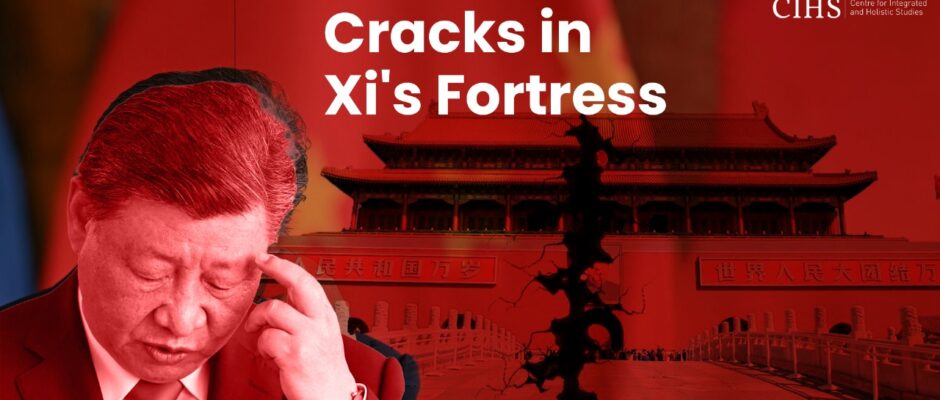
CCP inability and intolerance to resolve people’s grievances, economic woes, joblessness led to rise in number of “Zhang Xianzhong” attacks. Rahul Pawa China in 2024 has seen a startling surge in violent attacks on civilians, with over 20 incidents leaving more than 90 people dead and scores injured. These incidents, often described as “Zhang Xianzhong” attacks or “revenge on society” attacks expose deep societal fractures and challenging the image of stability and control that Xi Jinping’s leadership has meticulously cultivated. The attacks which included car-ramming and mass stabbings reflect a dangerous cocktail of economic despair, social grievances and a government increasingly out of touch with people’s issues. Last month, a 62-year-old man drove an SUV into crowds in Zhuhai, Guangdong Province that led to killing 35 and injuring 43. His motive, reportedly rooted in bitterness over a divorce settlement was a stark reminder of how personal grievances in today’s China are escalating into public tragedies. President Xi, in an uncharacteristically direct response, urged local authorities to “draw lessons” from the case and strengthen prevention measures. Yet, this rare acknowledgment of failure only highlighted limits of Chinese Communist Party’s (CCP) ability to control a society increasingly defined by tensions and resentment. These attacks are not anomalies. In 2024 alone, incidents like a stabbing spree in Wuxi that left eight dead, a car-ramming attack in Changsha that killed eight and at least ten school attacks have painted grim picture of a nation under siege from within. While Beijing’s strict censorship obscures much of the data, social media tallies and local reports suggest that the frequency and lethality of these events are on rise. Schools, once considered safe havens, have become frequent targets with attacks mirroring a wave of school violence last seen in 2010. Then, six schools were attacked in quick succession, killing over 15 children. Today’s resurgence of similar violence points to unresolved structural issues that have only deepened under Xi’s rule. Chinese netizens navigating state’s ever-present censorship have adopted the term “Zhang Xianzhong” to describe these attacks. The phrase refers to 17th-century rebel whose campaigns of mass killing were seen as acts of revenge on society. While officials quickly scrub mentions of the term online, its persistence reflects an undercurrent of fear and frustration among citizens. The attackers largely armed with knives or vehicles due to strict gun control laws often cite grievances ranging from economic hardships to personal injustices. Analysts believe these attacks are symptomatic of an eroding social contract in China where economic slowdown, unemployment and widening inequalities have left millions disillusioned. Economic despair is perhaps the most potent driver of this unrest. China’s post-COVID recovery has been sluggish with youth unemployment exceeding 20 per cent and small businesses closing at an alarming rate. The once-thriving property market has collapsed, household debt is mounting and local governments are grappling with financial insolvency. These pressures are not limited to economic woes; they are deeply personal, affecting livelihoods, aspirations and social cohesion. Promise of prosperity that once underpinned CCP’s legitimacy is faltering and with it, the trust of a society that had largely bought into Xi’s vision of a “Chinese Dream.” Making matters worse is CCP’s shrinking tolerance for dissent. The longstanding system of petitioning where citizens could formally lodge grievances with government has been effectively gutted. Local officials, fearing repercussions for their regions’ perceived instability, now block petitioners from reaching Beijing or dismiss complaints altogether. A 2022 regulatory revision further centralized complaint resolution at the local level, creating a perverse incentive for officials to suppress grievances rather than resolve them. For many citizens, this has closed one of the last remaining avenues for seeking justice in an increasingly opaque and authoritarian state. In such a climate, acts of violence become not just crimes but desperate expressions of discontent. They are, as one netizen put it before their post was censored, “the sound of a society breaking apart.” The CCP, ever wary of its image, has responded by doubling down on surveillance and control. Local governments are now tasked with identifying “high-risk” individuals—those categorized under what the state calls the “four nothings” (no spouse, no children, no income, no assets) and the “five losses” (financial, relational, social, mental or other critical stressors). In Zhuhai, this framework was deployed following the deadly vehicle attack, with authorities instructed to proactively monitor and intervene in lives of these vulnerable groups. While these measures may offer short-term reductions in violence, they do little to address root causes of societal discontent. Instead, they risk further alienating a population already weary of state overreach. Critics warn that treating citizens as potential threats rather than partners in governance will only deepen the divide between people and state. Moreover, China’s increasingly invasive surveillance apparatus, though technologically sophisticated, is ill-equipped to tackle complex, deeply human factors driving these attacks. Xi Jinping’s leadership is at a precarious crossroads. For years, he has positioned himself as China’s most powerful leader since Mao Zedong, centralizing authority and eliminating dissent within the party. But the events of 2024 have exposed vulnerabilities in his governance model. The rise in violent attacks, coupled with economic stagnation and growing public frustration is eroding the very foundation of his rule. Internationally, these issues are undermining Xi’s efforts to portray China as a stable and orderly superpower. The targeting of foreigners in some attacks has added another layer of complexity. In September, a ten year old Japanese boy was fatally stabbed near a school in Shenzhen, an incident followed by similar attacks on Japanese nationals in other cities. While Beijing has labeled these as isolated acts, they point to a growing strain of xenophobia and anti-foreigner sentiment under Xi’s rule. This ethno-nationalism, once a tool for consolidating domestic support, is now proving to be a double-edged sword, damaging China’s global reputation and risking diplomatic fallout. As 2024 draws to a close, CCP is scrambling to project an image of control. Xi’s speeches emphasize stability, his officials announce plans to address grievances and state media highlight the supposed

Read More

Boys Play Big in Muddied Waters!

US, China with diverse agendas coupled with religious extremist forces in Islam and evangelists may shrink open space to operate for Bharat that has big stakes in Bangladesh K.A.Badarinath The big boys are at play. Bangladesh government under Nobel laureate Muhammad Yunus is bound to be pulled apart by both United States of America seeking to establish a military base in South Asia and Chinese Communist Party led by President Xi Jingping that’s seeking unquestioned dominance in Asia. Jamaat-e-Islami and Bangladesh National Party (BNP) led by Khalid Zia would play willing tools in the big boys power play with Pakistan reduced to a lackey of minor variety. There’s denying that Muslim Brotherhood that’s globally dreaded would complicate the equation with its Islamist – Jihadist agenda on Bharat’s Eastern frontiers. ‘Razakars’ would become handy frontline private army in the hands of jihadist Muslim leadership internationally. There have been reports that already these Razakars have taken over civic policing as an occupational army of zealots. Well, tasks for Bharat are cut out after Sheikh Hasina’s government fell last week, Awami League purged, safe exit to her provided in a swift deal and Army took reins in a coup. Though interim government headed by Yunus and a battery of over dozen advisors have taken charge, nothing seems to have changed on the ground while Army calls the shots. Bangladesh’s under-belly has several layers that must be understood before Bharat gets to the drawing board to establish a working relationship with the new Army controlled, Yunus fronted regime given that Chinese, US and Pakistan deep state haggling for their pound of flesh. The ‘transitional’ Yunus regime got legitimacy as Democratic White House was first to recognise the government. Secretary of State’s spokesperson was drafted to convey that US was ‘ready and looked forward’ to working with Dhaka under Yunus. St Martin Island also known as ‘Narikel Jinjira’ (Coconut Island) or ‘Daruchini Dweep’ (Cinnamon Island) off-the-Chittagong coast may be eyed by US to set up a military base to lord over both Bharat and her expansionist neighbour China. Direct US presence in the region may not be encouraged or welcomed by Bharat given the strategic implications. Also, Bharat would get cut off virtually from entire South East Asia in terms of trade, investment and services. Church driven ‘Project K’ to carve out an artificial autonomous region christened as ‘Kukiland’ will come to the forefront. Church’s fancy idea of a separate Christian state encompasses parts of Bangladesh, Burma and Bharat’s Manipur and Mizoram. This Christian agenda is expected to get complete backing of White House under President Joe Biden or his possible successor Kamala Harris. Even if Donald Trump upstages the democrats and gets elected in November 2024 elections, this agenda may get going. Even if general elections in Bangladesh were to be held anytime now, a pliable government in Dhaka is what Washington DC may expect to see in the saddle given that Awami League is virtually out of power play. On the other hand, China would try and get Teesta River Project and other infrastructure ventures that provide Beijing proximity to India’s ‘chicken neck’ area. Weeks before Hasina government fell, US $ two billion worth interest free, concessional, commercial loans apart from grants were reportedly promised by China after a meeting that Bangladesh Prime Minister had with President Xi. On face of it, funding infrastructure projects either directly or through Asian Infrastructure Investment Bank (AIIB) may not just be limited to investment push. Instead, it will result in strategic issues for Bharat giving China advantage at her doorstep. Third dimension to Bangladesh story is the Jamaat-e-Islami backed by Pakistan and part of larger Muslim Brotherhood going berserk would pose serious challenges to Bharat. Jamaat pursuing genocide of Hindus in Bangladesh has been widely reported. CIHS has meticulously documented these grave crimes. Jamaat is popular as ‘congregation of Muslims’. Known as the largest Muslim formation founded in 1975, Jamaat was banned from political participation by Bangladesh Supreme Court in 2013 citing its opposition to religious freedom or practice of faith. Within its ambit were other organizations like Al – Badr, Al – Shams and self-styled peace committee that formed the jihadist network. All these are pronouncedly anti-Hindu, Buddhists and Christians in Bangladesh. Evangelists and Islamist forces are expected to be on collusion course given their extremely divergent agendas for Bangladesh. Bid to carve out an autonomous Christian area by extreme evangelists with backing from US may be at odds with ‘theocratic’ ‘Islamist’ state that Jamaat may like to evolve Bangladesh into. Conflict between evangelists and Muslims may turn rough reported from several cities in European countries. Contrarian geo-political forces in China, US and religious extremism donned by evangelists and Jamaat leaves very little space for open, flexible and forward thinking democratic agenda in Bangladesh. This is a heady mix in which India will have to tread carefully to safeguard her geo-political and strategic interests apart from that of Hindus and Indian origin people living in Bangladesh. Rightly, Prime Minister Narendra Modi has emphasised that Yunus government in Bangladesh must take steps to protect Hindus lives, properties, businesses especially women that have been targeted by Jihadists. For Bharat, dealing with influx of Bangladeshis fleeing the violence torn country may be a big priority apart from safeguarding her people in Bangladesh. Secondly, New Delhi may have to swerve through muddy waters that have become playground for both US and China apart from minions like Pakistan. Thirdly, recalibrating equations with Dhaka given an array of forces from far-left extremists, religious jihadists to military establishment may pose a big challenge. Fourthly, pursuing her agenda of peace, tranquillity and prosperity in South Asia may not be easy for Bharat. Fifthly, smoothening relations with Bangladesh may turn tricky while former Prime Minister and senior Awami League leader Sheikh Hasina continue to be respected state guest in Delhi. Sixthly, working with likeminded stakeholders to ring in democracy with all forces in tact may be a tall order. Seventhly, relatively tension free

Read More

Hindu Genocide Unfolding in Bangladesh

The situation in Bangladesh has reached a critical and alarming juncture, with a systematic and coordinated campaign targeting the Hindu community through acts of violence, destruction, and terror. This genocide, characterized by the deliberate annihilation of Hindu religious and cultural sites, as well as the targeted killings and displacement of individuals, poses an existential threat to the Hindu population in Bangladesh. The interim government must act with urgency and decisiveness: deploying security forces to protect vulnerable communities, ensuring justice through swift prosecution of those responsible, and initiating a comprehensive restoration of destroyed religious and cultural heritage. Moreover, the government must engage with international bodies to secure support and demonstrate a commitment to protecting all citizens, ensuring that such atrocities never occur again. Immediate action is not only a moral imperative but also crucial for the preservation of Bangladesh’s core fabric. Updated – Hindu Genocide Unfolding in Bangladesh

Read More

China-Pakistan Agenda in Bangladesh Protests

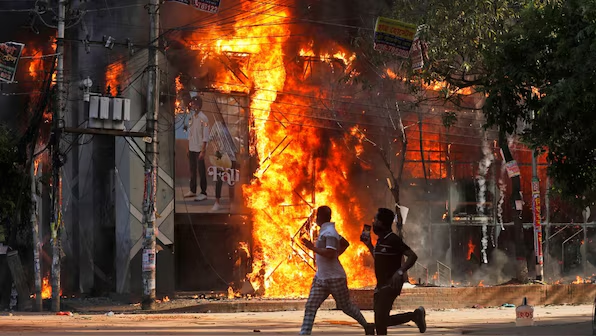
Violent protests by students against job quotas may have been conveniently used by Beijing & Islamabad to further their interests Rahul Pawa China, Pakistan, geo-political interest groups and international stakeholders may have muddied Bangladesh waters. They may have either directly or indirectly contributed to current wave of violent protests that resulted in 130 fatalities. These players may have conveniently used the anger against quotas for government jobs as a cover to stroke flames of dissent against Prime Minister Sheikh Hasina and her Awami League government. The current spate of violent incidents seems to have been triggered by Communist Party of China and Pakistan that have taken an adversarial position and spread discontent against Sheikh Hasina’s government. Protests erupted after Appellate Division of the Supreme Court decided on July 10, 2024 to maintain status quo on quota system intended for freedom fighters and their families for four weeks. This came after a High Court ruled on June 5, 2024 that declared 2018 government circular canceling 30 per cent quota for freedom fighter’s descendants in government jobs illegal. This sparked widespread anger among students and larger population, culminating in violent clashes and a death toll that continued to rise. Students from various universities in Dhaka united to demand quota reforms. After initial postponement owing to Eid and summer holidays, students movement resumed on July 1 with demonstrations. Students and teachers from public universities like University of Dhaka, Rajshahi University of Engineering and Technology and Jahangirnagar University, among others were soon joined by counterparts from private institutions such as North South University and BRAC University. Under the banner of Anti-discrimination Students Movement, they launched ‘Bangla Blockade’ (Bangladesh Shutdown) thereby disrupting domestic train and road transportation networks. Online activism surged with calls for “another 2018” in reference to previous quota reform movement. Subsequently, protestors call for a ‘Bangla Blockade’ intensified on July 7. As demonstrations spread nationwide, clashes with police on July 11 marked a significant escalation. Prime Minister Sheikh Hasina’s remarks on July 14, referring to Razakars (Bangladeshis who collaborated with Pakistan during 1971war) made during a press conference after her return from China coupled with the ruling Awami League’s hardened stance intensified the situation. This led to violent suppressions by Chhatra League and resulted in hundreds of injuries. The kindling for this unrest had been laid well before the court’s ruling as flames were fanned earlier this month during Prime Minister Sheikh Hasina’s visit to Beijing from July 8 to 10, 2024. The visit, intended to secure significant financial aid and strengthen bilateral ties ended abruptly, hinting at Hasina’s deep-seated dissatisfaction with the Communist Party of China (CPC). China offered only $100 million in financial assistance, a far cry from the initially promised $5 billion. Adding to the discord, Xi gave Hasina very little time as Beijing proposed a controversial ten-year re-education policy aimed at countering Islamic culture and promoting Chinese lifestyles, similar to measures implemented in Pakistan during 2010. This proposal, perceived as racist and a direct affront to Bangladesh’s cultural sovereignty, significantly strained Dhaka – Beijing relationship. The protests in Dhaka quickly escalated as protesting students and citizens voiced their dissatisfaction with reinstated job reservation quota. This policy initially abolished in 2018 reserved 30 percent government jobs for families of 1971 independence war veterans. The new quota system, viewed as unreasonable and discriminatory, exacerbated existing frustrations amid high unemployment and rampant inflation. Pakistan-backed Islamist groups such as Jamat-e-Islami, which have significantly undermined Bangladesh’s private sector, exacerbating economic challenges the country already faces.This influence, funded by the Middle East via Pakistan, has made government jobs even more sought after. The resulting volatility in the private sector has created a hostile environment, where economic grievances easily morph into political unrest. This destabilising influence was earlier evident during the violent response to the Bangladesh government’s attempt to modernise labor laws in 2018. The proposed changes aimed to attract more foreign investment by aligning local labour practices with international standards. However, Islamist groups, heavily funded by Pakistan vehemently opposed these changes arguing they would undermine Islamic values and worker rights. Jamat-e-Islami with its significant political clout mobilised large-scale protests and strikes which paralysed many sectors of the economy including the vital garment industry. This unrest discouraged foreign investment and highlighted the fragility of private sector in the face of Islamist political and religious extremism. Moreover, China’s involvement in Bangladesh’s student unions further escalates the situation. Reports indicate that CPC has infiltrated Bangladesh universities through education and student exchange programmes. Five Chinese universities in Yunnan province alone teach Bangla language and culture, sending students to Dhaka to create intelligence assets and funding channels for student wings. This strategy aims to mobilise Bangladeshi students against their own government’s policies thereby creating more space for CPC influence. Notably, student unions that staunchly defended Islam in Bangladesh remained conspicuously silent on CPC policies against Uyghur Muslims. The current situation reiterates CPC’s potential to influence and organise student protests in Bangladesh. Earlier, on April 13, 2021, students gathered at the Dhaka Press Club, demanding better arrangements from Hasina Administration for studying in China. The protest pressuring the Bangladeshi government nearly turned violent, demonstrating CPC’s influence and capability to mobilise students in Dhaka, highlighting its broader strategy of using education and cultural programs as tools of influence. Moreover, China-Pakistan nexus in Bangladesh adds another layer of complexity. Pakistani students often affiliated with Jamat-e-Islami collaborate with their Bangladeshi counterparts facilitating communication and coordination for protests. The human intelligence (HUMINT) capacity of Pakistan’s ISI has been instrumental in channeling Chinese funds to stage ongoing protests in Dhaka. Bangladeshi workers in Chinese companies are reported to have been trained to mobilise pro-China rallies as seen in 2019 when workers of Jingjiu Group in Bangladesh who were seen chanting Pro-China slogans in Mandarin. Intriguingly, CPC’s interest in Bangladesh extends beyond financial aid. Beijing aimed to establish strong foothold in South Asia leveraging its Belt and Road Initiative (BRI) aspiring to integrate Bangladesh into its economic sphere. Despite the disappointing loan offer, China has

Read More

Chinese Pangs Continue to Stifle Buddhists

US, India should devise a plan to stop President Xi from hijacking selection of next Dalai Lama and preserve Tibetan culture & resources Brahma Chellaney As Dalai Lama, spiritual leader visits US, to receive medical treatment for his knees, concerns over who will succeed him have become acute. While Tibetans around the world pray that 88-year-old Tenzin Gyatso, 14th Dalai Lama still has plenty of life ahead of him, China is eagerly awaiting his demise so that it can install a puppet successor. Tibetans regard Dalai Lama as living incarnation of Buddha with a total of 13 reincarnations since 1391. When one Dalai Lama dies, the search for next one begins, with a council of senior disciples taking responsibility for identifying the figure based on signs and visions. But in recent years, Chinese government has insisted that only it has the right to identify next Dalai Lama. This would not be first time China selected a leader of Tibetan Buddhism. In 1995, it anointed its own Panchen Lama, whose spiritual authority is second only to that of Dalai Lama, after abducting actual Panchen Lama — six-year-old boy who had already been confirmed by Dalai Lama. Almost three decades later, real Panchen Lama is among the world’s longest-serving political prisoners. China also appointed Karmapa, Tibetan Buddhism’s third most important spiritual leader and head of the Karma Kagyu sect. But in 1999, its appointee Ogyen Trinley Dorje fled to India. The ease with which 14-year-old Karmapa escaped China raised suspicions among Indians about his loyalties. After imposing travel restrictions on him, India decided in 2018 to no longer recognize China-anointed Karmapa as legitimate head of his sect. Now, he and his rival Karmapa Trinley Thaye Dorje have issued a joint statement pledging to cooperatively resolve leadership split in Karma Kagyu sect. But, Dalai Lama is China’s white whale. The incumbent — who was identified as Dalai Lama in 1937, at age two  — has been a thorn in the side of Chinese Communist Party (CCP) since Beijing’s 1951 annexation of Tibet. With his relentless espousal of nonviolence, Dalai Lama who won Nobel Peace Prize in 1989 embodies Tibetan resistance to Chinese occupation. (Had Tibet remained self-governing like Taiwan, it would be the world’s tenth-largest country by area.) In his past incarnations, Dalai Lama was not only Tibet’s spiritual leader, but also its political leader, making him a kind of cross between a pope and a president. But the Dalai Lama ceded his political role in 2011 to a Tibetan government-in-exile which is democratically elected every five years by Tibetan refugees living in India and elsewhere. Dalai Lama has declared that he might choose not to be reborn — a decision that would undermine legitimacy of any Chinese-anointed successor. He knows that for China, a Dalai Lama devoted to CCP is much more useful than no Dalai Lama at all. He knows that while he has retained his mental acuity, his body is weakening. In 2016, he underwent radiation therapy for prostate cancer. He says he was “completely cured,” but continues to struggle with his knees. Given his advanced age, more health problems are to be expected. Dalai Lama’s frailty is one reason why his travel schedule has slowed considerably. But it is not the only one: Bowing to Chinese pressure, most countries — including European democracies and Asia’s Buddhist states (except Japan) — are unwilling to grant him entry. Fortunately, some countries have retained their backbones. US is hosting Dalai Lama for knee treatment and India has been his home for more than 65 years. India has officially designated Dalai Lama it’s “most esteemed and honoured guest,” while the Tibetan leader describes himself as a “son of India.” India is home to vast majority of Tibetan exiles and has played a central role in helping to preserve Tibetan culture including by supporting Tibetan-language schools. By contrast, China has been working actively to destroy Tibetan culture and identity, especially since Chinese leader Xi Jinping has been in charge. China’s appropriation of Tibetan natural resources has gone into overdrive with consequences that extend far beyond the Tibetan Plateau. Resource-rich Tibet is a source of fresh water for more than one-fifth of the world’s population and a global biodiversity hotspot. The plateau influences Asia’s weather and monsoonal patterns, as well as Northern Hemisphere’s “atmospheric general circulation” — the system of winds that helps transport warm air from the equator toward higher latitudes, creating different climate zones. US and India should work together to foil China’s plan to handpick next Dalai Lama. Already, America’s Tibetan Policy and Support Act which took effect in 2020, says that “the wishes of the 14th Dalai Lama, including any written instructions, should play a determinative role in the selection, education, and veneration of a future 15th Dalai Lama.” And it calls for sanctions on Chinese officials who interfere with Tibetan Buddhist succession practices. But more must be done. For starters, US President Joe Biden should take the opportunity presented by Dalai Lama’s knee treatment to fulfil a 2020 campaign promise to meet with the spiritual leader. More broadly, Washington should work together with India to devise a multilateral strategy to counter Xi’s plan to capture the more than 600-year-old institution of Dalai Lama. This must include efforts to persuade Dalai Lama to spell out, once and for all, rules that must be followed to identify his successor. (Author is professor emeritus of strategic studies at New Delhi-based Center for Policy Research; fellow at Robert Bosch Academy in Berlin. He is author of “Water, Peace, and War: Confronting the Global Water Crisis” (Rowman & Littlefield, 2013). © Project Syndicate, 2024. This write up was first published in Japan Times)

Read More

Games that China Plays

Psychological warfare, media propaganda, narratives coupled with operations beyond diplomatic relations is what China is known for. Is the world listening? Dr Amritpal Kaur Prima Facie, diplomacy is a well-rehearsed hard bargain negotiation among countries to achieve the best possible outcomes for a nation without resorting to crude force. What does not however meet the eye is that it is an incessant process to resolve outstanding issues lurking around the corners, brewing for years before the final settlement, if ever, is achieved. With core interests at the heart of diplomatic deliberations, the high stakes make this complicated dance on eggshells all more crucial. It is assumed that deliberations conducted by diplomats are a standard process with similar training in negotiation processes and the parlance used in discussions. In reality, diplomatic negotiation is a high-voltage tussle with deep and far-reaching consequences. Even more astounding is that it does not end on the negotiation table but runs like an undercurrent. In the era of Globalization or ‘Complex interdependence’ as much as the international community is reality of domestic national life, diplomacy and diplomatic signals become more significant for nations. If diplomatic engagement is mired in psychological games with the intention of one-upmanship, bilateral engagements become complex and if one of the parties is contemporary China, it raises its own share of issues. Conspicuous silence President Xi Jingping maintained when Prime Minister Modi assumed office for historic third consecutive term was marked by world leaders. This silence seems to have sent out an eloquent underlying message. Though Chinese Premier Li Qiang joined top world leaders in congratulating Prime Minister Modi ahead of swearing in on June 9, 2024, President Xi’s silence was ostensibly aimed at mounting psychological pressure on India. Post-second world war, China and its international relations give us glimpse into the country’s thinking on its relations with others including India. Beginning with Zhau Enlai, average Chinese have relentlessly pursued overt and covert ways to achieve its desired bilateral outcomes with an astonishing disregard for international treaties and modus operandi. Indo-Chinese agreement of 1993, intermittent border skirmishes and war (1962) since 1948 reiterates the point that it’s not over, until the last bell rang. Border dispute with India and People’s Liberation Army operations on Indo-Chinese border comes at crucial junctures. Former National Security Advisor Shiv Shankar Menon recounted in his book Choices (2016) that in 2014 when the first Modi government took office and President Xi came to India, PLA engaged in border skirmishes with India. Similarly, during Prime Minister Modi’s visit to China, a similar tactic unfolded. Probable explanation to such acts, according to Menon is to create psychological pressure on the newly elected Indian prime Minister as to who is the sheriff in town. Richard Solomon, former diplomat in US and former Foreign Secretary of India Vijay Gokhale have written respectively about the Chinese style of diplomacy which is remarkably different from diplomacy of democratic countries. Chinese engage in psychological warfare even in diplomacy at various levels. From setting agenda to building narratives, Chinese are adept at controlling the whole process and go beyond closed doors of diplomatic negotiations. One pattern is to engage in crude coercion and use of force while the other is to leverage media to create narratives. Two examples can be cited here, one is that of 1950s when Pt. Jawaharlal Nehru was called the ‘Bourgeoise Imperialist’ by Chinese media. Earlier this month, the state-sponsored Chinese media and related ecosystem described Prime Minister Modi as ‘weakened’ leader. These reports also suggested possible use of counter measures by China if India maintains policy status quo. Why is it that Chinese takes recourse to multi-pronged games in strategic and diplomatic relations with other countries eventually leading to disturbing regional peace and tranquility? Nature of Chinese state perhaps necessitates such behaviour. To begin with, Henry Kissinger in On China argued that since antiquity China has believed in ‘Middle Kingdom’ phenomenon which places the Chinese state over rest of the world and only beneath the heaven. This perceived middle Kingdom phenomenon has percolated to Communist China as well and hence they believe that other countries can only be vassals to the dragon power. There have been suggestions to the effect that Chinese communist expansionists harbor the idea that bilateral relations cannot be between equal sovereigns. These relations should centre on ‘superior’ China and ‘inferior’ other nations. With regards to Bharat, Chinese terminology includes ‘legalized hegemony’ and perceives India as an inferior state given that it does not have a permanent seat in United Nations Security Council. Chinese may have effortlessly used this aspect to tip balance of power in their favour, as former NSA Shiv Shankar Menon calls it.  Former foreign secretary Gokhale argued that Chinese engage in such tactics to keep power equation in their favour. Communist Party of China is the state itself and officials are appointed by the Party and not the state. Hence, their allegiance is with the Party and not the state per se. Menon sums the Chinese position succinctly when he argues that China is a lonely state rising in a crowded neighbourhood with an acute need for regime survival and internal harmony. Hence, its no wonder that being adventurous in foreign relations was to offset domestic attention from key issues. Since China is viewed as a formidable power, there is critical need to find a mutually beneficial bilateral mechanism. But, there’s no letup in tricky Chinese games loaded with psychological operations that have implications for outstanding bilateral issues. China experts, time and again, underscore that if we had to deal with China, understanding its game is more important. Only then can we find favourable outcomes in diplomatic negotiations. Jiang Zemin was famous for saying in English that it takes two to tango and it is true in this case well. For bilateral relations to succeed, it takes two to clap and a possible egalitarian approach in Chinese diplomacy. (Author is Assistant Professor in Political Sciences, Dayal Singh College, Delhi University, New Delhi)

Read More

‘Neighbourhood First’ Policy and Its Innovative ‘SAGAR’

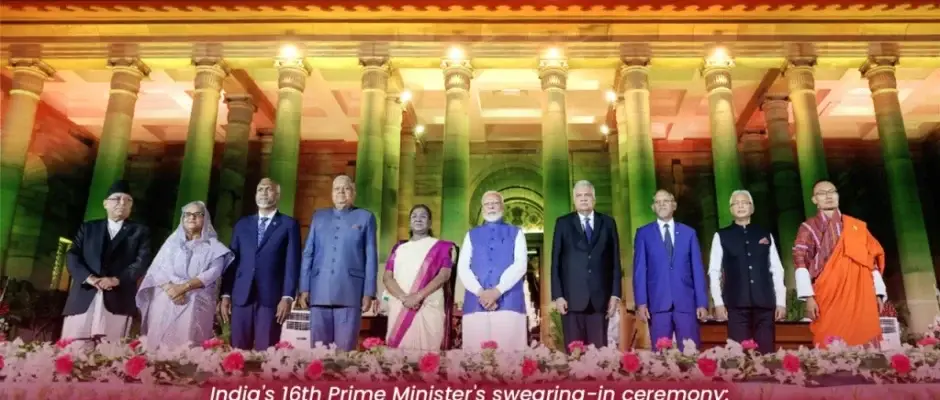
At the President house during swearing-in ceremony of India’s 16th Prime Minister, the country reaffirmed its unwavering commitment to its ‘Neighbourhood First’ policy and its innovative ‘SAGAR’ (Security and Growth for All in the Region) initiative. The invitation to neighbouring countries and those in the Indian Ocean Region (IOR), such as Sri Lanka, Bangladesh, Nepal, Bhutan, Maldives, Mauritius, and Seychelles, was extended amid the august assembly of dignitaries and demonstrated India’s unwavering commitment to developing strong ties with its maritime neighbours. Vision SAGAR started in 2015, to promote inclusion and adherence to international law while deepening economic and security cooperation, embodies India’s strategic vision for the IOR. Developing marine security capacities among neighbours is a key component of this goal, as it empowers them and ensures a cooperative approach to regional stability and prosperity. SAGAR is easily incorporated into the larger marine policy of India, working in concert with programs such as the Act East Policy, Project Mausam, and Project Sagarmala to advance the country’s approach towards regional providers of security. SAGAR highlights the significance of the Blue Economy and works to promote environmental stewardship and sustainable growth by utilizing the enormous potential of maritime resources. As India takes lead in IOR and is dedicated to creating an atmosphere of mutual respect, collaboration, and prosperity in order to fulfil the goals of all the nations in region. India aspires with SAGAR, the Indian Ocean would be a symbol of prosperity, peace, and advancement, demonstrating the strength of regional cooperation and strategic planning.

Read More