CIHS – Centre for Integrated and Holistic Studies

Date/Time:

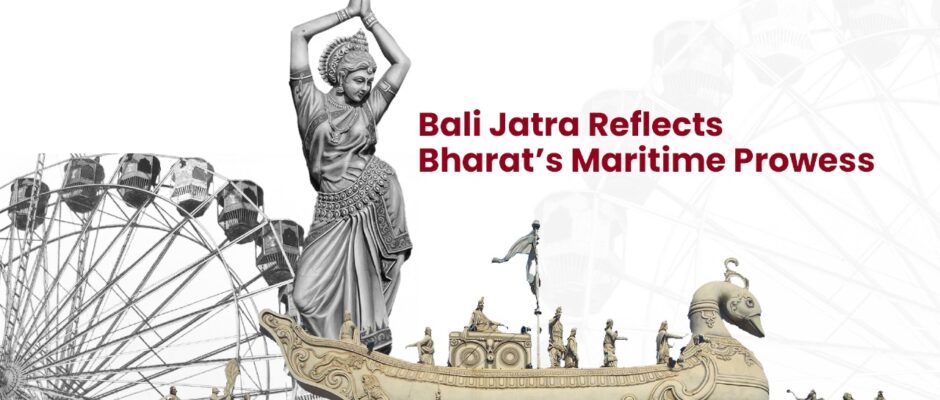
Bali Jatra Reflects Bharat’s Maritime Prowess

Bali Jatra Reflects Bharat’s Maritime Prowess

India and Southeast Asia share civilizational connect, maritime and cultural heritage that’s now dubbed as Global South. Dr Aniket Pingley Connections between India and Southeast Asia go back more than two thousand years, shaped by vast waters of Indian Ocean. These seas were not barriers but bridges, linking ports of ancient India with the islands and coastal regions of what we now call Southeast Asia. Merchants, monks, artisans and travelers carried more than goods; they carried stories, languages, faiths and practices. Over time, these exchanges left enduring marks on societies from Sumatra to the Malay Peninsula and beyond. In many ways, Southeast Asia became a mirror that reflected civilizational outreach of Bharat. Trade was the most visible layer of this relationship. India exported textiles, spices, beads and ivory while importing gold, tin, camphor and exotic wood from Southeast Asia. These exchanges were never limited to commerce alone. Maritime routes were also pathways for ideas. Ramayana and the Mahabharata were retold in local languages; Sanskrit and later Pali shaped courts and religious practices and Indian temple architecture inspired monuments from Angkor in Cambodia to Borobudur in Indonesia. The very names of places such as Yogyakarta, Ayutthaya and Srivijaya testify to these cultural flows. These interactions reveal how India’s influence went beyond its borders helping to form cosmopolitan societies in Southeast Asia that were both rooted in local traditions and open to outside influences. Diplomatic and political exchanges played an important role. Rulers in Java, Bali and Sumatra often drew on Indian ideas of kingship, legitimizing their authority through symbols and rituals derived from the subcontinent. The legend of King Airlangga of Java, for example, shows how Indian epics and models of governance were woven into local traditions [5]. Similarly, in Malay Peninsula, early polities combined maritime trade with cultural borrowing from India, laying the foundations for the region’s lasting connections with the subcontinent [7]. These layers of connection commercial, cultural, religious and political formed a civilizational network that is now increasingly referred to as “Global South.” India’s historic outreach demonstrated how societies of South could link with each other, exchange resources, and build hybrid cultures without external domination. This perspective is particularly important today as countries of Asia, Africa, and Latin America seek greater cooperation outside the traditional frameworks of the West [7]. Bali Jatra: Memory of the Ocean Voyages Odisha, known as Kalinga in ancient times, was a formidable maritime power. Its strategic location along Bharat’s eastern coast made it a hub for trade and cultural exchange. Major ports like Tamralipti, Palur and Manikapatna were bustling centres of commerce, facilitating movement of goods and ideas between India and Southeast Asia. It is in this context that festival of Bali Jatra (Baliyatra), celebrated in Cuttack, Odisha, hold such significance. Literally meaning “voyage to Bali,” the festival commemorates the journeys once undertaken by Sadhabas or Odia merchants, who sailed across the Bay of Bengal to trade with Java, Bali, Sumatra and other parts of Southeast Asia [1][2]. During full moon of Kartik Purnima every year, families in Odisha still set afloat small boats made of banana bark, paper, or cork, symbolizing vessels that once braved seas. The Balinese celebration of Nyepi, Hindu New Year, bears similarities to rituals of Kartik Purnima in Odisha. Both festivals involve offerings to the gods, prayers for prosperity and rituals closely tied to agricultural and maritime cycles. The practice is more than a regional ritual; it is a living archive of India’s maritime past. Bali Jatra reminds us that Indian Ocean trade was not incidental but central to Bharat’s engagement with Southeast Asia. At its height, these voyages established a dense web of relationships that enriched both sides. For Southeast Asia, Indian traders brought goods and technologies that supported local economies. For India, the voyages opened access to new markets, resources and cultural influences. The festival, therefore, is not only about nostalgia but also about acknowledging an interconnected past. Today, Bali Jatra has grown into one of the largest open-air fairs in Asia, attracting millions of visitors [3]. It showcases not just Odisha’s heritage but wider story of India’s role in maritime Asia. The festival includes cultural performances, food, handicrafts, and exhibitions that highlight the living traditions of seafaring communities. It also increasingly serves as a site of cultural diplomacy, inviting participation from Southeast Asian countries whose histories are tied to these voyages. Contemporary Relevance & Policy Play The significance of Bali Jatra does not end with heritage. It has clear implications for policy and diplomacy in the present. India and ASEAN today are strategic partners, cooperating in trade, security and cultural exchange. Yet for these partnerships to deepen, they need narratives that bind them beyond statistics. Bali Jatra provides one such narrative, rooted in shared history and civilizational connect. For Bharat’s policymakers, the festival is an example of India’s civilizational diplomacy. The presence of diplomats and foreign representatives at recent Bali Jatra celebrations shows growing recognition of its potential [3]. By inviting Southeast Asian leaders, academics, and artists to participate in the event, India can use the festival to create dialogues that are both cultural and strategic. Such engagements could align with forums like the Delhi Dialogue and ASEAN–India summits [8], making cultural heritage an integral part of foreign policy. For Southeast Asian nations, acknowledging festivals like Bali Jatra opens space to emphasize shared heritage while respecting national diversity. Countries such as Indonesia and Malaysia, where Indian cultural imprints remain visible, can view these connections not as relics of the past but as foundations for renewed cooperation. Policy research papers from think tanks such as Institute of Strategic and International Studies Malaysia already suggest that cultural diplomacy can strengthen the Comprehensive Strategic Partnership between India and Malaysia [6]. Similarly, Indonesian scholars point to the shared legacy of figures like King Airlangga as a reminder of intertweaved histories [4]. For the academic community, Bali Jatra offers a platform for dialogue on the meaning of the Global South. As scholars note, the Global South is not only

Read More
Kashmir to Kyrenia, Modi Resets Eurasian Chessboard

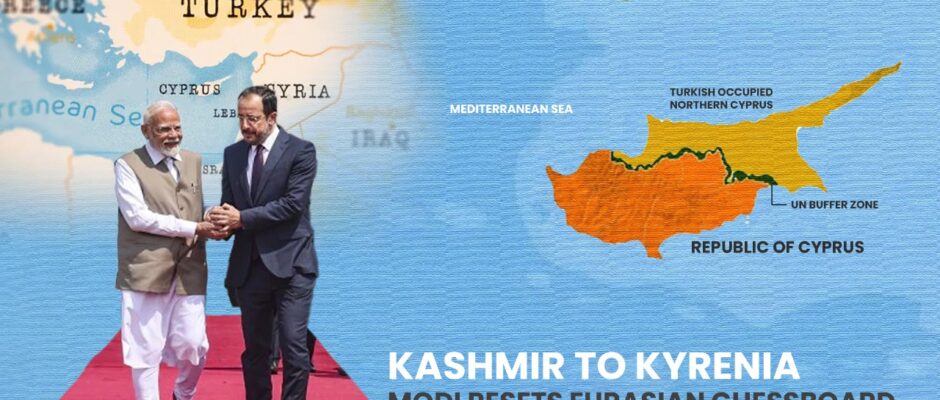
Kashmir to Kyrenia, Modi Resets Eurasian Chessboard

Modi’s choice of gift, a hand-knotted Kashmiri silk carpet, was a polite but firm reminder that Jammu and Kashmir is unquestionably India’s sovereign terrain, just as a reunited Cyprus remains Nicosia’s non-negotiable objective. Rahul Pawa The world took only passing notice when Prime Minister Narendra Modi touched down in Nicosia on June 15. Yet for close watchers of Eurasian geopolitics, the visit was a strategic inflection point: New Delhi’s most pointed riposte to Ankara’s unabashed support for Islamabad and a deft assertion of India’s own red lines on sovereignty. Turkey’s dictatorial President Erdogan has, for years, amplified Pakistan’s Jammu and Kashmir narrative at the UN, transferred unlawful killer drone technology to Rawalpindi, and aligned diplomatically after every India-Pakistan flare-up in May 2025.  For New Delhi, Indo-Pacific is no longer the only arena where coercive partnerships need balancing; the Eastern Mediterranean now figures prominently in India’s “extended neighbourhood.” With its 1974 invasion of Cyprus, Turkey occupies roughly 36 percent of the island, a fait accompli recognised only by Ankara. The occupation like the Pakistani Occupation of Jammu and Kashmir and territories of Ladakh namely Gilgit-Baltistan is rarely headline news.  But Modi’s landing in Cyprus made sure it briefly elbowed Gaza war, Red Sea shipping routes and Ukraine off analysts’ front pages. Nominally, the trip produced standard diplomatic deliverables: a joint declaration pledging intensified defence – industrial collaboration, an information-sharing framework on counter-terrorism & cyber security and expanded naval cooperation, Indian warships will make more calls at Cypriot ports and conduct joint search-and-rescue drills. What made the optics powerful was less the paperwork than symbolism. Modi’s choice of gift, a hand-knotted Kashmiri silk carpet, was a polite but firm reminder that Jammu and Kashmir is unquestionably India’s sovereign terrain, just as a reunited Cyprus remains Nicosia’s non-negotiable objective. The Cypriot leadership reciprocated by publicly thanking India for “standing up for sovereignty,” words that landed like a shot across the bow in Ankara, where strategic planners have banked on the Islamic world’s silence over Northern Cyprus. Modi offered no press-conference grandstanding; the statement of support appeared in the joint communiquéé and in Cyprus gratitude, proof that deliberate ambiguity often resonates louder than televised barbs. For decades Eastern Mediterranean has been Turkey’s strategic back-yard. The Turkish Navy exerts sea control; Turkish petroleum parastatals map offshore gas blocks; and Ankara leverages the “Cyprus question” to box out European Union pressure. India’s arrival alters that mental map. Regular Indian Navy port calls, if operationalised, will put a blue-water Asian presence at the doorstep of NATO’s southern flank. That has twin signaling value: to Turkey, that its actions in South Asia carry costs in its own neighbourhood and to the EU-27, that India is willing to shoulder limited security responsibilities in Europe’s periphery. The visit also dovetails neatly with the nascent India-Middle East-Europe Corridor (IMEC). Cyprus, an EU member and chair in 2026 with convenient trans-shipment facilities and legal clarity, can serve as the Mediterranean gateway for IMEC sea–land–rail lattice, reducing dependence on Suez chokepoint and giving Indian exporters a predictable entry point into the European single market. By grafting strategic access onto an economic corridor, New Delhi builds dual-use leverage without flaunting gunboat diplomacy. Domestically, Modi’s subtle poke at Ankara offers an answer to critics who argue that New Delhi is often too restrained when foreign capitals weaponise the Jammu and Kashmir discourse. Internationally, the gambit helps India consolidate support among small and medium European states that resent Turkish maximalism but lack the heft to counter it alone. For Nicosia, partnering with G-20 heavyweight boosts deterrence far beyond what Brussels has provided. There is a United Nations angle, too. Turkey’s military presence in Northern Cyprus violates multiple Security Council resolutions, but enforcement has languished. By throwing India’s diplomatic weight behind Cyprus’s territorial integrity, Modi has effectively globalised what Ankara hoped would remain a regional wrinkle. Elevated visibility complicates any future attempt by Turkey to extract concessions, whether on gas exploration blocs or on a two-state settlement, by holding European unity hostage. Great-power statecraft often hinges on narrative as much as kinetics. In Cyprus, Modi wrote a concise but compelling script: sovereignty is indivisible, occupations are unacceptable, and India has the agency to intervene, politically and symbolically, well beyond the Indian Ocean. In doing so, New Delhi inserted itself into a theatre where it had little historical presence, turned Turkey’s Cyprus problem into a talking point in South Asia, and reminded Pakistan that its external backers have vulnerabilities of their own. Analysts inclined to dismiss the visit as a minor European detour miss the slow-burn strategic dividend. Like Cheniere’s gas cargoes that transformed LNG markets after years of obscurity, today’s silk-carpet diplomacy may look mundane until the first Indian Navy destroyer docks in Limassol or the first IMEC freight train off-loads Indian pharmaceuticals bound for Central Europe. By then, the message to Ankara will require no amplification: alignments have consequences, and India now writes a few of the footnotes in the Eastern Mediterranean ledger. For a world fatigued by protracted altercations, Cyprus often feels like a frozen footnote to history. Modi’s masterstroke reminds us that frozen conflicts can thaw and when they do, new actors will shape the meltwater. The sooner chancelleries from Washington to Brussels internalise that reality, the better prepared they will be for the next iteration of Mediterranean geopolitics. (Rahul Pawa is director, research at New Delhi based think tank Centre for Integrated and Holistic Studies)

Read More
  • 1
  • 2