
CIHS – Centre for Integrated and Holistic Studies

Date/Time:

Ayodhya Overtakes Mecca, Vatican in Footfall

Ayodhya Overtakes Mecca, Vatican in Footfall

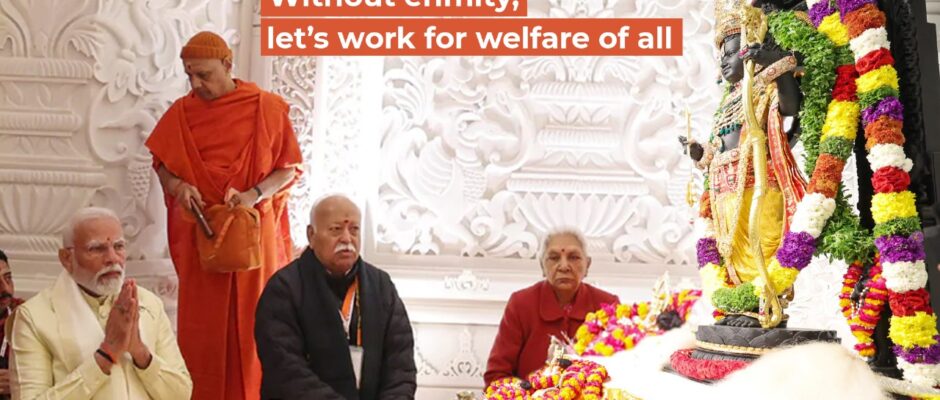
One Year after Bhagwan Ram Lalla’s  Pran Pratishta, the holy town holds out hope to be fulcrum of Hindu renaissance. Pummy Pandita Bhagwan Ram’s Pran Pratishta in January 2024 at his very birthplace in Ayodhya marked a new chapter in cultural and spiritual journey of Bharat. Since the construction of magnificent temple as abode of Ram Lalla, Ayodhya has undergone a transformation that devout Hindus connect to in spiritual terms and practicing faith. There’s no denying that Ayodhya, once a neglected, haunted and disconnected small town, is not any of these anymore. It’s bustling with devout people converging to Ayodhya by road, airways and superfast trains’ network. Infrastructure in Ayodhya has also undergone a sea change with roads, waterways and huge tourism circuit with hospitality points coming up in last one year. Footfall in Ayodhya as per estimates has crossed that of Vatican (6.7 Mn in 2023) and Mecca (1.83 Mn in 2024) many times over. As per Hindu calendar, January 11, 2025 marks first anniversary of Prana Pratishtha of Bhagwan Ram Lalla and the day would be celebrated as “Pratishtha Dwadashi” at Shri Ram Janmabhoomi Mandir in Ayodhya. A clutch of religious rites, devotional recitations, cultural acts and spiritual talks will be performed at the sanctum sanctorum and the entire Ayodhya Dham. Over three crore people are expected to witness the grand celebrations of Shri Ram’s Pran Pratishtha anniversary. Spiritual ceremonies will be held at Yajna Mandap, a dedicated location within the Mandir premises at break of dawn to kick off the celebrations. The Agnihotra ceremony involving lighting of fire will take place during 8 am – 11 am and again between 2 pm to 5 pm. This age-old Vedic practice is known for spiritual and cleansing and is carried out using mantras from Sukla Yajurveda. In addition to purifying the area, the ceremony will aid in fostering a spiritually uplifting atmosphere for the day’s activities. Highlights of the Day: Shri Ram’s Prasad, that’s regarded as a celestial blessing, will be offered all day long to devotees from early morning hours reflecting Bhagwan Ram’s grace. A Year of Record-breaking Footfall Shri Ram Lalla’s Pran Pratishtha has turned Ayodhya into a popular pilgrimage centre. An unprecedented 15 million pilgrims are estimated to have visited Shri Ram Mandir to seek the blessings of Shri Ram Lalla. Temple’s tremendous appeal was highlighted by daily footfall exceeding two lakh people daily during peak seasons like Ram Navami and Deepawali. Due to this massive influx of visitors, Ayodhya is now on par with Varanasi and Tirupati as one of India’s most popular pilgrimage destinations and overtaken both Mecca and Vatican, the two religious centres for faithful Muslims and catholic Christians respectively. Wider road networks, better train connectivity and recently opened Ayodhya International Airport have contributed to the boom in tourism. These advancements have made it easier for pilgrims from all over Bharat and the world to travel to Ayodhya. Economic Windfall Ayodhya has experienced exceptional economic growth due to constant influx of devotees. As per local authorities, the city’s yearly income from tourism-related activities has more than doubled hitting almost ₹4000 crore (approximately half a billion US dollars) in the most recent year – the key contributors included pilgrims’ arrival that has brought in about ₹15,000 crore ($1.8 billion) in tourism-related income. Occupancy rates at local establishments, such as restaurants, motels and guesthouses have increased significantly, surpassing 90 per cent during busy times. Infrastructure Development Realizing Ayodhya’s potential to into a world hub of spirituality, Uttar Pradesh state and Bharat’s central governments has made significant infrastructure investments: Spiritual and Cultural Renaissance Ram Lalla’s return to his abode and birthplace has ignited a cultural revival in Ayodhya. The city is now a thriving centre of faith based activity thanks to regular kirtans, bhajans and spiritual talks. To raise awareness of Shri Ram’s teachings, temple administration has planned a number of events that draw both young people and academics. Shri Ram Lalla’s return to Ayodhya also represents a cultural revival. It has inspired a generation to reconnect with their heritage and rekindled interest in Bharat’s legendary stories. The temple’s exquisite carvings and imposing construction serve as a tribute to the magnificence of traditional Indian craftsmanship. In addition to revitalising millions of people’s spiritual ties, Shri Ram Lalla’s Pran Pratishtha has transformed Ayodhya into a centre for both cultural and economic renaissance. Ayodhya is a living example of transformational power of Hindu faith as the city continues to change, striking a balance between its rich legacy and contemporary goals. While the first year of Shri Ram’s homecoming is significant, this holy place is expected to make even more waves in years to come. (Author is head of operations at Centre for Integrated and Holistic Studies, a non-partisan think tank based in New Delhi)Ayodhya Overtakes Mecca, Vatican in Footfall

Read More
Upholding Harmony: Countering the Threat of Khalistani Extremism in Australia

Upholding Harmony: Countering the Threat of Khalistani Extremism in Australia

Proposed anti-harassment laws by Victoria’s Premier and uneven anti-terror enforcement expose gaps in protecting Indian diaspora communities, especially Hindus from Khalistani & Islamists. Triveni Kaul  Australia prides itself on being a vibrant multicultural society, celebrating diversity and fostering harmony among its communities. However, recent incidents involving Khalistani extremism have disrupted this balance, targeting Indian and Hindu diaspora. The emergence of such extremism poses a grave challenge to Australia’s social fabric and raises urgent questions about the safety of vulnerable communities within this framework. Addressing this issue is critical to preserving Australia’s inclusive ethos and ensuring justice for those affected. Over the past few years, Khalistani extremists—advocates for a separate Sikh state carved out of India—have amplified their activities in Australia. While they claim to pursue political objectives, their actions have often crossed into the realm of harassment, vandalism, and violence, disproportionately affecting the Indian and Hindu diaspora. These incidents demand immediate attention to safeguard the multicultural ideals that underpin Australia’s identity. Australian Indian/Hindu Diaspora Indian Australians, particularly Hindus, have increasingly found themselves at the receiving end of targeted attacks fueled by Khalistani extremism. Reports of temple vandalism, such as the defacement of iconic Hindu temples in Melbourne earlier this year, have sent shockwaves through the community. Graffiti glorifying separatist leaders and slogans promoting violence have not only defiled sacred spaces but also instilled a sense of insecurity among devotees. Harassment and intimidation tactics have extended beyond physical locations to digital spaces, where diaspora members have faced online abuse and threats for expressing their views. Community leaders have reported incidents of individuals being followed, heckled at public events, and receiving threatening messages for opposing extremist narratives. The psychological toll on victims, compounded by fears of escalating violence, has been profound. The most alarming aspect of these challenges is the sense of alienation it fosters. Many Indian Australians feel let down by the lack of decisive action to address their grievances, raising concerns about equitable protection within Australia’s multicultural framework. This growing disillusionment risks undermining trust in the system and eroding the social cohesion that defines Australian society. Legal Frameworks Disparity Australia has robust laws to counter terrorism and hate crimes. However, the rise of Khalistani extremism highlights gaps in existing frameworks, particularly in addressing forms of violence that straddle the line between political activism and community harm. Victoria has recently proposed anti-harassment laws aimed at protecting individuals and communities from targeted abuse. These laws, if enacted, could offer a crucial safeguard for diaspora groups facing systematic intimidation. However, critics argue that enforcement will be key, as legislation alone cannot deter well-organized extremist networks. Australia’s anti-terrorism legislation—designed to counter threats from all forms of extremism—provides mechanisms to monitor and prosecute individuals engaging in terror-related activities. Yet, its application has been uneven, with limited cases of enforcement against those propagating Khalistani extremism. This disparity underscores the need for nuanced legal interpretations that recognize the diaspora’s unique vulnerabilities. Recent dialogues between Indian and Australian authorities have signaled a shared commitment to combating extremism. Joint initiatives to curb funding channels for extremist groups, coupled with intelligence-sharing agreements, mark important strides. However, tangible outcomes remain elusive, necessitating deeper collaborations and policy alignment. Policy Recommendations To address the growing threat of Khalistani extremism and protect the Indian/Hindu diaspora, a multi-pronged approach is essential. Key recommendations include: Concluding Observations Targeting of Indian and Hindu diaspora by Khalistani extremists represents a direct threat to Australia’s multicultural values. Proactive measures are essential to protect the rights of vulnerable communities and uphold the principles of diversity and inclusion. Australia’s commitment to multicultural harmony must translate into decisive action against extremism. By strengthening legal protections, fostering community engagement, and enhancing collaborations with India, Australia can ensure that its social fabric remains resilient in the face of divisive forces. Safeguarding the Indian and Hindu diaspora is not just about protecting a minority; it is about preserving the ideals that make Australia a beacon of coexistence and mutual respect. (Author is a corporate professional and foreign affairs enthusiast, she is a contributing writer at CIHS)

Read More
Dangerous Global Bias Goes Unchecked

Dangerous Global Bias Goes Unchecked

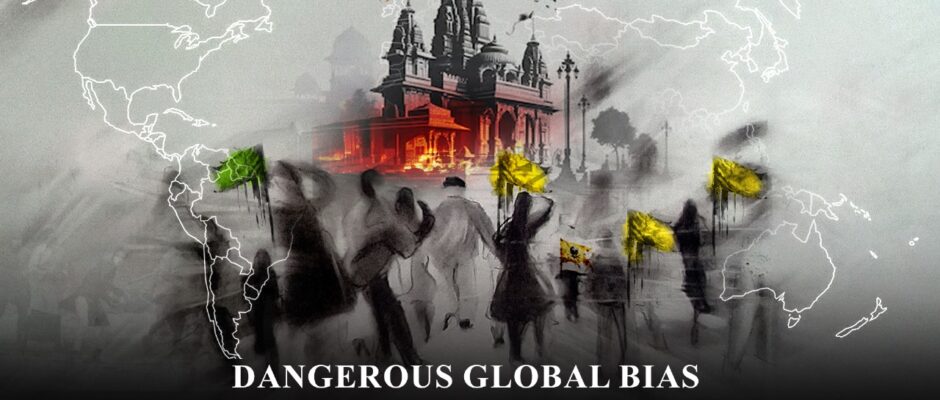
Hindu Temples, places of worship, communities in Western democracies and Islamic nations face grave threat and metamorphosed into a huge crisis. Dr Shailendra Kumar Pathak There’s a pattern to it. Hate and violence against Hindu communities has gone global. From Hindu temples, individuals and organizations have experienced extreme violence, vandalism and intolerance. These acts and incidents of violence have been reported in continuum with no respite to Hindus that seek to practice their faith in peace or live the Dharmic way propagating peace, tranquility and provide hope to humanity that’s under stress. From Brampton and Mississauga in Canada to Bangladesh where scores of temples have either been vandalized or closed down ‘by force’, Hindu minorities have been at the receiving end.  Khalistani terrorists, jihadists to Christian evangelists have targeted temples and places of worship even in Bharat that’s home to over a billion Hindus.  Most disturbing is that these violent incidents that totaled to over 300 in last few months went largely unnoticed or unreported. Intolerance is something that’s common to most of the violent incidents. For instance, on November 3 in Brampton, Canada, aggressive Khalistani terrorists attacked Hindu mandir in Brampton as practicing Hindus lined up for peaceful worship and Indian government representatives were busy verifying documents of elderly Sikhs and Hindus to ensure continuity in payment of pension back home. Devotees were beaten up, harassed, roughed up and pushed around violently while the Canadian police played dumb and deaf. It’s not an isolated incident. Mississauga Hindu temple was also vandalized with anti-Hindu graffiti and intimidation of extreme variety.  On November 12, 2024, Vishwa Hindu Parishad (VHP) released a comprehensive report documenting a series of attacks on Hindu communities around the world underscoring the need for attention to what many see as an escalating crisis. VHP report for 2024 documented hate crimes and attacks on temples in several nations like Canada, United States, United Kingdom, and Australia. Sharp rise in hate crimes targeting temples, cultural centers, and individuals has sent shock waves globally among 1.4 billion strong hindus spread across about 100 countries. In Canada, multiple Hindu temples faced attacks over the year including desecration of Gauri Shankar Mandir in Brampton and BAPS Swaminarayan temple in Windsor, which were both defaced with anti-Hindu slurs. United States temples in New Jersey, California and Texas vandalized and practicing Hindus harassed and defacement that included hateful messages specifically targeting Hindu beliefs and symbols were reported. This disturbing pattern suggests that these incidents are not random but part of a broader anti-Hindu agenda that is spreading in Western democracies. In United Kingdom, similar wave of anti-Hindu violence has been reported. Just last year, Leicester, a city with large South Asian population, witnessed intense anti-Hindu violence. Hindu homes, businesses and temples were attacked as mobs chanted slogans against the community, forcing Hindu families to stay indoors in fear. VHP’s report underscore that incidents like these signal an emboldened campaign against Hindu communities in societies that have long prided themselves on tolerance and inclusivity. Australia, too, has not been immune to this wave of hostility. The VHP’s November 2024 report documents attacks on Hindu temples in Melbourne where Hindu symbols were defaced with graffiti linking Hinduism to unrelated political disputes. This graffiti, filled with hateful rhetoric, was intended to shame and intimidate the Hindu community. Such acts reflect a deepening Hinduphobia that is no longer limited to casual prejudice but has manifested into violent, organized attacks on religious and cultural symbols. For Hindus living in these Western democracies, these incidents are betrayal of the promise of freedom and equality. VHP’s comprehensive report also highlights a dire situation for Hindus in neighboring Islamic countries including Pakistan, Bangladesh and Afghanistan where the situation is far more severe. In Pakistan, targeting Hindus has reached what some activists call protracted genocide. Hindu temples are routinely desecrated or destroyed, often with little to no response from authorities. Hindu girls, particularly in Sindh, face an alarming risk of abduction, forced conversion and marriage to much older Muslim men. VHP’s report included recent cases of Hindu girls being forcibly converted, torn from their families and left without any recourse for justice. Such violence and intimidation have become daily reality for Hindus in Pakistan where systemic discrimination allows these crimes to go largely unchecked. In Bangladesh, Hindus are staring at total erasure. VHP report notes that in early August 2024 in a span of five hours more than 50 attacks were recorded on Hindu homes, temples and businesses across various districts in Bangladesh. In places like Feni and Dinajpur, Hindu temples were desecrated and homes looted. Reports indicate that mobs of hundreds gathered to burn Hindu homes and assault community leaders as witnessed in multiple Bangladeshi districts such as Khulna, Satkhira and Bogura. This wave of violence has drawn international attention, as videos of the attacks went viral on social media showing mobs surrounding Hindu households, desecrating temples and forcing residents to flee their homes. VHP’s extensive list of incidents in its November 2024 report illustrates alarming scale and frequency of these attacks. It emphasizes that this violence against Hindus often has ideological backing, particularly from radical Islamic factions or Khalistani extremists which justify hostility toward Hindus under religious pretexts. VHP draws attention to anti-Hindu sentiment driven by certain missionary groups which promote aggressive conversion agendas in South Asia. This dynamic, the VHP argues, reveals that anti-Hindu prejudice is not only pervasive but systemic, fueled by a mix of religious and cultural biases. Equally concerning is general lack of accountability or response. When Hindu temples are attacked in Canada or Australia, political leaders and media outlets often remain mute spectators contrasting sharply with the swift response seen for crimes against other communities. This discrepancy has led many within the Hindu diaspora to question double standard practiced in international houses in reporting hate crimes. VHP has noted that Hinduphobia remains underreported and misunderstood, even as acts of Hindumisia (hatred for Hindu beliefs and practices) rise steadily. Unlike Islamophobia or anti-Semitism which are widely

Read More
Yunus is Lying, Plain and Simple

Yunus is Lying, Plain and Simple!

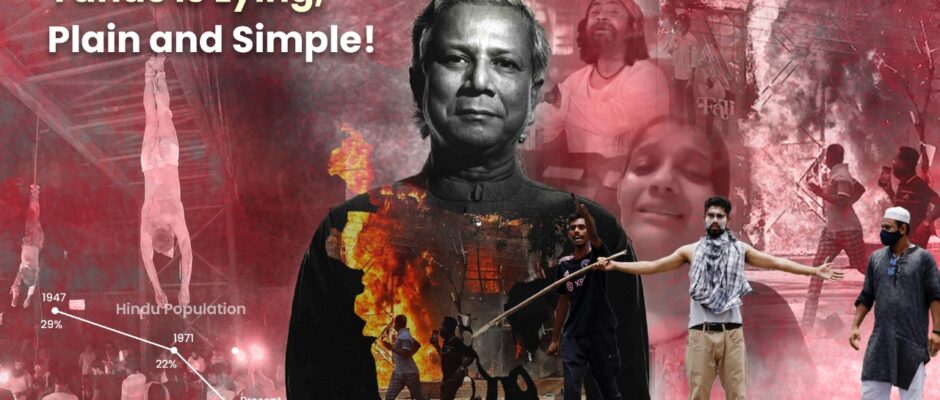
Bangladesh government has no plausible explanation for Hindus exodus while jihadists and jamaatis have a field day. Vinod Kumar Shukla The person who would have been in jail serving life time in Bangladesh on graft charges was hurriedly acquitted by Bangladesh’s anti-corruption commission  after his sworn in to run an interim government. Sheikh Hasina’s unceremonious ouster was reduced to a brief item in most media coverage on turn of events in Bangladesh. The Commission acquitted Muhammad Yunus, head of caretaker government and 13 others from corruption charges. Had Yunus been found guilty of money laundering charges, he would have been in jail for life. The caretaker government freed Jashimuddin Rahmani, the chief of Ansarullah Bangla Team (ABT), an al-Qaeda-affiliated terrorist outfit. And, Mohammad Yunus is making desperate attempts to speak from the high podium with teachings on good neighbour etiquette to India. In the melee, Hindus in Bangladesh faced a tricky situation with a government that took the lead in unleashing terror on her own minorities. Backing from Democratic White House till Kamala Harris bit the dust in recent US elections lent credibility to the genocide of Hindus in Bangladesh front-ended by Jamaatis, army, civil police and para-military forces. The government mandated to protect Hindus lives, property, jobs and honour was not just turning a blind eye but went on a denial mode by saying that reports of attacks on Hindus and other minorities were exaggerated. This lie has been repeated from August 5, 2024 when the then Prime Minister Sheikh Hasina was forced to flee in view of students’ protests actually orchestrated by radical Islamist organisations. Yunus not just downplayed attacks on Hindus but claimed that violence against minorities “only in some cases” and most complaints were “completely exaggerated”. Yunus ascribed  political angle to attacks are more of politics rather than acting against jihadist elements that unleashed terror on Hindus, Budhists, Jains, Christians, Ahmadis and other minor groups of colour. His opined that attacks against Hindus was more political and on afterthought said that such reports were more exaggerated. On the contrary, Bangladesh government has taken an anti-Hindu stand notwithstanding that jihadists have had a free run. Atrocities on Hindus post-August 5 is reminiscent of direct action by Mohammad Ali Jinnah, first Governor General of united Pakistan that began from Noakhali in Bangladesh killing thousands of Hindus. Hindus had been subject to persecution by Islamists in the region from pre-independence days asurping their basic right to live with dignity. Islamists were very strongly poised even in erstwhile East Pakistan but after Bangladesh Liberation war they had gone underground albeit for a very short period. Testimony to this is that Hindus who made up 22 per cent of Bangladesh’s population in 1971 and 29 per cent in 1947 were reduced to about 8 per cent of 17 crore population. Genocide on Hindus continued in full glare and was not hidden from anyone except that Yunus who apparently doesn’t read newspapers and listen to scholars of his own country. One scholar predicted way back in 2016 that no Hindus would be left in Bangladesh in 30 years if current rate of “exodus” at 632 people from minority community leaving each day continued.“The rate of exodus over past 49-years point in that direction,” Dr Abul Barkat, a Dhaka university professor had said in 2016. If things were hunky dory for Hindus in Bangladesh as Muhammad Yunus is trying to portray, there’s no plausible explanation for continued and enhanced exodus. One needs to reflect as to why Taslima Nasreen was forced to flee Bangladesh for writing Lajja that documented killings, rapes, conversion and capturing properties of Hindus in Bangladesh. In the present context, Sheikh Hasina was big hurdle in giving free run to jihadists in whose hand Muhammad Yunus seems to be playing along. Big questions therefore loom large before Muhammad Yunus. As chief of interim government, does he have anything to say about an Islamic song being recited at a Durga Puja gathering in Chittagong?  Was the case filed in connection with the incident?  Were reports on arrest of two people by his government fake? The incident occurred on September 26, 2024 at Durga Puja celebration at JM Sen Hall in Rahmatganj area of the city. Insaf Keemkari Chhatra-Janta, a radical Islamic group, staged a protest in Dhaka against use of playground by the Hindu community for Durga Puja celebrations. There were many instances where Aarti and Bhajan were not allowed and organisers of Durga Puja were threatened with dire consequences. In certain cases, immersion Durga idols were not allowed in flagrant violation of basic right to practice one’s ‘faith’. On September 19, 2024 violent muslim mobs attacked Buddhist Chakma and Hindu Tripuri communities in Dighinala and Khagrachhari Sadar in the Chittagong Division of Bangladesh. They set fire to over 200 shops and homes belonging to the minority groups. The Muslim mob also attacked a Buddhist temple and carried out an arson attack in which many people were killed. Some of the deceased identified were 20-year-old Junan Chakma, 60-year-old Dhananjoy Chakma and 30-year-old Rubel Tripura. Prime Minister of India Narendra Modi on August 15, expressed hope that the situation in violence-hit Bangladesh would return to normal soon and said 1.4 billion Indians were concerned about safety of Hindus and minorities in the neighbouring country. President-elect Donald Trump appointed Tulsi Gabbard as Director of National Intelligence (DNI) in his administration and often condemned the atrocities against Hindus and other minorities in Pakistan and Bangladesh. This could be one factor for Yunus trying to whitewash the hundreds of crimes committed against Hindus and minorities. Social media is replete with instances of attacks on Hindu villages, houses, temples and many other installations. The minority Hindu population faced vandalism of their businesses and properties, as well as the destruction of Hindu temples. They were forced to resign from government jobs. And, it was irony that Yunus urged them to protest as citizens of the country with equal rights and not as Hindus. Bangladesh Hindu Buddhist Christian

Read More

Guardians or Bystanders!

Canadian police remain mute spectators to violence and vandalism unleashed in Hindu temples by Khalistani extremists backed by Trudeau. Rahul Pawa On a quiet Diwali weekend, two temples in Canada, long-standing beacons of peace for Hindu diaspora became flashpoints of violence. In Brampton, at Hindu Sabha Mandir where a towering 55-foot statue of Lord Hanuman stands in majestic repose, sanctity of worship was violently interrupted.  In Surrey, around same time, similar desecration played out but with an unsettling twist: Canadian police, rather than offering protection from violence, reportedly turned their back on the very devotees they are sworn to safeguard. This spiraling saga of aggression against Canada’s Hindu community speaks of growing dissonance, one in which Anti-hindu allegiances and violent extremist ideology have found combustible alignment. These events call into question not Canadian authorities role in preserving peace and apparent lack of justice in face of rising extremism against Hindus. The incidents bear markings of a broader issue that Canada under the guise of neutrality may have dangerously fueled. Hindu Sabha Mandir in Brampton stands as a symbol of spiritual and cultural unity for Hindu community with its towering Hanuman statue —serving as proud reminder of ancient heritage in Canadian landscape. Yet, as Indian consular officials visited the temple to offer routine services, scenes of unrest unfolded that shattered the temple’s tranquility. Khalistani extremists, aligned with banned Sikhs for Justice extremist group, staged a violent protest that devolved into open aggression against temple-goers. Video footage shared across social media captures harrowing moments as Hindu devotees were set upon, beaten, and confronted with huge sticks by extremists. Aggressive violence by these extremists was unprovoked assault on peaceful community engaged in their sacred observances. Sikhs for Justice, a group with known links to Pakistan and history of terrorism linked to violent Khalistan secessionist movement had explicitly voiced their desire to disrupt consular services outside official premises, claiming these events posed a “threat” to Khalistani cause. Peel Regional Police, responsible for overseeing law enforcement in Brampton, have faced sharp criticism for their response or lack of it. Widespread violence notwithstanding, no arrests were made, a decision that many say reflects a worrisome leniency. Peel Police released a brief statement pledging to “investigate any acts of violence or threats,” yet to date, no charges have been filed. This inaction starkly contrasts with the force’s rapid response to similar instances of disorderly conduct in other communities. For Hindu Canadians, these events highlight troubling trend. Liberal MP Chandra Arya condemned the incident, calling attention to what he described as “free pass” given to Canadian Khalistani extremists. As he noted, “These extremists receive a degree of immunity that raises serious questions about Canada’s commitment to protecting its citizens equally.” Across the country in Surrey, a gathering of Hindu devotees at a temple similarly faced intimidation from Khalistani extremists operating with impunity in Canada. As people of all ages congregated to pray, the Khalistanis arrived with charged slogans, invoking Hardeep Singh Nijjar, a notorious Khalistani extremist recently slain under murky circumstances. Far from remaining a peaceful protest, the event quickly turned menacing, with calls for Hindus to “go back to their country.” Yet what unfolded next is perhaps more disturbing than the protest itself. As tensions escalated, members of the Royal Canadian Mounted Police (RCMP) intervened—but not to protect the threatened Hindu worshippers. Instead, in an act that has left the Hindu community in shock and disbelief, RCMP detained three Hindu devotees who were then escorted from temple grounds in full view of the protestors who had incited the incident. The reason for these detentions remains undisclosed, but the message it sent was clear: the victims of intimidation were cast as the culprits. This police action has left many questioning the RCMP’s impartiality. At a time when Hindus in Canada felt increasingly vulnerable, police response was inadequate or complicit. The pattern of law enforcement intervening against Hindu Canadians, rather than protecting them, has fostered deep resentment and fear. A local temple spokesperson pleaded for calm, reminding the community to await further information but the undercurrent of fear was palpable. Canadian authorities’ seeming unwillingness to protect Hindus or even acknowledge the intimidation they face revealed a chasm in the justice system they are meant to trust. Indian High Commission in Ottawa released a statement expressing disappointment at the violence allowed to mar routine consular events. “As in previous years,” the statement read, “the High Commission and Consulates General of India have planned consular camps during this period to assist local life certificate beneficiaries.” However, despite clear forewarning and requests for heightened security, Canadian authorities failed to prevent Khalistani disruption. This dereliction of duty has left Hindus in Canada and beyond questioning the nation’s dedication to ensuring safety for all religious communities. Diplomatic tensions sparked by Canadian Prime Minister Trudeau between Canada and India have simmered in recent months, with baseless accusations fueling discord. Yet Canada’s handling of these incidents hints at something more insidious— normalization of extremism under the guise of free speech. It appears that Canada is struggling, or perhaps choosing not to confront, a deeply ingrained bias in its approach to law enforcement where Khalistani sympathisers were concerned. India’s high commission has been left with few choices but to remind Canadian authorities of their duty to protect citizens and consular staff engaged in routine activities. The community they represent, however, feels abandoned, exposed to aggression with no recourse to justice. As Canada’s Hindu diaspora reflects on these violent episodes, an unsettling reality emerges: their homeland may be an ocean away, but the conflicts it faces seem to have followed them to Canadian shores. Devotees who once sought refuge in Canada, a country that promised peace and safety, now find themselves targeted, harassed, and abandoned by a system that seems unwilling to defend their rights. In these attacks, there is bitter irony—Canada’s celebrated multiculturalism, once source of pride, has been weaponised against the very people it claimed to protect. As Canadian authorities continue to walk the line

Read More

Refusal to Reform

Self-defeating journey that Pakistan embarked upon with Jihadist mindset has rendered Shimla agreement ineffective & unworkable. Rohan Giri Fifty two years back, Shimla accord inked on July 2, 1972 by then Bharat’s Prime Minister Indira Gandhi and Pakistan’s President Zulfiqar Ali Bhutto, bears testimony to Islamabad’s refusal to learn its lessons. It’s also a missed timeframe for Pakistan for evolving as a well-meaning, affable and socio-economic development partner on western borders that Bharat was looking for. Partition of Bharat in 1947 by imperialist British forces on withdrawal mode inflicted a huge injury that cannot be easily forgotten. Instead of metamorphosing as a well-meaning society based on true Islamic values, it resorted to genocide of Bengali Hindus in East Pakistan in most inhuman way in 1971. Pakistan had to eat a humble pie after getting defeated at the hands of Indian army and consequent liberation of Bangladesh. Shimla agreement concluded in Barnes Court christened as Raj Bhavan today was intended at bringing about lasting peace in South Asia, especially Bharat and Pakistan. But, that did not happen as predicted even before ink on the Shimla agreement dried. Things did not work out as Sunni extreme leadership refused to acknowledge magnanimity of Bharat in returning their 93,000 war prisoners without a word. Questions were raised on intent of Smt Indira Gandhi who returned all major territories of Pakistan that came under Bharat fold in aftermath of the war. Intentions and goals articulated in Shimla Agreement were magnificent on paper but hollow in reality. Commitment to a direct, bilateral approach to problem solving, emphasis on face-to-face interactions, were laudable. Pakistan that had long history of deception and flopped promises saw the accord as a strategic pause rather than genuine peace initiative. Among Shimla Agreement’s six important clauses, pledge to observe Jammu and Kashmir’s Line of Control (LoC) was most significant. This was one commitment that Pakistan gravely breached very frequently. Disagreements were to be settled amicably and that no government would unilaterally change the status. This again was violated. The rogue state that it evolved to be, Pakistan, continued to fuel fires of turmoil, culminating in Kargil War in 1999. This blatant crossing of Line of Control served as vivid reminder that Pakistan had never genuinely embraced principles of the Shimla Agreement. The accord had highlighted mutual respect for one another’s geographical integrity and political independence. Pakistan, with its malicious intent and plan on Kashmir made attempts on several occasions to intervene in India’s domestic affairs, breaking the very foundation of the accord. The pledge to desist from hostile propaganda was a scam, as Pakistan’s official machinery continued to spew anti-India rhetoric, stoking hatred and division. Despite the Shimla Agreement, Pakistan’s conduct over the decades demonstrated its deceit. The Kargil conflict, in which Pakistani soldiers penetrated Indian territory along the LoC, was a clear act of aggression that shattered the already fragile agreement. This fight, which lasted for more than 60 days, exposed Pakistan’s true character, reinforcing its reputation as an untrustworthy neighbor. Indira Gandhi, acclaimed as a competent leader, was heavily criticized for signing the Shimla Agreement without achieving a resolution to the Kashmir conflict. The pact was viewed as a strategic failure, a concession that failed to capitalize on India’s resounding victory in the 1971 war. Pakistan’s claim to Kashmir, combined with its repeated efforts to internationalize the issue, have rendered the Shimla Agreement ineffective and meaningless. The Shimla Agreement’s history is one of unfulfilled promises and broken expectations. It underscored the futility of trusting a country that has repeatedly proven its propensity to destabilize peace for geographical advantage. Pakistan’s repeated betrayal, from the Kargil conflict to its current backing for cross-border terrorism, demonstrates that it never intended to comply with the Shimla Agreement. The agreement, while ostensibly a plan for peace, was a strategic failure that failed to address the two countries’ core challenges. It allowed Pakistan to recover and rearm, which eventually led to other instances of conflict. India’s generous gesture of returning POWs and territory was met with Pakistan’s unwavering enmity, demonstrating once more that Pakistan’s word could not be trusted. Finally, the Shimla Agreement, which was offered as a historic step toward peace and stability. Pakistan’s reluctance to respect its pledges, as well as its ongoing efforts to destabilize the region, have demonstrated that any agreement with such a nation is worthless. The Shimla Agreement serves as a clear reminder of the drawbacks of naive diplomacy as well as the importance of taking a hard stance when dealing with a fraudulent neighbor like Pakistan. (Author is a doctoral fellow at Amity University in Gwalior, content manager at Centre for Integrated and Holistic Studies)

Read More

Explainer: Jammu and Kashmir Sankalp Diwas

In aftermath of India’s independence and subsequent Partition of earstwhile British occupied India, Princely States were vested with the prerogative to decide their accession to either the dominion of India or Pakistan, contingent upon geographical coherence as per Indian Independence Act of 1947. This foundational principle was disrupted on the night of October 22/23, 1947, when Pakistani army along with its rallied tribal raiders initiated a forceful assault on the Princely State of Jammu & Kashmir. Subsequently, Maharaja Hari Singh formally acceded to the dominion of India on October 26, 1947, prompting deployment of the Indian army. Read More….

Read More

Trudeau’s Lost Plot with India

Trudeau’s political gambits with Canada-based extremists threaten to undermine the fabric of Canada’s national interests, casting a long shadow over its democratic values and international relations, especially with India. Rahul PAWA  In a development that could further complicate the already strained ties between Ottawa and New Delhi, a commission established by the Trudeau administration to probe foreign interference allegations has officially called on the government to release information about India’s possible role in meddling with Canada’s electoral processes. This request unfolds against a backdrop of concerns raised by the Canadian Security Intelligence Service, which has pointed to covert efforts by China to influence the outcomes of Canada’s recent federal elections. A top-secret briefing report, later obtained by various news organizations, highlights the urgent need for Canada to strengthen its defences against such covert activities. The document sheds light on the sophisticated and wide-ranging campaign led by the People’s Republic of China, leveraging everything from diplomatic channels to grassroots community organizations to influence every stratum of society and governance. Adding a new layer to the narrative, the agency has expanded its scrutiny to include India, expressing its apprehensions in a detailed three-page memo that categorises India alongside China as a formidable threat to the democratic integrity of Canada. The report expressly singles out India, anticipating an uptick in interference efforts and strongly advising on the critical importance of bolstering Canada’s democratic systems and institutions to guard against external meddling. In an unfolding scenario that seems straight out of the saying ‘the pot calling the kettle black’, Prime Minister Justin Trudeau, recently labeled as the worst Canadian Prime Minister in the last fifty years, is fervently aiming for a fourth term in office—a milestone last reached in 1908. Despite facing significant hurdles, including trailing behind the opposition Conservatives in polls throughout 2023, Trudeau is unwavering in his quest for re-election, seeking to surpass the achievements of his father, Pierre Trudeau, who narrowly missed winning a fourth electoral term in 1979. Yet, Trudeau’s relentless pursuit of power bears a hefty price for the Canadian people, especially against the backdrop of deteriorating ties with India, the world’s fifth-largest economy, which is seemingly distancing itself from Trudeau’s politics. This growing estrangement is largely credited to Trudeau and his close confidant, Jagmeet Singh Dhaliwal of the New Democratic Party. Since ascending to office in 2015, Prime Minister Justin Trudeau, in alliance with Jagmeet Singh, has navigated the complex waters of Canadian politics with a strategy that leans heavily on the support of Pakistan backed and homegrown Khalistani separatist factions in Canada. This reliance is not merely a reflection of contemporary political strategy but also echoes a longstanding tradition within Canadian politics of providing sanctuary to individuals and organizations known for their dissent against Indian sovereignty. Throughout his tenure, Canada’s political landscape has seen Trudeau’s open endorsement of factions with a history of terrorism and violence within the Khalistani context, a stance that became more marked in the face of competition for the same voter base from Jagmeet Singh. This tactical courtship of Khalistani supporters and sympathisers by Trudeau has significantly influenced his administration’s policies towards India and its substantial diaspora in Canada evidenced by stands taken during India’s farmers protests and during illegitimate referendum dramas in Canada. This demographic, consisting of individuals from both India and Pakistan represents a critical vote bank, ostensibly enabling Trudeau to maintain his grip on power. However, this approach has raised concerns over the compromise of the broader interests of the Canadian people, highlighting a scenario where Trudeau’s political gain is seemingly placed above national welfare. Further demonstrating how their own Prime Minister has placed political gain above all, disrupting the delicate balance between fulfilling national interests and chasing personal political ambitions, especially by jeopardising the economic, moral, and internationally friendly relations with India and her citizens.  In a resolute and unified rebuttal to the latest misadventure to the accusations raised by the commission under the Trudeau government, the Indian Foreign Ministry vehemently dismissed the accusations as “baseless,” “absurd,” and “motivated.” The Ministry highlighted that similar claims had been brought up during Trudeau’s discussions with the Indian Prime Minister, only to be “completely rejected.” Furthermore, the statement from the Indian Foreign Ministry emphasised, “It is not the policy of the Government of India to meddle in the democratic processes of other countries. Contrary to these allegations, it is, in fact, Canada that has been found interfering in India’s internal matters.” The statement also reiterated India’s longstanding concern regarding Canada’s approach towards separatists, terrorists, and anti-India groups. This sharp rebuttal does more than just dismiss the claims; it redirects the focus onto the underlying diplomatic friction between the two nations, emphasizing India’s strongest objections to Canada’s treatment of elements opposed to Indian interests. The intensifying diplomatic standoff between Ottawa and New Delhi marks a pivotal moment, casting a spotlight on Prime Minister Justin Trudeau’s approach of political appeasement toward Canada-based Khalistani extremist factions. This strategy, aimed at securing votes and maintaining power, appears to have jeopardised the broader interests of Canada in favour of Trudeau’s personal political ambitions. The engagement with Khalistani elements by the Trudeau administration has not only soured relations with India but also underscored the fragile interplay between domestic political tactics and the responsibilities of international diplomacy. The firm rejection by the Indian government of the allegations put forth by a commission established under Trudeau’s government deepens the diplomatic divide, signalling a dramatic shift away from a foundation of mutual respect and shared democratic ideals. This situation has led to a moment of reckoning, with India responding with decisive words that challenge the veracity of the Canadian Prime Minister’s stance, thereby reshaping the contours of an intricate bilateral relationship. (Rahul Pawa is director of research at the Centre for Integrated and Holistic Studies in Delhi, India, specialising in international law, crime, security, future-tech & futuristic warfare.)

Read More

Technology Paradox!

Manipulation in technology becomes an effective tool with terrorists, fraudsters and dictates political conversations posing fresh challenges to humanity K.A.Badarinath Technology works weirdly. Human mind behind evolving technologies globally is all the more weird. When Prime Minister Narendra Modi gave a call to undertake research in areas of technology, innovation and development to further socio-economic progress, there were sneers and jeers especially the cynics. Reports appearing in media seek to underline significance of reorienting technology and scientific research to further Bharat’s development and economic prosperity. But, instances of technology manipulation have shaken Bharat’s conscience. Mahdev app is one of several fraudulent platforms that crept into the system and helped the crooks launder money, betting by vulnerable people, spread corrupt practices and bankroll political parties. About 22 such apps and websites were either restricted or banned completely by Bharat’s government this Sunday. Reports quoting Enforcement Directorate documents suggest that Rs 508 crore was paid to Chattisgarh chief minister Bhupesh Baghel as kickbacks for facilitating technology driven betting apparently managed and manipulated from Dubai. These funds were to support campaign of Indian National Congress fighting anti-incumbency in legislative assembly elections. Promoting corrupt practices through the instrument of technology is what has come to fore. Weird brains behind crafted technology platforms to further betting and entice vulnerable people with promise of big money may require closer scrutiny. Making conscious attempt to hoodwink law enforcement agencies by harvesting technology to ‘rob’ people of their hard earned money need to be recognized by ‘evolved societies’ that push for big technology foray. It’s not just technology driven software programmed betting apps that wreaked havoc on gullible people in Bharat as was the case with Mahadev App that was largely operated and managed from Dubai by its promoters and were hand in glove with Bhupesh Bhagel government’s bigwigs and ruling party bosses in the state. At a meeting of Thinkers Forum in Karnataka, Finance Minister Nirmala Sitharaman recently pointed to technology driven apps that were used by fraudsters and speculators to work up or pull down specifistocks, investment instruments apart from drumming up support as well as marketing Ponzi schemes. Genuine investors and savings of hard working people were bound to be lost to unscrupulous elements that manipulated technology to perpetuate financial crimes. Recent cash for questions scam being investigated by an ethics committee of Parliament also have a similar narrative. The accused Member of Parliament from opposition, Trinamool Congress Mahua Moitra apparently passed on her official mail login and passwords to corporate houses. Mail ID of this jet-setting MP were used and abused by corporate houses to steer Parliamentary discussions on issues that possibly relate to them. Dubai was the favourite destination for this MP from where her mail ID was logged in over 45 times by alleged handlers. A sweep of servers access and technology interface for this mail ID revealed the way she operated in conjunction with her corporate masters from whom she reportedly received expensive gifts and unlimited hospitality. Quick spread of artificial intelligence will not only disrupt Bharat’s society like any others, increase in financial crimes driven by technology is a foregone conclusion. Unprecedented advances in computer vision, languages processing, robotics have only complicated the world of money. Fraudsters are bound to have a hay day given issues relating to safety, accountability and transparency of technology driven, artificial intelligence propelled processes that govern the world of finance, banking, insurance, pension funds and markets. UK Prime Minister Rishi Sunak had recently compared dealing with artificial intelligence to emergence of internet or electricity several decades earlier. Rishi Sunak is right when he says that artificial intelligence brought with it fears that’s unparalleled in history of human evolution. Apart from large scale frauds, artificial intelligence and other cutting edge technologies have also brought fears of cyber-attacks, disinformation and it was an effective tool in hands of criminals and terrorists. Though the Bletchley declaration boasted of 29 countries including China and European Union being signatories to an alliance on artificial intelligence, there were enough naysayers especially the technology honchos of Meta and Tesla variety. From simple financial frauds to dictating political conversations, technology has emerged as the biggest threat in the hands of lumpen elements , terror mongers of every shade, variety & religious denomination apart from human disruptors. Moulding technology for human welfare, progress and development, spread of prosperity is the biggest challenge. (author is Director and Chief Executive of New Delhi based non-partisan think tank, Centre for Integrated and Holistic Studies)

Read More