CIHS – Centre for Integrated and Holistic Studies

Date/Time:

Unimplemented Bangladesh Guarantees

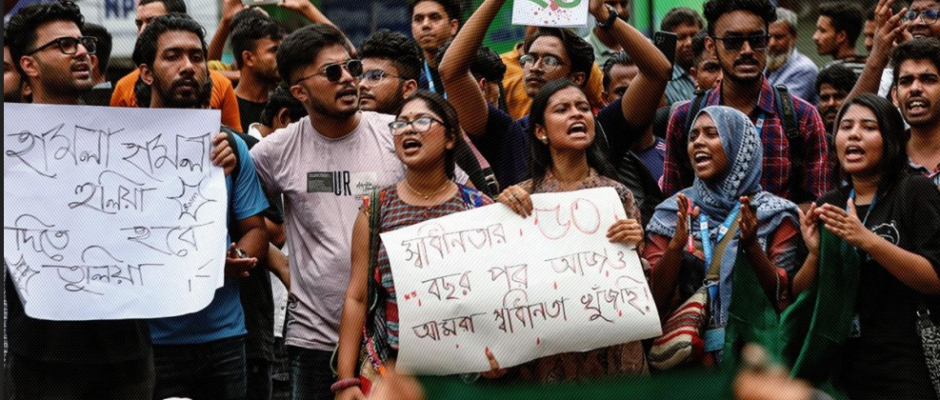
Ram Statue Row, unsettling minority question point to decay in societal plurality ideals with radicals holding the sway! Diganta Chakraborty History often throws up some unsettling questions. Partition of Bengal in 1947 was one such moment. A land enriched by freedom fighter Masterda Surya Sen, spiritual leader Dr. Mahanambrata Brahmachari and ancestors of Rabindranath Tagore was divided forever. Creation of East Pakistan today’s Bangladesh was presented as a political solution but it left millions of religious minorities facing an uncertain future even after six decades. During partition, Hindus constituted approximately 22–23 percent of East Bengal’s population. Today, they account for less than one-tenth of Bangladesh’s population. Demographic shifts can occur for various reasons, including migration, fertility patterns and economic opportunities. The magnitude and persistence of this decline have prompted scholars, activists and minority rights groups to ask whether it also reflects decades of communal violence, discrimination, land dispossession, insecurity and repeated episodes of forced migration. Regardless of differing interpretations, one reality is undeniable: the question of minorities’ security in Bangladesh remains unresolved. Recent events have yet again brought the issue into sharp focus. Thousands of Hindus gathered on streets of Dhaka and several other districts following allegations that an image of Lord Ram was desecrated during a demonstration in Gaibandha. Protesters marched with torches through Shahbagh and other parts of the capital chanting ‘Jai Shri Ram’ demanding arrest of those responsible and protect religious minorities. Community organisations warned that if justice was not delivered, larger demonstrations would follow. Reports also suggest that the controversy has been linked to opposition surrounding installation of a nearly completed statue of Lord Ram in Gaibandha which reportedly faced threats from radical Islamist groups. For many observers, these demonstrations were not simply about one incident. They reflected accumulated anxieties within a community that increasingly feels that even peaceful expressions of faith have become vulnerable to intimidation. The concerns expressed by Bangladeshi Hindus themselves reveal the emotional weight behind these protests. Brotaty Roy, a student at Indraprastha College for Women, University of Delhi and a Bangladeshi national, articulated the sense of uncertainty felt by many members of the minority community: “As a Bangladeshi Hindu, I see suspension of Lord Ram statue project as more than just a delay in construction. The statue was almost completed yet threats from radical Islamist groups were enough to stop the work. To many Hindus this is not simply about a monument, it is about the shrinking space for minorities to openly practice and celebrate their faith. When threats can stop a religious project that is near completion, it creates the feeling that minority rights can be overridden by intimidation. Many Hindus believe that this incident reflects a broader pattern of increasing religious pressure in society. In recent years, concerns have grown about the influence of Islamist groups in public life and politics. From this perspective, opposition to Ram statue is not only about religious disagreement but also about an attempt to limit the public visibility of Hindu identity.” Whether or not every observer agrees with this interpretation, Roy’s testimony illustrates fears and insecurities experienced by sections of Bangladesh’s Hindu community. Public confidence in equal citizenship depends not only on constitutional guarantees but on whether minorities feel safe enough to practise and express their faith without fear of intimidation. Every democracy is ultimately judged not by how comfortably its majority lives but by how securely its minorities can exercise their rights. Bangladesh’s Constitution appears to acknowledge this principle. Article 23A, introduced through Fifteenth Amendment in 2011, directs the State to protect and promote unique local culture and traditions of the tribes, minor races, ethnic sects and communities of Bangladesh. The provision reflects the country’s constitutional commitment to pluralism and cultural diversity. Yet constitutional promises acquire meaning only through implementation. Minority organisations and human rights advocates have repeatedly argued that these protections have not consistently translated into effective institutional safeguards. Reports of attacks on temples, vandalism of religious symbols, disputes over minority-owned land, and sporadic communal violence have periodically surfaced over the years. While Bangladeshi government has often condemned such incidents and initiated investigations, critics argue that response has not always been sufficient to reassure vulnerable communities. This is not merely a legal question. It is fundamentally a question of trust. Bangladesh emerged in 1971 through a struggle that championed linguistic identity, democracy, secularism and cultural pluralism. These ideals distinguished the country’s liberation movement and inspired admiration across South Asia. Preserving that legacy requires ensuring that every citizen Muslim, Hindu, Buddhist, Christian, or indigenous enjoys equal protection before the law. Importantly, many Bangladeshis themselves reject communal hatred and recognise that attacks on minorities undermine the nation’s founding ideals. Tasdik Ahmed, a student of English Language and Literature at Bangladesh University of Professionals reflects this sentiment: “As a citizen of Bangladesh, I believe that respecting all religions and their sacred symbols is essential for maintaining communal harmony. The alleged insult to Lord Ram’s image is unfortunate and has hurt the sentiments of many people. Bangladesh has a long tradition of religious coexistence, and such incidents should be addressed through proper legal measures while upholding mutual respect among all communities.” His remarks represent an important perspective. The demand for minority rights is not simply an issue raised internationally or by neighbouring India; it is also a concern shared by many conscientious Bangladeshi citizens who wish to preserve their country’s pluralistic traditions. This distinction deserves emphasis. Raising concerns about the safety of Bangladesh’s Hindu minority should never become an indictment of Bangladesh as a nation or of its people. Across the country, journalists, academics, students, lawyers, civil society organisations and ordinary citizens continue to speak in favour of religious harmony and equal citizenship. Their voices demonstrate that the struggle against communalism is also an internal Bangladeshi conversation. The responsibility now rests with the State. Investigations into incidents of religious desecration or communal intimidation must be impartial, transparent, and swift. Those responsible for inciting hatred or violence should face legal consequences irrespective of their political

Read More

Too Little, Late & Inadequate

Protestant Church of England’s apology on inhuman crimes committed against mothers, children over half a century is big sham. Catholics have not even recognized their inhuman atrocities. CIHS Desk Protestant doctrine led Church of England whose supreme governor was the British King offered an apology for inhumanly treating pregnant mothers, separating their babies and subjecting them to aggressively inhuman, menial work as punishment in over five decades. Tens of thousands mothers have been separated from their babies immediately after giving birth in the name of Christianity and the Lord. Archbishop of Canterbury Sarah Mullally’s apology for having inhumanly treated over 185,000 mothers and their kids is a sham. The ‘no apology’ is too little, late and inconsequential given the kind of Church administered atrocities on women following Second World War. While the number of mothers and babies impacted due to Church atrocities are manifold higher, this apology is more a face-saver. Playing down the Church’s role seems to be the strategy adopted by protestants to wriggle out of the historic inhuman blunder perpetuated on the English communities that went uninterrupted for over five decades. The Anglican institutions that were responsible for horrendous crimes against mothers and children have not taken responsibility for inhuman treatment, offered no relief, redress or rehabilitation. Catholic church in Ireland and elsewhere has also perpetuated atrocities on pregnant women separating their babies on birth, subjected them to racial discrimination and put them to menial work. Hundreds of babies reportedly died due to malnutrition and mistreatment by the Church authorities. While a 2021 report of Irish state did point to the inhuman practices, full scale of atrocities is yet to be fully documented. These atrocities by Church of different denominations happened globally in the name of Lord and Christianity while the state apparatus, governments maintained tight lid of secrecy. Across continents these practices prevailed in the name of religion and God with no remorse. Tens of thousands women, girls and children were subjected to abuse, malnutrition, inadequate hygiene and neglect if reports by US-based NPR were to go by. Excavating tiny skulls over the years also pointed to unaccounted deaths of kids that never saw light of the day or accounted for. All over Europe, Africa and Australia such cases of mothers and children separation have had been reported with Church leadership still on denial mode. Is this God’s work?  

Read More

Why Rawalakot Is Burning: Exploitation Dressed as Administration

Seven are dead and an internet blackout has fallen over the hills, but the protesters in Pakistan’s Illegally Occupied Jammu and Kashmir have refused to go home. After seventy-nine years, the territory Islamabad occupied is deciding it will no longer be ruled. Rahul Pawa | X @imrahulpawa The bridge at Khaigala is not the sort of place where states are supposed to lose their grip. It is a modest crossing in a green fold of the Pir Panjal, the kind of spot a traveller passes without noticing. Yet this past weekend the air above Rawalakot filled with tear gas and gunfire. By the time it cleared, seven people were dead, four police personnel and three civilians, with around forty injured, and the people in the road did the one thing an occupier never expects. They stayed. Days before the strike was due, the Joint Awami Action Committee had already been outlawed, dozens arrested, and the internet throttled across the region. To understand why an agitation over flour and electricity has hardened into something Islamabad now answers with bullets, you have to go back to the original sin. In October 1947, Maharaja Hari Singh signed the Instrument of Accession that made the princely state of Jammu and Kashmir part of India, the same legal document every other prince signed. Before the ink was dry, Pakistan had already sent tribal raiders and regular soldiers pouring across the western frontier. The invaders brought violence and occupation. In Mirpur, eyewitnesses recorded a massacre so complete that, by some accounts, the overwhelming majority of a town of twenty-five thousand was slaughtered over three days that November. Hundreds of thousands fled. The land those raiders seized and held when the guns fell silent in 1949 became what Pakistan euphemistically calls “Azad” Jammu and Kashmir . There is no azadi there. There never was. What there has been, for nearly eight decades, is exploitation dressed as administration. Consider the rivers. The gorges of this territory carry some of the richest hydropower potential in South Asia, and Pakistan has exploited them relentlessly.. The Mangla reservoir drowned the old town of Mirpur and displaced its people. Pakistan draws much of its electricity from these mountains, yet the power projects sit elsewhere, depriving the region of the royalties that are rightfully its own. The current flows down to the plains of Punjab. The dignity does not flow back up. It is precisely this absurdity, a people sitting in the dark while their rivers light other cities, that has driven crowds into the streets every year since. Then came the corridor. The China-Pakistan Economic Corridor was sold as a forty-billion-dollar dream, and for the Pakistan’s occupied territories it has been something closer to a second occupation. Ancestral land in Gilgit-Baltistan has been acquired forcibly, without consent or fair compensation, by the provincial government and the Pakistan army. The promised jobs evaporated as Chinese workers arrived to fill them, leaving locals dejected and shut out of the very projects carved through their valleys. Those who dare protest the corridor are booked under anti-terrorism laws and branded anti-state elements. The banks of the world lend against this land; its people are not invited to the counting house. The cost of that closeness with Beijing has reached into the region’s homes. Hundreds of men from Gilgit-Baltistan married Uyghur women from neighbouring Xinjiang, and since 2017 those wives have been swept into China’s mass detention camps, leaving husbands and children stranded on the wrong side of the Khunjerab pass. The Gilgit-Baltistan assembly passed a unanimous resolution demanding their release; the families have protested through sub-zero winters; Islamabad, unwilling to disturb its benefactor, has done effectively nothing. An occupier that will not lift a finger to bring home its subjects’ own wives and mothers has told them precisely where they stand.  Nowhere was that indifference starker than in the spring of 2020. As the Wuhan-epicentre pandemic climbed into the mountains, activists described a public-health system that existed mostly on paper. Gilgit-Baltistan, they reported, had two ageing ventilators for a region of millions and had received no meaningful medical aid from Islamabad, even as the same government broke ground on the fourteen-billion-dollar Diamer-Bhasha dam. Hospitals functioned as little more than referral desks, dispatching the seriously ill down the highway to Rawalpindi to fend for themselves. A land rich enough to power a country was not worth two machines that breathe.  The people have had enough. The Joint Awami Action Committee, born in 2023 from traders, lawyers, labourers and transporters, learned in 2024 and 2025 they have to voice their rights. But the demand that frightens Rawalpindi was never about groceries. It is the abolition of twelve seats in the local assembly reserved for refugees who settled in mainland Pakistan after 1947, seats the committee says mainstream Pakistani parties use to install governments in Muzaffarabad.  Strip away the procedural language and the message is plain: stop rigging the house. On Sunday, 7 June, the territory’s Supreme Court ruled that those seats enjoy constitutional protection and can be altered only by amendment, dealing a blow to the movement that had been pushing against them. And so this weekend the state answered the way it always has here, with proscription, arrests, a blackout and live rounds.  This is not a problem Pakistan can solve. What is failing is slower and more fatal: consent. An occupation can outlast oppressive deeds; it cannot outlast the people it claims to govern deciding, town by town, that they were never asked and no longer agree. When British MPs are rising in their own parliament to flag a communications blackout, fielding messages from constituents who cannot reach their families in the region, the cost of holding this land has begun to outrun the reason for holding it.  Jinnah’s two-nation theory was an argument for Pakistan. It was never an argument for these territories Pakistan occupied with raiders and regulars, for they belonged to a state that had lawfully acceded to India before the invasion

Read More

Balochistan’s Disappeared: Inside Pakistan’s Kill-and-Dump Campaign

In Pakistan’s largest province, Baloch families no longer ask only whether their loved ones will come home. They ask whether they will return alive, broken, or as a body left by the roadside.Rahul PAWA | X- @imrahulpawa In Balochistan, disappearance has become more than an allegation. It has become a method of rule, a language of fear, and, for many families, the most intimate face of the Pakistani state. A son leaves for college and does not return. A brother is picked up at a checkpoint and vanishes into an unmarked system. A body appears days later, bearing the marks of custody but not the burden of official acknowledgment. This is why the crisis in Balochistan can no longer be described as a peripheral human-rights issue. It now sits at the centre of the province’s politics, shaping how the state is seen, how dissent is expressed, and how the conflict itself reproduces. Balochistan has never sat easily inside Pakistan. Forcibly annexed in 1948 through military aggression, the province has been governed less as a constituent territory than as an occupied resource frontier, its people subjected to successive military operations, its political leaders jailed, exiled, or killed, its wealth extracted while its communities remain among the poorest in South Asia. The Pakistani army, the Inter-Services Intelligence directorate, and the civilian bureaucracy that answers to both have together built an architecture of control in the province that relies not on consent but on coercion. Enforced disappearance is its sharpest instrument. For years, Baloch families have spoken of men seized from hostels, lifted from homes in front of witnesses, or taken at security posts, only to disappear into a military and intelligence maze that rarely concedes it holds them. What follows has hardened into ritual: protests outside press clubs, sit-ins on national highways, petitions before courts that issue orders the deep state ignores, and mothers holding photographs that become, with time, the only official record they possess. Paank, the human-rights wing of the Baloch National Movement, documented 1,355 enforced disappearances in 2025 and 225 killings it describes as extrajudicial. Its monthly tallies show the pattern continuing into 2026, with 82 disappearances in January and 109 in February. These are activist figures but even if read conservatively, they describe something far larger than sporadic abuse. They describe a system that is persistent, province-wide, and increasingly willing to move from secret detention to what families and activists have long called “kill and dump.” That charge now carries weight beyond the activist circuit. After a fact-finding mission to the province, the Human Rights Commission of Pakistan called enforced disappearances Balochistan’s most urgent human-rights crisis and said testimony from victims and families pointed to a practice that had become systematic. Drawing on police data shared during its visit, HRCP reported 356 disappearance cases, of which 116 people had been traced, 36 were removed for incomplete information, 12 were listed as killed in police encounters, and 192 remained unresolved. Balochistan police alone registered 46 new cases in 2025. More alarming still, the commission described what witnesses called a faster “kill-and-dump cycle,” in which the interval between abduction and the recovery of a body appears to be shrinking. The targets are students, activists, human-rights defenders, journalists, and politically vocal young men and women. Anyone who speaks for Baloch rights, organises peacefully, or simply draws attention risks being categorised by the ISI and military intelligence as a threat to national security. HRCP documented that students had been surveilled and pressured over political expression on campus. In March 2025, UN special procedures experts demanded the release of detained Baloch human-rights defenders and called for an end to the crackdown on peaceful protest. A month later, the same body warned of the “unrelenting use” of enforced disappearances in the province and pressed for independent investigations, criminal accountability, and protection for victims families. The Pakistani state presents Balochistan through the vocabulary of security. The rights record reveals something closer to collective punishment of an occupied people. Islamabad’s counter-narrative rests on the existence of a separatist insurgency. After the March 2025 Jaffar Express attack, the Pakistan Army and the ISI found fresh justification for a harsher crackdown across Balochistan. But this repression is not an aberration. It is the logical outcome of decades of military control, resource extraction without political representation, and a security order that has long treated the Baloch as a population to be managed rather than Baloch to be heard. Pakistan’s institutions acknowledge the problem, but only in the bloodless language of bureaucracy. In October 2025, the government reported that the Commission of Inquiry on Enforced Disappearances had received 10,636 cases nationwide since 2011, disposed of 8,986, and left 1,650 under investigation. The numbers give Islamabad a defence of procedure. They do not answer the question that shadows Balochistan: why, after years of commissions, petitions, and court orders, do disappearances remain woven into everyday life? Why do families still pass between morgues, protest camps, police stations, and roadsides searching for men the state insists it cannot find? The answer may be that disappearance has outgrown its origins as a tactic. It has become governance by intimidation, the organising logic of an occupation that cannot justify itself by any other means. Each abduction removes one person but disciplines an entire social circle: a family that stops speaking, a campus that falls quiet, a town that learns the price of visibility. HRCP warned in 2025 that shrinking civic space, institutional impunity, and the conflation of human-rights advocacy with militancy were deepening alienation across the province. Here lies the central paradox of Pakistan’s campaign in Balochistan. It is designed to suppress dissent, yet it multiplies grievance. It is meant to restore control, yet it steadily drains the state of legitimacy. Balochistan’s disappeared are not merely a humanitarian ledger. They are the human index of a military occupation failing in plain sight. A state can compel silence for a time. It can deny custody, delay hearings, disperse protests, and reduce the missing to rows

Read More

Denials Versus Corrective Action

On this world social justice day, industrialised economies should pledge to take affirmative action to assuage indigenous communities that were subject to abuse, genocide & extinction. Rohan Giri World Social Justice Day seeks to encourage societies to slow down and confront challenging truths. It is not intended to elevate authority or reinforce inherited moral hierarchies. But, global discourse on social justice frequently takes a typical path. Bharat is scrutinized with its caste system portrayed as proof of civilizational failure whereas industrial world speaks from a position of purported ethical maturity. What’s rarely discussed is comparison of how different countries have treated indigenous and marginalized populations not through slogans, but by law, policy, consequences and lived experience. Let’s not forget that modern industrial economies were not built on organic progress but on conquest after bloody wars. When European powers entered American continent at the end of fifteenth century, they found cultures with intricate political systems, agricultural knowledge and cultural continuity that dated back generations. Scholars believe that indigenous population of US before European contact ranged between 50 and 60 million. By the early seventeenth century, this number fell by 90 percent. This virtual extinction was not due to disease, sickness or lack of facilities. Colonial records show that forced work, deliberate famine, mass killings and displacement were used as imperial instruments. In places like Caribbean, entire indigenous populations were eradicated within decades. Potosí silver mines in Bolivia reflect dark reality. Millions of indigenous people were forced to mine under harsh conditions using methods such as mita, a Spanish colonial forced-labour system that compelled indigenous communities to work in mines under brutal conditions. Owing to high mortality rate, colonial administrators considered indigenous labour to be disposable. The extracted silver from these mines bank-rolled European trade, wars and early industrial expansion. This pattern got duplicated in sugar plantations, lumber exploitation zones and later industrial agriculture. Indigenous territory was not incorporated into the contemporary state through consent or reform. It was seized, cleared and monetized. In North America, the story was no different. Treaties with Native American tribes were routinely broken as settlers moved westward. By the late nineteenth century, most tribes were restricted to reservations, typically on marginal terrain unsuitable for long-term economic viability. Indian boarding school system that was prevalent in late 1800s until the twentieth century forcibly separated indigenous students from their families. The explicit purpose was cultural erasure. Children were punished for speaking their languages or following their rituals. Canada’s residential school system followed the same reasoning and lasted until 1996. Official investigations have revealed pervasive physical, emotional and sexual abuse. Mass graves uncovered around former school locations have resurrected scars that were never fully healed. Europe frequently separates itself from colonial misdeeds by pointing to Atlantic, but its indigenous inhabitants tell a different version. Sami people of Norway, Sweden and Finland endured decades of forced assimilation. Their languages were discouraged or prohibited in schools. Traditional livelihoods like reindeer herding were affected by national borders, mining operations and infrastructure construction. Recognition of these abuses occurred of late through investigation panels and formal apologies, long after economic and cultural damage has become irreversible. These histories aren’t stuck in the past. Their ramifications are now measurable. Indigenous communities in US and Canada have much higher poverty rates than national average. Life expectancy is lower. Suicides, substance misuse, and imprisonment are disproportionately high. In Latin America, indigenous land defenders are among the most targeted campaigners facing violence for opposing mining, logging and dam construction projects. Justice in these communities is frequently manifested as symbolic acknowledgement rather than tangible compensation. United Nations Declaration on the Rights of Indigenous Peoples, adopted in 2007 upholds self-determination, land rights, cultural autonomy, and free, prior, and informed consent. However, it is non-binding. Many industrialized countries supported it despite maintaining policies that blatantly clash with its values. Large-scale development projects on indigenous lands continue to be allowed without any substantive consultation. Legal conflicts for land compensation span generations. The gap between word and material behaviour remains large. Against this backdrop, Bharat’s treatment of its indigenous and marginalized populations must be evaluated both scientifically and on the basis of evidence. Bharat has more than 100 million tribal people, making it one of the world’s largest indigenous communities. Unlike settler states, Bharat did not establish its national identity through eradication or displacement of these populations. At independence, Indian Constitution clearly recognized domestic social inequity. Untouchability was abolished by law. Affirmative action in education, employment and political representation was built into the constitutional structure. Tribal regions were given special administrative structures to protect their territory, culture and local government. This approach is important since it reflects intent. Bharat never pretended that inequality and exclusion did not exist. It assigned an obligation to the state to right historical wrongs. The results are varied, but the trend is clear. Literacy rates in indigenous communities, while still lower than national average have increased dramatically in recent decades. Political representation for Scheduled Tribes and Castes is guaranteed in legislatures, local governments and public institutions. Courts often hear disputes involving caste and tribal rights, accepting them as systemic issues rather than disputing their legitimacy. Laws that recognize forest and land rights strive, albeit poorly, to undo rather than normalize colonial dispossession. Welfare schemes, educational reservations and targeted development initiatives are specifically designed with the assumption that past injustice necessitates governmental action. These policies are freely debated, challenged in courts and scrutinized in public discourse. The struggle is on-going but the framework is intended to repair rather than eliminate. When comparisons are made honestly, distinction becomes evident. In industrial world, indigenous peoples were viewed as barriers to progress. Their customs were to be eradicated and their land exploited. Recognition arrived centuries later, often following irreversible loss. Marginalized communities in Bharagt have been regarded as members of the nation-state since its creation. The Constitution regarded them as rights-bearing citizens whose advancement was a collective national responsibility. This does not mean that caste discrimination has ended. It hasn’t. It still has

Read More

Hindu Pogrom Under a Nobel Laureate’s Watch in Bangladesh

Ethnic Cleansing of Bangladeshi Hindus A Nobel Peace Prize is not a shield against scrutiny. Bangladesh’s post-August 2024 reality demands a hard, evidence-led assessment: violence against Hindus has escalated into a pattern that aligns with internationally recognised elements of ethnic cleansing. This is not a claim made lightly, nor is it built on rhetoric. It is grounded in documented indicators that appear repeatedly across historical cases, from the Balkans to Rwanda and the forced flight of Kashmiri Hindus. Our report, “Hindu Pogrom Under a Nobel Laureate’s Watch in Bangladesh,” examines what changed after the extra-constitutional transition that installed Muhammad Yunus as head of the interim administration. In the immediate aftermath of Sheikh Hasina’s ouster, Hindu homes and temples were specifically targeted, and minority families attempted to flee toward India. This is the first stage seen in many ethnic cleansing trajectories: a sudden collapse of security, followed by identity-targeted attacks that signal “you are not safe here.” Reuters reporting captured these early markers, including vandalism of Hindu temples and homes and attempted flight by minorities. Ethnic cleansing is defined less by slogans and more by method. The method in Bangladesh is visible through six elements. Forced displacement is the predictable output when a minority is subjected to sustained terror and sees no credible protection from the state. When families attempt to flee, when communities retreat into guarded enclaves, when daily life becomes a risk calculation, the displacement is no longer voluntary. It is coerced Violence and terror form the second element. The pattern includes killings by shooting, hacking, abduction, lynching, and arson. The purpose is not only to kill, but to send a message to all remaining members of the community. Dipu Chandra Das’s lynching and burning is an emblematic example of violence designed to intimidate, not merely to harm. Deliberate attacks on civilians are the third element. The victims are not combatants. They are teachers, traders, community leaders, elderly couples, workers, and youth. They are targeted in homes, workplaces, and transit routes, consistent with identity-based selection rather than incidental crime. In the first post-ouster phase, minority groups documented attacks on Hindu homes and temples across multiple districts, underscoring organised targeting rather than isolated incidents. Destruction of property is the fourth element, and it is a strategic tool. Burning homes, looting businesses, and desecrating temples do more than punish. They make return difficult, erase cultural presence, and collapse economic survival. These are classic “remove the population by destroying the conditions of life” tactics. Reuters recorded that hundreds of Hindu homes and businesses were vandalised and multiple temples damaged during the initial post-ouster violence. Confinement is the fifth element. Even without formal camps, a minority can be confined by fear. When communities self-restrict movement, rely on volunteer night-guards, and avoid public visibility, they are being functionally contained. This is how pressure accumulates until exit becomes the only perceived option. Systematic policy is the sixth element. Ethnic cleansing does not require a written decree. In many cases, it proceeds through the combination of organised extremist violence and state failure: weak protection, delayed response, denial of communal targeting, and persistent impunity. Here, the core accountability question is state responsibility. Minority groups have accused the interim government of failing to protect Hindus, and the Yunus administration has denied those allegations. Denial, in the presence of repeated identity-targeted attacks, is not neutrality. It is an enabling posture. This is where the Yunus interim administration becomes central. The issue is not whether Yunus personally directs each assault. The issue is whether the state under his leadership has fulfilled its duty to prevent, protect, investigate, prosecute, and deter identity-based violence. When the outcome is repeated killings, recurring temple attacks, widespread property destruction, and the steady tightening of fear around a minority community, responsibility does not stop at the street-level perpetrator. It rises to the governing authority. The report also examines the role of Islamist forces operating in the current environment. Independent reporting notes that hardline Islamist actors have become more visible and influential since the fall of Hasina. This matters because ethnic cleansing campaigns typically require both ideological mobilisation and operational impunity: a narrative that dehumanises the target, and a system that fails to punish the perpetrators. Bangladesh is at a decision point. It can either reassert protection for all citizens and rebuild the rule of law, or drift toward a majoritarian model where minorities survive only as tolerated remnants. The world has seen this script before. The lesson from Rwanda and the Balkans is that early warning indicators are not “political noise.” They are the architecture of atrocity. What is required now is not performative condemnation. It is measurable action: robust protection for minority localities, transparent investigations, prosecutions that reach organisers and inciters, disruption of extremist mobilisation networks, and independent monitoring that makes denial impossible. Without these steps, the pattern described in our report will continue to harden. The Nobel label does not change the facts on the ground. The responsibility of the interim government is to stop the trajectory. If it cannot, it must be treated internationally as enabling an ethnic cleansing process by omission, denial, and impunity.

Read More
Venezuela Case & UN - Crisis of Global Institutions

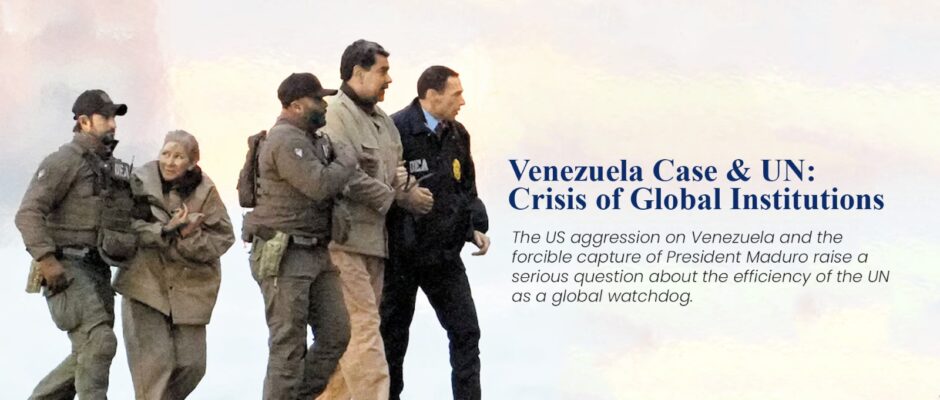
Venezuela Case & UN: Crisis of Global Institutions

The US aggression on Venezuela and the forcible capture of President Maduro raise a serious question about the efficiency of the UN as a global watchdog. It’s time to examine whether nations, which designed the post-1945 system, still regard themselves as committed to it, or treat the UN anchored treaty-based project as optional. Rahul Pawa On January 3, 2026, the U.S. forces launched a surprise strike inside Venezuela and forcibly removed President Nicolás Maduro and his wife, flying them to New York to face the U.S. charges. Reports described explosions in Caracas and the Maduro Government denounced an “imperialist attack” on national sovereignty. President Trump boasted on social media that the strike was carried out “in conjunction with U.S. law enforcement,” heralding Maduro’s capture as a triumph. The world responded with alarm. Venezuela’s interim Vice President, Delcy Rodríguez, demanded proof that the couple was alive. Russia and China voiced their strongest objections. Japan stressed the safety of its nationals, reaffirmed its commitment to “freedom, democracy, and the rule of law,” and indicated that it would work with G7 partners to help stabilise the region, while India expressed “deep concern” and reaffirmed support for the security of the Indian community and the people of Venezuela. Even within the United States, Secretary of State Marco Rubio acknowledged at a press briefing that Congress had not been consulted. These events raise stark legal questions. The core issues are jus ad bellum limits on the use of force, the prohibition on intervention and extraterritorial enforcement jurisdiction, the personal immunities of incumbent senior officials, and the consequences if the incursion triggered an international armed conflict. U.S. constitutional processes and the War Powers Resolution may constrain American decision-makers as a matter of domestic law, but they do not alter Venezuela’s rights under international law. Armed Assault or Law Enforcement Operation? Under the U.N. Charter, no state may unilaterally use military force against another except with Security Council approval or genuine self-defense. The US administration claims this was a cross-border “law enforcement” operation, but international law treats armed assaults like this as uses of force. As one expert summary notes, counter-narcotics or “illegitimacy” justifications cannot override Article 2(4)’s prohibition. Legal scholars agree that drug trafficking, even if a global scourge, is a criminal matter, not an armed conflict that justifies invasion. Customary international law adds another dimension: sitting heads of state have absolute immunity from arrest by foreign courts. Under the Arrest Warrant case and related practice, Maduro, as the incumbent Venezuelan President enjoys complete “inviolability” from forcible seizure. The U.S. might say it no longer recognises Maduro as legitimate, but international law does not allow one country to strip another’s leader of all protection while still holding it to its obligations. Even if Washington claims Noriega-like precedent, “unilateral kidnapping is unlawful regardless of recognition, and immunity questions aggravate, rather than cure, the illegality.”. Likewise, the principle of non-intervention is clear. “Cross-border apprehension” by force without the host state’s consent is an “unlawful exercise of enforcement power”. By sneaking in Marines or special ops to snatch Maduro, the U.S. bypassed all Venezuelan authorities and UN mechanisms. It also bypassed its own procedures by not informing Congress. As France’s foreign minister noted, the U.S., a Security Council member violated the principle of non-use of force and imposed an external solution, warning that “no sustainable political solution can be imposed from the outside” By employing bombs and missiles on Caracas, the operation arguably triggered an international armed conflict between two states. If so, the full body of international humanitarian law (IHL) applies. Every strike must meet IHL’s distinction and proportionality tests. For example, reported strikes that knocked out civilian power infrastructure would be illegal if the civilian harm outweighed any military gain. Moreover, once Maduro was captured, he became a protected person under the Geneva Conventions. He and his wife would be entitled to safe detention conditions and eventual release or trial, but under domestic law, not as prisoners of war. Importantly, even the abduction itself violates the duty to take “prisoners” only lawfully. In practical terms, neither side seems prepared to declare war, but the weapons used leave no doubt: the U.S. struck fixed targets with lethal force on foreign soil. Still, any escalation (for example armed skirmishes with Venezuelan forces) would immediately invoke full wartime protections. The Maduro abduction cannot be seen in isolation. In recent years, permanent members of the UN Security Council have repeatedly tested, stretched, or disregarded legal constraints: China has rejected the legal effect of the South China Sea arbitral award; Russia’s conduct in Ukraine has triggered sustained allegations of Charter breach; and the United States has its own history of unilateral uses of force, including the closely analogous 1989 intervention in Panama (Operation Just Cause). Each episode erodes confidence that treaties and the Charter’s restraints bind the most powerful as much as the rest. The United States is central to this story not only because it helped design the post-1945 order and was among the earliest to ratify the Charter, but also because its subsequent engagement with the UN’s treaty architecture has been selective. This is illustrated by continued non-ratification of major UN-linked instruments such as the Convention on the Rights of the Child (CRC), the Convention on the Elimination of All Forms of Discrimination against Women (CEDAW), and the United Nations Convention on the Law of the Sea (UNCLOS). Those choices do not reduce UN Charter obligations, but they sharpen doubts about commitment to the wider treaty-based project the UN Charter was designed to anchor. Unsurprisingly, the fiercest reaction came from Russia and China. After a China‑sponsored UNSC emergency session, several members condemned the raid as illegal, echoing concerns about a dangerous precedent. Russia’s Foreign Ministry condemned the raid online as “an act of armed aggression.” Intriguingly, France’s envoy reminded that any UN Security Council permanent member breaking the force ban would have “grave consequences for global security”. The cumulative message is clear: when the great powers act unilaterally, the

Read More

Myanmar’s Strategic Crossroads China’s Influence, Western Interests and a Turbulent Election

Arun Anand Myanmar (formerly Burma) sits at a critical crossroads in Asia, both geographically and geopolitically. The country’s location – bordering China, India, Bangladesh, Thailand, and Laos, with a long coastline on the Bay of Bengal and Andaman Sea – makes it a bridge between South Asia and Southeast Asia. In fact, Myanmar is often described as the “main connecting hub” linking East, South, and Southeast Asia. Its shores provide access to the Indian Ocean’s major shipping lanes, which has long attracted great power interest. In short, Myanmar’s geostrategic location grants it outsized importance: it is the only Southeast Asian nation sharing borders with both India and China, and it offers a land gateway from the Bay of Bengal into the heart of Asia.

Read More
Democracy, Disorder and the Question of Legitimacy in Bangladesh - An Interview with Sheikh Hasina

Democracy, Disorder and the Question of Legitimacy in Bangladesh

Sheikh Hasina’s Interview With Arun Anand In an exclusive and wide-ranging conversation with author and columnist Arun Anand, former Bangladesh Prime Minister Sheikh Hasina breaks her silence on the dramatic events that led to her departure from Dhaka, the violent derailment of the 2024 student protests, and what she describes as the systematic dismantling of democratic institutions under the Yunus-led interim regime. Speaking with rare candour, Hasina addresses allegations against her government, warns of rising extremism and minority persecution, and outlines the constitutional and political conditions she believes are essential for Bangladesh’s democratic recovery. From regional geopolitics and relations with India to the future of the Awami League and the legitimacy of proposed elections, this interview offers an unfiltered account from a leader who governed Bangladesh for over a decade and continues to shape its political destiny.   Question: Could you share what factors influenced your decision to leave Bangladesh, and what assurances you would need to consider returning? Answer: What began as a genuine student movement was escalated by radicalists who led the crowds into violence, destroying state and communications infrastructure and burning down police stations. By then, this was no longer a peaceful civic movement, but a violent mob.  My instinct has always been to protect our country and our citizens, and it was not an easy decision to leave while my country erupted into lawlessness. I regret that I was compelled to leave, but it was a decision I took to minimize any further loss of life, and to ensure the safety of people around me. For me to return, Bangladesh must restore constitutional governance and the rule of law. This means lifting the unlawful ban on the Awami League, releasing political prisoners detained on fabricated charges, and holding genuinely free elections. You cannot claim democratic legitimacy while banning the party elected nine times by the people. Question: How do you reflect on your government’s handling of the 2024 protests, and how do you respond to the concerns raised about the use of force and the legal cases that followed? Answer: In the initial days, we allowed students to protest freely and accepted their demands. Then extremists transformed peaceful demonstrations into a violent insurrection. We responded as any government would when faced with burning police stations and attacks on state infrastructure; we acted to restore order and to prevent further bloodshed. I attempted to gain a full picture of the events in August 2024 by establishing a judicial inquiry commission to investigate every death. The conspiracy behind these attacks became clear only later when Yunus immediately dissolved this inquiry, released convicted terrorists, and granted blanket immunity to those he now glorifies as ‘July warriors.’ These same actors marched on the Indian embassy last week, no doubt emboldened by the protection of the interim government. If there were genuine concerns about excessive force or wrongful prosecutions, why destroy the very mechanism designed to investigate them? The truth is that Yunus has consistently thwarted attempts to establish what really happened in July and August 2024, because an impartial investigation would reveal the orchestrated nature of the violence. Question: What is your assessment of the current Yunus-led regime, and how do you view Bangladesh’s future—both with the proposed February 2026 elections and in the longer term? Answer: We cannot forget that Yunus governs without a single vote from the Bangladeshi people. He has placed extremists in cabinet positions, released convicted terrorists, and done little or nothing to stop attacks on religious minorities. The economy that quadrupled during my tenure is now stalling. Yunus came to power promising reform yet all he has sown division and banned the country’s oldest and most popular political party, thus disenfranchising millions. These elections can never be legitimate if the Awami League is banned. My concern is that extremists are using Yunus to project an acceptable international face while they radicalise our institutions domestically. But Bangladesh and its people have extraordinary resilience and an unwavering belief in the power of participatory democracy. I trust that democracy will prevail and that we will set our great country back on the path to recovery and growth. Question: Looking back, how do you view the debate over democratic space during your tenure, and what reforms or new approaches would you prioritize if given another opportunity to lead? Answer: I believe our greatest achievement as a party was the restoration of democracy in the 1990s. When I returned to Bangladesh following my father’s assassination, the biggest challenge facing our country was a lack of popular representation. Those years of military rule and unelected leadership taught us valuable lessons about the power of democracy that we never took for granted during our time in government. As a government, we encouraged political engagement and participation across the nation. Democracy thrives with healthy opposition, yet some of those parties chose to boycott previous elections, restricting the democratic choice of millions of ordinary citizens. It is interesting that those who accused us of restricting democratic space now rule without a single vote, have forced judges to resign, and have detained journalists brave enough to critique their increasingly authoritarian grip on our nation. The question isn’t what reforms I would implement, it’s whether Bangladesh will retain any democratic institutions to reform. We are proud of our record in government. During those 15 years, we helped to lift millions out of poverty, empowered women, and transformed Bangladesh into one of Asia’s fastest-growing economies. We consistently protected the rights of minorities and prevented radicalism from eroding our democracy. It takes a legitimate and strong government to forge our country’s place both domestically and internationally, and we did so by operating within constitutional boundaries. We were repeatedly mandated by voters at the ballot box. Question: How do you assess the country’s current political course under the interim government, particularly in terms of national stability and long-term strategic interests? Answer: The Yunus government took power with a wave of western support from those who confused economic success with political

Read More
Will Religion Limit Talent Hiring in US

Will Religion Limit Talent Hiring in US?

JD Vance prodding that businesses hiring personnel from other communities and countries were ‘anti-Christian’ is simply gross. CIHS Desk For first time in recent history of United States of America (USA), faith and religion have been introduced to run businesses, economy, make investments and hiring of personnel. Valuing diverse culture of America may not be against basic ethos or tenets of that country. But to suggest that as a ‘Christian nation,’ US companies and businesses have to rethink employing talented people at cost-effective wages from third world is gross.  US Vice President JD Vance described America as a “Christian nation” and said we need to protect American jobs from cheaper workers of other countries. Speaking at Turning Point’s America First conference 2025, Vance prodded that employing people of other origins at competitive terms was not part of ‘true Christian politics’. Well, Vance may have to be shown the mirror. Not many would complain about ‘America First’ policy of President Donald Trump or his Vice President. But to give a religious or faith related twist to hiring, employment, running businesses is seriously untenable. The Republican eager to launch his presidential campaign in 2028 may have overstepped ideologically and pursued a sectarian, politically volatile agenda. While Christians of different denominations form US majority polity today, US itself came into being on the graves of Red Indians. In a globalized economy, flexibility in running businesses and recruitment of personnel based on their education, training, talent, value-addition, deliverables and costs must be the basis. Businesses and industry in US may not like to take J D Vance too seriously and reject a large number of their personnel just because they are not Christian or do not subscribe to his political agenda of exclusivity. In case businesses do limit their choice in talent hunt to American Christians as suggested by Vance, what about the large mass of atheists, agnostics and other minorities? While pandering to 162 million Christians of Protestants, Catholics is rather tempting, but to reject others from within and outside irrespective of talent and their contribution in terms of economic value is unsustainable even in short term. Is J D Vance making out a case against those coming for jobs, valued contribution to American economy? Does Vance not understand as to how many universities and institutions run just due to students and professionals from different countries? Is Vance laying the roadmap for Christian and ‘others’ kind of political campaigns that’s pugnacious? American cultural and civilizational evolution has subscribed to making it the ‘land of high value workers’ irrespective of their origin or pay packets they take home. Does Vance not appreciate contribution of religious minorities that include Jews, Hindus, Buddhists, Jains or people of colour? From the days of George Washington, Church has had a big say in governing United States though there was huge resistance to religious interference in state’s affairs. Now, extending it to private sector is something that the Catholic turned Vance proposes to do. This will have serious implications for American businesses as liberal access to talent globally sustained them till now. And, non-availability or limited choice would translate into gaps in high value chains across industrial and services sectors of American economy. Big question therefore several analysts posed was governing America by the country’s constitution or Apostles? Will ‘Ten Commandments have upper hand over Bill of Rights? Several policymakers within Trump administration think that JD Vance postulation of a Christian nation may not allow for hiring the brightest and most talented human resources to compete with China. Exclusive or restrictive policies may not only restrict opportunities for other communities but force top technology giants to shift their investments to more competitive, flexible and open markets.

Read More