CIHS – Centre for Integrated and Holistic Studies

Date/Time:

Unabashed Biases Come to Fore

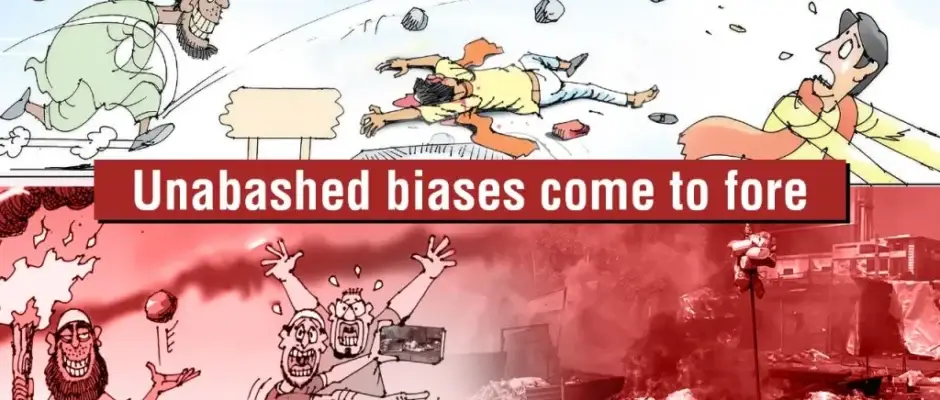
Hindu-phobic reportage during recent violence in Nuh may have actually led in part to escalation in violence, loot and daylight killings Introduction: Biases displayed by global media in reportage of recent violence in India’s northern state of Haryana are unprecedented. Unlike what is written in major global news outlets, it’s important to present the actual and on-the-ground reality to debunk fabricated narratives peddled as the truth. Certain media outlets, which disseminate false stories and mislead readers, not only cause misinformation but also contribute to social conflicts, intended or unintended. Media biases are particularly evident in reporting of communal incidents and political figures in India. Some media outlets and self-proclaimed left liberal ecosystem have faced accusations of taking stand that’s far from truth, engaging in selective reporting and appeasing a few communities as part of a larger well designed conspiracy. This raises concerns about fairness of media coverage during violent incidents or conflicts. While media has been critical in certain cases, it has been silent or biased in others, leading to accusations of double standards. Prevailing narrative suggests a trend of anti-Hindus sentiment in the global media, with increasing number of news portals being critical of right-wing politics and activism. It is worth questioning what happened to those who were once considered flag bearers of ethical journalism post-2014. Historical instances in 1985, 1968, and 1987 highlighted selective reporting on Hindu-Muslim issues in several studies. Some news publications even censor names of Hindu victims and replace perpetrator names to portray Hindus negatively, prompting the need for accountability within the media ecosystem. Haryana violence reportage If we look at the way Haryana’s Nuh violence is being analysed, explained and reported, then blindness of the media becomes apparent. In this whole arson, mayhem and worse, the killing of five people including two policemen, self-styled ‘liberal’ commentators and the intelligentsia failed to see any Islamic connection to it. Pre-mediated violence is evident as it occurred even though Monu Manesar was not part of the Hindu procession. Impulsiveness of the devastation is evident from prearranged amassing of stones and iron rods at the scene. Extraordinariness of the situation further unfolds as the violence erupted within mere 15 minutes of Hindus annual procession commencement, with an unexpectedly armed and well-dressed crowd of approximately 200 people seemingly appearing out of nowhere. According to media reports, the Hindu side initially retreated, but later regrouped and resisted. Now, let’s delve into truth of this incident and examine how the media has depicted it. It is concerning to observe a dangerous trend where incidents are unjustly linked to specific individuals and exploited against them. When all aspects of the violence strongly suggest that it was premeditated and pre-planned, it becomes even more questionable to single out and associate it with any one person. Look at some reportage of media outlets: Source: The New York Times Source: British Broadcast Corporation (BBC) Source: Al Jazeera A Premeditated Event Propaganda notwithstanding, Haryana state chief minister Mannohar Lal Khattar after chairing a high level meeting with state’s home minister along with senior police and administrative officials said “The incident appears to be part of a larger conspiracy, as the Samajik Yatra (societal procession) has been taking place annually for several years. The authorities are investigating the incident to further to find out the underlying causes and potential motives behind it.” Home minister Anil Vij said “the incident does not appear to have happened all of a sudden. The level of violence that took place and also occurred at different points, the way stones were collected, weapons brandished and shots were fired, it does not have happened all of a sudden.” Afzal Ahmed, Member of Legislative Assembly of Haryana from Nuh said “This was a planned act of violence that has been carried out. In the past, there have been trips, but nothing like this ever happened” Chronology of Violence: On July 31, 2023, a ‘Brij Mandal Jalabhishek Yatra’ , a procession held by Hindus annually was obstructed by a group of young Muslims near Khedla Mod area in Nuh district of Haryana. Brij Mandal Jalabhishek Yatra, aimed at rejuvenating sacred Hindu sites, has been an annual event for the past three years. Notably, Nuh, formerly known as Mewat, is believed to house three ancient Shiva lingas, namely Nalhar Mahadev Temple, Jhirakeshwar Mahadev, and Shringeshwar Mahadev Temple. Within mere 15 minutes of the yatra’s commencement at Khedla Mod of Nuh, the situation took a drastic turn as Islamists began pelting stones, and shooting from unlicensed weapons triggering acts of arson. Witnessing the escalating chaos, the devotees attempted to retreat, but they encountered a barrage of stones from behind as well. Amidst the turmoil, petrol bombs were hurled at the devotees, making virtually challenging for some to seek refuge at the Nalhar Mahadev temple. Having cornered the devout Hindus in a dragnet of sorts, the rioters closed in on the temple, surrounding it, and wreaking havoc by setting cars, buses, and various vehicles ablaze, while firing indiscriminately at anyone in their path. Tragically, two individuals were hit by bullets during this rampage. Almost all vehicles were either burnt or severely damaged in the onslaught. Upon arrival of the police, the rioters fled, seeking refuge in the nearby hills, where they continued their assault by firing bullets at women, children and other devotees who had sought shelter inside the temple. With great effort, the administration managed to subdue the rioters and bring devotees out under police escort. Throughout this violent attack, the rioters specifically targeted police posts, temples, shops, and properties belonging to Hindus, leaving a trail of destruction and fear in their wake. The violence that originated in Nuh district quickly spread to the neighbouring areas of Sohna, Gurgaon, and Faridabad. As a consequence, innocent residents of these regions fell victim to rampage unleashed by the Islamic rioters. Hindus faced attacks on their homes and shops, witnessed their vehicles being vandalized, and experienced direct physical assaults. Nuh (Mewat): Muslims dominant! Nuh, a district situated in the

Read More

India’s Space Supremacy on Ascent

Chandrayaan-3, ISRO’s premier lunar exploration is a milestone in its path to achieving greater excellence, cost competitiveness and emerge as space power Rahul Pawa Human space exploration has predominantly been shaped by superpowers of the Cold War era, with US space agency, NASA and its Russian counterpart, Roscosmos leading the way. This is a thing of the past. In recent decades, the biggest surprising candidate in contention is the Indian Space Research Organisation (ISRO). Though it started late and faces financial limitations as well as technological constraints, ISRO has demonstrated remarkable resilience and determination, carving out a unique path as a top-tier global space agency. Established in 1969, almost two decades after NASA, ISRO embarked on its journey amidst a space race that was already in full swing. Tasked with the formidable mission of propelling India into the age of space technology and catching up with technologically advanced nations, ISRO’s journey has been far from smooth. In the aftermath of India’s nuclear tests in 1974 and 1998, the nation faced broad international sanctions. This development dealt a significant blow to India’s space aspirations when Russia, succumbing to pressure from the Western world, cited the Missile Technology Control Regime (MTCR) and withdrew from an agreement to transfer crucial cryogenic engine technology to India. The cryogenic engine technology was indispensable for the development of heavy-lift launch vehicles. Such a setback could have easily derailed India’s ambitions. Instead, it ignited ISRO’s determination, fuelling its drive towards self-reliance and innovation. Over next two decades, ISRO focused its efforts on developing its own cryogenic engine technology. Despite numerous challenges, India’s space agency remained unwavering and in January 2014, it successfully launched the GSLV-D5 launch vehicle, powered by an indigenously developed cryogenic engine. This achievement serves as an exemplary showcase of perseverance and resilience in the face of adversity, a testament to ISRO’s unwavering commitment to its mission and the Indian Republic. Yet, this is just one chapter in the compelling saga of ISRO, where hurdles are transformed into springboards for success. It is a testament to ISRO’s prowess in transforming adversity into opportunity, illuminating India’s flourishing technological capabilities. As ISRO navigated its journey, it pioneered a new paradigm in space exploration, combining cost-effectiveness with ambition, establishing itself as a trailblazer in affordable space technology. The Mars Orbiter Mission, known as Mangalyaan, epitomises this innovative spirit. Accomplished at a fraction of the cost of similar missions by other agencies, Mangalyaan was not just a frugal exploration but a powerful demonstration of ISRO’s formidable capabilities to the world. A vivid illustration of ISRO’s economical yet ambitious spirit is its mastery of multi-launch capabilities, allowing multiple satellites to be taken into orbit with a single rocket. ISRO showcased this brilliantly in February 2017 when it successfully launched a record-breaking 104 satellites aboard a single PSLV-C37 rocket. This launch included not only India’s own earth observation satellite but also miniature satellites from several international players, underscoring ISRO’s leading role in the global commercial space industry. Furthermore, ISRO’s ability to maintain budgetary controls without compromising on scientific endeavours sets it apart from many international counterparts. Whether it is launching the world’s lightest satellite or sending a mission to Mars at a cost lower than a Hollywood blockbuster, ISRO’s exemplary record reflects that cost-effectiveness and ambitious exploration can indeed go hand in hand.  Chandrayaan-3, the latest iteration of ISRO’s flagship lunar exploration mission, is poised to embark on its momentous journey, aiming to achieve a soft landing in the Moon’s South Polar region on August 23, 2023 at 5:47 pm. This extraordinary endeavour, born out of years of rigorous scientific inquiry, stands as evidence of India’s expanding influence as a formidable force in space exploration. Chandrayaan-3 aims to succeed where its predecessor fell short, achieving a precise and controlled landing on the lunar surface. The proposition for an Indian moon mission was formally announced by former Indian Prime Minister Atal Bihari Vajpayee during his 2003 Independence Day address, and in 2008, Chandrayaan-1 was launched, marking a significant milestone in India’s cosmic journey. Comprising a lunar orbiter and impactor, Chandrayaan-1 not only fulfilled its scientific ambitions but also propelled India into an elite group of lunar explorers. Even before Chandrayaan-1 landed, ISRO and Roscosmos planned its sequel, Chandrayaan-2, with the goal of a moon landing and rover exploration. Due to delays from Roscosmos, ISRO independently developed a lander, pushing the launch to 2019. Technical setbacks and rescheduling notwithstanding, Chandrayaan-2 finally took off on July 22, 2019. Tragically, a software glitch on September 6, 2019, caused the Chandrayaan-2 lander to malfunction, resulting in the loss of communication with ISRO and loss of both the lander and the rover. This incident led to the development of Chandrayaan-3, the next phase of the mission, with the ambitious aim of achieving a successful soft lunar landing. With the clock ticking down, ISRO is diligently overseeing the timeline for the lunar touchdown, taking into account elements such as lunar sunrise. In case circumstances demanded, the landing can be pushed to September from the scheduled August 23 this year. Every step forward brings India’s Chandrayaan-3 closer to a ground breaking achievement on the moon. Successfully achieving this would place India in an elite group of nations; to date, only the US, Russia, and China have accomplished this feat. Odyssey of ISRO embodies the indomitable spirit of human endeavour—an unwavering resolve, tireless perseverance, and self-reliance that magnify India’s ascent as an increasingly formidable space superpower, bolstering its commanding presence within the global space community. Having begun as a latecomer, ISRO has transcended the confines of limitations and boldly challenged established order, thereby demonstrating that constraints are merely catalysts for boundless opportunities. ISRO’s unwavering dedication to perpetual learning, adaptability, and evolution has empowered it to overcome formidable obstacles and lay a robust groundwork for future triumphs. Through a multitude of accomplishments, it has forged an upward trajectory for India, shaping it into a rising space superpower of exceptional versatility. (Author is Research Director at Centre for Integrated and Holistic

Read More

Bangladesh’s Crossroads: Navigating Rising Extremism and Anti-Hindu Persecution

Rahul Pawa Since its inception in 1971, Bangladesh has borne witness to an alarming trend of persistent human rights violations against the Hindu minority. The initiation of this harrowing journey can be traced back to the Bangladesh Liberation War, which tragically saw hundreds of thousands – some estimates even escalating to 2.4 million – of Hindus losing their lives. In the subsequent two decades, from 1971 to 1991, the Hindu demographic saw a significant drop from constituting 13.5% of the population to a mere 9.2%. As time went by, the situation didn’t improve; the 2011 census data further revealed the Hindu population dwindling to 8.5%, showcasing the grim reality of a consistent Hindu exodus induced by relentless persecution. Instances of violence, particularly the distressing post-election attacks of 2001 where an estimated 200 Hindus were killed, and many more were displaced, serve as stark reminders of this sustained oppression. The history, darkened by the tales of these atrocities, underscores the urgent need for robust and comprehensive action to protect the rights and wellbeing of Bangladesh’s Hindu minority. Recently, the persecution of Hindus has taken an even more disturbing turn with the rise of Islamist extremism, spearheaded by the Bangladesh Nationalist Party (BNP) and their ideological ally Jamaat-e-Islami (JeI). On Friday, July 28, 2023, these radical Islamist factions orchestrated a series of deplorable acts, magnified by a rally staged in the Naya Paltan area of Dhaka city. This gathering, attended by over one hundred thousand Islamists, served as the platform for the announcement of a continuous agitation program, delivered through a video message by BNP’s acting chairman and convicted terrorist, Tarique Rahman. This climate of fear and hostility has effectively marginalised Hindus, relegating them to the status of second-class citizens in their own homeland. Such developments pose serious challenges to Bangladesh’s secular fabric and its commitment to uphold human rights. On multiple instances, a host of leaders from the BNP have fearlessly expressed their intentions to strike back against every member of the Sheikh Hasina lead Awami League. Their rhetoric ominously suggests that the “agents of Awami League,” which includes Hindu supporters and India (Bharat), would be subjected to severe consequences should the BNP regain power. This hostile stance was reflected at the recent gathering as well, with attendees zealously participating in anti-India and anti-Hindu chants. A particularly disconcerting sentiment emerged from the crowd as they proclaimed, “Bangladesh is Muslimstan, Hindus go to Hindustan” – a blatant effort to exclude and marginalise the Hindu community, this sets a dangerous precedent for a potential escalation in an already volatile and strained environment. In stark contrast to the ominous atmosphere generated by the BNP rally, another event, a peace rally organised by the youth front of the Awami League, presented a deeply human and sympathetic face to the issues at hand. The rallying cry came from Purnima Rani Shil, a Hindu woman who suffered an unthinkable ordeal at the hands of BNP members at the tender age of 14, in the Ullapara area of Sirajganj district in 2001. In her moving testimony, Purnima conveyed the stark reality of what a BNP return to power might mean: “If BNP regains control, I fear thousands of Hindu girls may become victims of this notoriously anti-Hindu party. They stole my childhood and my youth. They exiled my family from our village. I found no justice anywhere, as from 2001 to 2006, the country fell into the clutches of Pakistani agents and enemies of humanity. Khaleda Zia is the matriarch of anti-Hindu atrocities, with her son, the convicted terrorist Tarique Rahman, functioning as a marionette of the Pakistanis. They aim to transform a secular Bangladesh into another Pakistan.”  Alarmingly, the Bangladesh Nationalist Party recently declared what they ominously labeled as the “final part of war” against Prime Minister Sheikh Hasina and her governing body, the Awami League. Urging their supporters to make Dhaka city their stronghold until the ruling government is unseated, this call to arms rings a dangerous bell, not just in Bangladesh, but echoes ominously across the globe. What’s particularly disconcerting are the financial streams that the BNP is purportedly benefiting from. Media reports suggest that the party is being showered with millions of dollars from dubious sources. These funds, murkily acquired, are directed towards sustaining a challenge against the incumbent government. Even in the face of severe economic collapse, Pakistan appears to be pumping substantial sums into the coffers of the BNP, raising concerns over its vested interests. Disturbingly, infamous figures such as terrorist Dawood Ibrahim are believed to be aiding the ultra-Islamist party with substantial financial support. This level of global backing raises serious questions about the international networks of radicalism and the ideological hatred driving these alliances. The BNP is also believed to be deploying the power of propaganda to influence minds and fuel divisiveness. It has reportedly poured millions into lobbying activities across the United States and Europe.  Simultaneously, the BNP is staging an alarming media assault against Prime Minister Sheikh Hasina and her government. Utilising the reach of social media and international news outlets, the party is disseminating a narrative steeped in extremist ideologies. This massive propaganda drive seeks to undermine the established peace and unity, as it fuels societal divisions on a large scale, aided and abetted by the malignant forces of Islamist hatred. The dangerous undertones of their activities are a stark reminder of the relentless threats that peace-loving societies face around the world and how nations that fall for such extremist views and ideas are destined to collapse. The persistent plight of the Hindu minority in Bangladesh, marked by rising religious extremism and significant financing of such factions, highlights the pressing challenges to peace, social harmony, and human rights in the region. As Bangladesh continues to grapple with these complex issues, the manner in which it safeguards minority rights and counters religious extremism will be pivotal. These developments, resonating far beyond national boundaries, necessitate vigilant observation and strategic intervention from regional and international stakeholders, underscoring the critical

Read More

Academic Research or Hit Job?

Ashoka University paper deviously questions Indian electoral outcomes in the guise of research with very little basis or evidence Vinod Kumar Shukla It took over four years for Ashoka University to come up with 50-page research paper ‘Democratic Backsliding in the World’s Largest Democracy’ by Sabyasachi Das which terms 2019 Lok Sabha polls outcome as electoral fraud. The paper lacks objectivity when it outlines that polls were manipulated in closely contested constituencies. Manipulations at the time of voter registration, voting and counting are other findings that this paper boasts of. Insinuations that Muslims were deliberately de-franchised by removing their names from voter lists too figured in the report as one of the tools of manipulation. The research paper suggests that manipulation has its impact on nine to 18 seats with victory margin of three to seven per cent. Even if one were to believe that the data and findings were on dot, the outcomes would not have been tilted or would have remained unaffected as BJP had won 303 seats out of 543. BJP would have still formed the government even if it had lost all 18 seats as the paper claims. Another twisted argument claims that BJP won a disproportionately higher number of closely contested seats where it was in power. State cadre officers’ credentials have also been questioned in the report, They have been squarely held responsible for votes manipulation by charging that observers from state services of BJP-ruled states were in large numbers. Now, the interpretation that all state level officers resorted to manipulating outcomes to ensure a BJP victory was neither backed with evidence nor data or facts. This conclusion is more imaginary rather than being a fact. It’s libellous too. Let’s do a fact check on closely contested 98 seats with less than five per cent victory margins of which BJP had won 43 seats (roughly 44 per cent). Out of these seats, the BJP won 22 in states that it was in power. The paper in guise of research ignores the fact that BJP won equal number of seats from opposition parties ruled states. Ashoka University paper does not have any plausible explanation to insidious job in the name academic research.   Contrary to what Ashoka University academic claims, 2019 elections were not at all closely contested as BJP led by its mascot Narendra Modi had secured over 50 per cent votes share in 224 seats. This constitutes about 75 per cent seats that BJP garnered. Why does Ashoka University paper set aside a glaring fact that BJP bagged more seats in Uttar Pradesh in 2014 Lok Sabha polls at 71 when SP was in power. This is against 62 seats won in 2019 when it was in the saddle. In 2019, there was a Congress government in Madhya Pradesh but BJP had won 28 seats out of 29; it had won all seats in Rajasthan while nine out of 11 in Chhattisgarh. Karnataka too was ruled by the opposition when BJP and its ally had won 26 seats out of 28 seats. West Bengal, Odisha and Telangana were such states where BJP did well despite opposition governments. The Quint was quoted in the Ashoka University paper to point out variance in votes polled through Electronic Voting Machines (EVMs) and votes counted. The paper claims that there was variance in 373 seats but was able to provide examples of 11 seats where it purportedly found discrepancies. Of these, five were won by the BJP and six by others. Actually the author needs basic lessons in politics and election dynamics as closely contested seats won by any political party by no means suggest manipulation. They have won with organisational strength, social engineering, compatibility of alliance partners, campaign strategy, strength of economic and development agenda, star campaigners and benefits provided to people by the government. In closely contested elections, taking voters to booths on polling day matters the most and BJP is good at it. Election management in BJP is done with such precision that it goes for person to person, door to door contact with volunteers or party people marked to each voter or the family. So, BJP predictions on victory or outcomes made periodically is based on its extensive campaign machinery inputs and not conjecture, predictions made by media outlets or hear say. Asoka University paper also talks about deletion of Muslim votes from electoral lists thereby questioning the very basic electoral credential in India that has been hailed as ‘biggest festival of democracy’ by international agencies as well. The report commits another big blunder by completely ignoring notices given to parties like Samajwadi Party of Akhilesh Yadav to provide proof in support of his allegations on deletion of muslims names from the electoral lists. Actually, the case of Muslim vote banks is the other way round as Bangladeshi and Rohingya infiltrators are illegally getting inducted into voter lists not only changing demographies but are a threat to democracy. So, Ashoka University report is not academic work but a hit job done on behalf of certain political parties.  Report findings or observations in such cases are predetermined and arguments, data points or methodology is designed to such false narratives. Such reports are later amplified by leaders like Arvind Kejriwal and Mamata Banerjee to drive their own nefarious agenda. They have always been questioning Election Commission of India, Electronic Voting Machines and voter verified paper audit trail (VV PAT) whenever they lost elections or people rejected them. If non-BJP parties were to be elected, then these very parties hail such ‘electoral outcomes’ as ‘victory to democracy’.  As if in second thought, Ashoka University meanwhile distanced itself from findings in the paper commission by the institution. But question remains, who assigned the project? Who funded it? The university must come clean as it puts a big question mark on credibility of constitutional bodies of the country like Election Commission of India. Ashoka University in any case is known in academic circles for debunking alternative socio-economic

Read More

Trudeau goes Khalistan, Pakistan way!

Latest reshuffle in his council of ministers may not have addressed concerns on Canadian soil becoming fulcrum of anti-India elements Rohan Giri Canadian Prime Minister Justin Trudeau has recently reshuffled his council of ministers ahead of the upcoming general elections. This reshuffle involved making change of portfolios and work responsibilities of ministers along with four Indo-Canadians. As Canada reconfigured its leadership, discerning and assessing its implications for the country’s partners like India becomes pertinent. Evolving political dynamics in Canada and resulting strategic adjustments warrant careful consideration in the global arena. In specific, four Indo-Canadian ministers’ responsibilities were changed or promoted: Anita Anand, Kamal Khera, Harjit Sajjan, and Arif Virani. Notably, Anita Anand was promoted as President of Treasury Board, transitioning from her previous role as the Minister of National Defense. Similarly, Kamal Khera moved from a senior portfolio to become Minister for Diversity, Inclusion, and Persons with Disabilities. Harjit Sajjan, having served as International Development Minister, now holds the position of Minister for Emergency Preparedness. Arif Virani, another Indian-Canadian and the representative of Parkdale-High Park in Toronto made his cabinet debut as the Minister of Justice and Attorney General. Understanding their influence and engagement within the sizeable Indo-Canadian community and Indian affairs becomes crucial owing to the significant role overseas Indians play in influencing New Delhi’s relations with Ottawa. Professor-turned-politician Anita Anand is particularly vocal about her Indian heritage taking immense pride in her grandfather, freedom fighter VA Sundaram, who worked alongside Mahatma Gandhi during the freedom struggle. Anand’s involvement extended to assisting the panel in investigating tragic 1985 Air India Kanishka bombing. On 35th anniversary of the bombing, she tweeted, “The victims of the bombing of Air India 182 and their families are in my thoughts today and always. I am privileged to know some of you and honour the memories of your loved ones with you.” Anita Anand also held a position on advisory board of the Canada India Foundation, an organisation established in 2007 to bolster bilateral ties. During the cabinet transition, Kamalpreet Khera, representative for Brampton West in the House of Commons has taken on significant role of Minister for Diversity, Inclusion, and Persons with Disabilities. Khera’s Indo-Canadian background goes back to her ancestors from Ropar in Punjab. She is known to have close ties with Navdeep Bains, a former Canadian politician who served as Minister of Innovation, Science, and Industry during 2015 – 21. There have been reports pointing to strong links Navdeep Bains has with Khalistani movement. Bains has allegedly been groomed by World Sikh Organization (WSO), a pro-Khalistan hard line organisation accused of radicalizing Sikh community and fostering divisions apart from piloting anti-India propaganda. Relationship between Navdeep Bains and Kamalpreet Khera is said to be more than just acquaintanceship. Bains is regarded as mentor and guide to Khera. Indian authorities have expressed their concern to the Canadian government multiple times regarding separatist activities on the latter’s soil. Prime Minister Trudeau’s cabinet reshuffle also sparked reports on Harjit Sajjan, his association with Khalistani elements and his tacit support for their radical activities. Hitherto Punjab Chief Minister, Captain Amarinder Singh had publicly ostracised Sajjan as a “Khalistani supporter”. Singh had been a proponent of imposing sanctions on Canada for its ‘open and covert’ support to Khalistani terrorists. Captain Singh had called for global pressure on Canada to prevent the use of its soil for perpetrating terror against India, particularly the Sikh community targeted by Khalistani terrorists. Reports pointed to Harjit Sajjan’s parents, Kundan Singh Sajjan and Vidya Kaur Sajjan’s long term membership of WSO. Another notable Indo-Canadian that figured in the latest cabinet reshuffle is Arif Virani, who spent 15 years as human rights and constitutional lawyer before entering politics. Virani is vocal about purported Islamophobia and remained deeply committed to the trumped up issue. Since his initial election, he consistently advocated against Islamophobia, both on the ground and within the Parliament. Notably, he sought inputs from Muslim groups on how to tackle online hate faced by Muslims before Liberals introduced Bill C-36 in June 2021. Primary objective of this bill was to combat online hate with focus on addressing Islamophobia that Virani thinks is prevalent. Arif Virani was involved in a study on M-103, a non-binding motion in the 42nd Canadian Parliament urging the government to condemn Islamophobia and all forms of systemic racism and religious discrimination. Additionally, he is associated with the Aga Khan Foundation of Canada, an organisation working in various countries. The foundation faced accusations of involvement in money laundering Canadian Prime Minister Justin Trudeau’s decision to include Khalistani and Pakistani jihadist elements in his council of ministers may not go well with New Delhi. Comprehensive research conducted by veteran journalist Terry Milewski titled, “Khalistan: A Project of Pakistan” unequivocally demonstrates that the Khalistan movement poses not only a threat to India but also significant concern for Canada. Prime Minister Justin Trudeau’s undeniable link with anti-India elements underscore the risk it poses to bilateral relations and global security environment. (Author is operations manager at Centre for Integrated and Holistic Studies, non-partisan think tank based in New Delhi)

Read More

Quirky Chinese leadership undependable!

Retake ‘Aksai Chin’ under Chinese occupation, stop its draconian expansionist aggression and bring peace to Indian borders K.A.Badarinath China is at its old dark ways again. Otherwise, there’s no reason why three Indian Wushu sports persons from Arunachal Pradesh, Nyeman Wangsu, Onilu Tega and Mepung Lapgu, were given stapled visas. India’s Wushu team was to head for Chengdu to participate in the World University Games beginning Friday. The stapled visas issue is symptomatic of China’s war games and its claim on Arunachal Pradesh that’s integral to Bharat. The latest fracas seems to be scripted and directed by none other than the Chinese Oligarchs’ frontman and President, Xi Jingping who’s into his third term as head of Chinese Communist Party and also head of all powerful military commission. Most significant Chinese claim on Arunachal Pradesh ala indirectly through stapled visas comes on a day when three key developments were reported. Dichotomy in Chinese military checkers comes to fore on a day when Prime Minister Narendra Modi and Chinese President Xi Jingping spoke on phone to bring about stability on the borders. In fact, this was the first recorded conversation of the two leaders after their brief in person informal interaction at Bali as part of G-20 group at the invitation of Indonesian President. After the Galwan valley Chinese misadventure, there has been no engagement between heads of state and President Xi Jingping was busy ensuring third Presidential term for himself apart from ‘cleansing’ the party from his political rivals and policy antagonists. ‘Stapled visas’ hogged headlines also on a day when reports poured in about the two leaders’ discussion on military standoff during April – May 2020 in Eastern Ladakh. What has induced ‘stapled visas’ issue larger significance is the reports of Peoples Liberation Army (PLA) heightened build up from Eastern Ladakh to Arunachal Pradesh borders during last few weeks? Nineteen rounds of corps commander level talks between Indian and Chinese side have not yielded results nor have led to sensitizing PLA Generals or belligerent Communist leadership in China that rules its own people with an iron fist. Sense that one gets is China’s outright refusal to disengage from at the strategic Depsang plains and Charding Ninhlunh nallah track junction at the Demchock in Eastern Ladakh. On the other hand, reports suggest continued build-up of bunkers, posts, artillery positions, surface to air missile systems, radar sites and ammunition storages. Development of new helipads, roads, dual use villages development and last mile connectivity has also been on the rise across the border leading to beliefs that negotiations at political level may ‘not yield’ on the ground results but discussions have to happen. Stapled visas incident is seen more as one step further in China’s grand expansionist plan and communist vision to occupy others’ land disregarding international treaties, pacts and ‘gentlemen’ agreements to not change on-the-ground goal posts. Only way to put an end to this psycho-warfare like stapled visas is to firmly retake ‘Aksai Chin’ under its ‘illegal’ occupation since 1950s and held after the 1962 war. China’s claim on Aksai Chin was made a couple of years after Indian Constitution was adopted in 1950 that included whole of Jammu and Kashmir along with Ladakh. Aksai Chin was part of Ladakh till the Chinese claim leading to its occupation in ‘50s. In fact, no Chinese maps till 1920s even showed Aksai Chin as part of China. Even in 1930s map of Sinkiang or Xinjiang, Kunlun mountains were marked as Chinese boundary and not the Karakoram range. Chinese posturing and war games that were shaped in ‘wolf warrior’ diplomacy doctrine is essentially unsustainable in any bilateral relations. Beijing will have to realize that false claims, wolf warrior diplomacy combined with on-ground, air and water bound aggression may not help in positioning itself as a leader as well. In fact, Qin Gang who’s been closest aide to President Xi Jingping and later anointed a state councillor was considered architect of wolf warrior diplomacy doctrine adopted by Chinese Communist Party as one of its key principles in engaging with the world. While there’s no trace of ‘missing’ Qin Gang, bringing Wang Li back as top Chinese diplomat and foreign minister may not help clear the air. Openness, flexibility and clarity of thought and attitude make great world powers. China has a long way to go leaving its shady past, false claims and drudgery that the communist regime is known for.  (author is Director and Chief Executive, Centre for Integrated and Holistic Studies,  non-partisan think tank based in New Delhi)

Read More

Seema Haider, ISI deep cover asset?

Unravelling Seema’s suspicious shades through a probe may throw light on this much publicised cross border love story Rohan Giri & Resham Natt India and Pakistan are hogging headlines yet again. Surprisingly enough, this time, it’s not over Kashmir or terror modules that routinely try to cross over into India to create unrest. Blooming bond of togetherness between two distant lovers living in two conflicting nations has occupied media outlets overtime. Seema Haider and Sachin Meena reportedly found true love while playing PUBG at a time when the whole world was trapped within confines of their homes during Covid- 19 Pandemic. Mesmerized and charmed by the way Sachin conversed, his accent, and way of playing, the couple soon began engaging in long talks via voice calls and video calls, which helped them discover, in early January, that they were meant to be together, leading them to hatch a perfect plan to be together in one nation, which was India. Indians have however been pondering over two questions that in animated discussions that surround ethicality and security. These two prominent issues have attracted a great deal of attention to three very intriguing aspects, (A) Illegal arrival of Seema Haider with assistance from her lover, Sachin Meena, who is a resident of India in the Rabupura district of Uttar Pradesh, all the way from Nepal via Dubai without proper documents. (B) The discovery of her possible links to Intelligence services after she was adamant and expressed wish to stay in India and not be deported back and lastly (C) Over her decision to take her children to other side of the border against wishes of her so-called divorced husband, Ghulam Haider. But who is this fearless woman that dared to walk onto the most dangerous path in her quest to be united with her loved one? Cross border love, prime mover? Seema Ghulam Haider (once a famous tik tok star and popularly known as Seema Haider, Seema Rind and Seema Jhakrani) is a Pakistani citizen with roots in the Baloch Community, born on January 1, 2002 (as per her passport) who has spurred a discussion over her entry in India to meet her lover, along with her four children. Earlier, she was married to Ghulam Haider, a Pakistani resident of Garhi Khairo Taluka of Jacobabad district in the Sindh Province, who currently resides in Saudi Arabia as a labourer. However, it is hard to comment on their current relationship and it is uncertain whether she is already divorced (a year ago using the conventional way of Triple Talaq on call), as she has stated in press interviews, or whether she is yet to divorce him (as stated by Ghulam himself that he hasn’t and will not give her a divorce). Though Ghulam Haider presented some shocking revelations, denying and refuting Seema’s claims of marriage being that of a forced union and a simple one involving the signing of some papers in the court since she was already in love with someone in the village and that relationship was never recognized. Though Seema claimed that her married life was certainly tough with rough patches, Ghulam has been in total agreement that their marriage was certainly a lovey dovey affair and that there was not even a single trace of domestic violence. “Hindustan Zindabad, tha, hai aur Hamesha rahega,” is what Seema Haider has been saying at more than one or more forums.  Seema claims that her profound love for Indian culture and traditions convinced her to change religion and gave her a new reason and hope to stay in India. Her four children, Farhan Ali, Farwa, Fariha Batool have also converted and expressed their happiness over the decision. The four children have also changed names to Raj, Priyanka, Munni, and Pari respectively. But what is concerning here is that (A) Seema’s way of conversing nowhere reflects the Urdu accent though she claims that there have been significant changes in the way she speaks ever since she began staying with Sachin. (B) Seema’s over-exaggerated yet outpouring love for India and its culture as portrayed in her videos showing her without hijab, wearing a Radhe Radhe strap around her neck, vermilion on her forehead, the auspicious marriage thread around her neck, taking blessings from the elders in the good old Indian tradition of touching feet, engaging in Hindu prayers, worshiping the Tulsi plant and adopting a vegetarian lifestyle has consequently hinted at her ill motives. This has sparked debate on her possible involvement with the Pakistan’s dirty tricks department, ISI and its agents. Hhow can someone so quickly get so attached, connected and become a ‘bhakt’ of a particular religion is the moot question? This suspicious involvement with ISI was reported after media investigations found her family including Seema’s brother Asif and her uncle Ghulam Akbar serving in the Pakistan Army and with linkages to spy agency, ISI. One may be convinced that Seema who reportedly studied only till fifth grade has fluent yet evidently polished English -speaking skills, in-depth knowledge on computers usage, gaming and social media applications like Tik Tok and Instagram. This is quite surprising and very intriguing since she interacted with many users from Uttar Pradesh during PUBG. Seema didn’t come with her children, plain and simple love bird. She also carried baggage full of questions, suspicion, and allegations that would put her in a tough spot, raising questions on her past which will decide her fate. Seema’s journey to India not only threatened her life, jeopardized her survival and opened up upon her possible deportation to Pakistan. Ripples in Pakistan Seema Haider seems to have taken the 2001 Bollywood Blockbuster movie, Gadar too seriously! The Seema Haider case (booked under sections pertaining to the Foreigners Act and The Passport (Entry into India) Act for her illegal entry into the country) has sparked a devastating chain reaction sending shockwaves through Hindu minorities in Pakistan’s Sindh region. This appalling incident has set a vile horde of Muslim extremists hell-bent on terrorizing

Read More

Factsheet : Manipur’s Recent Incident

Putting an end to violence, abuse is prerequisite to finding lasting solution to multi-tribe diverse Manipur state On recent undignified assault on Manipuri women and unrelenting ethnic clashes, Indian Prime Minister, Narendra Modi stated that perpetrators of these crimes will not be spared or forgiven. An incident, where two Manipuri women of the Kuki tribe were paraded naked in broad daylight, went viral on social media, exacerbating the on-going turbulence in the region. While there have been significant on-going efforts from the government and civil society to stop these ethnic clashes in last few months, the event triggered widening gap between Hindus and Christians in the region. Historical background Continued violence in Manipur, a north-eastern state in India, has resulted in significant loss of life and property in over two months. This situation has highlighted the delicate social fabric and presence of non-state actors with divisive agendas. For several decades, ethnic clashes among various tribes and religious differences between Hindus, Christians, and Muslims have contributed to the state’s instability. This instability has been exacerbated by factors like infiltration and spread of drug mafias, illegal crossings from across the Myanmar border, circulation of fake currencies and activities of Islamist groups and Church proselytisers. It is important to note that Manipur became a state in India on September 21, 1949 following the signing of Manipur Merger Agreement between the Governor General of India and Maharaja of Manipur. In subsequent years, Indian Government granted Scheduled Tribe status to the Kukis, a large number of converted Christians, while the indigenous Naga tribe also saw significant conversions to Christianity through proselytization efforts. As a result, more than 90 per cent of Nagas are now Christians. On the other hand, Meitei tribe who practise Hinduism was not awarded Scheduled Tribe status and has since struggled to preserve its culture, traditions, customs and beliefs amidst rapid pace of religious conversions. Religious demography of Manipur over the years has been shown in Fig. 1. Fig.1. Religious demography of Manipur, Source: Census 1951-2011; CIHS Analytics. Christian population in Manipur consisting mainly of the Kukis, Nagas, and Meiteis (who are predominantly Hindus) is roughly equal in numbers across the state. The Meiteis have been protesting against their exclusion from Scheduled Tribe status, but these efforts have often faced violence and opposition from Christians affiliated with various denominations. In March this year, Manipur High Court ordered the state government to include Meiteis in the list of Scheduled Tribes within four weeks. This directive of the High Court was fiercely opposed by several tribal organisations including the All India Tribal Students Union of Manipur (ATSUM). These bodies argued that inclusion of Meiteis would be unfair to other tribes, disrupt the state’s social fabric and their own economic and cultural systems. Conversely, the Meiteis firmly believe that without obtaining Scheduled Tribe status and other constitutional protections, they might face ethnic cleansing within a few decades. Inclusion in the scheduled list of tribes would grant the Meiteis access to educational institutions such as schools, colleges, and universities, as well as provide them with socio-economic benefits available to tribal populations from both state and central governments. The Meiteis, also known as Manipuris, reside in resource-rich and fertile valley situated in the heart of Manipur, as depicted in Fig. 2. Towards north of the valley, the Nagas are predominantly concentrated, while the Kukis inhabit the hills in both the northern and southern parts of the state. According to recorded history, the Nagas and Meiteis have been inhabitants of the region for a longer period compared to the Kukis, who are considered migrants and share close connections with the Chins of Myanmar and the Mizos of Mizoram. Timeline May 4th: The incident took place in Manipur’s Kangpokpi district. May 18th: Zero FIR registered at Kangpokpi police station which was later transferred to Thoubal police station where the incident exactly took place. As per the police statement, the FIR was registered against unknown miscreants regarding abduction and gang rape, leading to subsequent investigation. May 27th and May 28th: Chief of Army Staff General Manoj Pande visited Manipur to assess on-ground situation in the state (and region). He interacted with Governor Anusuiya Uikey, Chief Minister N. Biren Singh to discuss internal security situation in the state. May 30th: Home Minister Amit Shah visited Manipur and interacted with civil society organisations, defence personnel, civil servants, and prominent personalities to discuss and address the many ethnic issues in the region. First week of July: As per Manipur Police, a total of 129 nakas / checkpoints were installed in different regions of the state to ensure law and order is maintained. Over 650 people have been detained in relation to the case till now. July 19th: The video clip of these two women paraded naked in the Manipur district of Kangpokpi went viral on social media. July 22nd: Six persons (05 main accused and 01 juvenile) were arrested so far. Over 60,000 security personnel have been deployed in various regions of the state to ensure law and order is maintained. This includes armed forces, paramilitary forces, and police. Aftermath of the incident While most of the media coverage highlighted ethnic conflicts between the Meiteis and the Kukis to be the root cause of the incident, it is also crucial to look into other factors as well.

Read More

Good numbers, greater challenges!

Antyodaya combined with family centric approach and spiritual odyssey may provide holistic solution to war against poverty K.A.Badarinath It’s heartening that socio-economic development agenda pursued by Prime Minister Narendra Modi has begun to pay off rich dividends. On twelve development indicators that denote poverty levels, there has been substantive progress in the way 1.4 billion Indians live, pursue their aspirations and engage to achieve life objectives. The Multi-dimensional Poverty Index (MPI) : Progress Review 2023 report released by Niti Aayog a couple of days back is fairly comprehensive and widely accepted on methodology, sampling and computational tools. Going by this report, over 135 million Indians escaped poverty during 2015-21 under Prime Minister Modi-led government. Many naysayers may tend to dispute these figures and findings. ‘Actual delivery’ and ‘plugging leakage of scarce resources’ in over a dozen of government schemes seem to have made this eminently possible. The MPI was launched in 2021 in line with United Nations Development Programme (UNDP) and Oxford Poverty and Development Initiative (OPDI) surveys globally. Our own MPI covered 707 administrative districts in 28 states and eight union territories to derive that poverty is on definitive decline curve in India. Significant changes have been reported on 12 indicators like nutrition, child and adolescent mortality, maternal health, years of schooling, school attendance, cooking fuel availability, sanitation, and access to clean drinking water, electricity, housing, assets, and bank accounts. These indicators have been spread across three broad areas i.e. education, healthcare and standard of living for Indians that was reviewed for years 2015-16 to 2020-21. Most significant finding of this survey has been that states like Uttar Pradesh have done extremely well with over 34.3 million people escaping poverty. States like opposition ruled Bihar, Rajasthan; BJD ruled Odisha and BJP held Madhya Pradesh seem to have performed well in tackling extreme poverty. Hitherto, these very states were regarded as laggards on socio-economic development parameters. Most interesting aspect is steep reduction in poverty levels across rural India dropping to 19.28 per cent from 32.59 per cent in the five-year period. But, poverty reduction has been at lower levels in cities at 5.27 per cent from earlier 8.65 per cent. Even after about 10 per cent aggregate decrease in poverty levels, highest numbers of poor people continue to live in Bihar, Uttar Pradesh, Jharkhand, Meghalaya and Madhya Pradesh going by Niti Aayog report. Now, the big question is whether war on poverty in India has entered a decisive phase. Obviously, much more may have to be done to turn India into a developed country by 2047 on all fronts including the Happiness Index. One sure way of measuring poverty as per UNDP was earnings at US $ two per day. There is no empirical data on number of people earning minimum wages in India. Statutorily, national minimum wages per day was set at Rs 178. Though implementation at ground level has been skewed, the minimum wages threshold translates to $ 1.92 as against $ 2 prescribed by UNDP for a developing country like India. Again, state wise minimum wages are different thereby making an aggregate estimate virtually daunting. Accepted principle was that earnings and poverty alleviation have undeniable link thereby making wages singularly one of the most important parameters in counting the poor and tackling the menace. Challenges to alleviating poverty from India is definitely a herculean task that demands newer socio-economic development models that are neither western driven nor communist way of commanding heights principle. Reaching out to last man standing in true spirit of ‘antyodaya’ or ‘sarvodaya’, taking everyone in inclusive development mode is the sure shot prescription to wiping out poverty in Bharat. In fact, that was pushed for by philosophers like Vinoba Bhave, Deen Dayal Upadyaya and veteran labour leader Dattopant Thengdi and rejected by the Western economists’ gang. A tectonic shift in economic development model may have to be seriously attempted by the new government that takes charge in 2024, be it National Democratic Alliance led by Prime Minister Narendra Modi or the opposition alliance of 26 political parties that seek to meekly challenge him. Shifting gears may not be easy if the war on poverty has to be won in the least possible time and not wait till 2047, centennial of Bharat’s independence. For this to happen, taking Indian growth story down below the district centres to evolve ‘self-reliant’ vibrant village clusters is an alternative that the next government can seriously consider. Going beyond districts and evolving villages-clusters is something that has only been talked about in seminar rooms and not attempted as a serious development model that’s unique to India. Strengthening grassroots governance especially in hinterlands as single window shops is one way to attack poverty and achieve self-reliance. As BJP gears up to roll-out its manifesto for next five years and vision document for next 25 years, taking governance to people’s doorstep is something it can consider as paradigm shift in its approach to eliminate poverty. Secondly, defining our own yardstick on ‘poverty’ is something that development experts may consider in next phase of India’s development strategy. Is earning $ 2 or $ 3 per day the benchmark or something beyond this bread and butter issue needs serious consideration? Thirdly, migration as a phenomenon has taken India by storm in last 75-years mostly after economic reforms of Harvard variety were forced down by Dr Manmohan Singh and his team. Migration from villages to urban centres and beyond to foreign shores has gripped this country which marks huge brain drain as well. Unless a holistic view of this phenomenon is taken, can we win the war against poverty? Fourthly, family centric approach to socio-economic conundrum confronting Indian people may widen the canvass for war on poverty as it pushes for basic shift in societal structures shaking away the shaky unrealistic western or socialistic foundations. Fifthly, redoing Indian society with spiritual content to happiness will complete the cycle in war against poverty. Finding holistic solutions to inadequacy of resources, governance at grassroots, earnings,

Read More

De-risking to defanging currency, trade deals

Rupee, UPI, desi currency trade has taken world by storm. Prime Minister Modi thrust in France, UAE paying handsome dividends K.A. Badarinath Defanging to de-risking global trade and currency deals for India is what Prime Minister Narendra Modi achieved in his visit to France and United Arab Emirates (UAE) last week. Agreements concluded during Prime Minister Modi’s visit not only make trade and currency deals more advantageous from Indian perspective but also reflect the country’s growing confidence in shaping commercial partnerships across geographies. Otherwise, how would one explain taking United Payments Interface (UPI) and RuPay to France or for that matter, UAE?  In his West Asia sojourn, UAE and India’s decision to denominate bilateral trade in Rupees and Dirhams is again a big departure from dollar or Euro centric transactions. This is over and above bringing the UPI and RuPay to Abu Dhabi. Currency transactions at retail level on Indian digital platforms to large rupee denominated trade deals have been described by some analysts as ‘de-dollarization’ of Indian economy. But, India’s latest thrust on currency and trade front are more to do with her growing economic and investment muscle and acceptability rather than moving away from the US greenback or euro. Indians visit to the Eiffel Tower in France by purchasing tickets in Rupees may be simpler way of presenting the implications of latest agreements for hoi polloi. The deal involving Lyra of France and National Payments Corporation of India to become operative in September this year would mean much more than paying for tickets at tourist spots in rupees. Wider and willing acceptance of Indian Rupee in Europe is due to financial innovation making Indian digital payments platform UPI secure and affordable across continents. The decision to link United Payments Interface with UAE’s Instant Payment Platform (IPP) makes the country’s digital payments foray wider and deeper in West Asia. In fact, the deal between RBI and UAE’s Central Bank allows for RuPay and UAE Switch interoperable. India’s structured financial messaging system (SFMS) will go to UAE thereby instantly recognizing Indian debit and credit cards. Larger implication is that holding Indian Rupee by central banks and dealers globally by value and quantity will go up many-fold in few years from now. Also, internationalization of Indian rupee is on the verge of becoming a hard reality. Rupee denominated export and import of goods and services internationally will make the Indian currency more tradable given the large ticket size of these transactions. France and UAE are not isolated cases in accepting Rupee denominated trade deals, UPI, RuPay or Rupee Switch. Singapore’s PayNow had done a deal with NPCI to embark on UPI platform. It moved Indian digital payments platform to South East Asian one step further. In May this year, India and Russia had announced making payments easier through RuPay and Mir cards in both countries. UPI of India and Bank of Russia’s Faster Payments System are being linked to make seamless real time transactions in Rupees and Roubles a reality apart from deal on financial messaging systems.  Non Resident Indians (NRIs), businessmen, tourists and students in ten countries including Australia, Canada, US, Oman, Qatar, Saudi Arabia and United Kingdom apart from others could either receive or send money once their domestic bank accounts were linked to their international phone numbers. As per independent consultancy Price Waterhouse Coopers (PwC), one billion rupee denominated transactions per day is estimated to happen in next two years through United Payments Interface and RuPay network. Already, over 73 per cent non-cash transactions in India have gone digital on UPI. Over 18 countries have either opened or in the process of opening Vostro accounts to settle trade deals in rupees or their respective local currencies moving away from US dollar, euro, UK pound or any major international currency. Latest to join this jamboree is Indonesia whose finance minister Sri Mulyani Indrawati firmly stated in Gandhinagar indicated that bilateral trade will happen in Rupees and Rupiah. Bangladesh went one step further and began trade settlements in Indian rupees. This was limited to US dollar till last week. India’s trade valued at US $ 1.6 trillion in last one year seem to have shaped the country’s strategy on cross border currency deals and rupee transactions. And, Indian strategy of gaining acceptability for rupee is however distinctly different from China’s ‘wolf worrier’ investment and loans strategy to gain dominance. Significant progress made by India on rupee’s acceptability and trade transactions cannot however sidestep the challenges in making it part of the reserve currency basket. Current strategy adopted by Reserve Bank of India (RBI) and Indian government has the potential to deliver notwithstanding its limitations. Unless rupee is increasingly used in current account transactions like investments and capital flows, internationalizing the currency may hit a wall. Secondly, as the RBI working group recommended, Rupee must get included in Special Drawing Rights basket of currencies maintained by International Monetary Fund (IMF) to hold its assets. Recalibration of Foreign Portfolio Investments (FPI) may have to be considered for hastening the path to internationalizing rupee. There has been serious discussion amongst BRICS countries to settle trade related transactions within the group in local currencies. A conscious decision on use of member countries’ currencies to square off trade deals would translate to democratization of economic world order. For the stakeholders, reduction in transactions costs, limiting the foreign exchange risks and more safeguards to the trade deals will be accrued apart from huge optimization in capital costs. India accounting for a modest two per cent of global trade in value terms limits internationalization of rupee. Similarly, there may be little to modest enthusiasm to denominate Indian debt globally in rupee terms instead of dollar. Internationalizing rupee and turning it to a currency in reserve is a long haul project for which a firm foundation has been laid by the Modi government. (Author is Director & Chief Executive of non-partisan think tank, Centre for Integrated and Holistic Studies based in New Delhi)

Read More