

Three flawless trials at Chandipur signal that India’s last line of aerial defence is no longer foreign.
Rahul PAWA | x – iamrahulpawa
On the evening of 27 February 2026, along the windswept test ranges of Chandipur on Odisha’s coastline, India wrote a new chapter in its quest for aerial self-reliance. The Defence Research and Development Organisation (DRDO) conducted three successive, flawless flight trials of the Very Short-Range Air Defence System or VSHORADS, a fourth-generation Man-Portable Air Defence System (MANPAD) that has been years in the making. The results were unambiguous: a 100% interception rate against fast-moving aerial targets that mimicked the full spectrum of modern aerial threats.
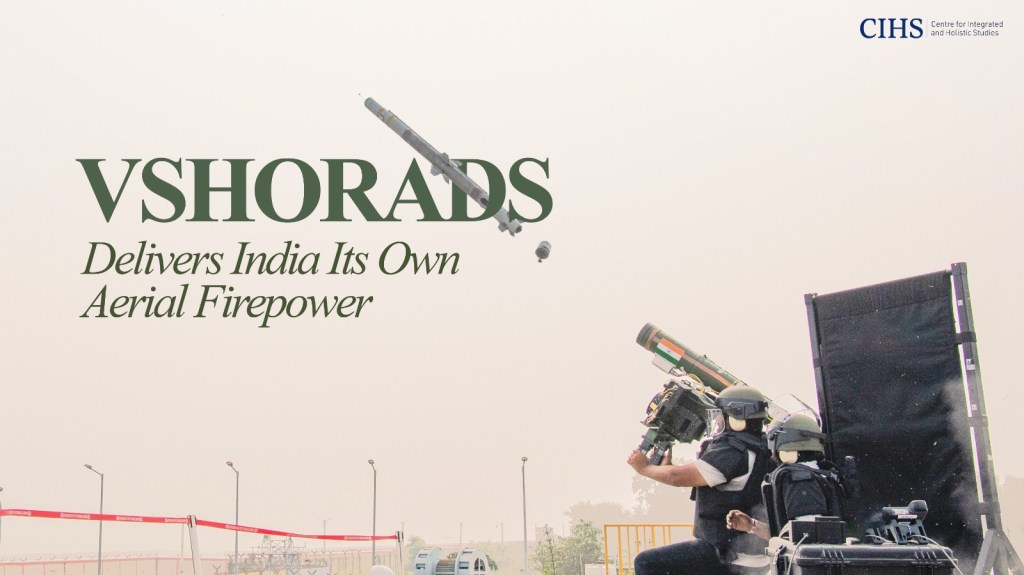
What made these trials extraordinary was not simply the precision of the kills, but the conditions under which they were achieved. For the first time, the system was operated not by DRDO scientists in lab coats, but by soldiers who will one day carry this very weapon into India’s most hostile frontiers. Targets were engaged at varying speeds, ranges, and altitudes, including aerial vehicles engineered to simulate the low thermal signatures of the surveillance and kamikaze drones that have fundamentally altered modern warfare from Ukraine to the Middle East.
Technology Inside the Tube
To appreciate why VSHORADS matters, one must understand what sets it apart, not just from the Russian Igla-M systems it is designed to replace, but from the world’s most battle-proven MANPADs. The American FIM-92 Stinger, for all its combat pedigree from Afghanistan to Ukraine, requires a coolant gas cylinder to chill its seeker head before firing, adding weight, complexity, and critical seconds to the launch sequence. The British Starstreak, while blindingly fast at Mach 3+, demands a highly trained operator to guide it manually onto the target, making it unforgiving under battlefield stress. VSHORADS sidesteps both limitations. At its heart sits an uncooled Imaging Infrared (IIR) seeker that needs no gas kit and no operator hand-holding. It locks, it fires, it hunts. Where the Stinger and the Igla-M track a point of heat and can be fooled by a magnesium flare, the IIR seeker builds a high-resolution thermal picture of its target. A jet engine looks nothing like a burning flare in thermal resolution, and VSHORADS knows the difference. The system further incorporates a miniaturised Reaction Control System (RCS), using small directional thrusters rather than fins alone to change course mid-flight, granting it the agility to chase a drone executing a sudden corkscrew or a cruise missile hugging a valley floor. Combined with dual-thrust solid propulsion, it keeps pace with whatever the modern battlefield throws at it.
Engineered for India’s Terrain
Unlike Western or Russian systems designed primarily for European plains or desert theatres, VSHORADS has been engineered from the outset to function in India’s uniquely demanding environments. Himalayas present challenges that most military hardware simply was not designed to overcome: oxygen-thin air that degrades aerodynamic control, sub-zero temperatures that drain batteries and fog optical seekers, and rugged mountain passes where a soldier must carry everything on their back. DRDO has hardened the electronics, optimised the battery systems, and ensured the seeker functions without the coolant gas cylinders that legacy MANPADs require. In Ladakh, where a soldier cannot afford to carry extra weight, that elimination of the coolant bottle is a logistical blessing.
The system can be shoulder-fired, tripod-mounted, or integrated onto vehicles, giving commanders tactical flexibility across mountainous, desert, and maritime environments. With an operational range of approximately six to seven kilometres, it comfortably outreaches the American FIM-92 Stinger and is competitive with the Igla-S, while offering superior guidance technology against modern threats.
The Strategic Picture: Mission Sudarshan Chakra
The February trials are the final milestone before full induction. Production has been assigned and the Indian Army placed an initial procurement order in June 2025. The Ministry of Defence has already issued a Request for Proposal for a next-generation VSHORADS-NG variant, signalling confidence that this platform will evolve with the threat landscape for decades to come. VSHORADS is a cornerstone of Mission Sudarshan Chakra. India’s ambitious roadmap to build native “Iron Dome” style, multi-layered air defence network by 2035. Named after the discus of Hindu deity Vishnu, the mission envisions an unbroken, spinning shield over Indian territory, from the highest Himalayan ridgelines to the coastal perimeter. Within this architecture, VSHORADS fills the most dangerous gap, the first 10,000 feet of airspace, where radar coverage is patchy, and response windows are measured in seconds. Alongside the Quick Reaction Surface to Air Missile (QRSAM) for mid-range threats and emerging laser-based directed energy weapons for close-in interception, VSHORADS forms the innermost and most mobile ring of the shield.
The successful trials at Chandipur are proof of concept that Indian ambition, when given the time and resources to mature, can produce systems that stand at the global technological frontier. India’s skies, from the frozen passes of Ladakh to the mangrove coastlines of the Bay of Bengal, will soon be guarded by a weapon born entirely on Indian soil. When VSHORADS finally takes its place in the inventory, it will represent far more than a missile, it will be the outermost blade of the Sudarshan Chakra, finally spinning.
(Rahul Pawa is an international public lawyer and Director of Research at the Centre for Integrated and Holistic Studies, New Delhi.)