

Panch Parivartan of RSS provides a transformative package for Bharat while communities globally could adopt the model.
Vinod Kumar Shukla
For its centennial events, Rashtriya Swayamsevak Sangh (RSS) ideated on five core social transformative ideas as ‘Panch Parivartan’ (Five Transformations).
Samajik Samrasta (Social Harmony), Kutumb Prabodhan (Family Enlightenment), Paryavaran Sanrakshan (Environmental Protection), Nagrik Kartavya (Civic Duties) and Swa / Swadeshi (Self-Reliance) as areas into which the Hindu-centric organization would like to work on. These initiatives serve as tools to transform Bharat’s society and provide a template for global communities.
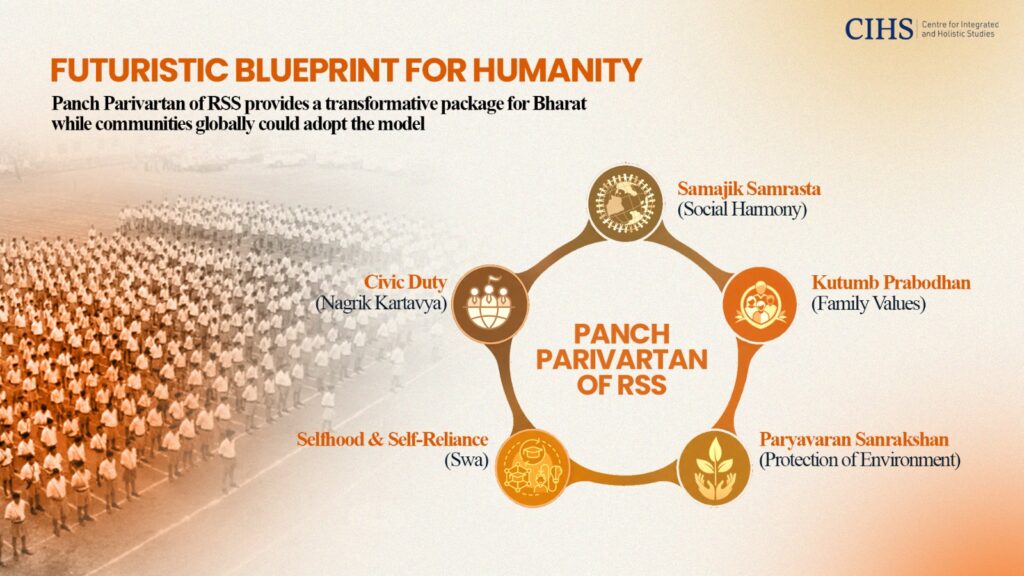
These five transformative campaigns represent collective resolutions to prepare people of Bharat to deal with futuristic challenges. By fostering essential behavioural changes, they aim to drive national renaissance and build stronger, self-reliant Bharat:
Samajik Samrasta (Social Harmony)
Pluralism is as old as the civilization of Bharat itself. It is a heritage where diverse ideas including contrarian philosophies and opposing viewpoints have not only been welcomed but have coexisted and flourished. People of Bharat are inherently seekers who engage in dialogue rather than denying or negating the very existence of others.
Samajik Samrasta programme is to promote unity and eliminate discrimination based on caste, creed or social status to build an inclusive society. In an ancient civilization like Bharat, social realignments are periodic necessity. RSS vision of social harmony begins with breaking down caste and community barriers. This is exemplified by call for Hindus to share “one temple, one well and one crematorium,” effectively erasing caste segregation at its source. While this is a prominent example, continuous efforts are being made to extend support to every section of society that feels marginalized or left behind.
Kutumb Prabodhan (Family Values)
After the individual, family constitutes the most vital unit of any society or the nation. Family being foundational unit, nurturing strong familial values, healthy dialogue within the family members and constructive cultural traditions in the household is primary objective of Kutumb Prabodhan.
Over time, the institution of the family has weakened due to various factors, facing a continuous onslaught from Western influences and those in Bharat swayed by them. RSS aims to strengthen this very institution, recognizing that a resilient family structure builds a robust society and consequently, a strong nation.
In Bharat, family values are not viewed as a form of bondage; rather, they are the cornerstone of personal growth and social stability, nurturing responsible, compassionate citizens.
Paryavaran Sanrakshan (Protection of Environment)
Today, entire globe faces the fury of nature, a direct consequence of unimpeded exploitation of natural resources. Encouraging sustainable living, tree plantation and a lifestyle that respects nature is deeply embedded in Bharat’s civilizational ethos, where the earth, rivers, seas, air, water, trees, moon and sun are traditionally worshiped.
In championing culture and civilization, RSS is simply advancing these ancient tenets that treat environmental protection as a cardinal rule of life. Through Panch Parivartan, RSS has made an “environment-friendly lifestyle” a core focus area. The message of Paryavaran Sanrakshan—saving water and using natural resources judiciously—is now transcending generations with each age group adopting its own methods to protect the planet. It represents a collective movement where different people take diverse paths toward a common cause.
Selfhood & Self-Reliance (Swa)
If there is anything that was severely eroded over past millennium, it was sentiment of Swa (Selfhood). Realizing essence of Swa is crucial; it begins with taking pride in indigenous roots, promoting local economies and embracing “Swadeshi” way of life as against western economic aggression. This is the core of being self-reliant and proudly Bharatiya.
The element of Swa extends beyond economic independence to encompass cultural self-confidence. This principle is applied through a five-fold transformative agenda known as Panchamukhi Vikas, which focuses on Swa (Self-Reliance), Shiksha (Education), Swasthya (Health), Sanskar (Culture) and Artha (Economy).
Civic Duty (Nagrik Kartavya)
The citizens of Bharat are frequently criticized for a perceived lack of civic sense, which is vital for the transformation of any society. The RSS seeks to instil deep sense of duty among citizens, encouraging them to follow rule of law, adhere to constitutional obligations and maintain social decency apart from participation in societal governance.
This also includes a citizen’s democratic duty to exercise their franchise during elections. While many people harbour cynicism toward “the system,” Panch Parivartan urges citizens to actively change the system from within instead of merely complaining.
Among the five resolutions, Environmental Protection is the most critical for survival of mankind. The immediate priority is raising awareness about vital importance of environmental conservation and educating people on how to achieve it.
As pressure on natural resources intensifies, several interventions have become urgent: protecting fresh drinking water bodies, undertaking large-scale afforestation to combat global warming, balancing oxygen levels, preventing soil erosion and eliminating single-use plastics to safeguard rivers, farmlands and oceans. The RSS seeks to address these challenges by blending traditional ecological practices with civic responsibility and community-driven movements.
The greatest immediate challenge is rapid development-linked urbanization which leaves a heavy negative footprint on the environment. Western model of development has caused maximum ecological harm. In contrast, Bharat not only talks but proposes eco-friendly development models. It also proved by achieving its initial goal of reducing emissions intensity of its GDP by 33 –35 per cent well ahead of 2030 deadline and has since escalated its ambition, targeting a 47 per cent reduction by 2035.
However, global progress on this is hindered by a long-standing schism between developed and developing nations. Many developed countries are reluctant to compromise or deviate from high-emission paths that initially secured their wealth. Consequently, developing nations are being pressured to reduce their carbon footprints disproportionately while others falter—such as the United States’ past withdrawal from climate agreements. The list of faltering nations is long.
Denying access to eco-friendly technologies and funding arrangements by the stubborn Western leadership is yet again an issue
Bharat not only abides by Paris Agreement but advocates for a sustainable development model that rejects aggressive consumerism. This model aligns with ancient Indian wisdom, which emphasizes that humanity is an integral part of nature meant to nurture the environment, not merely consume it. RSS is actively preparing citizens to adopt this mindset.
Environmental protection is now recognized as cornerstone of nation-building, for no society or nation can survive without potable water. Bharat possesses just four per cent of world’s fresh water resources to sustain 18 per cent of the global population. Therefore, water conservation is paramount. RSS volunteers are actively working to restore local water bodies, construct soak-pits in river basins and promote responsible household water management.
To combat deforestation that renders land barren, RSS volunteers conduct nationwide afforestation drives. These include community-led seed ball dispersal campaigns and initiatives where volunteers plant hundreds of thousands of saplings across the country. Additionally, the organization discourages the use of single-use plastics and thermocol while promoting eco-friendly community gatherings, recognizing that plastic waste poses the greatest threat to soil health.
RSS environmental initiatives aim to unite common citizens, farmers, students, scientists and most importantly faith leaders in the fight against climate change. Through its rural development programs (Gram Vikas Yojana), RSS trains village communities in sustainable farming, localized water management and organic waste disposal.
Furthermore, volunteers leverage local festivals and cultural traditions, such as Govardhan Puja and Tulsi Vivah, to instil an eco-friendly mindset in the younger generation. By anchoring environmental consciousness in cultural values, this initiative is transforming society and preparing citizens to be deeply sensitive to the preservation of nature.
Nothing can be more relevant for contemporary society than environmental protection for the reason that phenomena like global warming, melting glaciers, changing atmosphere, rising sea level, and all kinds of pollution are posing a serious threat to humanity.
RSS has taken up the cause for global community; others too need to wake up and join hands.
(Author is a senior journalist and associated with Centre for Integrated and Holistic Studies, a non-partisan think-tank based in New Delhi)