

After US-Iran Peace Deal, West Asia continues to burn. India has to devise long term tactics to tide over uncertainties in the region.
N. C. Bipindra
The ink had barely dried on Bürgenstock framework before bombs started falling again. Four months after US and Israel launched their war on Iran on February 29, 2026, and weeks after Washington and Tehran sat across the table in Switzerland to sign a memorandum of understanding meant to end the fighting “on all fronts,” there’s uncertainty all over. Lebanon is still burning, the Strait of Hormuz remains a flashpoint and peace deal that was supposed to calm the region has instead exposed how far apart its core players really are.
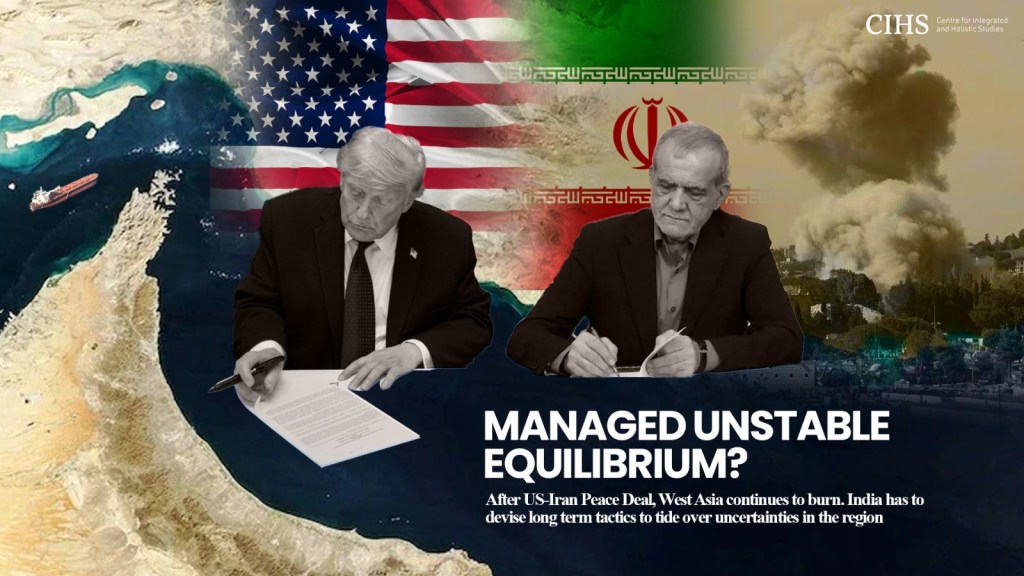
US – Iran interim agreement was billed as the moment the wider war finally ended. Iran agreed to stop blocking the Strait of Hormuz; Washington lifted its naval blockade of Iranian ports and both sides committed to 60 days of follow-on talks over Iran’s nuclear programme and sanctions relief. On paper, it looked like off – ramp the world had been waiting for since oil tankers first started getting stranded in the Gulf back in March 2026.
The problem is that MOU’s very first clause calls for a permanent end to hostilities in Lebanon, a country that was never at the table. Iran insisted on this because Hezbollah, its most important regional proxy, has been devastated by months of Israeli ground operations and airstrikes that have killed more than 4,000 people and displaced over a million Lebanese. For Tehran, protecting what’s left of Hezbollah isn’t a side issue; it’s the price of the peace deal itself. Iran has repeatedly said Israeli strikes on Lebanon “blatantly violate” the ceasefire it signed onto.
Israel sees it completely differently. Israeli officials have said openly that they view Lebanon’s inclusion in the MOU as a major concession Washington’s envoys’ handed to Iran, one Israel never agreed to. Defence Minister Israel Katz has said Israeli forces would keep operating in what he calls the “security zone” regardless of what any memorandum says and Prime Minister Benjamin Netanyahu has separately negotiated a bilateral framework with the Lebanese government, bypassing Hezbollah entirely.
That bilateral Israel-Lebanon framework signed in Washington just days ago, ties an Israeli troop withdrawal to Hezbollah’s disarmament, something Hezbollah has rejected outright. Hezbollah leader Naim Qassem called the agreement “humiliating, shameful, and a surrender of sovereignty,” and his supporters have taken to the streets of Beirut, burning tyres in protest. Even as the ink dried on that deal, an Israeli strike killed a civilian in southern Lebanon, the first casualty since the signing.
This is the trap Lebanon is caught in: its own government wants out of a war it never chose, but doing so on Israel’s terms means publicly disarming Hezbollah which Hezbollah says it will never accept “unconditionally” without an Israeli withdrawal first. Meanwhile, Israel says it won’t withdraw until Hezbollah disarms. It’s a circular standoff, and Lebanese civilians are paying for it with airstrikes that haven’t actually stopped despite three rounds of declared ceasefires since April this year.
Fragility of all this became impossible to ignore over past few days. An Iranian attack on a commercial vessel in the Strait of Hormuz triggered fresh US airstrikes on Iranian targets. Iran’s Revolutionary Guard responded by hitting American sites in the Gulf, warning that “if the aggression is repeated, our response will be broader.”
Vice President JD Vance, who had just left Switzerland after peace talks, declared bluntly that “violence will be met with violence.” Israeli drones continued striking southern Lebanon’s Nabatieh area even as Netanyahu was publicly hailing his Lebanon framework as “a historic achievement.”
In other words: the deal exists, the signing ceremonies happened and the shooting never really stopped.
For countries like India, this war was never an abstract geopolitical drama; it hit the fuel pumps and the kitchen stoves directly. Roughly 41per cent of India’s crude oil imports, 55 per cent of LNG and an extraordinary 88 per cent of its LPG normally transit the Strait of Hormuz.
When Iran effectively shut the strait in late February, India’s oil flow through that route collapsed from 2.8 million barrels a day to under 250,000, forcing New Delhi into a frantic scramble for alternatives.
India responded the way it usually does in a crisis: pragmatically, and on multiple tracks at once. It ramped up Russian crude purchases, competing head-to-head with China for cargoes. It diversified toward Angola, Venezuela, Brazil, and the UAE. It even resumed direct oil and LPG purchases from Iran after a seven-year gap, betting that Washington wouldn’t punish it too harshly for doing so.
The Indian Navy launched “Operation Urja Suraksha,” escorting Indian-flagged tankers through the Gulf rather than joining US-led naval coalition, a calculated act of strategic non-alignment.
The payoff: by June, India’s crude imports had climbed back above 5 million barrels a day, roughly back to pre-war levels, even as the geopolitical map of its suppliers shifted dramatically. But the cost was real: a weaker rupee, an Indian crude basket that spiked from $ 69 to over $113 a barrel at the worst of the crisis and inflationary pressure that touched everything from fertilisers to transport.
The deeper lesson for India and other import dependent developing economies is about exposure. A conflict thousands of kilometres away, between countries India does not quarrel with, was enough to threaten cooking gas supplies for hundreds of millions of households. That vulnerability is now feeding into longer-term decisions: faster EV adoption, push for piped natural gas over imported LPG and a renewed urgency around energy diversification that outlasts this particular war.
Is peace tenable and everlasting: not yet and maybe not soon. US -Iran deal solved the problem the world cared most about: the global energy chokepoint. But it left the problem the region cares most about — Lebanon and Hezbollah — essentially unresolved. Iran needs Hezbollah alive enough to claim it didn’t abandon its allies; Israel wants Hezbollah disarmed before it ever steps back; Lebanon is stuck negotiating its own sovereignty between two parties that don’t trust each other and don’t fully control their own hardliners.
Add to that Israel’s continued strikes, Iran’s insistence on linking any durable peace to a full Israeli withdrawal, and a US administration juggling competing factions: those pushing strategic separation of the Iran and Lebanon tracks, and those, like Senator Lindsey Graham, openly talking about hitting Iran again if Hezbollah “continues to attack.”
What’s emerging looks less like peace and more like a managed, unstable equilibrium — ceasefires that get announced, broken, renegotiated, and broken again. At the same time, the underlying disputes over Hezbollah’s weapons, Israeli troop presence, and Iran’s nuclear programme remain unresolved.
For the wider world, and especially energy-dependent economies like India, the practical takeaway is to plan for exactly this kind of prolonged uncertainty, rather than betting on any single signing ceremony being the last one.
(Author is Chairman, Law and Society Alliance, a New Delhi-based think tank, and guest columnist with CIHS)