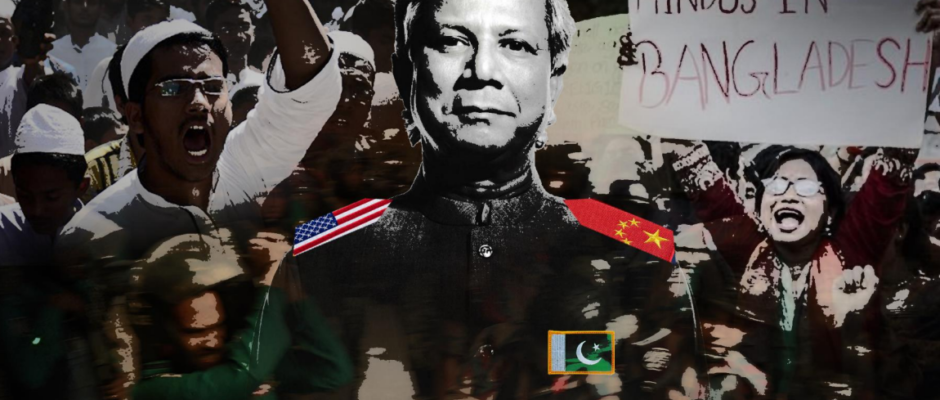
Coup, Chaos, Caliphate
Radical jihadists drawing support from influential elements in US, China and Pakistan are driving Bangladesh to anarchy, instability.
CIHS – Centre for Integrated and Holistic Studies
Radical jihadists drawing support from influential elements in US, China and Pakistan are driving Bangladesh to anarchy, instability.
Political parties, old and new, will have to measure up to expectations of Nepalese people for socio-economic development, prosperity Navita Srikant General Elections of November 2022 in Nepal saw emergence of alternate political parties besides the mainstream traditional players. Traditional democratic forces and communist ideologies were challenged by young and professional voices who advocated change. Terai Leaders continued their journey in fragments. The Elections also witnessed calls for return to Hindu Nation and Constitutional Monarchy as against the present multi-party system. “Raja aau Desh Bachau” (Oh King! Please come to save the country) was popular with youngsters. It has been eighteen months since 2022 elections and political uncertainty as well as chaos has become the new normal. If there be one line to sum up the mood amongst citizenry, it would be the desire to seek change from prevailing status quo. Youth continue to be a frustrated lot given that the education is redundant and does not land them in jobs. Women struggle to make their voice heard and be represented in decision making within a regimental patriarchal society while businesses struggle to deal with liquidity crunch. They see little hope even in clearing public borrowings made during global pandemic Covid19. Entrepreneurship across Nepal is on the deathbed as there’s no supportive ecosystem. Amidst this social and economic unrest in Nepalese society, one had hoped for political stability to address these lingering issues. But, the mainstream parties as well as new political formations could barely sustain the momentum of growth and development. Instead, they got pre-occupied with power sharing permutations and combinations. In the meanwhile, forex reserves swelled only due to increased remittances. But, increasing conflict and war situations around the world exposed vulnerability of remittances-based economies like Nepal and amplified the need for more stable policy frameworks. On domestic front, Nepal was hit by high profile policy related corruption that seriously dented the image of political parties. Bhutanese Fake Refugee Scam of transnational nature incriminated high ranking politicians, former ministers and bureaucrats. Policy linked corruption in cases as Giri Bandhu Tea Estate, Lalita Niwas Land scam and Cooperative sector irregularities are classic cases of amending rules, regulations to enable non-state actors from taking advantage to benefit chosen private entities at the cost of the Exchequer. Similarly, Maoist Cantonment scam is another case to use state coffers to pay the parties’ supporters. It wouldn’t be an exaggeration to state that the strongest and only nation state in South Asia that was never colonized is being plundered and looted by its own political leadership and more so under the new three-tier federal system. In the recently released, sixty first annual report of the Office of Auditor General of Nepal, it is stated that 171 local level units under Local Government have spent Nepali Rs 9.15 crores in salaries for appointment of personal secretaries and advisors for which there is no provision in provincial laws. Additionally, the report pointed out irregularities in procurement and implementation in projects managed by Nepali Police and Security Forces. Nepali Army’s name was embroiled in cases of procurement irregularities in Kathmandu Terai Fast Track Project (KTFT Project). In a recent case, there was an uproar in arrest of Kailash Sirohiya, the chairman of Kantipur Media Group (KMG) over his citizenship credentials. In brief, the citizenship number allotted to Sirohiya was previously set aside to one Shivaji Sahu Teli. Sirohiya had obtained citizenship by descent in 1979 and renewed his citizenship card in 2000. The confusion with citizenship numbers and two persons being allotted the same number appears to be an issue of institutional capacity at local administrative units. What was surprising that local authorities jumped the gun and arrived at his offices to arrest in broad daylight instead of serving show cause notice to Sirohiya for explanation and in parallel conducting their own review of files and archives? KMG is one of the leading Media Groups in Nepal. Recent news stories in KMG on irregularities and unlawful gains reportedly made through four cooperatives by Rabi Lamichhane, Deputy Prime Minister and Minister of Home Affairs may have served as immediate provocation to question Sirohiya’s citizenship. Developments leading to arrest and thereafter national uproar, calls for solidarity with KMG’s Sirohiya and demands to end pressure tactics to prevent free press and freedom of expression hogged headlines. Leading opposition party, Nepali Congress including some of the leaders of the existing coalition condemned use of undue force and pressure by the Government for what seemed like a procedural inquiry and could have followed its due course without having to flex muscle. Coalition Government leaders remained mum to save the government from a free fall. Prime Minister Pushpa Kamal Dahal ‘Prachanda’ recently stood for his fourth ‘Vote of Confidence’ in just18 months, three times by swapping coalition partners and once due to break-up in Janata Socialist Party (JSP), the coalition partner in the third time government. Rather than rainbow colours of sectoral development, growth plans and progress, Nepal’s canvas on domestic affairs reflect predominance in dark colors of coalition politics, corruption and vendetta politics, financial irregularities surpassing past numbers due to three-tier political administrative structure. Investment Board of Nepal put in huge efforts to organise a high-level Nepal Investment Summit with over 800 foreign delegates and 2500 domestic leaders. The summit rightly created positive buzz and provided a platform for networking and collaborations. Summit participants were rather unanimous that ‘Emerging Nepal’ is ready for foreign investment. But, one silently noticed that a shiver went down the halls of the Summit in desperate search for domestic political leadership with spine. It is now imperative that the shiver doesn’t end looking for a foreign spine with attractive offers and hidden caveats in between the lines that can end up ruining the economy. Nepal is still sitting with exposure of Chinese defunct aircrafts (which were rejected by Bangladesh but bought by Nepal) and Pokhara Airport Loan. While Chinese leadership stated Pokhara Airport to be part of BRI Project, then Nepali Government clearly stated that
Rohan Giri US State Department’s annual human rights report for 2023 on Bharat (India)[1] appears to have lost credibility in its assessment of human rights incidents. It’s latest edition brings forth numerous significant issues that necessitate a response. Unfortunately, the report’s depiction of Bharat’s human rights landscape suffers from a noticeable agenda, undermining its own integrity as an self appointed, global evaluative agency. The report draws on sources that are both unreliable and ambiguous, including media reports and statements from NGOs, which fail to comprehensively represent the human rights situation in Bharat. Such sources lack the depth required to understand the nuances and recognise progress in these areas. Moreover, numerous instances of factually incorrect or misleading data undermine the report’s credibility and distract from addressing legitimate human rights issues that demand serious consideration. Furthermore, the report’s methodology of aggregating data over extended periods, sometimes spanning more than five years, distorts the current state of affairs. It is perplexing why the report does not focus on the human rights conditions of a specific year, rather than a cumulative period. This approach to data aggregation skews perceptions and hinders a true understanding of the present conditions and the improvements made. These significant flaws necessitate a rigorous review and response to ensure that discussions about human rights in Bharat are based on accurate, timely, and contextual information. This rebuttal aims to correct these misconceptions, provide relevant data, and offer a nuanced perspective that accurately reflects both the ongoing challenges and the significant advancements of Bharat. While the report contains several misrepresentations. However, for the purpose of this rebuttal, we are highlighting a select few to assist the US state department in re-reflecting on its sources, information, and overall presentation. Section on Arbitrary Deprivation of Life and Other Unlawful or Politically Motivated Killings reported, “On July 31, media reports stated security official Chetan Singh killed his senior officer and three men who identified as Muslims on a train near Mumbai, targeting them based on their appearance.” The family members of the three men called the incident “a hate crime” and “an act of terror” based on the hate speech Singh used against the three men before he shot them. Police arrested Singh on the same day.” Report frames the incident in a way that suggests two Muslims, who unexpectedly died in this accident, were targeted because of their faith. However, conversations with those close to the situation narrate a different story. Ghanshyam Acharya, who was on duty with Chetan, provided further context in his statement to the Railway Police, recounted that shortly after their duty started, he observed ASI Meena mention that Chetan was running a fever and still had two hours of duty ahead.[2] However, the manner in which the US Human Rights Report represents the incident raises serious concerns about the accuracy of its sources and the integrity of its presentation. The same section asserts that the deaths in regions like Jammu and Kashmir and those affected by Maoist terrorism are fault of Indian security forces. Nevertheless, it is a fact that Pakistan backed terrorists and Naxal Maoist terrorists pose the most substantial threat to both the development, peace and security of the region. It is also a fact that the Indian Security forces have carried out several operations against terrorists, often suffering heavy casualties in their pursuit of protecting their motherland and its habitants. To put things into perspective, website of the Office of the UN High Commissioner for Human Rights was updated on March 24, 2023, with the headline “India: UN expert demands immediate end to crackdown on Kashmiri human rights defenders,”[3] in which UN Special Rapporteur Mary Lawlor talks about those who illegally concealed their original identity, supported terrorist activities, and furthered their cause. Mary Lawlor should understand that her job is to defend rights, not crimes. Lawlor previously directed the Irish chapter of Amnesty International from 1988 to 2000.[4] In several instances , Lawlor has violated the UN code of conduct by agenda driven narrative building, especially about India, a sovereign and respectable UN member state. Furthermore, the U.S. State Human Rights Report details that ‘on October 31, the Supreme Court announced it would hear the bail plea of student and human rights activist Umar Khalid on November 22, which was then adjourned to January 2024. Khalid has been repeatedly denied bail since his 2020 arrest under the Unlawful Activities (Prevention) Act (UAPA).’ Despite international and local activists demanding Khalid’s release, citing his arbitrary detention without trial since 2020, the report fails to mention significant details. For instance, Khalid’s counsel requested seven of the fourteen adjournments during his Supreme Court hearings. Furthermore, the public prosecutor pointed out during the bail hearings that Khalid often creates narratives in the media and online. It is also noteworthy that Khalid, described in the report as a ‘student and human rights activist,’ is the son of Syed Qasim Rasool Ilyas, a former member of the banned terrorist group Students Islamic Movement of India (SIMI). Khalid is accused of being a primary conspirator in the 2020 anti-Hindu Delhi riots, which resulted in significant legal charges against him. The U.S. State Department’s report, perhaps naively, seems to undermine the judiciary of a sovereign state and a key U.S. partner. Such an approach is safely viewed as a misuse of state department resources to further specific agendas, particularly concerning India. The Human Rights Report inaccurately used the killing of Canadian Terrorist Hardeep Singh Nijjar to propagate the notion that the Indian government is engaged in global repression. It notes, ‘On September 18, Canadian Prime Minister Justin Trudeau announced that his government was investigating allegations linking Indian government agents to the killing of Sikh Canadian citizen Hardeep Singh Nijjar, who had been designated as a terrorist by India and advocated for the creation of an independent Sikh state, Khalistan. The Indian government has denied any involvement. However, this portrayal overlooks significant details. Canadian Prime Minister Justin Trudeau’s allegations of Indian agency involvement were made
It’s time to celebrate Nari Shakti (women power) and remarkable strides made by them even as we celebrate International Women’s Day. From ancient times to present day, Bharatiya women have been an integral force in shaping Bharat’s rich culture and society. Their contributions span every walk of life and their indomitable spirit continues to inspire and propel Bharat’s progress. From farming, sports, technology to space odysseys, there’s hardly a field that women in Bharat have not influenced. In today’s age of Artificial intelligence and robotics, Bharat’s women are set to become “drone didi’s” (A sister that can operate drones) in rural Bharat. The steady ascent of women in owning assets and their growing influence in the socio-economic realms of India is a development that rightfully commands global admiration. (Article is written by Triveni Kaul, a Professional Content Writer)
In aftermath of India’s independence and subsequent Partition of earstwhile British occupied India, Princely States were vested with the prerogative to decide their accession to either the dominion of India or Pakistan, contingent upon geographical coherence as per Indian Independence Act of 1947. This foundational principle was disrupted on the night of October 22/23, 1947, when Pakistani army along with its rallied tribal raiders initiated a forceful assault on the Princely State of Jammu & Kashmir. Subsequently, Maharaja Hari Singh formally acceded to the dominion of India on October 26, 1947, prompting deployment of the Indian army. Read More….
Over the years, Banbhoolpura in Haldwani has shot to fame as a centre for Islamist extremism. Recent history of extremist activities came to fore with violence unleashed on a police station and public transport in 2019, attacks on COVID19 healthcare personnel in 2020 and assaults on Hindus in 2022. The islamist gangs’ ties with drugs and crime apart from violence is a heady mix remenescent of Hollywood thrillers.
RSS message of unity transcending caste, creed, gender, region and faiths will strengthen Bharat’s social fabric, signal global leadership role K.A.Badarinath ‘Reconciliation, security and peace’ are what Hindu centric Rashtriya Swayamsevak Sangh (RSS) Sarsanghchalak, Mohan Bhagawat articulated while delivering his annual Vijay Dashami speech at the organization’s headquarters in Nagpur. This is at variance with ‘radicalism’ and ‘fundamentalism’ sought to be attached to Hindus and RSS by self-styled ‘liberal minds’, conspiracy theorists and those opposed to Bharat’s unity. RSS chief’s Dussehra speech is widely recognized in Bharat and internationally as firm indicator of the organization’s outlook towards issues, happenings and unfolding developments on socio-economic and political front. ‘Sulah, Salamati & Aman’ is what Mohan Bhagawat pushed for with diverse communities that form larger Bharat’s society. Bhagawat appealed for reconciliation, security and peace as against discord, strife and violence (Fitna, Fasad & Kitan) to realize vast breadth of unity in diversity that Bharat’s 1.4 billion population is known for since millennia. Use of Arabic and Persian root words by RSS chief to drive home the point of unity rising above differences seems a firm signal to over 210 million Muslims in India and their counterparts around the world especially the Sunnis that eye RSS and Hindus with suspicion and distrust. His reference to Christians and other minorities that may have differences with Hindus is again significant given ‘tolerant, embracing attitude’ of Bharat’s citizens to all those that made this country their home. There was very little or no mention of RSS chief’s reconciliatory note in Bharat’s media or dispatches of foreign writers. Forging unity by rising above selfish and divisive tendencies disrupting Bharat’s growth seems to be central theme of RSS chief’s speech. RSS appeal for forging unity as ‘mantra’ is refreshing and assuring given the false propaganda unleashed by Bharat’s rivals on reported Muslims ‘genocide’ or Christians being targeted post-2014. A couple of Christian and Muslim organizations have being propagating globally on their being targeted by RSS, BJP and Modi Government, in that order. Sangh chief spoke for his organization unequivocally and plain terms that RSS does not believe in such an agenda. Playing victimhood, looking at each other with suspicion and seeking political dominance have been identified as three big evils that come in the way of achieving unity. RSS chief also made it clear that his push for unity did not tantamount to ‘ceasefire’ between the so called warring parties. It was RSS chief’s way of reflecting on cultural continuity, unity and vast diversity. Rightly so, RSS targeted ‘cultural Marxists’ and ‘woke’ that have sought to dominate the narrative and peddle confusion, chaos and corruption’ through deceitful means to meet selfish ends and discriminatory in attitude. RSS chief came down heavily on these elements that promoted anarchy and indiscretion in public life as individuals and groups. A lot of what Mohan Bhagawat said makes sense when one looks at disruptive campaigns, ‘tool kits’ and physical demonstrations that are done by anti-Hindu conglomerations that are indoctrinated by misplaced Marxism, jihad, evangelism and of all extremism and violence that breed divisiveness. Case in point is the aggressive, violent and extremist minority Khalistani elements in otherwise calm and quiet larger Sikh community. These vocal groups and individuals, not very large in numbers in Bharat, UK, US, Canada and Europe have threatened to derail perception about Bharat globally. Line of conciliation and message of unity propounded by RSS chief Mohan Bhagawat is significant given that Bharat is celebrating 75-years post adoption of the country’s constitution and in a year or so, RSS turns 100-years old with rich legacy of its founders Dr Keshav Baliram Hedgewar and his successor, Madhav Sadashivrao Golwalkar. Sangh’s message of unity cannot be more apt given the challenges that Bharat faces within and outside as a country and ‘classical civilization with rich heritage. It’s no denying that this unity should also be the driving force for Bharat to provide leadership globally especially after an eventful G-20 Presidency, forging bilateral and regional pacts with equanimity at centre. RSS chief seems to have exercised huge restraint in his commentary on the Russian onslaught of Ukraine and Hamas terror attack on Israel that have led to ‘conflicts’ which will have disruptive impact on humanity and economic recovery that’s nascent post-Covid 19. Briefly, RSS chief referred to basic tenets of Sanatan Dharma as the guiding principles that shaped Hindu way of life. He seems to have exercised a lot of restraint in calling out the likes of Tamil Nadu’s first political family that view Sanatan Dharma as ‘dengue’ and ‘malaria’ to be weeded out. One issue that’s dear to Hindus on which RSS chief came out unambiguously is ‘grand’ Ram temple to house Ram Lalla at Ayodhya whose consecration has been scheduled for January 22 next year. RSS and likeminded organizations view Ram temple as a ‘unifying factor’ for all citizens in Bharat transcending castes, creed, sex, region and faiths. His call for holding programmes that send out a strong message of unity across Bharat and globally is extension of his extrapolation to rise above narrow mind-set. (Author is Director & Chief Executive of New Delhi based non-partisan think tank, Centre for Integrated and Holistic Studies)
Policymakers, legislative bodies and city councils in US may have exercise more vigilance against divisive manipulative agendas and be compassionate, sensitive to supporting minority Hindu community that seeks to protect Sanatan dharma based values that propagate an inclusive and all pervasive, peaceful, progressive and prosperous America ….. read more
Latest reshuffle in his council of ministers may not have addressed concerns on Canadian soil becoming fulcrum of anti-India elements Rohan Giri Canadian Prime Minister Justin Trudeau has recently reshuffled his council of ministers ahead of the upcoming general elections. This reshuffle involved making change of portfolios and work responsibilities of ministers along with four Indo-Canadians. As Canada reconfigured its leadership, discerning and assessing its implications for the country’s partners like India becomes pertinent. Evolving political dynamics in Canada and resulting strategic adjustments warrant careful consideration in the global arena. In specific, four Indo-Canadian ministers’ responsibilities were changed or promoted: Anita Anand, Kamal Khera, Harjit Sajjan, and Arif Virani. Notably, Anita Anand was promoted as President of Treasury Board, transitioning from her previous role as the Minister of National Defense. Similarly, Kamal Khera moved from a senior portfolio to become Minister for Diversity, Inclusion, and Persons with Disabilities. Harjit Sajjan, having served as International Development Minister, now holds the position of Minister for Emergency Preparedness. Arif Virani, another Indian-Canadian and the representative of Parkdale-High Park in Toronto made his cabinet debut as the Minister of Justice and Attorney General. Understanding their influence and engagement within the sizeable Indo-Canadian community and Indian affairs becomes crucial owing to the significant role overseas Indians play in influencing New Delhi’s relations with Ottawa. Professor-turned-politician Anita Anand is particularly vocal about her Indian heritage taking immense pride in her grandfather, freedom fighter VA Sundaram, who worked alongside Mahatma Gandhi during the freedom struggle. Anand’s involvement extended to assisting the panel in investigating tragic 1985 Air India Kanishka bombing. On 35th anniversary of the bombing, she tweeted, “The victims of the bombing of Air India 182 and their families are in my thoughts today and always. I am privileged to know some of you and honour the memories of your loved ones with you.” Anita Anand also held a position on advisory board of the Canada India Foundation, an organisation established in 2007 to bolster bilateral ties. During the cabinet transition, Kamalpreet Khera, representative for Brampton West in the House of Commons has taken on significant role of Minister for Diversity, Inclusion, and Persons with Disabilities. Khera’s Indo-Canadian background goes back to her ancestors from Ropar in Punjab. She is known to have close ties with Navdeep Bains, a former Canadian politician who served as Minister of Innovation, Science, and Industry during 2015 – 21. There have been reports pointing to strong links Navdeep Bains has with Khalistani movement. Bains has allegedly been groomed by World Sikh Organization (WSO), a pro-Khalistan hard line organisation accused of radicalizing Sikh community and fostering divisions apart from piloting anti-India propaganda. Relationship between Navdeep Bains and Kamalpreet Khera is said to be more than just acquaintanceship. Bains is regarded as mentor and guide to Khera. Indian authorities have expressed their concern to the Canadian government multiple times regarding separatist activities on the latter’s soil. Prime Minister Trudeau’s cabinet reshuffle also sparked reports on Harjit Sajjan, his association with Khalistani elements and his tacit support for their radical activities. Hitherto Punjab Chief Minister, Captain Amarinder Singh had publicly ostracised Sajjan as a “Khalistani supporter”. Singh had been a proponent of imposing sanctions on Canada for its ‘open and covert’ support to Khalistani terrorists. Captain Singh had called for global pressure on Canada to prevent the use of its soil for perpetrating terror against India, particularly the Sikh community targeted by Khalistani terrorists. Reports pointed to Harjit Sajjan’s parents, Kundan Singh Sajjan and Vidya Kaur Sajjan’s long term membership of WSO. Another notable Indo-Canadian that figured in the latest cabinet reshuffle is Arif Virani, who spent 15 years as human rights and constitutional lawyer before entering politics. Virani is vocal about purported Islamophobia and remained deeply committed to the trumped up issue. Since his initial election, he consistently advocated against Islamophobia, both on the ground and within the Parliament. Notably, he sought inputs from Muslim groups on how to tackle online hate faced by Muslims before Liberals introduced Bill C-36 in June 2021. Primary objective of this bill was to combat online hate with focus on addressing Islamophobia that Virani thinks is prevalent. Arif Virani was involved in a study on M-103, a non-binding motion in the 42nd Canadian Parliament urging the government to condemn Islamophobia and all forms of systemic racism and religious discrimination. Additionally, he is associated with the Aga Khan Foundation of Canada, an organisation working in various countries. The foundation faced accusations of involvement in money laundering Canadian Prime Minister Justin Trudeau’s decision to include Khalistani and Pakistani jihadist elements in his council of ministers may not go well with New Delhi. Comprehensive research conducted by veteran journalist Terry Milewski titled, “Khalistan: A Project of Pakistan” unequivocally demonstrates that the Khalistan movement poses not only a threat to India but also significant concern for Canada. Prime Minister Justin Trudeau’s undeniable link with anti-India elements underscore the risk it poses to bilateral relations and global security environment. (Author is operations manager at Centre for Integrated and Holistic Studies, non-partisan think tank based in New Delhi)
Not just freedom to write and report by media professionals, globally threat to live freely and practice one’s Dharma is under attack K.A.Badarinath “Freedom is the goal of the universe. Nor love nor hate nor pleasure nor pain nor death nor life nor religion nor irreligion: not this, not this, not this.” This was one of the most comprehensive definitions to freedom provided by revered Swami Vivekananda, India’s greatest monk, Hindu philosopher in a letter to one Church sister Mary Hale on June 26, 1895. Freedom to write, think, interpret and see life as such is the essence of human life. And, this freedom is all the more significant in the context of press globally that routinely is at the receiving end for having spoken the truth or exposed inhumanity. From Syria, Russia, United States, United Kingdom to European geographies, freedom to responsibly write has been constantly under attack with no reprieve for reporters of media outlets, be it print, broadcasting corporations, radio or digital networks. In the name of region, religion, caste, creed, sex and otherwise, violence in all shades and hues is perpetuated without reprieve. It happens more so in the trumped up liberal societies internationally. Discussing freedom on international press freedom day becomes also pertinent as on this very day United Nations took upon itself 30 years back to protect freedom for media to report fearlessly on happenings across the globe. Well, in these thirty years, globalization and corporatization of media that was hitherto a commitment and conviction to societies and communities has made discharging this responsibility all the more difficult. Cutting edge technologies like artificial intelligence, machine learning and robotics has given a new dimension to media that’s real time, hard to regulate and many a time sans responsibility. Discussing freedom makes sense when it’s exercised with responsibility. Political establishments, security agencies and terror groups have many a time seen free media as biggest hindrance to achieving their ulterior goals. For instance, Neither President Xi Jinping of China nor his Chinese Communist Party been a great votary of press freedom. Given a single party rule, the rigour of communist regimes made periodic attempts to even restrict human thinking, behaviour, families or even procreation. Same is the case with another military style communist regime led by President Kim Jong Un. These two are classic cases of turning respective communist parties into family enterprise or solo. Even in the most celebrated liberal democracies, freedom to live on one’s terms is skewed. Otherwise, there’s no plausible explanation for hatred heaped on minority Hindus either in US, UK, Canada, Australia or elsewhere. Constantly being targeted either in Columbia, California or elsewhere like Leicester in UK does not guarantee any freedom to even live, practice one’s ‘Dharma’. In countries run by religious fascism of extreme variety exemplified by Taliban in Afghanistan, military establishment in Pakistan, grooming gangs of UK and IS run Caliphate in Syria, threats to freedom is too grave to even discuss, decipher or interpret in saner terms. Gone are the days that hailed liberty, democracy and freedom centric slogans in these very countries. Constant threats to life, living spaces and eking out an earning honourably has become the basic issue in most of these ‘liberal minded’ societies that lecture the globe on freedom of every variety beginning with media to religion. A quick look in the mirror would reflect realities of life in these touted liberal democracies that time and again taken upon them to ostracise others on these very issues. Periodic reports dished out by USCIRF including latest speaks about non-availability of religious freedom in India. While credibility of this report or the team that trashes India needs to be called out, does this organization even recognize what’s happening in its own back yard? Gun running and violence related crimes due to factors like skin colour, religious faith or even the physical build of an individual is something the ‘most liberal democratic’ leadership in US refuses to even recognize. As per a last week’s BBC report that quoted not for profit organization, the Gun Violence Archive, there have been 160 mass shootings in United States so far in 2023. This report also puts the figures for mass shootings at 600 in each of the three preceding years. While freedom to live fearlessly is under threat, press and media freedom is a wee-bit complicated in both UK and US where lobbies, technology companies and access to information highway determine as to what messages are delivered to readers or narratives woven in conversations that are completely slanted and uni-focal. Freedom to live and report is definitely under threat. Threat perceptions have undergone a sea change. There’s no way any group, community or Dharmic people that can live unhindered. This may have to be recognized by all stakeholders. A global consensus on achieving freedom on different planes must be achieved. Lip service to freedom is like lip syncing in music. It’s not real. (author is Director & Chief Executive at non-partisan think tank, Centre for Integrated and Holistic Studies based in New Delhi)