
CIHS – Centre for Integrated and Holistic Studies

Date/Time:

Strategic Autonomy, Balancing Powers

Indo-Russian summit strengthened special & privileged strategic partnership. India offers to play role of a peacenik in Ukraine conflict Dr. Punit Gaur Indian Prime Minister Narendra Modi’s two day visit to Russia has been watched keenly across world capitals. Especially so, given that it is the first bilateral engagement of Modi in his third term and it coincided with North Atlantic Treaty Organization (NATO) summit in Washington DC. Modi’s Russia visit to participate in the twenty second annual summit of India and Russia invited sharp reactions from Indian allies and foes alike. From US, European Union to Ukraine, there were comments on what Prime Minister Modi should be doing in Moscow. The Moscow summit is a first after President Vladimir Putin’s visit to New Delhi in 2021 and this engagement has come in the backdrop of ongoing conflict on East European front with Ukraine. Perhaps, global leaders expected serious talks between Modi and Putin that paved for a swift and organic end to the bloody conflict in Ukraine. To their great comfort, Prime Minister Modi did not let them down, Modi made serious attempts to counsel and convince President Putin that peace in the region was not possible with blood on hands. At the same time, Modi played a balancing act not to annoy his host in Moscow who spent most of the two days with Indian Prime Minister. On its part, Keiv expressed its disappointment on Modi’s visit to Moscow though President Zelensky is fully aware of Bharat’s position vis-à-vis Russia. Resilience in relations between the two partners who have evolved relations despite challenges may not have missed Zelensky while stating the obvious on Modi’s Moscow visit. Even White House and European Union may have known the inseparable strategic relations between Bharat and Russia. Several firsts marked Prime Minister Modi’s visit to Moscow. The milestones crossed during the visit underscore profound significance attached to this bilateral engagement. Russia’s highest state decoration, the Order of St Andrew was bestowed on Modi that may not go well with India bashers. This award signifies PM Modi’s efforts to cultivate bilateral relations between India and Russia. In 2000, India took the initiative to commence the cycle of annual summits between two countries at highest level. The tradition of having structured high-level discussions has been easily recognized by both sides as a way to take the bilateral relations to next level each time. India-Russia trade has seen an unprecedented surge to more than US $ 65 billion in 2022 owing to diverse products and services and there’s no denying the fact that energy constitute a big chunk of this bilateral transactions. India’s continued oil and gas dealings with Moscow have not gone well with the Western powers. US $ 100 billion bilateral trade targeted in six years during Modi’s visit is yet again a milestone that can be easily achieved. In recent years, Russia’s Far East and Arctic have drawn India’s attention as possible strategic investment sites. Though national currencies account for 60 per cent trade between India and Russia, the urgency for quicker and more real-time settlement of transactions is growing, especially in backdrop of Russia that got delinked from SWIFT ecosystem. Ignoring the unilateral sanctions on Russia and threats from US, India has not only maintained but strengthened its diplomatic and commercial ties with Moscow. These ties fraught with challenges and underscores the need for more diversified trade. Additionally, India has increased military collaboration with Russia announcing plans to work together on weapon manufacture, joint deployment of troops, vessels and fighter jets and access to military installations. India and Russia call on visa-free travel would significantly boost tourism and people-to-people connectivity. The move to allow students and visitors to use national currency, clearances for MiR cards in India and RuPay cards in Russia is again a significant first. The proposal to open two more consulates in Russia underlines the importance of economic and cultural ties and holds the potential for further economic growth.   Bharat’s decision to go ahead with ‘strategic autonomy’ on multilateral issues is what most allies have been trying to come to terms with. When Modi and Putin spoke at Uzbekistan in 2022 during Shanghai Cooperation Organisation (SCO) conference, he reportedly told the Russian president, “This is not the time for war.” This stance was reiterated during Modi’s Moscow visit while amplifying Bharat’s policy framework. India adopted an autonomous neutral stance regarding Ukraine and did not sign a joint communiqué at the Switzerland Summit last insisting on conditions for participation of all parties including Russia for lasting peace. Upholding UN Charter’s tenets, especially concerning value of preserving national sovereignty and territorial integrity was also insisted upon in Switzerland as well as Russia now. India firmly rejected the idea of using force to settle disputes. Peaceful negotiation and diplomacy are the most critical approaches for all disputes and this position reflected in Modi’s engagement with Russia. One significant development is Bharat’s willingness and commitment to offer a platform and play the role of a mediator for the peace process has again come to fore. At the same time, Bharat has emphasized that Russia should guarantee safety and repatriation of its citizens who are employed by Russian military ever since the conflict between Russia and Ukraine began. President Putin’s ready agreement on this request is a significant take away from Moscow. Russia seeks to create a multipolar world order and India vying for for a key role among Global South countries regard one another as crucial political allies. Russia continues to be an essential supplier of weapons, energy and space technology, all of which India views as necessary for its transition to become a major developed country by 2047.  Modi’s trip to Russia not only demonstrates New Delhi’s intention to grow ties with Russia but underscores the potential for significant mutual benefits and the importance of India’s strategic autonomy. (Author is a Research Fellow at Indian Council of World Affairs with focus on Eurasia)

Read More

Embracing Bharat’s Ancient Health Wisdom

Pummy Pandita Introduction With about $800 million in revenue, India has surpassed the US to become Herbalife’s largest market, marking a dramatic shift in the company’s operations. This significant achievement highlights the rising demand in India for wellness and health products and offers a propitious moment to investigate the possibilities of traditional and age-old medical techniques for promoting Bharat’s natural, holistic approaches to health and wellness, especially in light of the market dominance of Western manufactured and processed health products. Global nutrition giant Herbalife has been a major force in the health and wellness sector for a long time, thanks to its line of health products, meal replacements, and dietary supplements. The foundation of Herbalife’s success is its assurance of health and wellbeing through processed goods and vitamins. Manufactured supplements and processed goods are the main features of the Western health and wellness market. These consist of several kinds of dietary supplements, protein powders, meal replacement drinks, and vitamins. These goods may be more convenient and have specific nutritional advantages, but they frequently don’t follow the holistic perspective on health that views the body, mind, and spirit as interrelated beings. Furthermore, these items’ extensive processing and artificial composition result in unfavourable side effects and long-term health issues. This situation offers a chance to investigate alternatives that prioritise all-natural, holistic approaches to wellness. Traditional foods and yoga, among other old Indian health and wellness techniques, offer a powerful counterpoint to the Western industralised & processed health and wellness industry. Bharat’s Ancient Health and Wellness Practices Unlike the Western method, Bharat provides a plethora of natural health and wellness remedies because of its rich legacy in Ayurveda, traditional foods, and yoga. These methods offer a strong substitute for Western artificial and processed goods by emphasising balance, holistic health, and natural elements. Ayurveda: The Science of Life 5,000-year-old Ayurvedic medical system focuses on balancing the body’s energies (doshas) through lifestyle changes, herbal treatments, and food. Important elements consist of: Traditional Foods Traditional foods of Bharat offer a balanced approach to health and are a nutritional goldmine. These foods are high in natural components and frequently undergo minimum processing. Important elements consist of: Yoga: The Path to Holistic Wellness An essential component of Bharat’s cultural legacy, Yoga provides a holistic approach to well-being through physical postures (asanas), breathing techniques (pranayama), and meditation. Yoga has numerous established advantages, which include: Bridging the Gap: Integrating Ancient Wisdom with Modern Needs A balanced approach to wellness can be provided through the fusion of traditional Indian medical methods with contemporary demands. Important tactics consist of: By adopting Bharat’s age-old wellness and health practices, we can offer an effective substitute for the manufactured and processed goods that rule the Western health market. In addition to promoting physical health, this holistic approach also fosters mental and spiritual well-being, leading to a more all-encompassing sense of wholeness. Bharat has a potential to completely transform the field of health and wellbeing by investigating and validating these age-old methods and offering long-term, all-natural solutions. Closing Observations: Bharat’s age-old health and wellness practices present a hopeful alternative as the world struggles with the negative effects of processed and manufactured health goods. By utilising the holistic advantages of yoga, the nutritional value of traditional foods, and the wisdom of Ayurveda, we can create a more balanced and health-conscious lifestyle. Adopting these habits can improve one’s own health as well as contribute to a more equitable and sustainable global health system.   (Author is operations head at Centre for Integrated and Holistic Studies, a New Delhi based non-partisan think tank)
Read More

Identity in Flux: Understanding Complexities of Self-Perception

Balbir Punj While speaking in Lok Sabha on Monday (July 1), Rahul Gandhi issued a proclamation, “Aap Hindu Ho Hi Nahin” (You are not Hindu). The diatribe was undoubtedly directed against the Bharatiya Janata Party and the RSS, including Prime Minister Narendra Modi, his cabinet colleagues, fellow members of both houses and millions of voters and supporters of the saffron outfit. Rahul’s profane rant smacked of three things— his sense of entitlement, ignorance of Indian ethos and outright contempt for democratic norms. Can Rahul or anybody else decide who is a Hindu or not? During the just concluded Lok Sabha polls, 23.59 crore Indians had voted for the BJP. There would be millions more who support the BJP but couldn’t vote for their favourite party for various reasons. Without a doubt, overwhelmingly, they identify themselves as Hindus. In a jiffy, Rahul stripped them of their faith and identity! Who can dare make such a condescending statement? Only someone with an acute sense of entitlement. Unlike Abrahamic religions, Hinduism is timeless (hence also Sanatan), catholic and pluralistic. There is no centralised authority in Hinduism, and none has any right to pass such edicts regarding the faith. However, Abrahamic faiths are different. The Ahmadiyya sect in Pakistan has been shunned from Islam, and its followers are routinely persecuted because their belief system, differs a little from the mainline Shia-Sunni doctrine. These two sects are also perpetually locked in internecine wars because of their conflicting theological beliefs. Ironically, Ahmadiyyas were at the forefront, along with the Communists and Muslim League, in striving for an Islamic Pakistan. Doesn’t Rahul somewhat sound like a Pakistani establishment when he decrees in Lok Sabha who is a Hindu and who isn’t? During his one-hour 40-minute speech, Rahul also observed, “Those who call themselves Hindus indulge in hatred, violence and untruths 24×7.” Can anyone, including Rahul, make such an acerbic statement about Islam, or any other faith? Don’t miss the contradiction. After suspects are identified following a terror episode anywhere in the world, the usual comment is: a terrorist has no religion. The perpetrators of terror, however, insist that they caused the mayhem as a part of a divine mandate ordained by their faith. Rahul’s scalding allegations against Hinduism are without any basis whatsoever. He can get away with this charade because of the immunity members of Parliament enjoy. In their entire history, Hindus have resorted to violence only to defend themselves. Hinduism is inclusive and has in its fold numerous traditions, all equally valid – ranging from devout idol worshippers to outright heretic atheists. Anyone who cares to call oneself a Hindu is a Hindu. Rahul spoke about violence and hate. Given his track record in this respect, he sounds sanctimonious? While Rahul argues against the two evils, he happily promotes divisive narratives and conveniently allies with those very forces that seek to divide Indians based on caste, region and faith. Reducing Indians to sheer caste identity was central to his election campaign. Hate and divisiveness, the bane of India, have been introduced into its socio-economic-religio-cultural life by alien creeds. Use of violence and or deceit are a part of their playbook while dealing with non-believers or dissent within their ranks. Uniformity, particularly in matters relating to faith, is central to their existence. In contrast, Indian ethos indifferent to uniformity, focuses only on harmony. Who ceded one-fourth of India (August 1947) to the forces of Islamic fundamentalism, where only hate and intolerance rule? Pakistan is not just a country; it’s a bigoted idea that transcends borders. Recall 1980-90 when Pakistan trained, and funded terrorists, with local help, hounded Kashmiri Pandits, out of their ancestral homeland. In a recent interview, the newly elected National Conference Member of Parliament Aga Syed Ruhullah Mehdi threatened a repetition of the black decade in retaliation to the abrogation of Articles 370 and 35A. In the recent past, Kanhaiya Lal (28 June 2022) in Rajasthan and Umesh (21 June 2022) in Maharashtra, were beheaded by Islamic zealots. Last week (June 30, 2024), a young couple was publicly humiliated and battered in Taliban style by a muscleman affiliated with the local ruling party in West Bengal’s Uttar Dinajpur. On 27 June 2024, a Muslim woman was stripped, dragged by her hair and thrashed for over an hour by goons for supporting the BJP in West Bengal’s Cooch Behar. Berating and inhuman torture of victims such as Anees Mian-Parveen Jahan (Uttarakhand, 2022), Samina (Madhya Pradesh, 2023), and Tahira Bano (Rajasthan, 2023) don’t figure in public discourse. Killings of Hafizul Sheikh (West Bengal- 2024), Aijaz Ahmad Sheikh (J&K- 2024), Babar Ali (Uttar Pradesh- 2022), Sheikh Waseem Bari (J&K- 2020) etc. could get hardly any traction at home or abroad. They were all victims of hate and were guilty of a common ‘crime’: supporting the BJP. This list of hate crimes is indicative and not an exhaustive one. This loathsome itinerary of hate and violence, however, doesn’t concern Rahul. His public utterances are shaped by the compulsions of power politics and the requirements of the ideological ecosystem he is aligned with. His narrative, divorced from reality, is solely fashioned by political dividends he is aiming to reap. No wonder, with complete disregard to facts, he conveniently blames only those “who call themselves Hindus…” for these twin evils. There is a method to this madness. For decades, Congress has been on the decline. Rahul is in a hurry to resurrect it. His options are limited. It’s difficult to fault the incumbent Modi with his performance- his achievements are outstanding in most areas. As a shortcut to gather electoral support, Rahul is increasingly leaning on identity politics and aligning, knowingly or unknowingly, with the forces of neo-colonialism, that abhor a resurgent India. Rahul won Wayanad with the Indian Union Muslim League’s (IUML) support— a rabidly communal party, a post-independence reincarnation of the infamous Mohamed Ali Jinnah-led Muslim League. M. Muhammad Ismail fathered IUML after independence. Prior to 1947, he was the President of the Madras unit of the

Read More

Indian Independence Act: A legislation that unleashed human tragedy of epic proportions

Arun Anand The Indian Independence Act was passed in 1947 in British Parliament on July 5 and it got the royal assent on July 18 thus paving the way for partition of India into two independent and sovereign nations- India and Pakistan. This division was result of what is known in common parleys as the ‘Mountbatten Plan.’ According to the British Parliamentary archives1, “The act created two new independent dominions; India and Pakistan. Pakistan was split into Pakistan and East Pakistan which is now Bangladesh. The Bengal and Punjab provinces were partitioned between the two new countries. These dominions separated the Muslim, Hindu and Sikh population and caused the biggest forced migration which has ever happened that was not the result of war or famine.”  The Act repealed the use of ‘Emperor of India’ as a title for the British Crown. It also ended all existing treaties with the princely states. However, Lord Mountbatten continued as Governor-General of India while Jawaharlal Nehru was appointed India’s first Prime Minister. Meanwhile Muhammad Ali Jinnah became Pakistan’s Governor-General and Liaquat Ali Khan its Prime Minster.  The Indian Independence Act was subsequently repealed through Article 395 of the Constitution of India that was implemented on 26 January 1950. Pakistan repealed this Act through Article 221 of its Constitution in 1956, both constitutions being intended to bring about greater independence for the new states. Some of the key takeaways from the India Independence Act, 1947 were2– -It declared India an independent and sovereign state on August 15, 1947, ending British authority in India. -It called for the partition of India and the establishment of two sovereign, Indian and Pakistani dominions, each with the right to withdraw from the British Commonwealth. -It abolished the viceroyalty and established a governor-general for each dominion, who was to be nominated by the British King on the recommendation of the dominion government. His Majesty’s Government in the United Kingdom was not to be held responsible for the governments of India or Pakistan. -It gave the two dominions’ Constituent Assemblies the right to draft and approve any constitution for their separate countries, as well as annul any British Parliament legislation, including the Independence Act itself. -It gave both dominions’ Constituent Assemblies the right to legislate for their separate regions until new constitutions were created and implemented. After August 15, 1947, no Act of the British Parliament could be extended to either of the two dominions unless it was preceded by a statute of the dominion’s legislature. -The secretary of state for India was disbanded, and his responsibilities were moved to the secretary of state for Commonwealth Affairs. -From August 15, 1947, it declared the end of British supremacy over Indian princely kingdoms and treaty agreements with tribal lands. -It gave Indian princely states the option of joining the Dominion of India or the Dominion of Pakistan, or remaining independent. -The Government of India Act of 1935 was used to rule each of the dominions and provinces until the new Constitutions were drafted. The dominions, on the other hand, were given the authority to amend the Act. -It took away the British Monarch’s ability to reject measures or request that specific bills be reserved for his approval. This power, however, was reserved for the Governor-General. In the name of His Majesty, the Governor-General would have complete authority to consent to any measure. -It named the Governor-General of India and the provincial governors as the states’ constitutional (nominal) leaders. In all things, they were required to follow the advice of their individual councils of ministers. -It removed the title of Emperor of India from the king of England’s regal titles. -It stopped the secretary of state for India from appointing civil servants and reserving jobs. Civil servants who were hired before August 15, 1947, would continue to receive any perks that they were entitled to up to that period. Partition of India Indian Independence ACT, 1947 unleashed one of the biggest human tragedies in the history of mankind caused due to partition. The Partition of India was one of the most defining events in the history of the Indian subcontinent. With no accurate accounts of how many died or lost their homes, estimates suggest that perhaps up to 20 million people were affected by the Partition and somewhere between 200,000 – 1 million lost their lives.3 Organisations like Rashtriya Swayamsevak Sangh(RSS) played an important role in saving lives of millions of Hindus and Sikhs. The volunteers of the RSS, a socio-cultural organisation also played an important role in relief and rehabilitation efforts in various cities of India where the refugees from Pakistan were trying to settle down to begin their new lives. Though the RSS was a relatively young organisation at the time as it was only set up in 1925, it played a stellar role in bringing millions of Hindus and Sikhs safely to India as there was a communal carnage targeting them in the geographical regions which were supposed to go to Pakistan. Recalling the role of the RSS’ swayamsevaks during Partition, Professor A.N. Bali, in his book Now It Can Be Told, wrote that the RSS was ever-present in Punjab.  “Who came to the rescue in those difficult times to protect the people, except those young men known as RSS. They arranged for safe passage of women and children in each and every mohalla, in every city of the state,” he wrote. “They arranged for their food, medical help, and clothing and took care in every possible way. They organised fire-fighting teams in different cities and towns. They arranged for lorries and buses to carry the escaping Hindus and Sikhs and posted defence teams in railway trains.” Bali wrote that even Congress leaders took the help of the RSS. “They patrolled relentlessly in different Hindu and Sikh localities. They trained people in self-defence. They were the first ones to reach these terrified people, first to help them and were the last to come to secure places in east Punjab,” he wrote. “I

Read More

Fight for Freedom, Justice

Brave Sikh warrior Banda Singh Bahadur repelled Mughal invaders, and regained and extended Sikh territories that were illegally taken. Vivek Raina On October 26, 1670, a brave boy, Lachman Dev, was born in Hindu farming family who later fought against the Mughal invaders. The brave boy was none other than Baba Banda Singh Bahadur. His journey from a young farmer’s son to a revered military leader and martyr is a testimony of courage, resilience, and unwavering commitment to justice in Indian history. He displayed remarkable skills in horsemanship, wrestling, archery, and swordsmanship from a young age. These talents later served him well in his crucial role in challenging the cruelty of Mughal rule in Bharat. Baba Banda Singh Bahadur, a Sikh general, played a pioneering role in the 18th century fight against Mughal invaders’ despotism and bravely defended Bharat from the Jihad imposed by the Mughals. His military initiatives not only expanded Sikh territory but also addressed fundamental injustices wreaked during the Mughal era. Baba Banda Singh Bahadur’s legacy endures as a symbol of bravery and resistance against autocracy. Life Journey: Baba Banda Singh Bahadur Lachman Dev’s life changed drastically when he was 15 years old and saw the heartbreaking demise of a pregnant deer; this event inspired him to give up on the worldly things and become a Bairagi sadhu. Following his departure from his family as a monk, he met Bairagi Sadhu Janaki Das and took up his teachings. Banda Singh’s name was changed from Lachman Dev to Madho Das by Bairagi Sadhu Prasad. Following a few men, Banda Singh Badhur founded his own (ashram) monastery at Nānded, on the banks of the Godāvarī river. He gained magical abilities known as siddhis and riddhis from many spiritual gurus, but he was still unhappy until he met Guru Gobind Singh. Guru Gobind Singh paid a visit to Madho Das, also known as Banda Singh Bahadur, in 1708 at his monastery located on the banks of the Godāvarī river near Nānded. Banda Singh was profoundly affected by an occurrence involving a chair and the spiritual presence of the Guru. He accepted defeat and was moved to ask for pardon, stating in a humble manner, “I am your banda (slave)”. and after that, he followed Guru Gobind Singh’s advice. Banda Singh, guided by the Guru, accepted his Khalsa status and committed himself to studying Sikhism, including Gurubani, Sikh history, and the core beliefs of the religion. Inspired by Guru Gobind Singh’s teachings on righteousness and bravery, Banda Singh was tasked with a mission to challenge the oppressive Mughal rulers. Endowed with a hukam-nama from the Guru, he rallied Sikhs across Punjab, swiftly gaining support and initiating a campaign against tyranny. Under his leadership, Sikhs liberated several towns and regions in Punjab from Mughal control, establishing Khalsa rule and abolishing the exploitative zamindari system. Military Campaign for Sikh Sovereignty From 1709 onwards, Banda Singh led daring military campaigns, capturing key territories like Samaana, Sonepat, Thaska, and others. A significant event in Sikh history occurred during the siege of Sirhind in 1710, when Sikh troops led by Banda Singh Bahadur besieged, assaulted, and took the city. They vanquished and decapitated Wazir Khan after winning the Battle of Chappar Chiri, which was a major success in their war against the Mughal Empire. This victory marked a significant turning point in Sikh history, asserting their military prowess and determination against the Mughal Empire’s dominance. With each conquest, Banda Singh strengthened Sikh sovereignty by abolishing the Zamindari system and granted property rights to the tillers of the land in Punjab, fostering a sense of unity and self-governance among Sikhs. He also introduces the Nanak Shahi coins. His administration focused on justice and equality, promoting Sikh principles and traditions while ensuring protection for the common people against oppression. Beacon of Hope for Justice Baba Banda Singh Bahadur exemplified hope and justice, especially when he learned about the heroic sacrifice of Bibi Anoop Kaur. After the siege of Anandpur Sahib, instead of being forced to convert, she defiantly chose imprisonment and died, symbolizing her deep respect and love for the Sikhs. Muhammad Khan of Malerkotla buried her body quietly. But upon hearing her story, Banda Singh was deeply moved. He arrived unopposed at Malerkotla, carried out Anoop Kaur’s body and performed a ceremonial ardanas before cremating her with utmost respect. This act not only honored Anoop Kaur’s bravery but also strengthened Banda Singh’s reputation as a beacon of justice and mercy. His actions resonated deeply with the people, cementing his role as a symbol of Sikh resilience and steadfast respect for principles. Through such deeds, Banda Singh Bahadur continues to inspire generations and embodies the Sikh spirit of bravery and justice in the face of adversity. Martyrdom and Legacy The Mughal Emperor Farrukh Siyar ordered all governors of north India to either execute or capture Baba Badhur Singh. Following six years of warfare, Mughal forces led by Abd al-Samad Khan, the then-governor of Lahore, surrounded  Banda Bahadur and the Sikh army in Punjabi hamlet of Gurdas Nangal in March 1715. Following eight-month siege, Mughals eventually stormed into the famished camp in December 1715, taking Banda Singh and seven hundred Sikh warriors’ prisoner after they put up a fierce fight. The remaining Sikhs were chained, taken to Delhi in a procession, and placed in the Delhi fort, also known as the Red Fort. Banda Singh was placed within an iron cage. Sikh soldiers were under pressure to convert to Islam and give up their beliefs, but they refused to back down. These soldiers were taken out of the fort and executed in public every day for several days after they refused to convert to Islam. Baba Banda Singh Bahadur was then brutally slain. Banda was decapitated after having his skin taken, limbs severed, and eyes gouged out. Cultural Impact & Historical Reverence Beyond Sikhism, Banda Singh’s legacy resonates in Indian history and culture. His life has been commemorated in literature, art, and poetry across various regions of India,

Read More

Refusal to Reform

Self-defeating journey that Pakistan embarked upon with Jihadist mindset has rendered Shimla agreement ineffective & unworkable. Rohan Giri Fifty two years back, Shimla accord inked on July 2, 1972 by then Bharat’s Prime Minister Indira Gandhi and Pakistan’s President Zulfiqar Ali Bhutto, bears testimony to Islamabad’s refusal to learn its lessons. It’s also a missed timeframe for Pakistan for evolving as a well-meaning, affable and socio-economic development partner on western borders that Bharat was looking for. Partition of Bharat in 1947 by imperialist British forces on withdrawal mode inflicted a huge injury that cannot be easily forgotten. Instead of metamorphosing as a well-meaning society based on true Islamic values, it resorted to genocide of Bengali Hindus in East Pakistan in most inhuman way in 1971. Pakistan had to eat a humble pie after getting defeated at the hands of Indian army and consequent liberation of Bangladesh. Shimla agreement concluded in Barnes Court christened as Raj Bhavan today was intended at bringing about lasting peace in South Asia, especially Bharat and Pakistan. But, that did not happen as predicted even before ink on the Shimla agreement dried. Things did not work out as Sunni extreme leadership refused to acknowledge magnanimity of Bharat in returning their 93,000 war prisoners without a word. Questions were raised on intent of Smt Indira Gandhi who returned all major territories of Pakistan that came under Bharat fold in aftermath of the war. Intentions and goals articulated in Shimla Agreement were magnificent on paper but hollow in reality. Commitment to a direct, bilateral approach to problem solving, emphasis on face-to-face interactions, were laudable. Pakistan that had long history of deception and flopped promises saw the accord as a strategic pause rather than genuine peace initiative. Among Shimla Agreement’s six important clauses, pledge to observe Jammu and Kashmir’s Line of Control (LoC) was most significant. This was one commitment that Pakistan gravely breached very frequently. Disagreements were to be settled amicably and that no government would unilaterally change the status. This again was violated. The rogue state that it evolved to be, Pakistan, continued to fuel fires of turmoil, culminating in Kargil War in 1999. This blatant crossing of Line of Control served as vivid reminder that Pakistan had never genuinely embraced principles of the Shimla Agreement. The accord had highlighted mutual respect for one another’s geographical integrity and political independence. Pakistan, with its malicious intent and plan on Kashmir made attempts on several occasions to intervene in India’s domestic affairs, breaking the very foundation of the accord. The pledge to desist from hostile propaganda was a scam, as Pakistan’s official machinery continued to spew anti-India rhetoric, stoking hatred and division. Despite the Shimla Agreement, Pakistan’s conduct over the decades demonstrated its deceit. The Kargil conflict, in which Pakistani soldiers penetrated Indian territory along the LoC, was a clear act of aggression that shattered the already fragile agreement. This fight, which lasted for more than 60 days, exposed Pakistan’s true character, reinforcing its reputation as an untrustworthy neighbor. Indira Gandhi, acclaimed as a competent leader, was heavily criticized for signing the Shimla Agreement without achieving a resolution to the Kashmir conflict. The pact was viewed as a strategic failure, a concession that failed to capitalize on India’s resounding victory in the 1971 war. Pakistan’s claim to Kashmir, combined with its repeated efforts to internationalize the issue, have rendered the Shimla Agreement ineffective and meaningless. The Shimla Agreement’s history is one of unfulfilled promises and broken expectations. It underscored the futility of trusting a country that has repeatedly proven its propensity to destabilize peace for geographical advantage. Pakistan’s repeated betrayal, from the Kargil conflict to its current backing for cross-border terrorism, demonstrates that it never intended to comply with the Shimla Agreement. The agreement, while ostensibly a plan for peace, was a strategic failure that failed to address the two countries’ core challenges. It allowed Pakistan to recover and rearm, which eventually led to other instances of conflict. India’s generous gesture of returning POWs and territory was met with Pakistan’s unwavering enmity, demonstrating once more that Pakistan’s word could not be trusted. Finally, the Shimla Agreement, which was offered as a historic step toward peace and stability. Pakistan’s reluctance to respect its pledges, as well as its ongoing efforts to destabilize the region, have demonstrated that any agreement with such a nation is worthless. The Shimla Agreement serves as a clear reminder of the drawbacks of naive diplomacy as well as the importance of taking a hard stance when dealing with a fraudulent neighbor like Pakistan. (Author is a doctoral fellow at Amity University in Gwalior, content manager at Centre for Integrated and Holistic Studies)

Read More

Chinese Pangs Continue to Stifle Buddhists

US, India should devise a plan to stop President Xi from hijacking selection of next Dalai Lama and preserve Tibetan culture & resources Brahma Chellaney As Dalai Lama, spiritual leader visits US, to receive medical treatment for his knees, concerns over who will succeed him have become acute. While Tibetans around the world pray that 88-year-old Tenzin Gyatso, 14th Dalai Lama still has plenty of life ahead of him, China is eagerly awaiting his demise so that it can install a puppet successor. Tibetans regard Dalai Lama as living incarnation of Buddha with a total of 13 reincarnations since 1391. When one Dalai Lama dies, the search for next one begins, with a council of senior disciples taking responsibility for identifying the figure based on signs and visions. But in recent years, Chinese government has insisted that only it has the right to identify next Dalai Lama. This would not be first time China selected a leader of Tibetan Buddhism. In 1995, it anointed its own Panchen Lama, whose spiritual authority is second only to that of Dalai Lama, after abducting actual Panchen Lama — six-year-old boy who had already been confirmed by Dalai Lama. Almost three decades later, real Panchen Lama is among the world’s longest-serving political prisoners. China also appointed Karmapa, Tibetan Buddhism’s third most important spiritual leader and head of the Karma Kagyu sect. But in 1999, its appointee Ogyen Trinley Dorje fled to India. The ease with which 14-year-old Karmapa escaped China raised suspicions among Indians about his loyalties. After imposing travel restrictions on him, India decided in 2018 to no longer recognize China-anointed Karmapa as legitimate head of his sect. Now, he and his rival Karmapa Trinley Thaye Dorje have issued a joint statement pledging to cooperatively resolve leadership split in Karma Kagyu sect. But, Dalai Lama is China’s white whale. The incumbent — who was identified as Dalai Lama in 1937, at age two  — has been a thorn in the side of Chinese Communist Party (CCP) since Beijing’s 1951 annexation of Tibet. With his relentless espousal of nonviolence, Dalai Lama who won Nobel Peace Prize in 1989 embodies Tibetan resistance to Chinese occupation. (Had Tibet remained self-governing like Taiwan, it would be the world’s tenth-largest country by area.) In his past incarnations, Dalai Lama was not only Tibet’s spiritual leader, but also its political leader, making him a kind of cross between a pope and a president. But the Dalai Lama ceded his political role in 2011 to a Tibetan government-in-exile which is democratically elected every five years by Tibetan refugees living in India and elsewhere. Dalai Lama has declared that he might choose not to be reborn — a decision that would undermine legitimacy of any Chinese-anointed successor. He knows that for China, a Dalai Lama devoted to CCP is much more useful than no Dalai Lama at all. He knows that while he has retained his mental acuity, his body is weakening. In 2016, he underwent radiation therapy for prostate cancer. He says he was “completely cured,” but continues to struggle with his knees. Given his advanced age, more health problems are to be expected. Dalai Lama’s frailty is one reason why his travel schedule has slowed considerably. But it is not the only one: Bowing to Chinese pressure, most countries — including European democracies and Asia’s Buddhist states (except Japan) — are unwilling to grant him entry. Fortunately, some countries have retained their backbones. US is hosting Dalai Lama for knee treatment and India has been his home for more than 65 years. India has officially designated Dalai Lama it’s “most esteemed and honoured guest,” while the Tibetan leader describes himself as a “son of India.” India is home to vast majority of Tibetan exiles and has played a central role in helping to preserve Tibetan culture including by supporting Tibetan-language schools. By contrast, China has been working actively to destroy Tibetan culture and identity, especially since Chinese leader Xi Jinping has been in charge. China’s appropriation of Tibetan natural resources has gone into overdrive with consequences that extend far beyond the Tibetan Plateau. Resource-rich Tibet is a source of fresh water for more than one-fifth of the world’s population and a global biodiversity hotspot. The plateau influences Asia’s weather and monsoonal patterns, as well as Northern Hemisphere’s “atmospheric general circulation” — the system of winds that helps transport warm air from the equator toward higher latitudes, creating different climate zones. US and India should work together to foil China’s plan to handpick next Dalai Lama. Already, America’s Tibetan Policy and Support Act which took effect in 2020, says that “the wishes of the 14th Dalai Lama, including any written instructions, should play a determinative role in the selection, education, and veneration of a future 15th Dalai Lama.” And it calls for sanctions on Chinese officials who interfere with Tibetan Buddhist succession practices. But more must be done. For starters, US President Joe Biden should take the opportunity presented by Dalai Lama’s knee treatment to fulfil a 2020 campaign promise to meet with the spiritual leader. More broadly, Washington should work together with India to devise a multilateral strategy to counter Xi’s plan to capture the more than 600-year-old institution of Dalai Lama. This must include efforts to persuade Dalai Lama to spell out, once and for all, rules that must be followed to identify his successor. (Author is professor emeritus of strategic studies at New Delhi-based Center for Policy Research; fellow at Robert Bosch Academy in Berlin. He is author of “Water, Peace, and War: Confronting the Global Water Crisis” (Rowman & Littlefield, 2013). © Project Syndicate, 2024. This write up was first published in Japan Times)

Read More

Games that China Plays

Psychological warfare, media propaganda, narratives coupled with operations beyond diplomatic relations is what China is known for. Is the world listening? Dr Amritpal Kaur Prima Facie, diplomacy is a well-rehearsed hard bargain negotiation among countries to achieve the best possible outcomes for a nation without resorting to crude force. What does not however meet the eye is that it is an incessant process to resolve outstanding issues lurking around the corners, brewing for years before the final settlement, if ever, is achieved. With core interests at the heart of diplomatic deliberations, the high stakes make this complicated dance on eggshells all more crucial. It is assumed that deliberations conducted by diplomats are a standard process with similar training in negotiation processes and the parlance used in discussions. In reality, diplomatic negotiation is a high-voltage tussle with deep and far-reaching consequences. Even more astounding is that it does not end on the negotiation table but runs like an undercurrent. In the era of Globalization or ‘Complex interdependence’ as much as the international community is reality of domestic national life, diplomacy and diplomatic signals become more significant for nations. If diplomatic engagement is mired in psychological games with the intention of one-upmanship, bilateral engagements become complex and if one of the parties is contemporary China, it raises its own share of issues. Conspicuous silence President Xi Jingping maintained when Prime Minister Modi assumed office for historic third consecutive term was marked by world leaders. This silence seems to have sent out an eloquent underlying message. Though Chinese Premier Li Qiang joined top world leaders in congratulating Prime Minister Modi ahead of swearing in on June 9, 2024, President Xi’s silence was ostensibly aimed at mounting psychological pressure on India. Post-second world war, China and its international relations give us glimpse into the country’s thinking on its relations with others including India. Beginning with Zhau Enlai, average Chinese have relentlessly pursued overt and covert ways to achieve its desired bilateral outcomes with an astonishing disregard for international treaties and modus operandi. Indo-Chinese agreement of 1993, intermittent border skirmishes and war (1962) since 1948 reiterates the point that it’s not over, until the last bell rang. Border dispute with India and People’s Liberation Army operations on Indo-Chinese border comes at crucial junctures. Former National Security Advisor Shiv Shankar Menon recounted in his book Choices (2016) that in 2014 when the first Modi government took office and President Xi came to India, PLA engaged in border skirmishes with India. Similarly, during Prime Minister Modi’s visit to China, a similar tactic unfolded. Probable explanation to such acts, according to Menon is to create psychological pressure on the newly elected Indian prime Minister as to who is the sheriff in town. Richard Solomon, former diplomat in US and former Foreign Secretary of India Vijay Gokhale have written respectively about the Chinese style of diplomacy which is remarkably different from diplomacy of democratic countries. Chinese engage in psychological warfare even in diplomacy at various levels. From setting agenda to building narratives, Chinese are adept at controlling the whole process and go beyond closed doors of diplomatic negotiations. One pattern is to engage in crude coercion and use of force while the other is to leverage media to create narratives. Two examples can be cited here, one is that of 1950s when Pt. Jawaharlal Nehru was called the ‘Bourgeoise Imperialist’ by Chinese media. Earlier this month, the state-sponsored Chinese media and related ecosystem described Prime Minister Modi as ‘weakened’ leader. These reports also suggested possible use of counter measures by China if India maintains policy status quo. Why is it that Chinese takes recourse to multi-pronged games in strategic and diplomatic relations with other countries eventually leading to disturbing regional peace and tranquility? Nature of Chinese state perhaps necessitates such behaviour. To begin with, Henry Kissinger in On China argued that since antiquity China has believed in ‘Middle Kingdom’ phenomenon which places the Chinese state over rest of the world and only beneath the heaven. This perceived middle Kingdom phenomenon has percolated to Communist China as well and hence they believe that other countries can only be vassals to the dragon power. There have been suggestions to the effect that Chinese communist expansionists harbor the idea that bilateral relations cannot be between equal sovereigns. These relations should centre on ‘superior’ China and ‘inferior’ other nations. With regards to Bharat, Chinese terminology includes ‘legalized hegemony’ and perceives India as an inferior state given that it does not have a permanent seat in United Nations Security Council. Chinese may have effortlessly used this aspect to tip balance of power in their favour, as former NSA Shiv Shankar Menon calls it.  Former foreign secretary Gokhale argued that Chinese engage in such tactics to keep power equation in their favour. Communist Party of China is the state itself and officials are appointed by the Party and not the state. Hence, their allegiance is with the Party and not the state per se. Menon sums the Chinese position succinctly when he argues that China is a lonely state rising in a crowded neighbourhood with an acute need for regime survival and internal harmony. Hence, its no wonder that being adventurous in foreign relations was to offset domestic attention from key issues. Since China is viewed as a formidable power, there is critical need to find a mutually beneficial bilateral mechanism. But, there’s no letup in tricky Chinese games loaded with psychological operations that have implications for outstanding bilateral issues. China experts, time and again, underscore that if we had to deal with China, understanding its game is more important. Only then can we find favourable outcomes in diplomatic negotiations. Jiang Zemin was famous for saying in English that it takes two to tango and it is true in this case well. For bilateral relations to succeed, it takes two to clap and a possible egalitarian approach in Chinese diplomacy. (Author is Assistant Professor in Political Sciences, Dayal Singh College, Delhi University, New Delhi)

Read More

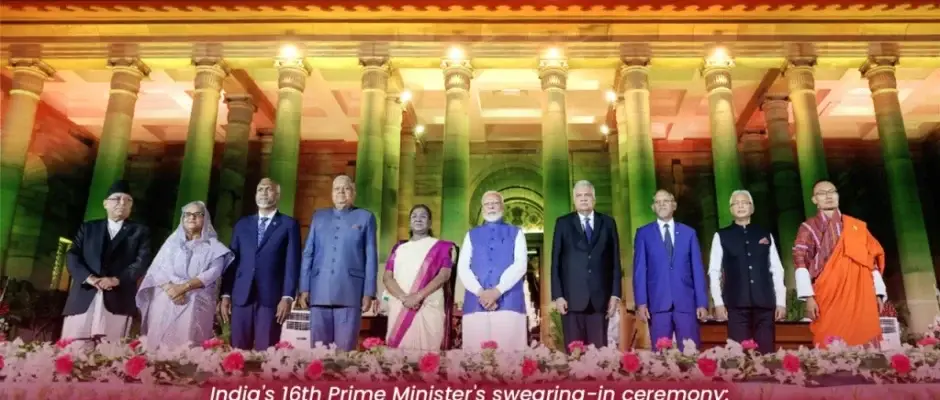
‘Neighbourhood First’ Policy and Its Innovative ‘SAGAR’

At the President house during swearing-in ceremony of India’s 16th Prime Minister, the country reaffirmed its unwavering commitment to its ‘Neighbourhood First’ policy and its innovative ‘SAGAR’ (Security and Growth for All in the Region) initiative. The invitation to neighbouring countries and those in the Indian Ocean Region (IOR), such as Sri Lanka, Bangladesh, Nepal, Bhutan, Maldives, Mauritius, and Seychelles, was extended amid the august assembly of dignitaries and demonstrated India’s unwavering commitment to developing strong ties with its maritime neighbours. Vision SAGAR started in 2015, to promote inclusion and adherence to international law while deepening economic and security cooperation, embodies India’s strategic vision for the IOR. Developing marine security capacities among neighbours is a key component of this goal, as it empowers them and ensures a cooperative approach to regional stability and prosperity. SAGAR is easily incorporated into the larger marine policy of India, working in concert with programs such as the Act East Policy, Project Mausam, and Project Sagarmala to advance the country’s approach towards regional providers of security. SAGAR highlights the significance of the Blue Economy and works to promote environmental stewardship and sustainable growth by utilizing the enormous potential of maritime resources. As India takes lead in IOR and is dedicated to creating an atmosphere of mutual respect, collaboration, and prosperity in order to fulfil the goals of all the nations in region. India aspires with SAGAR, the Indian Ocean would be a symbol of prosperity, peace, and advancement, demonstrating the strength of regional cooperation and strategic planning.

Read More

Hindu Manifesto 2024

On Saturday, June 8, the British Hindu community officially unveiled the Hindu Manifesto 2024. A long-overdue manifesto will emphasise a shared commitment to the advancement of not just British Hindus but the entire nation. Rohan GIRI             With the United Kingdom’s (UK) general election set for July 4, 2024. British Hindus are at a critical juncture. Due to its historical unwillingness to engage in political discourse, the community frequently regarded politics as a taboo subject. Many people do not vote, whereas some vote without thinking about the long-term consequences for themselves, their community, and the nation at large. According to the 2021 UK Census, British Hindus make up about 1.7% of the UK population, or approximately one million people. Despite their small numbers, their contributions to the British economy are unparalleled. As a community, they are among the top taxpayers, and their contributions to UK’s National Health Service (NHS) are imperative, with a large number of doctors, nurses, engineers, and other professionals. Additionally, Indians employ tens of thousands of individuals. British Hindus are a well-educated community that is self-sufficient, independent, and prosperous. Their commitment to prosperity and the rule of law reflects their extremely low numbers in British prisons, accounting for less than 0.3 percent of the total prisoners. Despite the community’s alignment with British values and society, it has minimal influence in British politics. This arena, where policies are formulated, laws enacted, and narratives established, demands a significant voice to shape the future. Unfortunately, British Hindus are often underrepresented or misrepresented in education, academia, media, and politics, both locally and nationally. They frequently face attacks, vilification, and maligning, with no substantial collective response to defend their interests and set the record straight. The next general election presents a crucial opportunity for the community to voice their thoughts. Parliamentary candidates must understand that British Hindu votes cannot be taken for granted. The community seeks fair representation and recognition of its contributions, highlighting Sanātan Hindu Dharma as an asset to Britain. The next general election presents a crucial opportunity for the community to voice their thoughts. Parliamentary candidates must understand that British Hindu votes cannot be taken for granted. The community seeks fair representation and recognition of its contributions, highlighting Sanātan Hindu Dharma as an asset to Britain. It is time for British Hindus to claim their seat at the table, shaping and influencing the country’s future. This involvement is not just a right but also a duty, or Dharma. The Hindu Manifesto 2024, launched by the British Hindu community, contains seven crucial pledges that the community expects from parliamentary candidates and future governments. These assurances are designed to ensure the protection, promotion, and progress of Hindu values and interests within the broader British society. The Seven Assurances of the Hindu Manifesto UK 2024: “Recognising Anti-Hindu Hate as a Religious Hate Crime: This expectation demands the identification and prosecution of groups and individuals that perpetrate anti-Hindu hatred. Recognising such acts as religious hate crimes will ensure that they are taken appropriately and addressed accordingly. Protecting Places of Hindu Worship: Ensuring the safety and purity of Hindu temples and places of worship is critical. This promise aims to preserve these precious areas from damage and attacks. Access to Fairer Education: This involves advocacy for an education system that accurately represents Hindu culture and contributions, as well as ensuring that textbooks are inclusive and unbiased. Equal Representation and Opportunities for Hindus: This protection aims to address Hindus’ underrepresentation in numerous sectors by struggling for equal opportunities in employment, politics, and other areas. Streamlining Immigration: The need for fair and efficient immigration laws that make it easier for people looking to join family in the UK or contribute to the British economy. Healthcare and Social Care: Encourage and enhance access to healthcare and social care services for Hindus while also addressing their special needs and concerns. Acknowledging and Protecting Dharmic Values: It aims to understand and respect the Hindu Dharmic way of life by consulting with the community while legislating on intra-community issues affecting the UK Hindu community, by facilitating infrastructure for religious ceremonies such as marriage and cremation, by commissioning a memorial for Hindu soldiers who served and died for the UK, and by understanding that the connection between UK Hindus and India (Bharat) is spiritual rather than political.” The Hindu Manifesto is a call to all parliamentary candidates and political parties to engage with and support the Hindu community in their respective areas. It has already received endorsements from various parliamentary candidates who have declared their support for the manifesto and its goals. As the general election approaches, the Hindu Manifesto will act as a guide for British Hindus, reminding them of their ability to shape the political landscape and ensure their community’s interests are reflected and safeguarded. This election is a critical opportunity for British Hindus to establish their presence, demand fair representation, and contribute to determining the future of the UK in a way that recognises and appreciates their substantial contributions. The election is an opportunity for British Hindus to turn their contributions, concerns, and expectations into legitimate political influence. The substantial participation and widespread support for the Hindu Manifesto 2024 can demonstrate to political leaders that the community is a force to be reckoned with, worthy of representation and consideration in policies. The ramifications of this participation will extend far beyond election day, potentially ushering in an era where British Hindus’ voices are fundamental to national conversations, their needs are met, and their values are upheld in the halls of government. (Author: Rohan Giri is a journalism graduate from Indian Institute of Mass Communication (IIMC) New Delhi, and Manager Operations at CIHS.)

Read More