CIHS – Centre for Integrated and Holistic Studies

Date/Time:

Blog Post

Futuristic Blueprint for Humanity

Panch Parivartan of RSS provides a transformative package for Bharat while communities globally could adopt the model. Vinod Kumar Shukla ​For its centennial events, Rashtriya Swayamsevak Sangh (RSS) ideated on five core social transformative ideas as ‘Panch Parivartan’ (Five Transformations). Samajik Samrasta (Social Harmony), Kutumb Prabodhan (Family Enlightenment), Paryavaran Sanrakshan (Environmental Protection), Nagrik Kartavya (Civic Duties) and Swa / Swadeshi (Self-Reliance) as areas into which the Hindu-centric organization would like to work on. These initiatives serve as tools to transform Bharat’s society and provide a template for global communities. These five transformative campaigns represent collective resolutions to prepare people of Bharat to deal with futuristic challenges. By fostering essential behavioural changes, they aim to drive national renaissance and build stronger, self-reliant Bharat: Samajik Samrasta (Social Harmony) ​Pluralism is as old as the civilization of Bharat itself. It is a heritage where diverse ideas including contrarian philosophies and opposing viewpoints have not only been welcomed but have coexisted and flourished. People of Bharat are inherently seekers who engage in dialogue rather than denying or negating the very existence of others. ​Samajik Samrasta programme is to promote unity and eliminate discrimination based on caste, creed or social status to build an inclusive society. In an ancient civilization like Bharat, social realignments are periodic necessity. RSS vision of social harmony begins with breaking down caste and community barriers. This is exemplified by call for Hindus to share “one temple, one well and one crematorium,” effectively erasing caste segregation at its source. While this is a prominent example, continuous efforts are being made to extend support to every section of society that feels marginalized or left behind. ​Kutumb Prabodhan (Family Values) ​After the individual, family constitutes the most vital unit of any society or the nation. Family being foundational unit, nurturing strong familial values, healthy dialogue within the family members and constructive cultural traditions in the household is primary objective of Kutumb Prabodhan. ​Over time, the institution of the family has weakened due to various factors, facing a continuous onslaught from Western influences and those in Bharat swayed by them. RSS aims to strengthen this very institution, recognizing that a resilient family structure builds a robust society and consequently, a strong nation. In Bharat, family values are not viewed as a form of bondage; rather, they are the cornerstone of personal growth and social stability, nurturing responsible, compassionate citizens. ​Paryavaran Sanrakshan (Protection of Environment) ​Today, entire globe faces the fury of nature, a direct consequence of unimpeded exploitation of natural resources. Encouraging sustainable living, tree plantation and a lifestyle that respects nature is deeply embedded in Bharat’s civilizational ethos, where the earth, rivers, seas, air, water, trees, moon and sun are traditionally worshiped. ​In championing culture and civilization, RSS is simply advancing these ancient tenets that treat environmental protection as a cardinal rule of life. Through Panch Parivartan, RSS has made an “environment-friendly lifestyle” a core focus area. The message of Paryavaran Sanrakshan—saving water and using natural resources judiciously—is now transcending generations with each age group adopting its own methods to protect the planet. It represents a collective movement where different people take diverse paths toward a common cause. ​Selfhood & Self-Reliance (Swa) ​If there is anything that was severely eroded over past millennium, it was sentiment of Swa (Selfhood). Realizing essence of Swa is crucial; it begins with taking pride in indigenous roots, promoting local economies and embracing “Swadeshi” way of life as against western economic aggression. This is the core of being self-reliant and proudly Bharatiya. ​The element of Swa extends beyond economic independence to encompass cultural self-confidence. This principle is applied through a five-fold transformative agenda known as Panchamukhi Vikas, which focuses on Swa (Self-Reliance), Shiksha (Education), Swasthya (Health), Sanskar (Culture) and Artha (Economy). Civic Duty (Nagrik Kartavya) ​The citizens of Bharat are frequently criticized for a perceived lack of civic sense, which is vital for the transformation of any society. The RSS seeks to instil deep sense of duty among citizens, encouraging them to follow rule of law, adhere to constitutional obligations and maintain social decency apart from participation in societal governance. ​This also includes a citizen’s democratic duty to exercise their franchise during elections. While many people harbour cynicism toward “the system,” Panch Parivartan urges citizens to actively change the system from within instead of merely complaining. Among the five resolutions, Environmental Protection is the most critical for survival of mankind. The immediate priority is raising awareness about vital importance of environmental conservation and educating people on how to achieve it. As pressure on natural resources intensifies, several interventions have become urgent: protecting fresh drinking water bodies, undertaking large-scale afforestation to combat global warming, balancing oxygen levels, preventing soil erosion and eliminating single-use plastics to safeguard rivers, farmlands and oceans. The RSS seeks to address these challenges by blending traditional ecological practices with civic responsibility and community-driven movements. ​The greatest immediate challenge is rapid development-linked urbanization which leaves a heavy negative footprint on the environment. Western model of development has caused maximum ecological harm. In contrast, Bharat not only talks but proposes eco-friendly development models. It also proved by achieving its initial goal of reducing emissions intensity of its GDP by 33 –35 per cent well ahead of 2030 deadline and has since escalated its ambition, targeting a 47 per cent reduction by 2035. ​However, global progress on this is hindered by a long-standing schism between developed and developing nations. Many developed countries are reluctant to compromise or deviate from high-emission paths that initially secured their wealth. Consequently, developing nations are being pressured to reduce their carbon footprints disproportionately while others falter—such as the United States’ past withdrawal from climate agreements. The list of faltering nations is long. Denying access to eco-friendly technologies and funding arrangements by the stubborn Western leadership is yet again an issue ​Bharat not only abides by Paris Agreement but advocates for a sustainable development model that rejects aggressive consumerism. This model aligns with ancient Indian wisdom, which emphasizes that humanity is an integral
Read More

Swadeshi Goes Hi-Tech!

‘Swa’ and Bharat’s self-reliance in advanced technology areas is a reality, domestic nuclear power campaign to fuel energy security. Dr Upender Krishen Saroop Swadeshi way of life carries a very deep and broader meaning. One must first understand Self (Swa) inherent in the word “Swadeshi.” ‘Swa’ has three foundational dimensions that have given Bharat a distinct identity and personality. When these three dimensions find natural expression in our personal, familial, professional, social and national life, only then can that way of living be truly called Swadeshi way of life in fullest sense. Bharat’s first and most fundamental concept of ‘Swa’ is spirituality. As Bharatiya worldview is rooted in spirituality, it is integral (Ekatma) and holistic (Sarvangeen). Bharat perceives the entire creation as interconnected, and it is from this that idea of “world is one family” (Vasudhaiva Kutumbakam) emanates. Rashtriya Swayamsevak Sangh (RSS) advocates Swadeshi (economic and cultural self-reliance) as outward manifestation of this unique concept, ‘Swa’ and a core pillar of national reconstruction. Championed through its socio-political affiliates, this philosophy shapes domestic policies, promotes indigenous industries and re-centres Bharat’s cultural identity. Rooted in the philosophy propounded by RSS ideologue Deendayal Upadhyaya, Swadeshi goes beyond economics to encompass cultural and spiritual self-reliance that ingrains holistic human development over unchecked consumerist globalisation. RSS promotes a native economic model that avoids both hyper-capitalism and state-controlled socialism, emphasizing on sustainable development, small-scale industries and maintaining environmental balance. The organization advocates protection of traditional familial structures, local community bonds and promotion of mother tongues and indigenous lifestyles. The Swadeshi concept forms ideological bedrock for major national campaigns. It heavily aligns with Bharat government’s Atmanirbhar Bharat (Self-Reliant India) and “Vocal for Local” initiatives which aim to empower domestic manufacturers and boost locally made products.  India’s successful Swadeshi designed Nuclear reactor: India has marked a major milestone in its nuclear energy programme. The indigenously designed and built Prototype Fast Breeder Reactor (PFBR) at Kalpakkam in Tamil Nadu successfully attained first criticality on April 6, 2026, marking initiation of a sustained nuclear chain reaction. This PFBR is 500 MW reactor built by Bharatiya Nabhikiya Vidyut Nigam Limited (BHAVINI) at the Kalpakkam Nuclear Complex. With this feat, Bharat has entered second stage of its three-stage nuclear power campaign, first conceived by Dr. Homi Jehangir Bhabha, the architect of domestic nuclear programme. The milestone carries substantial global significance. Once fully operational, India will become only the second country in the world after Russia to operate a commercial fast breeder reactor. This milestone is testament to decades of scientific effort led by Department of Atomic Energy. It also marks a significant step in India’s clean energy journey, reinforcing the country’s commitment to reliable, low-carbon power. Additionally, it brings Bharat closer to realizing net zero emissions by 2070, a target set by Prime Minister Narendra Modi. Three-stage nuclear power campaign India holds limited uranium reserves but one of the largest thorium deposits globally. To make the most of these resources, Department of Atomic Energy designed a three-stage nuclear power campaign built on a closed nuclear fuel cycle. The goal is to progressively multiply domestic fissile resources and secure long-term energy independence. Natural uranium is used as fuel in PHWRs to generate power. The spent fuel from these reactors produces plutonium which becomes primary input for the next stage. The plutonium obtained from Stage 1 is used as fuel in Fast Breeder Reactors which generate more fuel than they consume. PFBR at Kalpakkam marks Bharat’s entry into this stage. These reactors will be used to breed Uranium-233 from thorium, laying the groundwork for Stage 3. This stage will harness India’s vast thorium reserves at scale using Uranium-233 bred in Stage 2 as fuel. Thorium is considered a practically vast energy source and this stage holds the key to India’s long-term energy security. Each stage feeds into the next, making India’s nuclear programme one of the most forward-looking energy strategies in the world. PFBR: An Overview PFBR represents decades of indigenous research, design and engineering. Its technology was developed by Indira Gandhi Centre for Atomic Research (IGCAR), an R&D centre under Department of Atomic Energy. Nuclear Power Landscape in India Bharat’s nuclear energy campaign has maintained steady presence in the country’s electricity mix. It now stands at a pivotal moment with significant expansion planned over coming years. Taken together, these numbers tell a clear story. Nuclear energy is no longer just a supplementary source of power in India. It is fast becoming cornerstone of the country’s clean energy future. Long-Term Mission Bharat has set sights on a significantly larger role for nuclear energy in its power mix. Government has announced Nuclear Energy Mission, outlined in Union Budget 2025–26, with the aim of achieving 100 GW nuclear power generation capacity by 2047. The mission also supports India’s broader goal of achieving net zero carbon emissions by 2070. The sector is under regulatory oversight, opening new avenues for collaboration and investment. India’s long-term nuclear vision is ambitious by design. With policy backing, dedicated funding and indigenous research at its core, country is building a nuclear future that is both self-reliant and globally significant. Conclusion Concept of Self Reliance or Atma nirbharta has its roots and inspiration from the concept of Swa and Swadeshi, an important paradigm for RSS. This is one of the five transformative ideas put forth in centenary year of RSS. Realm of Swadeshi has gone into high technology areas like Nuclear and solar energy to ensure energy security of our nation, space missions, defence equipment production, Semiconductors to name a few. The emergence of Bharat as an economic superpower based on ennobling values of peace and Vasudhaiva Kutumbakam is not only inevitable but desirable for the world which is torn apart in wars and violence. Bharat will provide the lead in this endeavour. (Author holds a doctorate in polymer technology from Indian Institute of Technology Delhi. He was a scientist in Shriram Institute for Industrial Research and formerly Vice President with Reliance Industries. Currently, he’s advisor to several packaging and polymer companies)

Read More

RSS at 100: A Civilisational Dialogue

In April 2026, in the centenary year of Rashtriya Swayamsevak Sangh (RSS). RSS Sarkaryavah, Dattatreya Hosabale, undertook a sequence of engagements across the United Kingdom, the United States and Germany. During his engagements, he addressed Chatham House in London, the inaugural THRIVE 2026 summit at the Stanford Faculty Club, the Hudson Institute in Washington, the Stiftung Wissenschaft und Politik and Konrad-Adenauer-Stiftung in Berlin, alongside Nobel laureates, legislators, academic communities, business leaders, community leaders and members of the Indian diaspora in all three countries. Centre for Integrated and Holistic Studies has released RSS at 100: A Civilisational Dialogue, a structured account of these engagements and of the philosophical foundations on which the world’s largest socio-cultural movement now offers a hundred years of reflection and experience to humanity at large for global good. Download & Read Full Brief:

Read More

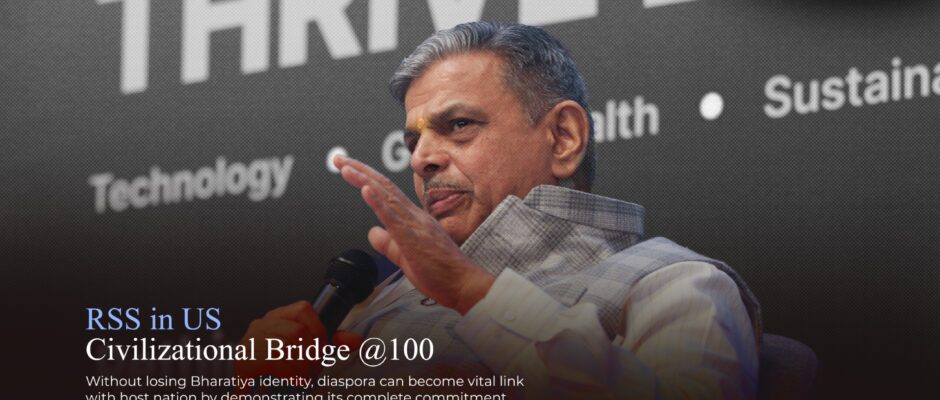
RSS in US: Civilizational Bridge @100

Without losing Bharatiya identity, diaspora can become vital link with host nation by demonstrating its complete commitment. Arun Anand Commemorating its centennial, Rashtriya Swayamsevak Sangh has begun a serious conversation with a bevy of stakeholders in the West especially the United States and Europe. As part of its global outreach, RSS General Secretary Dattatreya Hosabale undertook a significant visit to United States in April 2026. It’s more than a routine diaspora engagement. This tour represented a carefully crafted civilisational outreach—one that combined reflection on a hundred-year journey with a forward-looking articulation of Bharat’s intellectual and cultural role in a rapidly transforming world. At a time when global discourse is increasingly shaped by technology, geopolitics and identity debates, Hosabale’s visit sought to position the RSS not merely as an Indian organisation but as a participant in a wider philosophical conversation about humanity’s future. Civilizational Dialogue in Silicon Valley The intellectual centre piece of the visit was Hosabale’s address at Stanford University during the Thrive 2026 conference. Speaking before an audience comprising technologists, entrepreneurs and members of the Indian diaspora, he framed his intervention around a central proposition: that modern technological advancement must be guided by deeper ethical and civilisational wisdom. Drawing from Indic traditions, he argued that knowledge systems in India have historically refused to separate the spiritual from the scientific. Ancient texts, including the Upanishads, were presented not merely as theological works but as repositories of inquiry into the nature of the human mind, the cosmos, and existence itself. In this view, the fragmentation of knowledge into rigid categories science versus spirituality is a relatively recent phenomenon. Hosabale suggested that this integrated approach offers valuable insights in an age defined by artificial intelligence, ecological stress, and social inequality. He advocated what he termed a “holistic lifestyle,” contrasting it with excesses of consumerism and unchecked technological ambition. The emphasis was not on rejecting modernity, but on anchoring it within a broader ethical framework. At the heart of this framework lies the idea of Vasudhaiva Kutumbakam, the belief that the world is one family. Hosabale presented this not as a rhetorical flourish, but as a practical principle for navigating global fragmentation and conflict. Science, Knowledge & Civilisation A key theme that ran through his address was the need to revisit and revitalise Indic knowledge systems. Centuries of disruption particularly during protracted periods of foreign rule led to erosion and marginalisation of indigenous intellectual traditions, he averred. As a result, many scientific ideas embedded within cultural and spiritual texts were either forgotten or dismissed as superstition. Today, he argued, there is a renewed effort in India to recover and systematise this knowledge. Education, in this context, becomes central, not merely as a means of economic advancement but as a tool for reconnecting society with its intellectual heritage. Hosabale emphasised that scientific inquiry and spirituality were not opposing forces. Rather, they complement and enrich each other. Historically, scholars engaged in both domains simultaneously, integrating empirical observation with philosophical reflection. This integrated approach also carries ethical implications. He proposed that any technology intended for human welfare must be evaluated on three touchstones: economy, ecology and ethics. Technological progress that generates inequality, exploits nature or violates moral norms, he warned, ultimately undermines both society and the environment. Equally significant was his emphasis on democratization of knowledge. While knowledge production has accelerated globally, access to it remains uneven. A truly equitable world, in his view, requires insights from all civilizations that be shared widely, enabling a more balanced and inclusive global order. Redefining Diaspora Role Beyond intellectual discourse, Hosabale’s engagement with Indian diaspora carried a clear and pragmatic message. Addressing gatherings in Silicon Valley, he urged Indian-origin communities to demonstrate complete commitment to countries they inhabit. For the diaspora, he stated, contributing to progress and well-being of their host nation is basic dharma. This articulation is significant in contemporary debates around identity and belonging. Rather than encouraging a divided loyalty, Hosabale advocated a model of integration rooted in responsibility and participation. At the same time, he encouraged diaspora to remain connected to Bharat’s cultural and civilisational values. This dual identity, being fully American while retaining an Indian cultural consciousness was presented as strength rather than a contradiction. In effect, the diaspora becomes a bridge: grounded locally, yet carrying a global civilisational perspective. Path Ahead: Balancing Extremes A recurring thread throughout the visit was call for balance. Hosabale warned against dangers of an unrestrained race for technological dominance, one that prioritises speed and scale over sustainability and human well-being. He argued that traditional Indian thought offers a corrective: a worldview that emphasises harmony with nature, respect for all forms of life and an understanding of interconnectedness of existence. This perspective, he suggested, is particularly relevant in addressing contemporary challenges such as climate change and social fragmentation. The concept of “knowledge guided by wisdom” emerged as a central motif. Knowledge, when divorced from ethical judgment, can lead to arrogance and exploitation. When guided by discernment, viveka, it becomes a force for collective good. Conclusion Dattatreya Hosabale’s 2026 visit to the United States was not merely a commemorative exercise marking RSS centenary. It was an attempt to articulate a vision, one that situates Indian civilizational thought within global debates on technology, ecology and human coexistence. By engaging with Indian diaspora and intellectual communities in Silicon Valley, RSS signalled its intent to participate more actively in shaping global narratives. The emphasis on loyalty to host nations, cultural rootedness and ethical balance reflects a nuanced approach to globalisation, one that seeks integration without loss of identity. (Author is a senior journalist & columnist. He has authored more than a dozen books)

Read More
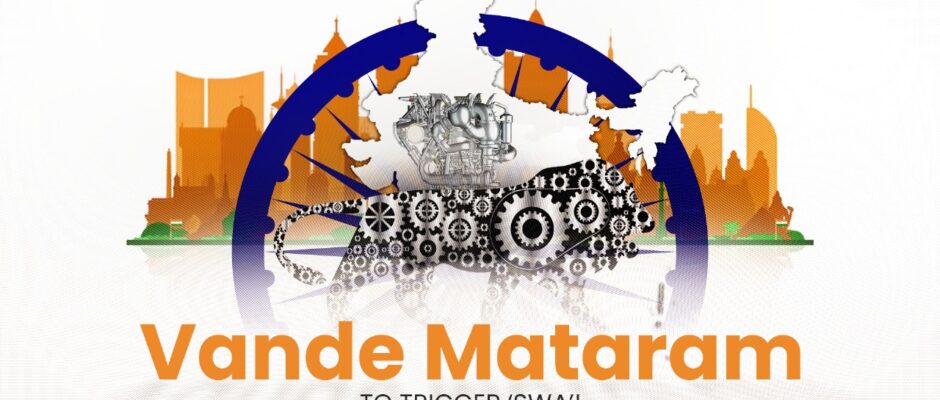
Vande Mataram to Trigger ‘Swa’!

Vande Mataram to Trigger ‘Swa’!

From home grown tech, goods, services to Bharat’s way of resolving her problems would celebrate the spirit of ‘Swa’ to’swadeshi’! K.A.Badarinath The national song ‘Vande Mataram’ that caught the imagination of all freedom fighters for united Bharat against British occupation seeking ‘swaraj’ a la self-rule has turned 150. Bankim Chandra Chattopadhyay penned the verses in 1875 and this became the swan song for complete freedom and rejection of foreign rule, goods and services. This very song can serve as inspiration for a united, developed country of 1.5 billion people overcoming both internal and external challenges. And, rightly, central executive council of Rashtriya Swayamsevak Sangh (RSS) that held three-day conclave in Jabalpur earlier this week announced one-year long campaign to celebrate and revive the spirit of ‘Vande Mataram’. It was first voiced at the Congress session in 1896 by none other than Bharat Ratna Rabindranath Tagore. And, the delegates at Congress session were swayed by this national song. It also turned the ‘mantra’ against British and sung by icons like Maharashi Arbindo, Madame Bhikaji Cama, renowned poets like Subramanya Bharati, Lala Hardayal and Lala Lajpat Rai apart from reformers like Dayananda Saraswati. Mahatma Gandhi had deftly used ‘Vande Maataram’ to greet people even in his letters to fellow compatriots and freedom fighters. When ‘Vande Mataram’ turned 100, ironically, the Congress-led government restricted its singing in 1975 after then Prime Minister Smt Indira Gandhi imposed internal emergency, trampled upon citizens’ fundamental and democratic rights. Most democratic institutions including both houses of parliament were dissolved and began two-year near lunatic undemocratic rule to stay in power. Hence, the entire Sangh parivar that bore the brunt of a criminal rule in New Delhi, seems to have decided to ring in the spirit of ‘Vande Mataram’ after 50-years. The national song treated on par with national anthem is sought to reunite the entire country’s citizenry against divisive forces seeking to weaken the fundamentals of the society on lines of caste, creed, sex, region, religion and faith. ‘Vande Mataram’ has the big potential to rekindle the spirit of ‘Swa’ (selfhood) and ‘Bharatiyata’ (Indian-ness) against forces of disruption having linkages with foreign powers. From villages, counties, communities to the entire nation, Vande Mataram could inject the sense of belonging for Bharat, resurrect its civilizational ethos, celebrate its diversity and unite to become a developed country laying a firm path for other nations to move along as well. RSS Sarkaryavah Dattatreya Hosabale has emphasised on reviving the spirit of ‘swa’ as the basis for national renaissance, development and bringing about inclusive prosperity in Bharat setting aside differences within some sections. ‘Swa’ includes reliance on domestic resources, talent, ideas, innovations and technology that could define Indian-ness. For instance Sridhar Vembu’s arattai can be our basic communication medium as against Whatsapp. For instance, building our own Kaveri engine that can power passenger and fighter aircraft should be our priority as against building Russia’s SJ-100 aircraft. As Dattatreya Hosabale said, ‘Swa’ or ‘Swadeshi’ should not translate into complete ‘isolation’ from Bharat’s perspective. It only means that heavy dependencw on domestic resources, desi talent, home grown technologies, innovations and human mind. From aerospace engineering, defence production to information technology, self-reliance should become the key word in spirit, content or processes. Puritan ‘Swadeshi’ way coupled with multiple global partnerships would bring about resilience to Bharat’s campaign for her socio-economic renaissance. One is reminded of Russia buckling under US pressure to deny Bharat the cryogenic engines technology to power her rockets and missiles. Russian space agency Glavcosmos revised its 1994 pact with Indian Space Research Organisation (ISRO) to deny the cryogenic engines technology and limited to supply nine engines. And, ISRO scientists outflanked the global space powers to rise from ashes and dominate the space sector. Big positive in this campaign is also Narendra Modi led government’s move to join the parivar campaign on ‘Vande Mataram’. If the recent Home Ministry memorandum is any indication, Prime Minister Modi will lead the nation to rekindle the spirit of ‘Vande Mataram’ way on Friday, November 7 that’s Akshay Navami. Last month itself, Union Cabinet had through a resolution decided to celebrate ‘Vande Mataram’ till November 7 next year. This campaign would become more purposeful if the governance at every level adapts ‘swadeshi’ as the ‘mantra’ Overtaking Japan or Germany, competing for the top of the stack position vis-à-vis China and US on economic front is a doable project if the spirit of ‘swa’ in every sector was applied. From governance reforms to celebrating diverse languages of Bharat’s people, governments, political formations and leadership will play a significant role. (Author is Director & Chief Executive of New Delhi based non-partisan think tank, Centre for Integrated and Holistic Studies)

Read More
100 Years’ Journey of RSS: New Horizons

100 Years’ Journey of RSS: New Horizons

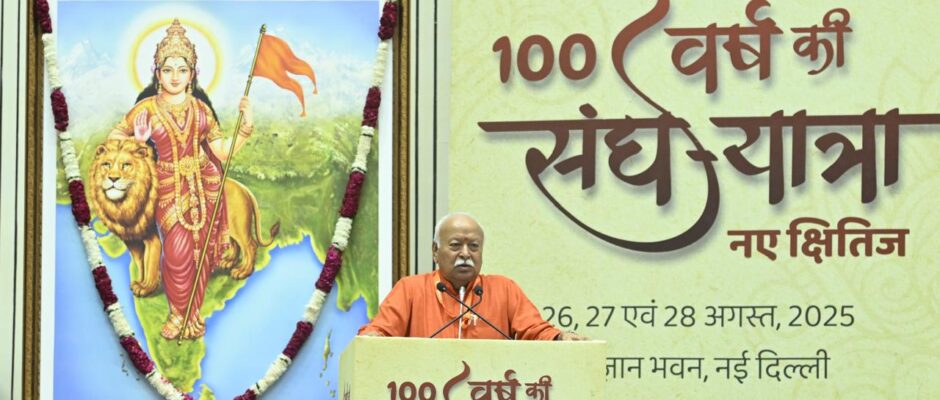
As the Rashtriya Swayamsevak Sangh enters its Centenary Year, a special 3-day lecture and interaction series of “100 Years’ Journey of RSS: New Horizons” was organised at Vigyan Bhawan, New Delhi, from 26–28 August 2025. The event, marked by thoughtful deliberations and inspiring addresses, brought together swayamsevaks, intellectuals, foreign dignitaries from more than 20 countries viz., US, UK, Russia, China, Germany, Japan, Australia, Nepal, Sri Lanka, Argentina, Malaysia, Indonesia, New Zealand, Uzbekistan, ⁠Kazakistan, Denmark, ⁠ Isreal, (to name a few), foreign media viz., BBC, AFP, DW, Sputnik, Reuters, NYT, WSJ, Kyodo News and many others, to look back and see the future. Sarsanghchalak, Dr. Mohan Bhagwat Ji, in his keynote address presented a deep insight into the Sangh’s journey since 1925. He brought before the gathering the fact that the Sangh had not been born due to some passing cause, but due to a timeless civilisational requirement, to cultivate character, cohesion, and service in society. He noted that whereas Sangh’s first one hundred years have been committed to establishing a robust infrastructure and national consciousness, the coming century will require newer models of involvement in the areas of education, technology, nature, culture, and international discoursed. During the three days, there were thematic sessions discussing crucial aspects of the Sangh’s contribution: Nation First and Social Harmony, Civilisational Continuity in a Changing World, and Empowering Communities for Self-Reliant Bharat. Representatives from various walks of life deliberated on how the Sangh’s quiet and consistent efforts in villages, towns, and cities have brought up a generation with sanskars and with the confidence to tackle contemporary issues. The exchanges brought out one shared spirit: that the 100-year RSS pilgrimage is not so much a history of expansion, but a living witness to the dynamism of selfless service and cultural consciousness. As Sangh embarks on its second century, the challenge is to widen horizons, adopting inclusiveness, innovativeness, and greater social connect, yet staying rooted in the fundamental vision of ekatmata, sewa, aur rashtra-nirman (unity, service, and nation-building). Three day event at Vigyan Bhawan ended with a fresh commitment, that the Centenary of RSS will not only marks a glorious past but also plant the seeds of a brighter, harmonious, and self-assured Bharat for the future generations. “Sanghachhadhwam, Samvadadhwam, Sam Vo Manamsi Janatam” (Let us move together, let us speak together, let our minds be in harmony.) — Rig Veda

Read More

Akhand Bharat: Manifestation of Spiritual Nationalism

‘Indian Nationalism’ is quite different from European or the Western Nationalism. In this context, it is important to bust this myth propagated by the colonial and Marxist historians that the rise of nationalism in India was an outcome of British rule hence it needs to follow the paradigms set by ‘Western Nationalism.’ The trajectory of Western nationalism and Indian nationalism are altogether different. Arun Anand We have been talking about Akhand Bharat i.e. an undivided India since independence. Many people, especially the youth of today’s generation, consider this concept impractical. Those who oppose this concept often ask the question whether the formation of Akhand Bharat would mean that we will join Pakistan, Bangladesh and other neighbouring countries with present India as a geographical unit? Does the idea of ​​Akhand Bharat include only the Indian subcontinent? Where do countries like Cambodia, Vietnam, Thailand, Indonesia, which have a deep influence of Hindu culture, find a place in the concept of Akhand Bharat? Will any other country be ready to give up its existence and merge into a unit to make Akhand Bharat a reality?  Is it even possible? The answer to these questions can be given in one sentence – Akhand Bharat implies a continuous cultural flow whose root is spirituality, not materialism. Therefore, geography is secondary in the concept of Akhand Bharat. It is not necessary that all countries merge with each other. The eternal consciousness of Sanatan Dharma and Hindu culture has been the basis of the dharma-based life of societies and communities settled on a large part of the earth. With time, this consciousness based on eternal values ​​got lost in many regions. Led Islamic preachers and Christian missionaries, countries were invaded, cultures were destroyed and massive conversions by force were carried out. Exploitation, racism and colonialism were the hall marks of these campaigns. In Bharat too, an attempt was made to eliminate this cultural consciousness from eight century AD onwards. Unfortunately, there was no course correction after independence. But the consciousness based on eternal values ​​is basically spiritual in nature, so it was not possible to eliminate it. In India, with the efforts of the Rashtriya Swayamsevak Sangh (RSS) and many other spiritual, social and cultural organizations, there has been a re-emergence of the Bharatiya consciousness. This consciousness is still prevalent on a large part of the earth. When this consciousness emerges in a strong form in various other regions, the dream of Akhand Bharat will come true. Even if all countries are not named India or Bharat on the political map, wherever the values ​​on which Bharatiya consciousness is based are re-established, all those territories and societies will be a part of ‘Akhand Bharat’. Indian vs Western Nationalism One of the key reasons that has led to this confusion over the concept of Akhand Bharat is the absence of understanding the Indian concept of nationalism.   What ‘nationalism’ means for Indians is however vastly different from what ‘nationalism’ means for the West. The time has come for the West to look at Indian nationalism from an Indian lens and not through their own perspective which is deeply flawed because of the oppressive and colonial character of Western nationalism. According to Merriam Webster dictionary, Nationalism means “loyalty and devotion to a nation; a sense of national consciousness exalting one nation above all others and placing primary emphasis on promotion of its culture and interests as opposed to those of other nations or supranational groups.” The dictionary further mentions in an additional note, “intense nationalism leads to war”. Thus, nationalism, in the Western framework, is seen as an oppressive concept that leads to wars and conflicts. While the concept of ‘nationalism’ in Bharat or what we may call, ‘Hindu nationalism’ dates back to thousands of years, it is a very recent phenomenon in the West. The western concept of ‘Nationalism’ originated from the French Revolution in 1789. If you look at the map of mid-eighteenth-century Europe, you will find that there were no ‘nation-states’ as we know them today. What we know today as Germany, Italy and Switzerland were divided into kingdoms, duchies and cantons whose rulers had their autonomous territories. Eastern and Central Europe were under autocratic monarchies within the territories of which lived diverse peoples. They did not see themselves as sharing a collective identity or a common culture. Often, they even spoke different languages and belonged to different ethnic groups. The Habsburg Empire that ruled over Austria-Hungary, for example, was a patchwork of many different regions and peoples. It included the Alpine regions — the Tyrol, Austria and the Sudetenland — as well as Bohemia, where the aristocracy was predominantly German-speaking. It also included the Italian-speaking provinces of Lombardy and Venetia. In Hungary, half of the population spoke Magyar while the other half spoke a variety of dialects. In Galicia, the aristocracy spoke Polish. Besides these three dominant groups, there also lived within the boundaries of the empire, a mass of subject peasant peoples – Bohemians and Slovaks to the north, Slovenes in Carniola, Croats to the south, and Roumans to the east in Transylvania. Such differences did not easily promote a sense of political unity. The only tie binding these diverse groups together was a common allegiance to the emperor. Noted historian David Sasson who earned his PhD under Eric Hobsbawm, one of the foremost authorities on Western nationalism, observed in his introduction to a collection of essays and lectures by Hobsbawm ‘On Nationalism’, “In Europe, nationalism was the product of the ‘dual revolutions’, the French Revolution and the British Industrial Revolution. Some, such as the historian Elie Kedourie (who defined nationalism as a political religion), suggested that the invention of nationalism could be traced back to German Enlightenment thinkers such as Immanuel Kant and Johann Gottlieb Fichte in response to Napoleon’s occupation of German territory.” John Hutchinson underlined the true character of Western nationalism in Nations and War as he wrote, “The ideology of nationalism, powerfully articulated in the French Revolution, emerged in late eighteenth-century

Read More

Social Harmony, RSS Transformative Blueprint

Educational initiatives, cultural engagement, community service and conflict resolution to be vehicles to achieve harmony Dr Shailendra Kumar Pathak In contemporary Bharat, Rashtriya Swayamsevak Sangh (RSS) has emerged as pivot for Bharat’s socio-cultural fabric, advocating principles deeply rooted in fostering social harmony. At its core, RSS promotes a vision of unity transcending religious, linguistic and regional boundaries thereby emphasizing cohesive national identity. Central to its philosophy is the belief in innate unity of all Bharatiyas, irrespective of diversity, aiming to forge a collective strength through cultural rejuvenation and societal uplift. RSS endeavours to cultivate a society where mutual respect, understanding and cooperation prevail among different communities. Through its extensive network of Shakhas (basic units or branches) and socio-cultural initiatives, RSS promotes values of discipline, patriotism and social responsibility aimed at building a harmonious environment conducive to national progress. This commitment to social harmony is underpinned by its efforts in disaster relief, education and healthcare reflecting a holistic approach to building a strong and disciplined nation. Social harmony refers to peaceful and cooperative coexistence of diverse groups within a society. It encompasses mutual respect, understanding and integration of various cultural, religious, and social backgrounds. In a country as diverse as Bharat, achieving social harmony is both a challenge and a necessity. RSS, through its numerous initiatives, strives to bridge gaps between different communities, fostering a sense of national unity and collective identity. Social harmony refers to peaceful coexistence of various groups, characterized by mutual respect, understanding, and cooperation. It is essential for several reasons: Its importance notwithstanding, achieving social harmony is fraught with challenges: RSS, founded in 1925 by Dr. Keshav Baliram Hedgewar has always advocated for a united and strong Bharat. Historically, the organization has worked towards mitigating social divisions whether they are based on caste, region, religion, or ethnicity. Sangh’s emphasis on “Hindutva” is often misunderstood; it is not about religious dominance but rather about cultural inclusivity and national pride. Hindutva, in the RSS lexicon, seeks to bring together various cultural strands that make up Bharatiya identity. Since 1983, the Rashtriya Swayamsevak Sangh (RSS) has emphasized on concept of “Samarasata” (harmony). Veteran RSS member and thinker Dattopant Thengadi introduced the term in a social context, coining the phrase, “Samajik Samarasata” (social harmony). This led to formation of the Samajik Samarasata Manch in Maharashtra that promoted the idea of equality which was not possible without harmony. The term sparked debates with critics arguing that it perpetuated inequality and Manuvad. However, understanding RSS’s interpretation of Samarasata is crucial. Equality, freedom and fraternity, principles enshrined in Bharat’s Constitution are interconnected. The preamble originally lacked fraternity. But, Dr. Babasaheb Ambedkar added it, recognizing its importance for national unity. European and American revolutions focused on political freedom and equality, but their societal contexts differed from Bharat’s, where caste-based inequality prevailed. Ambedkar emphasized that mere legal provisions for equality and freedom are insufficient without fraternity—a sense of brotherhood fostering social equality. Fraternity, a state of mind, cannot be legislated but must be cultivated emotionally and metaphysical level, similar to family bonds. RSS aims to foster this sense of fraternity within Hindu society, historically divided by caste and language. Dr. Hedgewar, RSS founder, exemplified this through personal actions, promoting unity without preaching against untouchability. He demonstrated that genuine affinity could bridge social divides. Sri Guruji, second Sarsanghchalak and subsequent RSS leaders continued this mission emphasizing service to marginalized communities. They promoted the idea that Samarasata is not just a principle but a lived practice, embodying freedom, equality and fraternity. RSS focuses on practical experiences of equality and fraternity, rather than mere rhetoric, fostering a deep sense of unity and shared humanity. This lived sense of affinity, cornerstone of RSS’s work, is viewed as essential for true social harmony. RSS, through its various programmes and initiatives, aims to address these challenges and foster social harmony: Educational Initiatives Community Service Cultural Programmes Conflict Resolution RSS’s efforts have yielded positive results in various regions: At National Executive Council of RSS held during March 14-17, 2024, a pledge for fostering social harmony was taken along with four other transformational ideas. Social harmony is bedrock upon which other pillars of the RSS five-fold transformation stand: Centennial & Beyond As RSS heads for its centennial in 2025, it redoubles its commitment to these transformative ideals. Focus is not only on quantitative expansion reflected in increasing Shakhas or basic units but on qualitative growth. Dissemination of national thoughts, mobilization of righteous societal power and active engagement in democracy are central to this mission. Social harmony is not merely an idealistic goal for RSS; it is a necessity for sustainable development of Bharat. In the context of RSS five-fold transformative ideas, social harmony acts as foundation upon which other pillars—environmental conservation, self-reliance, family awakening and civic duty—can be built. While challenges remain, RSS multifaceted approach to fostering unity, respect, and cooperation among Bharat’s diverse communities offers hope to a more harmonious and integrated society. As Bharat continues to evolve, principles of social harmony advocated by RSS will play a crucial role in shaping a nation that is not only economically prosperous but socially cohesive and culturally inclusive. Through education, community engagement, social service and a commitment to shared values, RSS aims to build a society where every individual, irrespective of their background, can contribute to and benefit from collective progress of nation. (Author is a Delhi based researcher, Political Analyst & formerly an Assistant Professor of Political Science)

Read More

Spice, Imagination & Conspiracy

ABC peddles ‘Spies, secrets and threats’ that grossly misrepresents Hindus, RSS & Indian government through agenda-based peddling of lies. Rohan Giri Forty six minutes video report “Spies, secrets and threats: How the Modi regime targets people overseas, Four Corners”  broadcast by Australian Broadcasting Corporation (ABC) which features infamous reporter Avani Dias declares its extreme antagonism towards Hindu centric Rashtriya Swayamsevak Sangh (RSS) Through this report, state-run ABC also targets the ruling Bharatiya Janata Party (BJP) whose senior leader Narendra Modi has been elected Prime Minister for third consecutive term. This ABC report and Dias reek of bias and misrepresentation, constantly presenting RSS as a paramilitary group despite its long-standing efforts as a cultural and service-oriented movement. Easily recognized as the world’s largest voluntary organization, RSS is dedicated to community service particularly for the deprived sections of Indian communities. Overlooking this, Dias intentionally distorts its image, dismissing its substantial contributions to a larger society. Selfless service work carried out by RSS volunteers inspired by its founder Dr Keshav Baliram Hedgewar’s pre-independence movement experiences has been largely ignored or intentionally set aside to paint a shady picture of an open flexible organization. Avani Dias seems to have blinded herself and the ABC viewers on RSS service activities through over 120,000 projects in areas ranging from education, healthcare to socio-economic empowerment. These projects have positively contributed to millions of families in India. A whopping 2.145 million individuals and families in Bharat have benefitted and continue to be supported by projects across half a dozen sectors that contributed to improving living standards. Beneficiaries in the healthcare sector separately have crossed 8.716 million and food support programmes touched 2.735 million. Community well-being and development is the under-lying objective of RSS volunteers’ drive that’s comprehensive and unique in their organization. Avni Dias who left Bharat after being under cloud argued that minorities do not have sufficient opportunities under Prime Minister Narendra Modi’s leadership. This is factually incorrect and a false claim made by Avni Dias and concurred by ABC editorial board. Facts on contradict her politically charged propaganda. Since 2014, the Indian government has executed welfare initiatives for minorities. The Maulana Azad National Fellowship (MANF) gives five years of financial help while the Padho Pardesh scheme provides interest subsidies for study abroad at the Masters, M.Phil., and Ph.D. levels. The Seekho aur Kamao initiative improves minority youngsters’ abilities in a variety of occupations, ensuring employability or self-employment. The Pradhan Mantri Jan Vikas Karyakram seeks to enhance socio economic infrastructure for minority populations. Despite these substantial initiatives, Avani seems to have peddled anti-India agendas and divisive ideas. The report’s most glaring flaw is its blatant endorsement of Pakistan-backed Khalistani terrorism. The script seems to have been written by Khalistani supporters themselves, with Dias serving just as their representative. This is an attack on journalistic integrity and an insult to sufferers of Khalistani terrorism. In 1980s, Khalistani terrorists in India carried out an upsurge of cruel violence, killing thousands of innocent people. However, Dias selectively disregards this grave and historical fact overlooking to acknowledge the terrible adversity and bloodshed caused by these separatists. Dias’s narrative represents Khalistani terrorists when she says Sikhs were victims and under pressure in Australia which is a flagrant white lie. The fact is otherwise. A handful aggressive Khalistani terrorists has continued their campaign of violence and terrorization not just in India but also in other nations including Australia. In less than a month, pro-Khalistani outfits in Australia have launched three distinct attacks on Hindu temples. On January 23, 2023 Hare Krishna Temple in Albert Park, Melbourne of Australia came under attack. On January 17, 2023, Melbourne’s historic Shri Shiva Vishnu Temple at Carrum Downs was targeted. On January 12, 2023, Khalistan activists vandalized and destroyed BAPS Swaminarayan Mandir, a Hindu temple in Melbourne, by spray-painting anti-India graffiti. The walls of Melbourne’s landmark Swaminarayan temple in the northern suburbs of Mill Park have been spray-painted with ‘Hindustan Murdabad’ slogans. Hundreds of innocent Indians in Australia have been threatened or abused by these terrorists, a reality that Dias completely ignores. Instead, she promotes Khalistani propaganda while ignoring their current terrorist acts and the true threat to peace and security. It’s not that the entire sikh community in India, Australia or elsewhere endorses this divisive agenda. Despite the report’s contentious storylines, it is crucial to highlight India and Australia’s developing strategic, economic and bilateral relations. Both countries have worked together extensively on a range of issues, including trade, defense, education, and cultural exchange. The relationship is based on mutual respect and democratic values with the goal of enhancing regional stability and economic progress. The report’s description of chronic animosity and conflict is refuted by the upward trend in Indo-Australian relations. Collaborative initiatives in education, technology, and counter-terrorism demonstrate both countries’ commitment to fostering a robust and long-term alliance. Avani Dias’s report exemplifies biased and irresponsible journalism. It misrepresents the RSS, glorifies Khalistani crimes and dismisses recent improvements in Indo-Australian ties. This reporting fosters division and promotes radical agendas. The Australian Broadcasting Corporation should be held accountable for broadcasting such an evidently biased and factually wrong story. True media should seek and provide an honest presentation rather than serve as a propaganda weapon for violent extremists. Dias’ report is a disservice to the profession and to innumerable people who have suffered at the hands of the terrorists she explicitly supports. (Author is a doctoral fellow at Amity University in Gwalior, content head at Centre for Integrated and Holistic Studies)

Read More

Sanatan Dharma embraces unity, truth & non-violence

RSS chief calls for sinking differences, fostering unity among Hindus, reach out to people across to play a meaningful role in world affairs   Rohan Giri Hindu centric Rashtriya Swayamsevak Sangh (RSS) chief Mohan Bhagwat’s address at ‘World Hindu Congress 2023’ in Bangkok resonates with a message of hope and connectivity in a world grappling with unprecedented challenges. Bhagwat dwelt at length into historical experiments undertaken across millennia for happiness and peace. His emphasis on potential role of Bharat (India) as guiding force for the world offers a compelling perspective on the nation’s cultural and philosophical heritage. The third World Hindu Congress (WHC) three-day jamboree themed “Jayasya Aayatnam Dharmah” (Dharma, the Abode of Victory) made a historic decision to renounce the term ‘Hinduism’. Global Hindu leaders that converged at the Congress argued that it reflected oppressiveness and discrimination. Instead, Hindutva and Hindu-ness were embraced to characterize the eternal Dharmic way of life. WHC’s declaration emphasized that Hindutva was a more accurate term encompassing full spectrum of Hindu identity. At the same time, Hindu Dharma was chosen for its unbounded essence, signifying all that is Sanatan or Eternal. Limitations of Hinduism prompted this shift, suffixed with ‘ism,’ a term associated with oppressive and discriminatory attitudes. The declaration asserted that Hindutva, meaning Hindu-ness was not complicated and criticized its portrayal as anti-thesis of Hindu Dharma by some academicians and intellectuals. WHC condemned attacks on Hindu Dharma, calling for global unity to overcome bigotry and emerge victorious against those engaging in such criticism. RSS Chief Dr. Mohan Bhagwat fervently called upon Hindus worldwide to forge connections and unite with global community. Stressing the significance of outreach, he emphasized, “We must reach out and connect with every Hindu. As a cohesive Hindu community, we will connect with individuals worldwide. With a growing number of Hindus forming connections, the process of global connectivity has already commenced.” Bhagwat recounted World Muslim Council secretary general who acknowledged Bharat’s crucial role in fostering global harmony. The emphasis on connecting hearts through service emerged as a central theme, reflecting Bharat’s tradition of selfless service. ‘Vasudhaiva Kutumbakam’, one world – one family principle, was central to Bhagwat’s discourse. He pointed to shared responsibility of Hindu society to connect with the global community. Bhagwat argued that Bharat’s duty was to foster harmony worldwide. He contended that this duty propelled Hindu society’s existence, emphasizing the common starting point and shared goals among Sanatan traditions. On the quadrennial conference theme, “Jayasya Aayatnam Dharmah,” he said, ‘Jaya’ provided insight into its profound meaning, transcending mere conquests and victories over others. Illuminating this concept, he brought distinction between destructive ‘Rakshas Vijaya’ (demonic victory) and self-centred ‘Dhan Vijaya.’ (materialistic victory) on one side and Dharma Vijaya, on the other. Focal point becomes ‘Dharma Vijaya’ – a victory firmly rooted in righteousness and guided by the principles of Dharma. This nuanced perspective challenges prevailing narratives of aggression and domination, aligning Hindu aspirations with a higher moral purpose. The address acknowledged stumbling state of the contemporary world, having experimented with ideologies and religions for over two millennia yet finding no lasting satisfaction. Eyes have now turned to Bharat with hope, recognizing the potential for a path beyond material prosperity, a path rooted in Dharma. Articulating on destructive forces – anger, hatred, lust, foul speech, envy, and ego – as impediments to unity, Bhagwat underscored the importance of overcoming these negative emotions. The call for coming together to break societal and organizational barriers resonates as a clarion call for united harmonious global society. He argued that in a world fixated on material pursuits, Bharat’s national task was “not a materialistic victory.” He challenged the prevailing narrative of dominance for material happiness, asserting that the essence of Bharat’s contribution lies in a dharmic approach—a commitment to uplift everyone. He has argued that the material world has to be taken to the spiritual level; this is the key to achieving true satisfaction and global unity. As the world looks towards Bharat with hope, Hindu society duty was clearly to embody and propagate principles of Dharma, fostering a global perspective rooted in unity, truth, and non-violence. World Hindu Congress stood as a beacon, guiding the way towards a world where diverse cultures merge in the spirit of Dharmic Vijaya, RSS chief said. (Author is manager – operations at New Delhi based non-partisan think tank, Centre for Integrated and Holistic Studies)

Read More
  • 1
  • 2