CIHS – Centre for Integrated and Holistic Studies

Date/Time:

Naxal Terror on Wane, Red Corridor Crumbles

Bringing on board forest dwellers and tribal youth that are outside famed growth story through specially designed projects should form part of a comprehensive strategy Rohan Giri Bharat’s security forces undertook a massive counter-terrorism operation in the state of Chhattisgarh’s Kanker district on April 16, 2024 to capture naxalite terrorists. In the over-night operation, 29 Naxalite terrorists were eliminated in the fierce gun battle. Shankar Rao, a notorious naxalite terrorist with reward of Rs 25 lakhs for his capture was neutralised in the campaign. (The author is Head of Content at Centre for Integrated and Holistic Studies, a New Delhi based non-partisan think-tank)

Read More

THE BHOJSHALA

Located within the Dhar district of Madhya Pradesh, India, Bhojshala stands as an ancient Hindu institution devoted to Devi Vagdevi (Saraswati). In recent times, it has become the center of heated debate, with the Archaeological Survey of India conducting a thorough scientific survey of the site. Bhojshala’s significance lies in its multitude of layers, which encompass historical, theological, and cultural dimensions. It stands as a profound exemplar, showcasing the intricate intersections between historical legacy and Bharat’s contemporary faith-based and nationalistic foundations. Introduction Bhojshala stands as a poignant symbol of India’s rich tapestry of religious and cultural heritage. Established in the 11th century by the renowned Raja Bhoja of the Paramara dynasty, it was envisioned as a bastion of Sanskrit learning and Vedic wisdom, epitomising the intellectual zenith of medieval India. However, in the 13th century, the arrival of the Delhi Sultanate, led by the Islamic invader Alauddin Khilji, marked a dark chapter in Bhojshala’s history. The esteemed center of knowledge underwent significant destruction, partly transforming into the Kamal Maula Mosque, an Islamic structure. This event profoundly shaped the religious and cultural landscape of the region. Today, Bhojshala finds itself embroiled in a contentious altercation between Hindu and Muslim communities, each vying for religious rights and laying claim to the site’s historical significance. The annual Hindu festival of Basant Panchami often becomes a flashpoint, with tensions escalating as Muslim groups assert their right to worship at the revered location. Particularly volatile situations arise when Basant Panchami coincides with a Friday, frequently resulting in clashes. Amidst this turmoil, the Archaeological Survey of India, which is currently conducting a comprehensive survey of this heritage site. Yet, as Bhojshala remains a focal point of debate, it represents the broader dynamics of demolition of cultural heritage in India. Historical Background Bhojshala offers a captivating glimpse into India’s opulent medieval era, epitomised by the reign of Raja Bhoja, a luminary among the educated monarchs of the Paramara dynasty. Celebrated for his patronage of the arts, literature, and architecture, Raja Bhoja established Bhojshala as a prestigious center of learning, dedicated to the goddess of wisdom, Saraswati. It flourished as a vibrant hub where scholars and students from diverse backgrounds converged to delve into the study of Sanskrit and the Vedas, leaving an indelible mark on the intellectual and social fabric of the time.  However, Bhojshala underwent a significant transformation with the advent of Islamic invaders in the region. During the 13th century, Alauddin Khilji’s expansion into the Indian subcontinent precipitated a notable decline in Bhojshala’s prominence and identity. Once revered for its educational and religious significance, the site was partially repurposed into a mosque, known as the Kamal Maula Mosque. This era marked the onset of a complex stratification of cultural and religious identities, as reflected in the alteration of Bhojshala’s architecture and spiritual essence.  The architectural remnants of Bhojshala today bear witness to its storied past. Its design elements echo the Hindu architectural styles of its inception, while Islamic motifs were incorporated during its conversion into a mosque. This amalgamation serves as a poignant symbol of the enduring and far-reaching impact of history and culture on the Indian subcontinent.  Bhojshala’s historical significance as a center of learning and religious devotion serves as a poignant testament to Bharat’s cultural richness and the enduring legacy of its ancient civilisation. The ongoing struggle over worship rights at Bhojshala underscores the complex interplay between contemporary religious identities and historical legacies, providing a compelling illustration of the intricate dynamics between history, religion, and politics in shaping the destiny of cultural treasures. Hindu Struggle for Bhojshala The battle to reclaim and safeguard Bhojshala stands as a testament to the indomitable spirit of Hindus, a struggle ignited in 1305 when the Islamic invader Alauddin Khilji besieged Malwa in present-day Madhya Pradesh. This brutal onslaught ravaged numerous revered Hindu institutions, including Bhojshala. Yet, in the face of adversity, the courageous acharyas (educators) and students stood unwavering, engaging in fierce combat. When 1200 esteemed scholars were presented with the dire ultimatum of conversion or death, their steadfast refusal to abandon their Sanatan Dharma in favour of Islam led to their brutal massacre, their bodies desecrated within the sacred precincts of Bhojshala. The aggression did not cease there. In 1401, under the guise of empire-building, Dilawar Khaw Ghori audaciously attempted to convert Vijay Mandir (Surya Martand Temple), now known as Lat Masjid, and sections of Saraswati Mandir Bhojshala into Islamic structures. This sacrilegious endeavour was further pursued in 1514 by Mehmud Shah Khilji II, who sought to obliterate Bhojshala and eradicate its Hindu legacy by transforming it into a mosque. The tomb of Kamal Maulana (who died in 1310) was erected 204 years posthumously as part of a sinister plot to usurp the Saraswati Temple Bhojshala.Even the British colonialists played a role in this cultural plunder. In 1902, Lord Curzon dispatched the revered statue of Maa Vagdevi to England, a priceless relic of our heritage now confined to the London Museum. In the modern era, the state administration not only turned a deaf ear to cries for justice but actively opposed efforts to liberate Bhojshala and restore the statue of Mata Vagdevi. In a blatant act of suppression, 273 activists were detained in 1996. In May 1997, then-Chief Minister Digvijay Singh controversially issued a decree permitting the performance of Namaz within Bhojshala’s sacred precincts every Friday, sparking widespread democratic protests and demonstrations by the Hindu community. This served as a testament to their unwavering resolve to defend their cultural and religious sanctity. The struggle for Bhojshala transcends mere territorial disputes; it embodies a fervent crusade to revive an ancient bastion of knowledge, science, art, culture, and spirituality. It symbolises the broader battle to reclaim countless Indian and Hindu institutions still unlawfully encroached upon. This is a clarion call to resist cultural erasure and stand steadfast against forces seeking to diminish our rich heritage. Government and Legal Interventions In 1904, recognising the rich historical legacy and illustrious past of Bhojshala, the imperialist British administration granted it

Read More

West’s Supremacist, Colonial Mindset Gets Exposed

Bharat does not require dictates in democratic principles from US, Germany or other European powers. West’s misguided, outdated and conceited assumptions must be abandoned outright. Rahul Pawa April and May 2024 will be etched as ‘decisive months’ in Bharat’s modern history as the country prepares for yet another dance of democracy, a five-yearly feature. It also unfolds the grand electoral exercise when an estimated 970 million voters would exercise their franchise to elect a new government. Bharat’s citizens spanning geographic landscape from the mighty Himalayas in the north to vast Indian Ocean in the south and from Thar Desert in the west to the Mishmi Hills in the east would queue up to vote and elect the new government for next five years. As per Election Commission of India, the electorate this year includes 20 million young first-time voters and 14.1 million newly registered female voters amongst 1.4 billion population, indicating a significant uptick in youth and female participation in Bharat’s democratic process. Hosting the world’s most expansive, inclusive and resilient proven democratic exercise may not have been fully appreciated by Western powers. And, Bharat finds itself as the target of unsolicited interventions by her Western counterparts like United States Commission on International Religious Freedom (USCIRF), German Foreign Office, US State Department and United Nations (UN). These actions portray an arrogant presumption, a misplaced sense of superiority and a lingering colonial mindset that presupposes Western democratic models as the pinnacle of governance, undermining the sovereignty and integrity of Bharat’s electoral, legislative and constitutional workings.   West have had often cited Athens as cradle of democracy, a system born from the union of the Greek terms ‘demos’ (people) and ‘kratos’ (power). This narrative positions Athenian model established under Cleisthenes in the fifth century BCE as the archetype of people-powered governance. Yet, this Eurocentric perspective overlooks profound democratic ethos embedded within the ancient civilization of Bharat, predating Greek democracy by centuries. Bharat’s engagement with democratic principles is not a borrowed concept but a homegrown tradition that finds its roots in the Rig Veda, estimated to be composed around 1500 BCE. This ancient text reveals a society where governance was not the dominion of a singular ruler but a collaborative effort involving the collective wisdom of the Sabha (assembly) and Samiti (council), indicative of an evolved and sophisticated understanding of democratic governance far before emergence of Greek Athenian model. Vedic texts including both the Rig and Atharva vedas, detail existence of assemblies where decisions were deliberated in the presence of kings, ministers and scholars. Such gatherings were characterized by inclusive discussions and integration of diverse viewpoints embodying the essence of democratic dialogue. Approval of these assemblies led to electing or identifying a leader or ‘rajan’ unlike in the west. The very concept of a leader or ‘Rajan’ was neither divine, absolute nor hereditary. Systemic checks and balances resonate with current democratic ideals.  The invocation of ‘Samjnana’ in the Rig Veda symbolizing collective consciousness furthers intrinsic democratic spirit of ancient Bharat. This term, representing unity of thought and purpose among the people, was foundational to Vedic concept of governance where decisions were made through consensus reflecting a commitment to communal harmony and mutual respect. Moreover, historical records of Mahabharata and governance models described in Kautilya’s Arthashastra reveal a continuum of democratic practices through various epochs including republican systems of Licchavi and Vaishali where leaders were elected rather than born into power. Such examples affirmed that principles of democracy—participation, deliberation and representation—are not new to Bharat but are woven into the fabric of its society. Considering this wealth of historical evidence, the notion that Bharat requires dictates in democratic principles from a Western standpoint is not only misguided but perpetuates an outdated and conceited assumption that ought to be abandoned without delay.  Bharat’s democratic and judicial frameworks are subjected to proliferated patterns of interference from international organizations necessitating a detailed examination of the motives and potential impacts of such foreign meddling. United States Commission on International Religious Freedom (USCIRF) established by Christian missionary groups concerned with the alleged persecution of Christian missionaries worldwide has positioned itself as a self-appointed global arbiter of religious freedom. Over years, it has regularly vocalized, often misleadingly, about Bharat’s society and governance. Since 2013-14, USCIRF’s stance towards Bharat has been significantly influenced by its interactions with Indian American Muslim Council (IAMC), an organization linked to the Islamic Circle of North America (ICNA), an offshoot of Jamaat-e-Islami (Pakistan), particularly regarding Citizenship Amendment Act. This relationship, uncovered by independent research from an Open Source Intelligence (OSINT) firm indicates a strategic campaign to influence US policy and public opinion against Bharat highlighting a complex network of influences that questions USCIRF and other such US based entities and their impartiality in evaluations concerning Bharat. Recent machinations to portray Bharat in a negative context magnify apprehensions regarding international discourse surrounding Bharat’s internal matters. Germany’s criticism of lawful arrest of Indian politician Arvind Kejriwal and remarks by UN Secretary-General Antonio Guterres questioning integrity of its electoral process not only encroach upon the principles of sovereign equality and non-interference but also reveal a pattern of biased and agenda-driven scrutiny. Strikingly, Germany’s observations, juxtaposed against its role in hosting Nuremberg trials which aspired to set global legal precedents and ensure legal accountability at the highest levels of governance particularly stand out. United Nations bound by its charter to respect the sovereignty of its member states, seems increasingly influenced by growing financial contributions of Communist Party of China (CPC) indicating a shift in the dynamics of international power play. These developments do not merely affect the mechanisms of global governance but hint at complex strategic maneuvers, acknowledging resurgent Bharat as a principal contender in this global maze. Bharat advances towards electing her representatives to 18th Lok Sabha which is essentially a celebration of democracy that is unparalleled in scale and tradition, Unwarranted overreach by West into Bharat’s sovereign affairs and internal matters casts a long shadow over their intent and interest. This external curiosity cloaked in the guise of

Read More

Changed Foreign Policy Stems from Bharat’s Cohesive Leadership

‘Why Bharat matters’ is a wonderful and compact rendition of the dynamic policy matrix by S. Jaishankar while being in corner office! Dr Amritpal Kaur When the realist External affairs Minister present a clinical picture of the world affairs in a compact book, it should be read with all the care. It’s because the analysis of a career diplomat is palpable and it also gives a sense of the minds that work at the helm, in the control room, assiduously at work of foreign policy making and execution. As the book unfolds, it reveals to the reader nuances of International relations from contemporary Indian vantage point from the actors end to the influencers arena, to general people who more often than not, are at the receiving end. Broadly, the book deals with various stakeholders of Indian Foreign Policy, past and present. It discusses the government’s account of international issues as well as the take of people sitting inside the power corridors or outside it. Sardar Patel, Syama Prasad Mookerjee and Dr. B R Ambedkar’s views on foreign policy issues which were not mainstreamed by the then Government of India are discussed. The point that Jaishankar is driving home in this book and his earlier publication, The India Way is that many problems of today have their roots in yesteryear’s regimes. These issues have over the years become soar points for India, territorial disputes and strategic-tactical missteps taken by Indian dispensation are the glaring examples. Why Sardar Patel or Mookerjee matter today, in part, is because they tried to warn about these mistakes and had the Government taken their suggestions on board, the picture might have been different today. There is also a shift in the approach to International relations within Indian government since the last decade and this shift comes through the book as well Nationalist foreign policy, in place of third world internationalism, open ended multipolar world order with greater role for countries like India. Jaishankar calling out the double standards that dominant powers use for similar situations are some of the examples of this shift.  In many ways, Why Bharat Matters is a book that announces to the world that India has arrived, again! It goes beyond the usual standard academic analysis, into the fields of real time variables with direct impact on contours of policy making. For example, how Government of India responded to crises like COVID 19, Ukraine war, Afghanistan crisis are some issues dealt with in the book on a first person account basis. What also contribute to its salience is that Jaishankar has a deep and detailed knowledge about International relations and the games that nations play and it is this knowledge which peeps through the book. As much as it is a written word, it is also a policy statement of Government of India, its approach and stakes in international relations. In that sense, it is not a dated analysis, rather an up-to-date, in-the-moment picture of the events that have happened in the past decade and are transpiring as we write and read. What sets this analysis apart is not just frankness of Jaishankar in offering his perspective on issues, but the cool matter-of-fact assertion of strategic elbow room that India is claiming in foreign relations under mounting pressure from various parties. That India needs to take into account its own unique predicaments and opportunities to accomplish its own national goals are according to Jaishankar its raison d’etat. Though the world is still coming to terms with this changed attitude on the Indian side, but the change itself came about with the cohesive leadership under the present dispensation. Interestingly, for Jaishankar India’s arrival is not a new-kid-on-the-block phenomenon, rather it was coming for a long time. India’s rise in the past decade is the central argument of the book. There are certain fixtures of Indian foreign policy, which has remained constant in the analysis too, that is, centrality of Prime Minister in terms of Foreign Policy making, the neighbourhood policy emanating from Gujral Doctrine and the impact of foreign policy on general public. A chapter dedicated to Prime Minister Modi, his world-view and approach to foreign policy is a telling example of how Prime Ministers keep foreign policy as their own prerogative domain. It can be argued that centrality of Prime Minister in foreign policy formulation emanates from the fact that as the leader of the country, he or she has a direct hand in how the world sees us and how should the world be dealt with. Jaishankar argues in the book that on all occasions, it has been crystal clear vision of Prime Minister Modi that led the way for clearer formulations in foreign policy. That the book declares India’s arrival on the world stage as a  fait accompli, not as a third world country, but as a frontline state with increasing stakes in the outcomes of international politics can also be attributed to confidence of leadership in standing up and owning responsibility in precarious situations. The book is a telling story of how the shift in confidence of leadership impacts the policy outcomes and Prime Minister as the prime example of this evolution. Dr. S Jaishankar’s experience as a seasoned Diplomat is palpable in the book he put together. The depth and crux of issues pertaining to India’s international relations are visible in his analysis. In certain ways, his style reminds one of Henry Kissinger, with crisp, assertive language and a punch in the end. However, the problem with the work is that it reads more like a diplomat’s manual than a foreign policy analysis. For an amateur reader, with no background in the foreign policy analysis the book is somewhat difficult to follow due to the insufficient information given. For example, in discussing the Afghan crisis and its outcome for USA, an indepth analysis would have been a more impactful. Issues that the book raises are pertinent in their own right, their salience could be accentuated by additional

Read More

Bharat’s Civilizational Democratic System Has Evolved!

Methodological inaccuracies & biases adopted by V-Dem apart from experts enlisted to evaluate Bharat’s democratic credentials is questionable Pummy Pandita The encroachment of selective and biased methodologies into the arena of international rankings and surveys has raised serious questions about their integrity. Far from being an anomaly, this issue permeates a broad spectrum of indices. Among them, the Varieties of Democracy (V-Dem) Institute’s eighth annual report on democracy, entitled “Democracy Winning and Losing at the Ballot.” Purportedly known for its deep dive into state of democratic governance around the globe, this report seeks to provide an exploration into complex dynamics of democracy in various nations, with India receiving particular emphasis. India, the world’s largest democracy, stands at the forefront of discussions on democratic health and vitality. The nation’s democratic journey is distinguished by its commitment to regular electoral engagement, a robust multiparty system and a steadfast embrace of diversity and pluralism. Yet, V-Dem’s labeling of India as “one of the worst autocratisers” casts a long shadow, provoking thorough scrutiny of the methodologies and criteria V-Dem employs. Such a characterization not only stirs discussion but demands a more nuanced understanding of the factors influencing these assessments. As observers and analysts scrutinize these rankings, the debate underscores need for transparency and rigour in evaluative methodologies employed by V-Dem and other indices around the world. Alarmingly, implications of such rankings extend far beyond mere numbers; they significantly influence a nation’s access to resources, financial implications, opportunities, and its global reputation. Consequently, when integrity of these methodologies is called into question, it can precipitate disagreements, escalate into diplomatic strains, or necessitate shifts in policy. Varieties of Democracy Institute, anchored at University of Gothenburg in Sweden, stands as the source behind V-DEM rankings. This report includes a suite of indices such as Liberal Democracy Index, Electoral Democracy Index, Liberal Component Index, Egalitarian Component Index, Participatory Component Index, and Deliberative Component Index, each contributing to a understanding of democratic health and governance globally.  The methodology and approach adopted by V-Dem Institute have raised considerable concerns particularly in their evaluation of India’s democratic credentials. A detailed scrutiny of indices and sub-indices utilised by V-Dem reveals a mixed picture: India scores well on objective measures such as the proportion of the population with voting rights and the percentage of direct popular votes. However, a noticeable decline is observed in areas heavily reliant on ‘expert opinion.’  V-Dem’s reliance on “innovative methods for aggregating expert judgments” to derive “valid and reliable estimates” for concepts that are inherently challenging to observe is a point of contention. The field of social science research is well-acquainted with the biases and limitations inherent to such methodologies. Despite this, V-Dem’s acknowledgment of potential biases in its operations appears cursory at best, quickly passing the buck to ‘experts’ and claiming to mitigate these biases through a so-called ‘measurement model’. This approach raises questions about the institute’s commitment to academic rigour, as it seems to prioritize self-promotion over methodological integrity. The transparency and accountability of V-Dem’s evaluation process are also under scrutiny. The institute reportedly relies on around roughly 25 “Country Experts” across five categories to assess each country, with the identities of most of these experts remaining concealed. This small group of experts is tasked with making judgments on the democratic status of nations, a stark contrast to the democratic ethos upon which countries like India are built. India, for its part, has established a democratic system that allows its citizens to shape their destiny through participatory elections, rather than deferring to the opinions of a select few.  Moreover, V-Dem’s approach to updating its methodologies and assumptions appears uninspiring. While it claims to regularly review its methods, actual adjustments are made only “occasionally.” Criticisms from countries in the Global South, which highlight the biases and ideological leanings inherent in V-Dem’s methodologies, have been persistent. These critiques often point out the alignment of such evaluations with the interests of influential figures and the lack of significant efforts by V-Dem to address or amend its flawed methods. This ongoing resistance highlights not only concerns about the transparency and accuracy of V-Dem’s methodology but also about the competence and intentions behind the reports it publishes. The portrayal of democratic performance in V-Dem’s reports also seems to echo a familiar narrative found in Western literature and analysis, where Western nations—primarily the United States, Canada, Europe, and Australia—are consistently depicted as outperforming the rest of the world. This narrative perpetuates a simplistic and often misleading view of global democratic landscapes, further complicating the trust and validity of such assessments. The persistent reluctance of V-Dem to revisit and revise its evaluative processes suggests a deeper problem than mere methodological transparency. It hints at a fundamental disconnect between the institute’s proclaimed objectives and its operational ethos. This steadfast adherence to a disputed methodology, in the face of widespread critique, underscores a concerning lack of competence or, more troublingly, suggests potential ill-intentions behind the production of these reports. In conclusion, the approach of the Varieties of Democracy (V-Dem) Institute towards evaluating global democracies, with a notable focus on India, underscores a deeply troubling confluence of methodological shortcomings and apparent biases. While V-Dem positions itself as a standard-bearer of academic integrity, leveraging innovative methods and expert judgments, its persistent neglect in addressing and amending the inherent biases within its methodologies significantly detracts from the trustworthiness of its evaluations. This steadfast stance not only erodes the credibility of its reports but also casts doubt on the objectivity and underlying motives of the institute. Particularly glaring is V-Dem’s indifference towards engaging with the sustained critiques from countries across the Global South, which points to a broader disregard for the multifaceted expressions of democratic governance beyond the Western paradigm. The institute’s assessments of India bring these issues into sharp relief, highlighting a potential bias and even anti-India sentiment that seems to overshadow the nation’s democratic achievements and complexities. India’s democratic journey, marked by its vast electoral processes, dynamic multiparty engagements, and commitment to pluralism, stands in stark

Read More

Bangladeshi Hindus Face Religious Persecution

The book brings to fore sexual assault, rapes, extreme inhuman discrimination perpetuated by Muslim vandals on minority Hindus. Prakhar Sharma “Being Hindu In Bangladesh” is documentation of a narrative often sidelined in mainstream discourse. Authored by Deep Halder, an esteemed editor and Avishek Biswas, a seasoned professor, this publication offers first-hand account of the lives of Hindus in Bangladesh, transcending mere secondary research to provide a grassroots perspective. The book cover serves as a powerful prelude to the content within. Adorned with stark red blood sign, it commands attention and sets tone for the narrative. This imagery resonates deeply evoking visceral responses and hinting at harsh realities faced by Hindus in Bangladesh. It captures author’s experiences in Dhaka. Within the pages of this tome lie two prevailing sentiments that encapsulate plight of Hindus in Bangladesh. Firstly, there is the pervasive fear that under the rule of opposition Bangladesh Nationalist Party (BNP), the already precarious situation of Hindus would deteriorate further with murderous mobs threatening their very existence. Secondly, even under governance of the Awami League, Hindus continue to harbour concerns about their future, uncertain about what awaits them beyond the tenure of Sheikh Hasina. Halder and Biswas meticulously unravel these beliefs, presenting a harrowing portrait of challenges faced by Hindus in a predominantly Muslim nation. They delve into grim reality of unprovoked violence, where Hindus routinely lose not only their land and livelihoods but their homes and daughters to marauding mobs. These incidents, occurring year-round and predominantly in rural areas, remain obscured from journalistic scrutiny, compelling the authors to undertake a journalistic odyssey akin to war reporting. In “Being Hindu In Bangladesh,” Halder and Biswas have not only shed light on a marginalized narrative but have provided a platform for voices that often go unheard. Their work stands as a testament to resilience of a community grappling with adversity, urging readers to confront uncomfortable truths and advocate for change. “Dalit – Muslim Unity is a false Narrative” Yes, you have read it correctly. Deep Halder, the book’s author, ventured to Mandal’s house in Bangladesh, gathering evidence and first-hand information for his narrative. The book meticulously unravels the story behind “Jai Bhim – Jai Mem,” a narrative that has been romanticized over decades. Halder skilfully captures life of Jogendranath Mandal, Pakistan’s first Law Minister and a towering figure in pre-partition dalit leadership. Mandal, who opted for Pakistan over India, envisioned harmonious coexistence between dalits and muslims in newly-formed nation. However, as communal tensions escalated, Hindus began fleeing East Pakistan for India in large numbers with Mandal eventually following suit. Few in Mandal’s lower-middle-class neighbourhood now recall that this very house was host to the eminent leader during his twilight years. Mandal, disillusioned and broken, spent his final years here, perhaps reflecting on his shattered dream of Hindu-Muslim unity in East Pakistan. He passed away in obscurity in Bongaon, North 24 Parganas, West Bengal, in 1968. The house, adorned with blue windows and nondescript outer walls, is owned by Bharat Chandra Adhikary. Adhikary extended refuge to Mandal upon his return to India in 1950, offering solace to a man who had resigned from the Pakistani cabinet in despair. In his resignation letter to Pakistan’s Prime Minister Liaquat Ali Khan, dated October 8, 1950, Mandal expressed his belief that economic interests of Muslims and Scheduled Castes in Bengal were aligned. However, disillusionment with Muslim League and scepticism towards Indian National Congress and Hindu Mahasabha eventually led him to accept unpopularity of his decision to support Pakistan. Halder’s exploration of Mandal’s life and choices offers readers a nuanced understanding of complexities surrounding identity, politics, and communalism in tumultuous era of partition. Through meticulous research and poignant storytelling, Halder brings to light the untold story of a man whose ideals and aspirations were ultimately overshadowed by harsh realities of history. “Noakhali Horror” In a poignant interview reminiscent of haunting tales depicted in “Pather Panchali,” Deep Halder met with Smritikana Biswas, a 90-year-old witness to horrors of Hindu – Muslim riots in Noakhali in 1946 and subsequent atrocities in 2021 which included attacks on Hindu temples and homes. Biswas recounted a chilling memory of her father’s desperate attempt to save her sister during the 1946 pogrom, where violence threatened their village located hours away from Dhaka. It was a haunting decision but the only means to safeguard the girl. Even now, the trauma of witnessing mutilated bodies and stench of blood still lingers, as Biswas confessed to Halder, reflecting on tragic events that have left an indelible mark on her life. Each time I revisited this chapter, I found myself recoiling in horror. Through first-hand account of Purnima Rani Shil, detailed in “Horror In The Countryside,” the grim reality of plight faced by Bangladesh’s Hindu population came into stark focus. Shil’s harrowing experience on the night of October 8, 2001 where she was brutally assaulted and violated until losing consciousness, serves as a reminder of unfathomable brutality endured by countless individuals. Even worse, the perpetrators and their associates continue to torment her with incessant harassment. Why This Book is ‘Different’? What sets “Being Hindu In Bangladesh” apart from other contemporary literature is its distinctive focus on a narrative often overlooked in discussions of war and history. While numerous books delve into broader themes of conflict and violence, this publication stands out by addressing a significant gap in partition literature which has predominantly been shaped by a selective narrative favoured by left historians. Moreover, Partition of Bengal and its aftermath remain underexplored topics, lacking the attention it rightfully deserves. Authors Deep Halder and Abhishek Biswas seize the opportunity to rectify this oversight. They embark on a unique journey into lives of Hindus in Bangladesh, traversing the country to document their experiences, challenges, and broader socio-political landscape. By shining a spotlight on this overlooked aspect of history, the authors offer readers a more comprehensive understanding of complexities inherent in post-partition societies. Hindu American Foundation’s report revealing that 11.3 million Hindus have fled Bangladesh due to religious persecution

Read More

Bharat, An Evolving, Chaotic but Vibrant Democracy

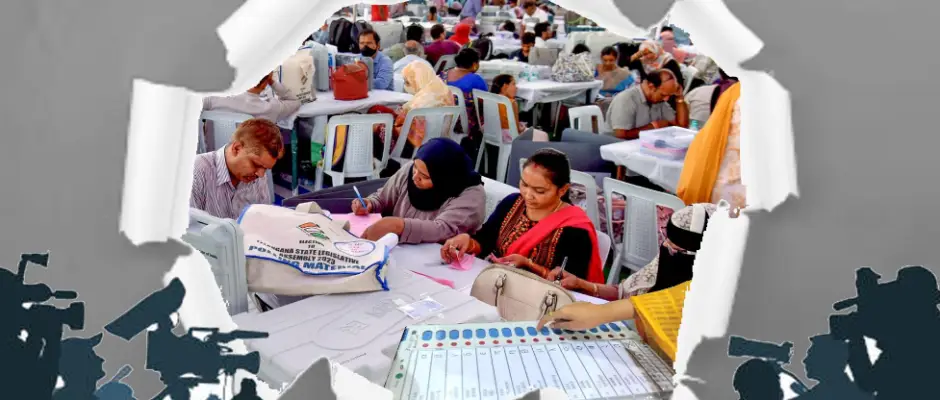
From being ‘gana rajyas’ to going high-tech in campaigns & voting, Bharat has covered huge space and willing to experiment with spiritual democracy Dr Aniruddh Subhedar Like people, nations too have a distinct nature, character and history of their own. Bharat is no exception to this and has its own uniqueness in all these three aspects. Studying Bharat diligently and objectively, one will find that ideal of democracy and freedom to choose leaders has been ingrained in her ethos since times immemorial. No doubt the modern democratic institutions of Bharat took their form after British colonization but roots of democracy in Bharat are as old as it gets. When Greece was enjoying its city states, in Bharat there were Gana-Rajyas. Ganas means the people making up a state and Gana-Rajya translates to “rule of people”. Scholars tell us that even before Gana-Rajyas, during evolution of Bharatiya civilization, in Vedic period we find existence of assemblies like Sabha, Samiti and Vidath, which used to administer people and whose leaders were elected by the people only. The Ganas were basically units as cohesive as families or clans. Later when monarchy became the norm in Bharat, it was not too far away from this basic ideal. The word ‘praja‘, which means people / subjects, literally translates to ‘offspring’ or children. In essence, Raja (King) was supposed to take care of his people as his own children. And, even during that era of monarchy, at the village level panchayats or village assemblies, usually made up of community elders, were thriving in Bharat; respected and accepted by the State. Therefore, transition to modern democratic political setup was not too hard for Bharatiyas. As soon as Bharat freed itself from colonial clutches, it made universal adult franchise one of the defining characteristics of its political system. In Letter & Practice In modern times, democratic ethics are too well entrenched in Bharat’s polity in letter and practice. Preamble of Bharat’s Constitution pledges to constitute the country into “a democratic republic”. Free and fair elections are bedrock on which this democratic systems stands upon. The Constitution ensures that there is a permanent and independent body- ‘Election Commission of India’ (ECI) which has the power to control and regulate elections to parliament, state legislatures, office of president and vice-president. Measures relating to elections are so stringent that once ‘Model Code of Conduct’ is implemented by the Election Commission, the government is prohibited from making any announcements or policy decisions that could potentially influence people’s voting choices. This means government cannot start any populist scheme and even government bodies cannot start any recruiting process. Provisions of Constitution are not a dead letter. In fact, it’s followed quite strictly. General elections in Bharat are not some run-of-the-mill affair; it is of gigantic proportions. General elections in 2024 Bharat will be the largest exercise ever in the world surpassing even the one held in 2019. Total 90 million people are eligible to vote in this election. It will be the longest-held general election in Bharat (except for the first general election of Independent Bharat in 1951-52) spanning over 44 days. One of the reasons Bharat’s democracy has endured test of time is the seriousness about voting rights and fair elections. Otherwise in Bharat’s neighbourhood there’s hardly a country which can pride itself as a true democracy. In fact, in Bharat’s west, it is hard to find a truly functioning democracy till one crosses the Middle-Eastern countries. Being one of the most populous and diverse countries in the world, Bharat plays a major role in ensuring that democracy and human rights are secure in South East Asia. Bharatiyas take their right to vote seriously and don’t like anyone meddling with it. The closest Bharat came to dictatorship was during 1975-77 emergency imposed by then Prime Minister Indira Gandhi. But what preceded and followed this 21-month stint with dictatorship is worth mentioning here. Among the other reasons, the immediate cause of Indira Gandhi implementing emergency was that the courts concluded that malpractices were used in her election and declared it as null and void. Indira Gandhi paid the price for imposing the Emergency when she and her party Congress were wiped out in elections post-emergency. Interestingly enough, she was re-elected by the people again and later her son Rajiv Gandhi won highest number of seats in Bharat’s political history owing to sympathy wave caused by Indira Gandhi’s assassination by Khalistani terrorists. It shows that Indira Gandhi always had a political stature but even Prime Minister of her standing wasn’t spared by Bharatiya people when she tried to curb their freedom. Credibility of Election Process Given the vast geographical area and size of the electorate, ECI has modernized the process by using Electronic Voting Machines (EVMs) for polling and counting votes for more than two decades. Making the process more credible and faster, EVMs were first used in 1980s, and they are used in general elections since 2004. In 2017 many Opposition parties like Congress, Bahujan Samaj Party, Aam Admi Party harboured doubts on credibility of EVMs after they lost elections in some states. It was alleged that BJP is tempering with EVMs. The allegations went as bizarre as claiming that EVMs (a self-contained, stand-alone machine, lacking any networking capability) is being hacked via internet. A leader of AAP even brought a machine to the Delhi Assembly which looked like EVM and demonstrated how it could be hacked. All this hullabaloo was silenced when in May-June 2017 the ECI invited these parties and gave them the real EVM to prove that it could be hacked. Parties like AAP did not even participate in the challenge, while other two other parties, CPI (M) and NCP, who sent their representatives said that “they just came to understand how EVMs work”. Even without going into technical know-how the allegations against EVMs could be easily dismissed by looking at the fact that even in these 2017 elections, BJP lost in Punjab and Congress won. AAP won Punjab state

Read More

Pakistan, China Rob Balochs Freedom to Live

Protests in Amsterdam, Berlin on ‘black day’ against forced occupation and annexation of Balochi land marks 76 years struggle for liberation Rahul Pawa Seventy-six years ago, on March 27, 1948, Pakistan’s occupation and forceful annexation of Balochistan ignited a bloody conflict that has simmered since decades and claimed innumerable lives. This annexation, far from being a justifiable integration, signalled start of a prolonged struggle for Baloch people, who have since endured relentless torment and despair. Despite passage of time, the spirit of resistance within Balochistan remains undiminished, as its people continue to assert their rejection of Pakistani illegal occupation. This struggle is not just a tale of contested territory but a profound testament to resilience of Baloch peoples’ steadfast in their pursuit of self-determination.  Baloch account for roughly 15 million of Pakistan’s 240 million people, however, their province, largest in current day Pakistan, stands as the country’s most backward region despite its immense wealth in natural resources. This stark contrast is highlighted by its vast reserves of oil, coal, gold, copper, and gas which significantly contribute to Pakistan’s revenue. Result of, Balochistan has experienced a prolonged period of neglect and exploitation by the Pakistani state, which has primarily focused on exploiting its rich mineral resources without consideration for the people of Balochistan. This exploitation came to a head following Pakistan’s nuclear tests on May 28, 1998, at the Ras Koh mountains in Balochistan, which had devastating environmental and health impacts on the local population. The tests resulted in significant livestock losses and led to increased cancer rates among the Baloch people due to nuclear radiation exposure. These actions have fueled discontent and resistance against the state authorities. In addition to environmental degradation and a public health crisis, the region has been subjected to severe human rights abuses, including enforced disappearances and a notorious “kill and dump” policy of the Pakistan Army. This inhumane treatment has further exacerbated tensions in the occupied territory and fueled discontent leading to resistance against the Pakistani state and highlighted the urgent need for addressing severe human rights concerns in Balochistan. The dire situation in Balochistan, as unveiled in a 2016 United Nations Working Group’s assessment and corroborated by activist accounts, illustrates a severe human rights crisis that has not been adequately reported or acknowledged by the Pakistani state. The discrepancy between the provincial government’s admission of fewer than 100 missing persons and data from local sources of over 14,000 individuals missing underscores a profound transparency and accountability issue. Furthermore, while the Pakistan Commission of Inquiry on Enforced Disappearances documented 2,708 missing persons since 2011, activists report a staggering 504 extrajudicial killings within the province in just the previous year alone. These numbers, vastly divergent from official state reports, highlight a critical gap in the state’s acknowledgment and documentation of human rights abuses pointing to state complicity in the violations against the people of Balochistan. In addition, banking on occupied territories, the province hosts Pakistan’s only deep-sea port at Gwadar. This port, pivotal to the US $65 billion China-Pakistan Economic Corridor (CPEC), a project designed to connect southwestern China with the Arabian Sea via Pakistan, has added another layer of occupation of Baloch lands by the Communist Party of China (CPC) and its People’s Liberation Army (PLA). The strategic significance of Gwadar Port extends beyond economic interests, serving as a key maritime node in China’s Belt and Road Initiative (BRI). This development aims to expand China’s influence through a vast network of trade routes and infrastructure projects across Asia, Africa, and Europe. However, the expansion of Gwadar Port and the broader CPEC initiative have raised concerns among the Baloch population regarding sovereignty and the fair distribution of resources. These massive infrastructure projects serve the interests of CPC and Pakistani federal stakeholders, compounding environmental impacts, the displacement of local populations, and the alteration of traditional livelihoods. The influx of foreign workers, particularly from China, and the prioritisation of their needs and security have created an environment where the rights and welfare of the local population are sidelined. Reports of forced marriages have sparked outrage, highlighting the exploitation and vulnerability of local communities amidst the sweeping changes brought by these Chinese projects. This scenario is further complicated by extreme instances of human rights violations, including the suppression of dissent, censorship, and the curtailing of freedoms. The Baloch population’s grievances are not limited to economic marginalisation but extend to a profound sense of cultural and societal invasion. The presence of PLA and Pakistani security forces, under the guise of protecting investments, has led to a militarisation of the region, contributing to a climate of occupation, fear and repression. In the face of persistent human rights abuses and the forceful occupation of their homeland, the Baloch community worldwide observes March 27th as a ‘black day’, symbolising resistance against their land’s forced annexation. Spearheaded by the Baloch National Movement (BNM), significant protests across cities like Amsterdam and Berlin highlight Baloch struggle for freedom, denouncing Pakistan’s oppressive control, amplified by the complicating presence of China’s CPC and PLA through projects like the CPEC. This international outcry, marked by rallies and informative campaigns, not only exposes the dire situation in Balochistan but also calls for global intervention. The Baloch people’s defiance is a plea for recognition of their sovereignty and an end to external exploitations—a clear demand for justice and respect for human rights in the shadow of occupation and exploitation.  (Author is Director – Research at Centre for Integrated and Holistic Studies, a non-partisan think tank based in New Delhi)

Read More

Jinnah’s Fallacy Commemorated as Pakistan’s National Day!

The Lahore Resolution, aka Pakistan Resolution, written by Sher-e-Bangla A.K. Fazlul Huq, said that Muslims in India were a separate country with their own social, religious, and cultural identities. It called for the creation of independent states in areas where Muslims predominated. Despite the resolution’s own lack of mention of the term “Pakistan,” it planted the seeds for its ultimate establishment. Millions of Muslims’ hopes for their political future were brought to life and given a tangible vision by the Lahore Resolution. Intellectuals like Allama Iqbal, who emphasised the political, social, and cultural distinctions between Muslims and Hindus, were instrumental in developing the idea of a distinct Muslim state. The concept gained more popularity after Choudhary Rahmat Ali’s 1933 pamphlet “Now or Never”, which suggested calling the hypothetical state “Pakistan”, was published. Pakistan is an odd outlier in the vast fabric of geopolitical history, a nation that appeared out of thin air and lacks a tangible locus. Its establishment in 1947, during the mayhem of British decolonization in the Indian subcontinent, was not a product of historical or cultural evolution, but rather of political expediency. Ever since its establishment, Pakistan has faced difficulties in defining its identity and navigating issues related to legitimacy, governance, and identity beyond its arbitrary borders. Pakistan was created by political plotting motivated by the demands of sectarian politics and colonial legacies, not by a natural process based on nationalism. Pakistan was created by the division of British India. Pakistan’s ideological foundation came from the Two-Nation Theory, which maintained that Muslims and Hindus were two distinct nations that could not cohabit in a single state. Nevertheless, this notion oversimplified the complex sociocultural context of the Indian subcontinent and ignored the diversity within Muslim communities. Pakistan’s identity gets more complex by its large geographical region. Divided by over a thousand miles of Indian territory, East and West Pakistan (now Bangladesh and Pakistan, respectively) had little in common except their shared religious beliefs. This physical separation further undermined the legitimacy of the Pakistani state, escalating racial tensions and ultimately leading to the bloody battle and Bangladesh’s secession in 1971. Two-Nation Theory of Muhammad Ali Jinnah was weak and unimpressive. It was hollow on an intellectual level and disconnected from reality. Muslims were everywhere throughout India and all of them would not have been able to have had their own homeland without a massive population swap. Although Ambedkar and Jinnah discussed it in passing but both must have understood how unrealistic it was. Yet, Jinnah was able to stir up fleeting feelings and sway Muslim sentiment in his favour. The day India was divided proved its falsehood. Just slightly more than half of the 100 million Muslims migrated to Pakistan. The remainder chose to remain in India.[1] Jinnah, leader of the All-India Muslim League, fiercely advocated Muslims’ rights in British India. He believed that the Muslims of the subcontinent were a distinct people and that they ought to have their own nation where they could openly practice their religion and have their rights to politics and culture protected. This idea served as the cornerstone of his political campaign to establish Pakistan. A fundamental element of Jinnah’s scheme and subsequent partition of the Indian subcontinent was the Two-Nation Theory. The argument that Muslims and Hindus in British India were two different nations with irreconcilable differences was used by Jinnah and his Muslim League to support the demand for a separate Muslim state.[2] With support from Muslim League, Jinnah formulated the Two-Nation Theory for the purpose of defending their political, cultural, and religious rights, contented that Muslims needed their own state.  This increased tensions between communities and prepared the ground for the terrible violence and uprooting that precipitated division in 1947. In fact, the split itself continues to rank among the most horrific events in the history of the region, causing extensive killings, large-scale migrations, and lingering hostilities. There is no denying that Jinnah’s Two-Nation Theory still has an impact on South Asia’s political climate today. The contentious relations between India and Pakistan and the continuous discussions in the region about nationalism, identity, and religious plurality are all affected by the legacy of partition. Dismissing the Myth That Hindus and Muslims Cannot Coexist With a population of over a billion, India is home to both one of the biggest Muslim populations in the world and a majority Hindu population, dispelling the idea that the two religions cannot live in harmony. Most Muslims and Hindus in India live in harmony, sharing homes, workplaces, and cultural activities.  This coexistence is a result of centuries of shared history and respect for one another, not just an oddity. Rhetoric that asserts Muslims and Hindus cannot live in harmony has reappeared in recent years. The long history of tranquilly and cohabitation between these two cultures in the Indian subcontinent is undermined by this dividing narrative, which is frequently supported by political agendas and sectarian interests. The belief that Muslims and Hindus cannot live together exaggerates complex social realities and ignores millennia of shared cultural history and respect. Many religious sects have historically called India home, contributing to the country’s rich cultural diversity. First of all, these claims are contradicted by India’s own history. For centuries, Muslims and Hindus have coexisted in the same social and cultural context, sometimes amicably and other times tensely. The blending of these two major religions is attested to by the nation’s syncretic traditions, which are seen in its literature, festivals, and architectural design. From ancient times India has been a melting pot of several religions, where mutual respect and understanding have often prevailed. During the Indian Independence movement, Muslims and Hindus fought side by side against British colonial rule. Visionaries like Mahatma Gandhi and Maulana Abul Kalam Azad, who highlighted that all Indians, regardless of their creed, share a common destiny, advocated religious harmony and cooperation. There are countless examples of Hindus and Muslims living side by side in harmony and peace throughout India. The reality on the ground belies the

Read More

China Spins Jingoistic Narrative

Bharat hits back on Chinese Communist Party’s false claims on Arunachal Pradesh. Global community including US recognize the dragon ploy. Rohan Giri There’s something innate in China that cannot change. It’s in its DNA to encroach on others. As part of its grand plan to usurp others land, properties and expand its hegemony, China and its ruling Communist Party of China (CPC) have tasted success in few areas while they eagerly look at grabbing neighbours’ territories. Tibet is one area where Chinese Communist Party has had large success in altering names of places, assert control on large swaps of land and change, culture, languages and life of ordinary citizens. Through coercion, China constructed certain structures to also advance on its border regions through coercive means. Similar attempts have been made with Bharat’s territories especially Arunachal Pradesh to assert its dominance in the region. Communist Party of China and its life time General Secretary Xi Jingping announced Chinese names to places in and around Arunachal Pradesh. Latest in the Chinese ploy of old and deceitful rhetoric is evidenced by statements made by People’s Liberation Army’s Senior Colonel Zhang Xiaogang, spokesperson for Chinese Defense Ministry. By intention, he claimed that southern region of Xizang, the Chinese nomenclature for Tibet, was integral component of China’s territory.  This was obvious reference to Arunachal Pradesh which China thinks is its own territory. Chinese Defense Ministry raked up the bogey on Bharat’s north-eastern state of Arunachal Pradesh after Sela Tunnel was constructed to enhance civic and military connectivity and capabilities in the state. The latest overtures by China expose the Chinese Communist Party ploy to initially seize Tibet and subsequently move in on Arunachal Pradesh. Bharat along with 17 other countries, mostly neighbours, has experienced adverse consequences of persistently making unsubstantiated claims by Chinese Communist Party. Henry McMahon, then foreign secretary of Britain drew an 890-km border between Bharat and Tibet in 1914. Arunachal Pradesh was formerly referred to as North Eastern Frontier Agency before the establishment of the McMahon Line. On one side of McMahon, Tibet existed as an autonomous region while on the other Arunachal Pradesh was an Indian state. Chinese communist party falsely maintains that Tibet is one component of China and refuses to acknowledge this demarcation. China’s aspirations for territorial expansion had begun to gain momentum at this point. The act of manipulating maps to include some regions of Bharat has been observed since ancient times, hence its innate to its nature. Bogus claims of Chinese communists were undermined when Japanese forces launched an invasion of Arunachal Pradesh, north-eastern state of Bharat during Second World War. Additionally, emergence of Chinese expansionism posed an enormous threat to Bharat’s territorial integrity. During that period, the British-led Indian Army provided protection to Tawang of Arunachal Pradesh. Bharat has had consistently maintained a firm stance against China’s claims and Arunachal Pradesh residents have historically rejected  China’s expansionist aspirations and unsubstantiated assertions. Latest PLA statements on Arunachal Pradesh have come after Chinese Communist Party misleading names of 11 locations in Arunachal Pradesh. In addition to expressing their outrage, local populace actively engaged in peace marches on the roads, demonstrating their opposition to China. The protesting people were holding placards that read, “We stand by India” and “Arunachal is not part of China.” The posters in their possession had the message, “Don’t we know… How China is oppressing the people of Tibet and is always engaged in looting it? At any cost, we would not like the condition of Arunachal Pradesh to become like that of Tibet…” Individuals hailing from Arunachal Pradesh, holding tricolor flags, asserted that similar demonstration were held when China changed the names of six locations in 2017 and 15 locations in 2021. The misleading names were in the Chinese and Tibetan languages. In 2023, the controversy over stapled visas gained attention as Indian Wushu players were granted such visas by China. New Delhi-based think tank Center for Integrated and Holistic Studies, at that time, had reported that the “Stapled visas incident is seen more as one step further in China’s grand expansionist plan and communist vision to occupy others’ land disregarding international treaties, pacts and ‘gentlemen’ agreements to not change on-the-ground goal posts. Only way to put an end to this psycho-warfare like stapled visas is to firmly retake ‘Aksai Chin’ under its ‘illegal’ occupation since 1950s and held after the 1962 war.” Bharat and its government always said that Arunachal Pradesh was, is, and will remain integral to the country. China’s illegal expansionist strategy extended much beyond Arunachal Pradesh, Tibet, or Nepal. Countries and international communities need to be alert to such machinations and not succumb to mechanisms like debt trap, infrastructure development or other forms of avarice. (Author: Rohan Giri is a journalism graduate from Indian Institute of Mass Communication (IIMC) New Delhi, and Manager Operations at CIHS.)

Read More