CIHS – Centre for Integrated and Holistic Studies

Date/Time:

Bhojshala Verdict: Constitutional and Historical Perspectives

On May 15, 2026, the Indore Bench of the Madhya Pradesh High Court delivered a historic decision recognizing the Bhojshala complex as the temple of Goddess Vagdevi (Saraswati), overturning 2003 dual-use arrangement barring namaz on Fridays inside the site. Court established an evidence-based system for resolving heritage disputes based on the ASI’s 2024 scientific study, historical evidence connecting the site to Raja Bhoj’s Paramara-era Sanskrit learning center and the persistence of Hindu worship while allowing the Muslim community to seek alternate site for a mosque in the Dhar area. The decision, which prioritises historical and archeological evidence over administrative compromise, is a significant development in India’s heritage jurisprudence.

Read More

Pragmatism Over Ambition

BRICS currency may not be shelved all together. Non-dollar settlements, digital currencies, regional payment gateways to take precedence. N. C. Bipindra A common BRICS currency is an idea that once symbolised the grouping’s ambitious challenge to dominance of US Dollar. The common BRICS currency was proposed to reshape the global financial order apart from geo-political realignments. But the geopolitical climate is rapidly going downhill, what with the West Asian conflict engaging global attention over last two-and-a-half months now. The diverging national interests of BRICS nations are compounding the challenge. This divergence is exposing deep structural limits of the group’s common currency proposal. Instead of accelerating toward a unified currency for the 11-nation grouping, BRICS members are increasingly moving more toward a fragmented but practical financial system built around national digital currencies and local-currency trade settlements. BRICS originally with just four members in Brazil, Russia, India, and China, has grown to include South Africa (and hence became BRICS from BRIC). The BRICS now includes world’s major energy producers and regional powers, essentially positioning itself as a counterbalance to the G7, which is unwilling to accommodate other major economies within its architecture. The expanded BRICS has repeatedly discussed reducing dependence on US Dollar in trade settlements. Yet, despite the strong rhetoric from nations like Russia and China, a consensus among the member states is elusive. There is no real agreement on creating a single BRICS currency notwithstanding the Delhi declaration that had the currency as a big selling point for the group. The latest instability in West Asia, a major energy-producing region, has only complicated the situation. The conflict-driven volatility in oil markets, sanctions risks, supply chain disruptions and currency instability have all highlighted a basic geopolitical reality. BRICS economies are too diverse in structure, political orientation, and monetary priorities to surrender sovereignty over currency policy. Unlike the Eurozone, BRICS lacks integrated fiscal systems, coordinated central banks or a unified political architecture for it to move towards a common currency. Without these foundational similarities, a common currency would risk becoming economically unsustainable. The changing geopolitical environment is especially significant for Bharat. New Delhi has historically and consistently supported multi-polarity in geopolitical order. India has also emphasised greater use of local currencies in trade, particularly in energy transactions, such as with Russia and Iran. However, India has remained cautious about any arrangement that could disproportionately strengthen China’s financial influence within BRICS. With tensions across West Asia and Europe intensifying and global markets becoming more unpredictable, India may increasingly rethink the feasibility of a BRICS currency altogether. India’s concerns with a single BRICS currency are not just political. Adapting to a unified BRICS currency would require India to significantly align its monetary policy, exchange-rate management, and reserve coordination. India’s economy operates under vastly different conditions than those of China, Russia, Brazil, or South Africa. India’s inflation management, capital controls, banking regulation, and trade priorities differ sharply from those of the other BRICS nations. In times of geopolitical crisis or a pandemic situation like COVID-19, nations typically prefer stronger control over domestic monetary tools rather than less. This explains why an alternative model, such as digital national currencies for intra-bloc settlements, is gaining traction inside BRICS. Instead of replacing sovereign currencies with a single BRICS unit, member states are increasingly exploring Central Bank Digital Currencies (CBDCs) and bilateral payment systems that bypass the Dollar without requiring full monetary union. China’s digital Yuan initiative remains the most advanced example of the CBDC. Russia has accelerated the development of digital payment systems after Western sanctions. India, meanwhile, has actively tested its own digital Rupee infrastructure through the Reserve Bank of India (RBI). These developments in CBDCs suggest that future of BRICS financial integration may be technological rather than monetary.  Under this evolving framework, BRICS nations could settle trade in their own currencies using interoperable digital platforms. For example, energy exports could be priced in Yuan, Rupee, Rubble, or other local currencies, depending on bilateral arrangements. Such a system would gradually reduce exposure to US Dollar, while avoiding the political and economic complications of a shared currency within BRICS. This approach offers several advantages to BRICS nations. One, it preserves monetary sovereignty for all its member states. Two, it lowers transaction costs and reduces vulnerability to sanctions. Three, it allows nations to deepen financial cooperation incrementally rather than through a risky “big bang” currency union. President Donald J Trump had been fuming on the very idea of BRICS currency and threatened to slap huge imposts on member countries in case they moved ahead. Though US dollar continues to be the major preferred currency to settle transactions, it’s slowly losing sheen. President Trump expects that a strong alternative BRICS currency would dampen the US dollar’s primacy as the major international paper.  Till now, US Dollar remained the most deeply embedded in global financial system due to scale of the American economy, liquidity of US financial markets, and institutional trust surrounding Dollar-denominated assets. Even nations critical of American financial influence continue to rely heavily on US Dollar reserves and US Dollar-based trade mechanisms. Therefore, future of BRICS currency project depends less on political declarations and more on whether the grouping can build a credible financial infrastructure capable of rivaling the existing US Dollar system. At present, BRICS lacks the institutional cohesion needed for such a transformation. Moreover, internal contradictions within BRICS remain substantial. China and India continue to compete strategically and militarily in Asia. Russia’s economy faces sanctions-driven isolation. Newer BRICS members have differing alignments with the West and varying levels of dependence on US Dollar-based trade. These realities weaken possibility of a unified BRICS currency. Current West Asian conflict-induced instability may further reinforce caution among BRICS members. In periods of geopolitical uncertainty, investors and governments typically gravitate toward stable and liquid reserve currencies. And, the US dollar still dominates that space. Even today, oil exporters exploring non-Dollar trade continue to benchmark much of global energy commerce in US Dollars, because of market familiarity and financial stability. But this doesn’t

Read More

Modi’s Mandate to Fuel Reforms

Big wins in state assembly polls especially in West Bengal would hasten pace of economic, governance reforms and spreading the growth story. Bharat continues to be brightest star. K.A. Badarinath West Asia conflict, Russia-Ukraine war notwithstanding, Bharat will continue to be the brightest spot globally on economic front. It will continue to be the fastest growing large economy next three years and bring tangible prosperity to Indians and contribute a large chunk to global communities. Thanks to a stable government headed by Prime Minister Narendra Modi and BJP heading 80 per cent states, union territories, this economic consolidation and expansion will continue into 2029, beyond. A big show of expanding political strength in five states legislative assembly elections would only bolster pace of economic reforms in the country. There’s virtually no stopping despite global uncertainties throwing intermittent challenges to Bharat’s sweepstakes as an economic behemoth. A recent Morgan Stanley report has projected Bharat’s economy to expand beyond US$ 5.7 billion in two years from now. The report released a week ago also talks about continued foreign investment flows during next five years. A whopping US$ 800 billion is expected to be invested in Indian projects, markets and paper by foreign companies spread over 5 years. If we go by the report, at a time when key stakeholders were complaining of uncertainties bogging down the market sentiment, Bharat seems to be the only big exception. What’s more likely is that while domestic demand in India continues its upward swing, export markets may contribute an additional US$ two trillion. Energy, infrastructure, data centres and rural economy will be the biggest drivers of this new growth cycle even as Bharat tests its ‘strategic autonomy’ framework for its global engagement. Till date this framework has delivered handsomely as Bharat continues to carve out its own space internationally without getting bogged down in cliques. For instance, doing energy business with US, Europe, Russia, Iran and engaging both Israel and Palestine have been hallmark of this policy framework. Getting access to energy in gallons of hydrocarbons, Bharat has played its cards deftly to keep its business communication open. Balancing competing forces, holding on its aces and pro-actively pursuing its goals is something Bharat has done amazingly well. It’s not energy front alone. Concluding a raft of free trade and investment agreements with over a countries or unions proves Bharat’s dogged perseverance. From European Union, United Kingdom to signing these agreements with Oman and New Zealand, free trade, investment and economy pacts have demonstrated Bharat’s widest arc of economic engagement. In 2025-26 alone, nine such agreements were concluded while such arrangements are in place with 38 countries. Initial apprehension on such agreements seems to have been set aside while Bharat’s leadership confidently moves forward. Differences notwithstanding, Bharat continues to engage two largest economies internationally, United States and China. Geo-political, border issues, security and perspective continue to be limiting factors. But, that has not stopped Bharat from doing business with these powers that be. Only a couple of days back, companies like Sun Pharma, JSW Steel, Sterlite group and nine others have committed to invest over US$ 20.5 billion in pharmaceuticals, steel, advanced manufacturing, artificial intelligence and infrastructure. At the Select US Invest summit the investments flummoxed markets as it demonstrates the resilience and confidence with which Bharat goes ahead doing business. One would not have imagined targeting US$ 500 billion worth economic engagement between US and Bharat notwithstanding the quixotic Republican White House led by President Donald J Trump. Today, these are the kind of figures being discussed as part of on-going trade talks. Definitely, China is a tricky customer on business front and a difficult northern neighbour from strategic point of view. But, the two uneasy neighbours have been doing business while China has emerged as the largest trading partner for Bharat with bilateral trade of over US$ 151 billion in financial year ending April 1, 2026. There’s no denying the fact that this trade engagement is completely lopsided and in favour of China by many times over. While New Delhi works hard to balance out the trade, go up the value chain and enhance exports to China, the two continue to talk, invest and do business. It does not mean that border disputes with China can be wished away. Out of the US$ 863 billion, services account for about half at US$ 421.32 billion during financial year ending April 1, 2026. Also, the massive trade surplus from services has been making up for huge deficit on merchandise trade. While this anomaly gets corrected, US$ two trillion services exports are something that Bharat is working towards. While there are no shortcuts, artificial intelligence is bound to impact the IT services exports in particular. As the rejig in strategy happens with short term adverse impact staring in the face, Bharat’s biggest bet may be to expand merchandise exports market, go for high value products while retaining the small ticket items. Strengthening agriculture and farm-based rural economy, expanding the allied agricultural services is yet another area that Bharat has been working for long term. Given that economic expansion has shifted to sub-urban, semi-urban and rural areas, the government in Bharat seems to have changed track to capitalize on the opportunities. When the Narendra Modi government announced US$ 26.5 billion credit guarantee fund for micro, small and medium enterprises, it was one way of addressing the West Asia impact on both businesses and jobs. Political stability with the massive mandate that Prime Minister Modi and his party got in West Bengal, Assam, Puducherry, things could not have been better for India. Analysts expect economic reforms apart from politically nuanced policy issues like delimitation of constituencies and bringing in more women into governance would gain pace. While that happens, Bharat continues its economic expansion and prosperity spread drive. (Author is veteran journalist, Director & Chief Executive of New Delhi based non-partisan think tank, Centre for Integrated and Holistic Studies) 

Read More

Canada’s Bill C-9 and Its Implications for Hindus and Khalistani Extremism

With the enactment of Bill C-9 (Combatting Hate Act), Canada’s legislative stance on hate speech, extremist iconography and religious space protection underwent an important change. The law establishes penalties for intimidation at religious institutions motivated by hatred and makes it illegal to publicly display insignia associated with terrorist groups. The law is both a chance for legal protection and a test of the legitimacy of enforcement for Canada’s Hindu minority, which is dealing with an increase in temple destruction, intimidation, and hate speech related to Khalistan. The rule was passed in response to growing worries about targeted animosity toward Hindu populations, temple destruction, and radicalization of the diaspora.

Read More

Trump, Tariffs & Tumult

Uncertainty in global trade got new lease of life with US President Trump insisting on weaponising tariffs with no signs of easing down. K.A.Badarinath President Donald Trump is going bonkers. Tariffs or weapons of mass destruction, it makes no difference to him or the Republican White House that he runs. It’s with the same vigour that deadly arms to different parts of the world are supplied or sold, tariffs slapped or reviewed. In one of my earlier write ups, I did say that Donald Trump would be one of the ‘biggest disruptor’ of global order, be it geo-political, economic and trade relations. This has been proved beyond doubt in recent days. US Supreme Court order of last week may have been just a few hours of pause on weaponised tariffs that’s central to Donald Trump’s economic policy formulation. In those few hours, he switched statutes, juggled acts, related provisions and then slapped 15 per cent import tariffs on each and every country that America trades with, be it an ally or a foe. Well, reciprocal tariff regime of President Trump under his emergency economic powers may have ended. But then, he opened another line to slap tariffs for 150 days pending approval from US Congress. Even as new tariff regime comes into operation beginning Tuesday that are over and above most favoured nations (MFN) duties, uncertainty in global trade continues to reign supreme with nations’ capital across seven seas trying to make sense of the new tariffs, their future and what’s in store for each one of them. By weaponizing tariffs to force both allies and enemies alike into submission, Donald Trump opened a new untested model of building relationships. In the process, President Trump has addressed his domestic white core political constituency who perceive him as a ‘decisive leader’ who’s just going about his job of governing America. From provisions relating to balance of payments, discrimination against American interests to several substantive clauses of Trade Acts in US may be invoked by President Trump to carry forward what he describes as part of his campaign to Make America Great Again (MAGA). President Trump is going gaga to leave his imprint on America’s governance come what may. He shows no signs of backing off any time now. But, what essentially happens is that period of uncertainty would extend, most countries will use this timeframe to recalibrate to redefine their negotiation strategy. While China is better off as it secured one-year negotiation time to sign upon a new trade deal, Bharat has kept its options open and may need more fresh air in the room before a pact is clinched with Washington DC. Now, the proposed18 per cent reciprocal duty to be part of free trade agreement with US becomes infructuous as use of International Economic Emergency powers have been struck down by US Supreme Court. Fresh negotiations for a deal between Bharat and US seem inevitable at much below 18 per cent impost though President Trump continues to insist that nothing has changed for Bharat. Postponing current round of negotiations on FTA for a later date would work well for both India and US as Washington DC.  Secondly, keeping all options open would work in best interest of Bharat and its 1.4 billion citizens. Reworking the entire deal with US in totem over next six months is not a bad idea with ‘strategic autonomy’ being central to engagement. In this context, taking a common approach on US tariffs with like-minded partners as suggested by Brazilian President Luiz Inacio Lula da Silva may be explored. Building blocks or unions against America may not be an option for Bharat though the visiting President Lula has postulated such a strategy. Similarly, putting a full stop to purchase of oil and gas from Russia cannot be an option as Bharat continues to diversify its energy basket, sources and undertakes rework of energy matrix. Diversifying its markets for selling its goods and services beyond European Union should be seriously considered by Bharat’s negotiators. Speciality minerals deal with Brazil is a fine example like the ‘strategic relations’ entered into France is unique and specific to Bharat. Similarly, arriving at a working understanding with China be seriously considered notwithstanding the aggressions, transgressions made by the people’s liberation army on the borders. Containing border conflicts, China giving up its falsified claims in Indo-Pacific should be integral to the working arrangement with Beijing. Thirdly, Bharat should aggressively play the role of a peacenik in conflict between Russia and Ukraine, Israel & Iran apart from taking an aggressive ‘zero tolerance’ posture against radicalism, religious terror and overseas interferences on the sly. Fourthly, achieving a fine balance in our global engagement in the medium to long term to safeguard Bharat’s security interests that are non-negotiable should be the objective. Republican or Democratic White House is no patronizing friend of Bharat. Bharat must safeguard her own interests. (Author is a veteran journalist, writer & blogger, director & chief executive at non-partisan New Delhi based think-tank, Centre for Integrated & Holistic Studies)

Read More

Myanmar’s Strategic Crossroads China’s Influence, Western Interests and a Turbulent Election

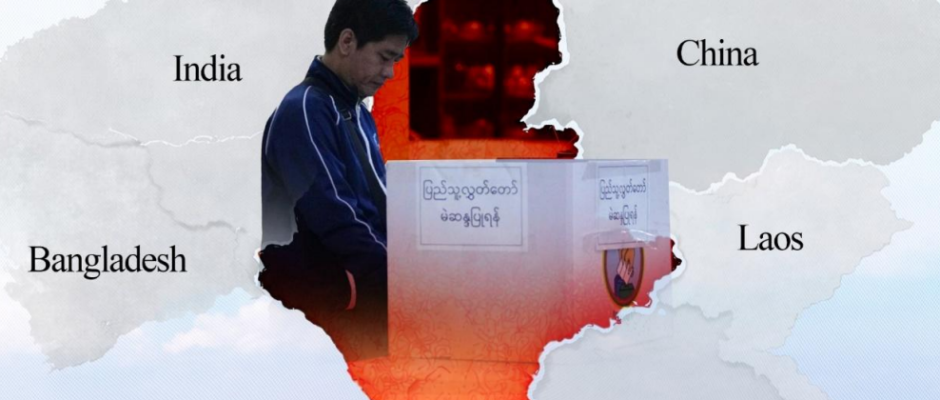
Arun Anand Myanmar (formerly Burma) sits at a critical crossroads in Asia, both geographically and geopolitically. The country’s location – bordering China, India, Bangladesh, Thailand, and Laos, with a long coastline on the Bay of Bengal and Andaman Sea – makes it a bridge between South Asia and Southeast Asia. In fact, Myanmar is often described as the “main connecting hub” linking East, South, and Southeast Asia. Its shores provide access to the Indian Ocean’s major shipping lanes, which has long attracted great power interest. In short, Myanmar’s geostrategic location grants it outsized importance: it is the only Southeast Asian nation sharing borders with both India and China, and it offers a land gateway from the Bay of Bengal into the heart of Asia.

Read More
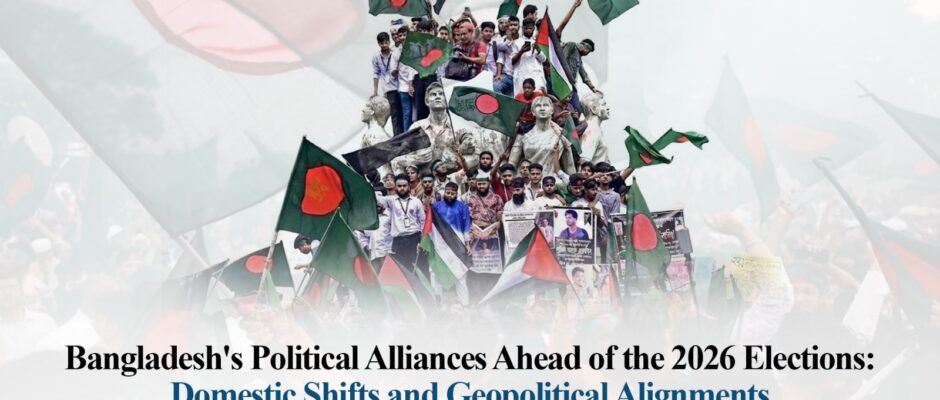
Bangladesh’s Political Alliances Ahead of the 2026 Elections: Domestic Shifts and Geopolitical Alignments

Bangladesh’s Political Alliances Ahead of the 2026 Elections: Domestic Shifts and Geopolitical Alignments

By N. C. Bipindra As Bangladesh moves toward the general elections scheduled for February 2026, the country is experiencing its most far-reaching political realignment in decades. The collapse of Sheikh Hasina’s long-entrenched Awami League dominance following the 2024 mass uprising has dismantled the familiar two-party framework and given rise to a fragmented, competitive political arena. New coalitions, revived Islamist forces and youth-driven political platforms are all vying for space, and their manoeuvring is unfolding amid intensifying regional and global interest. For India, China, the United States and Pakistan, the choices Bangladeshi voters and parties make in 2026 will shape not only domestic governance but also Dhaka’s strategic orientation in South Asia and the wider Indo-Pacific. From Awami League Dominance to Political Fragmentation For more than a decade, Bangladesh’s political and foreign policy trajectory was closely associated with Sheikh Hasina’s Awami League. Domestically, the party presided over a strong centralised system that delivered economic growth while constricting political competition. Internationally, it cultivated a close strategic partnership with India, maintained extensive economic and infrastructure engagement with China and managed an increasingly strained relationship with the United States over issues of democracy, elections and human rights. The upheaval of 2024 abruptly ended this equilibrium. The interim administration under Muhammad Yunus pledged institutional reform and credible elections, but it also left the Awami League politically marginalised, creating a vacuum that rival forces are now racing to fill. BNP: Strategic Balancer with a Nationalist Tilt In this transformed landscape, the Bangladesh Nationalist Party (BNP) has emerged as the most significant electoral contender. Long the principal opposition to the Awami League, BNP now sees itself as the natural governing alternative in a post-Hasina order. Its campaign narrative centres on restoring democratic norms, recalibrating economic policy, and reasserting civilian political authority. The death of party chairperson Khaleda Zia in December 2025 has accelerated a generational shift within the BNP, with her son Tarique Rahman assuming a central leadership role and directing alliance-building efforts ahead of the polls. This transition has infused the party with renewed urgency but also heightened scrutiny of its internal cohesion and strategic direction. Geopolitically, a BNP-led government would likely pursue a more balanced and less India-centric foreign policy than the Awami League. While ties with New Delhi would remain important, BNP has historically been more cautious, sometimes sceptical, of India’s influence and would seek a relationship framed more explicitly around reciprocity and sovereignty. At the same time, BNP is open to deepening economic engagement with China, viewing Beijing primarily as a source of investment and infrastructure rather than an ideological partner. Relations with the United States are expected to improve relative to the later Awami League years, as Washington sees BNP as more receptive to competitive politics, though US support would remain contingent on credible elections and limits on Islamist influence. Any warming of ties with Pakistan under a BNP government would likely be symbolic rather than transformative, constrained by historical sensitivities and limited economic incentives. Islamist Bloc: Ideological Identity, Strategic Ambiguity Alongside BNP’s resurgence, the return of Islamist politics has added a new layer of complexity to the electoral contest. The reinstatement of Jamaat-e-Islami has allowed it to rebuild an Islamist-leaning bloc drawing on conservative rural constituencies and religious networks. Although Jamaat is unlikely to dominate nationally, it is well-positioned to influence outcomes in a fragmented parliament. Its re-entry into mainstream politics has unsettled secular and centrist forces, raising questions about Bangladesh’s ideological trajectory after years of enforced secularism under the Awami League. From a geopolitical perspective, Jamaat’s participation is viewed with unease by both India and the United States. New Delhi associates Islamist political mobilisation with potential risks to border security and counter-extremism cooperation, while Washington remains wary of Jamaat’s ideological orientation and historical baggage. Pakistan, by contrast, sees a degree of ideological affinity in Jamaat’s worldview, though this does not automatically translate into strategic alignment. China has taken a more pragmatic stance, showing little concern for Jamaat’s ideology so long as political stability is maintained and economic engagements remain intact. In this sense, Islamist influence complicates Bangladesh’s external relationships without clearly anchoring the country to any single power. National Citizen Party (NCP): Reformist Politics, Geopolitical Ambiguity Another significant player in the evolving political landscape is the National Citizen Party, a youth-led formation that emerged from the 2024 protest movement. The NCP articulates a reformist agenda centred on institutional accountability, anti-corruption measures and generational change in politics. Its rise reflects widespread public fatigue with dynastic politics and entrenched elites. However, the party’s limited grassroots organisation and inexperience have constrained its electoral prospects, pushing it toward alliance calculations that have sparked internal divisions, particularly over potential cooperation with Islamist groups. Internationally, NCP’s discourse resonates most strongly with Western actors, especially the United States, which views its emphasis on transparency and civic rights as aligned with democratic norms. The party has not articulated a clear or consistent stance toward India or China, reflecting both its novelty and its focus on domestic reform rather than foreign policy. Over the longer term, NCP represents a potential new political elite that could tilt Bangladesh toward stronger engagement with Western institutions, but in the immediate electoral cycle, its influence is likely to be indirect, mediated through alliances. Awami League Remnant: Pro-India, Diminished but Not Irrelevant Although the Awami League has been largely sidelined, its residual networks within the bureaucracy, business community and local governance structures continue to matter. Any partial rehabilitation of the party would be welcomed in New Delhi, which still regards the Awami League as its most reliable partner in Bangladesh. However, strained relations with the United States and deep hostility toward Pakistan would remain defining features of an Awami League foreign policy orientation, limiting its room for manoeuvre even if it regains political relevance. Democracy, Stability, and Strategic Competition For the United States, 2026 election represents a test of process rather than personalities. Washington’s primary concerns revolve around electoral credibility, political pluralism and the containment of violent extremism. A BNP-led or broadly technocratic

Read More

Bangladesh: A Nobel Halo, an Islamist State,Terror Networks and Radicalisation as State Policy

Rahul PAWA | @imrahulpawa (X) Global jihadists see an opening: a chance to reconnect their Pakistani networks with Bangladeshi extremists, reversing years of counterterrorism and counter-radicalisation gains. On a mid-December night in Bangladesh, 25-year-old Dipu Chandra Das, a Hindu garment factory worker was beaten by a frenzy of Islamists, hung from a tree, and set ablaze on a highway. His alleged “crime”? A rumor that he insulted Islam. Yet investigators have since confirmed there is zero evidence that Dipu ever blasphemed at all. Not one can point to a single derogatory remark he made; “no one saw or heard” anything offensive, a Rapid Action Battalion officer admitted. In other words, an innocent Hindu man was lynched and immolated over a lie. One would expect such a medieval atrocity, captured on video and circulated worldwide, to provoke an outpouring of shock from international human rights watchdogs. Imagine if the roles were reversed: a Muslim man lynched and burned by a mob in a Hindu-majority country. The global indignation would be instantaneous and deafening. But in Dipu’s case, the outrage has been oddly muted. Major human rights organizations and Western governments that normally champion minority rights barely mustered a whisper of protest. The deafening silence of these supposed watchdogs is as harrowing as the crime itself, and it exposes a disturbing double standard. Bangladesh’s own minority rights groups vehemently condemned the lynching, the Bangladesh Hindu-Buddhist-Christian Unity Council decried the “so-called blasphemy” killing as an assault on communal harmony. But where were the urgent press releases from Geneva, the high-profile tweets from Human Rights Watch, the emergency sessions at the UN? Their voices have been either absent or astonishingly subdued. Such restraint stands in stark contrast to their usual activism when religious persecution occurs elsewhere. The message implicit in this silence is chilling: that the lynching of a poor Hindu man in Bangladesh is somehow a lesser transgression on the global human rights ledger. The hypocrisy extends to Bangladesh’s interim rulers. The current government, led by Nobel Peace laureate Muhammad Yunus, swept to power in August 2024 after a Islamist-led “Monsoon Revolution” toppled Sheikh Hasina’s democratically elected administration. Internationally, Yunus is venerated for championing human rights and equality. Domestically, his regime’s actions tell a darker story. Chief Adviser Yunus was quick to issue a condemnation of Dipu’s lynching, vowing the perpetrators “will not be spared”. However, such words ring hollow against the regime’s track record: while it denounces one mob killing, it has concurrently overseen the release or escape of hundreds of criminals and Islamist extremists since taking power. At Hadi’s funeral, Yunus himself delivered a eulogy that should have set off international alarm bells. In front of tens of thousands, Yunus heaped praise on Hadi’s “mantra” and vowed to fulfill Hadi’s vision “generation after generation”. Let’s be clear: Hadi was explicitly known for his anti-India and anti-Hindu rhetoric and polarising, Islamist-tinged politics. By publicly sanctifying Hadi’s ideals, Yunus sent a dangerous signal that anti-India and anti-Hindu dictate is now quasi-official ideology in Dhaka. Unsurprisingly, the fallout was swift. Days after Hadi’s death, Bangladesh erupted in fury, not just against alleged conspirators in his killing, but against perceived Indian influence. Mobs attacked the Indian Assistant High Commission in Chittagong, and hundreds of protesters marched on the Indian High Commission in Dhaka, chanting anti-India slogans and even hurling stones at diplomatic compounds. Bangladesh’s police hinted (without evidence) that Hadi’s assassins might have fled to India – where ex-PM Hasina has taken refuge – a claim that only inflamed public paranoia. In the frenzy, fact and fiction mattered little: ‘anti-India and anti-Hindu agenda’ was the rallying cry. Caught in the crossfire were Bangladesh’s Hindu minorities, now doubly scapegoated as both “blasphemers” at home and perceived fifth-columnists for India. Attacks on Hindu homes, temples and community leaders have spiked over the past year and a half. Even before Dipu Das’s lynching, minority groups warned that the post-Hasina political climate had emboldened extremists to settle scores with Hindus, Buddhists and Christians. Tragically, those warnings proved prescient in Bhaluka, Mymensingh, when Dipu’s killers exploited a religious rumor to unleash lethal mob “justice.” Police and RAB have detained ten suspects, Mohammad Limon Sarkar, Mohammad Tarek Hossain, Mohammad Manik Mia, Ershad Ali, Nijum Uddin, Alomgir Hossain, Mohammad Miraj Hossain Akon, Mohammad Azmol Hasan Sagir, Mohammad Shahin Mia, and Mohammad Nazmul, aged 19 to 46. The interim regime’s, especially Mohammad Yunis’s own actions, from baiting an anti-Indian agitator to allowing Islamist hardliners back into public life, have fertilised the soil in which Islamist extremism and radicalisation grows. Perhaps most cynical of all has been the Bangladesh Foreign Ministry’s complicity and the atrocious attempt to downplay these horrors. When India officially protested the mob killing of a Hindu Bangladeshi (and even a small peoples demonstration in New Delhi decrying it), Dhaka’s response was dismissive. Foreign Affairs Adviser Mohammad Touhid Hossain bristled at the notion that Dipu Das’s lynching had anything to do with minority targeting. He then lectured that “such incidents occur across the region” and every country has a responsibility to address themas if mob lynching and immolation of religious minorities is just business as usual in South Asia, nothing special. This whataboutist shrug is nothing short of an attempt to normalise hate crimes. By equating a communal lynching with generic law-and-order problems everywhere, Bangladesh’s officials signal that the brutal murder of a Hindu for an unproven slur is not a national emergency but a routine matter that merits no extra soul-searching. This attitude is profoundly dangerous. Bangladesh was founded on principles of secularism and communal harmony in 1971, a legacy now under siege. To shrug off anti-Hindu violence as “common in the region” is to abandon the very idea of a pluralistic Bangladesh. It emboldens extremists and tells persecuted minorities that they are essentially on their own. Indeed, Islamist radicals have heard the message loud and clear. With the new regime’s indulgence, dormant terrorist networks are roaring back to life. Key jihadist leaders have re-entered the fray, for example,

Read More
A Nation at Risk While the World Watches

A Nation at Risk While the World Watches

By R K Raina The events that unfolded in Dhaka this week should end any remaining illusion that Bangladesh’s current political drift is a contained or internal matter. On Wednesday afternoon, hundreds of protesters marched towards the Indian High Commission under the banner of July Oikya, raising anti-India slogans and issuing open threats against a diplomatic mission. Police restraint prevented immediate escalation, but the message was unmistakable: radical forces now feel emboldened enough to challenge diplomatic norms in broad daylight. The protest was not spontaneous. July Oikya, a front comprising several groups linked to the July mass uprising, had announced its “March to Indian High Commission” in advance. Its leaders warned that they would forcibly enter the High Commission if their demands were not met. These included the return of individuals convicted in the so-called July massacre case, including former Prime Minister Sheikh Hasina, and an end to what they described as “Indian conspiracies” against Bangladesh. Such rhetoric mirrors the familiar language of Islamist mobilisation across the region, where external enemies are invoked to justify internal radicalisation. What makes this incident especially alarming is not merely the hostility directed at India, but the broader political context in which it occurred. Several fundamentalist and extremist figures, previously detained on terrorism-related charges, have been released in recent months under the current interim administration. Many of these elements are now active on the streets, shaping protest narratives and openly threatening foreign missions. This is not accidental. It is the predictable outcome of legitimising radical actors under the pretext of political transition. Threatening a foreign high commission violates the most basic norms of the diplomatic community. When such acts are tolerated, or downplayed as expressions of popular anger, the consequences extend far beyond bilateral relations. They signal a breakdown of state authority and a willingness to allow extremist mobilisation to dictate political space. This moment must be understood within Bangladesh’s longer historical arc. The country was born in 1971 as a rejection of Pakistan’s ideological model. Bengali nationalism asserted that language, culture and democratic choice mattered more than religious uniformity imposed by the state. Sheikh Mujibur Rahman articulated this vision decades earlier, insisting that Bengal’s history and identity could not be erased. That vision guided Bangladesh through its most successful periods of economic growth and social stability. The forces now gaining ground stand in direct opposition to that legacy. Pakistan’s role in this trajectory is being conspicuously ignored. Since 1971, Islamabad has never reconciled itself to the idea of a secular, culturally confident Bangladesh. Its historical hostility to Bengali identity culminated in genocide, and its ideological influence has since flowed through organisations that opposed Bangladesh’s independence. Jamaat-e-Islami, banned for its collaboration with Pakistan during the liberation war and now politically rehabilitated, remains the clearest example. Its ideological alignment with Pakistan is neither incidental nor historical trivia; it is central to the current moment. Yet while these forces resurface, much of the  world has chosen silence. Worse, some have framed recent developments as a domestic political correction, urging restraint while avoiding any serious engagement with the ideological direction Bangladesh is being pushed towards. Treating the rise of radical street power, the intimidation of diplomatic missions and the release of extremist figures as internal matters is not neutrality. It is abdication. This selective blindness sets a dangerous precedent. Terrorism, it appears, is being judged differently depending on the target and the geography. Threats against Indian diplomatic property are brushed aside, while the same actors would be condemned instantly if they appeared near other embassies. Such double standards undermine the very international norms. The regional consequences are serious. South Asia is already burdened by fragile borders, unresolved conflicts and ideological fault lines. Allowing Bangladesh to slide towards Pakistan-style politics, marked by street radicalism, ideological hostility and economic uncertainty, risks destabilising an entire neighbourhood. The early economic signals are already troubling. Political instability and radical mobilisation have begun to erode confidence in what was once one of Asia’s most promising growth stories. Equally at stake is Bangladesh’s cultural future. The sustained assault on symbols of the liberation movement, and the replacement of Bengali nationalism with political Islam represent an attempt to rewrite the country’s founding narrative. History shows that such projects do not end with symbolism. They reshape education, law and social norms, often irreversibly. World policymakers should be under no illusion. Pakistan itself is a case study in how tolerating or enabling radical forces for short-term stability leads to long-term dysfunction. Decades of engagement have failed to undo the damage caused by ideological capture of the state. To allow Bangladesh to move down the same path is not a policy error; it is a strategic failure. The warning signs today are far clearer. Threats to diplomatic missions, the release of extremists and the open mobilisation of radical fronts are not normal features of democratic transition. They are indicators of state erosion. If the world continues to look away, it will share responsibility for what follows. The erosion of peace in this region, the empowerment of extremist networks and the slow destruction of Bengali cultural identity will not remain confined within Bangladesh’s borders. Silence, in this case, is not caution. It is complicity. (Author is a former diplomat and policy commentator focused on South Asian geopolitics, Tibet and India’s neighbourhood. He contributes to leading think tanks and policy platforms on regional and civilisational issues.)

Read More

Reject Hindu Label to Slow Growth

Hinduphobia, colonial enslavement led certain intellectuals, socialists to frame Hinduness for tardy progress. Real culprits are socialists and their handlers! K.A.Badarinath It’s a colonial era slur. None has the right to deride about two billion Hindus living in 100 countries on some pretext or the other. Debunking Hindutva as being somehow responsible for Bharat’s tardy progress or sub-optimal GDP growth of 3.5 per cent in 1950s and 1980s era reeks of hatred. At last week’s Hindustan Times annual leadership summit, Prime Minister Narendra Modi rightly pointed to colonial mind-set for framing Hindu faith with tardy economic growth. Big question is why does one attribute slow economic progress and development to Hindutva? Why do some scholars make derogatory remarks and prejudiced framework to point fingers at Hindu people? Why do self-proclaimed intellectuals and economists ignore Bharat’s seven to eight per cent growth in last two decades was precisely due to these very Hindus? Colonial overhang and socialist underpinning of some intellectuals may have led to bracket low growth with Hindutva. As per The Oxford Companion to Economics in India, economist Raj Krishna made an attempt in 1982 to link the then 3.5 per cent economic growth to an inherent cultural phenomenon. Raj Krishna, a faculty member with Delhi School of Economics, blamed Hindus for not thinking big, staying reticent sans ambition etc. Well, Raj Krishna or his disciples’ arguments are not tenable. He may have grossly erred on intent and by design. Economic progress and development models hitherto adopted during Smt Indira Gandhi or Pandit Jawahar Lal Nehru were largely socialist in orientation and governance. Till, economic reforms were unveiled in 1991, state controls were overbearing and stifled growth. In pre-liberation era, strangulating free enterprise, spirit of Bharat’s businesses and individuals was the norm. Even the governance model was socialist in nature with most power concentrated in Prime Minister like the communist oligarchy. Most annoying was accusing Hindus of strangulating socio-economic development in Bharat and slowing down fight against poverty. It’s rather well documented that economist Raghuram Rajan had revived the debate on linking Hindutva to slow growth rates in 2023. In last quarter ending September 2025, Bharat’s economy reported an expansion of 8.2 per cent with about 65 crore people going to work. Similarly, Bharat was the top major economy to report growth of 7.3 per cent globally, highest amongst G-20 nations with China and Indonesia at second and third position with 5.3 per cent and 5.1 per cent respectively in 2024-25. Countries like Italy and Canada reported contractions in their economies during some quarters. Germany reportedly was at bottom of the pyramid with a feeble 0.2 per cent growth. Stellar economic performance by Bharat was not given a cultural, civilizational or Dharmic label? If it’s not Hinduphobic mind-set, why did self-proclaimed intellectuals bring in Hindu angle to lack of or slow economic progress? Consequence of this Hinduphobic mind-set was that ‘Hindu rate of growth’ gained credence internationally amongst academics and audience thereby driving wrong notion and reinforcing that Bharat and Hindus was incapable of development. Attaching a civilizational label or wrongly portraying Hindus as lethargic or not being innovative may be rejected lock stock barrel. In fact, socialist policies adopted in first four decades put Bharat’s economy on a slumber. Unleashing the potential in a free, flexible and predictable policy paradigm would allow Bharat to realize its potential and emerge the ace. Getting out of colonial mind-set and rejecting out-dated socialist doctrines is pre-requisite to further hastening growth the Bharatiya way. (author is Director & Chief Executive at New Delhi based non-partisan think tank, Centre for Integrated and Holistic Studies)

Read More