CIHS – Centre for Integrated and Holistic Studies

Date/Time:

Hit Job Guised as Study

Caravan’s purported study on Rashtriya Swayamsevak Sangh and like-minded organisations smack of framing agenda for future Dr Aniket Pingley “A plausible explanation is not necessarily a true one.” Dr. Richard Feynman, American Physicist & Nobel Laureate  Synopsis: The Caravan published a study on December 17, 2025 titled “Unveiling the RSS – Exposing the largest far-right network in history”. Its central hypothesis can be summarized as follows: The RSS is not a loose family of ideologically inspired but autonomous organizations, as claimed. Rather, it functions as a single, centrally coordinated political organism that strategically uses thousands of legally distinct civil-society entities as proxies to expand power, evade accountability, and manufacture the illusion of an organic grassroots movement. The study repeatedly asserts that what appears as decentralization has in fact concealed bureaucratic control and that RSS maintains a dual narrative: public denial of control and internal acknowledgment of centralized authority. The central hypothesis smuggles in multiple unstated claims that radically escalate its meaning. Here is what the study actually posits: The study advances several interlocking claims: This is not the first, nor the last, “study” that “attempts” to “demystify” RSS and a large bouquet of organizations with shared ideals. Keeping my subjective opinion about the intention behind this study aside, let us put it to an objective, rational and fundamental test. The test has three questions: “Suspicion, however strong, cannot take the place of proof.” Supreme Court of India, February 2021 Mapping Caravan’s Claims Against Four Postulations The afore-stated verification framework which includes first-hand verification, evidentiary validity and inferential necessity, will be applied to all postulations. P1: “Claims of autonomy are intentionally deceptive; RSS is consciously lying.” This is an accusation of intentional deception and not mis-description. Here are Caravan’s claims. Failure on Verification Test: Caravan’s Proof #1: Caravan states that RSS public material states that it “runs” other organizations as well. The books by Rakesh Sinha and Ratan Sharda are used as a proof of RSS own public material. It also hand wavingly states, “It is, however, common knowledge that the RSS’s influence extends far beyond this limited circle.” Counter-questions for Caravan: What is the basis to qualify a certain literary work as RSS own public material? Does RSS own a publication or on the contrary publicly denies owning a publication? Are even the authors cited holding any official position in RSS? Did Caravan meet an RSS top-level functionary to ascertain if the authors in-fact officially represent RSS? How does Caravan define and measure extent of RSS’s circle of influence? Failure: By asserting and concluding, before offering any evidence, that any literary work by an RSS sympathizer, well-wisher or volunteer is automatically RSS public material, Caravan demonstrates that it treats its own conclusions as proof, rather than seeking actual substantiation. Caravan has accused RSS of obfuscation while it being blurry about the mechanism to measure RSS influence by making use of hand waving statements. Caravan’s Proof #2: Caravan states, “the RSS, as has been repeatedly noted, is —not registered—not as an NGO, not as a religious trust, nor as any other legal entity.” And, that “ … lack of traceability on paper allowed it to set up a headquarters in the heart of the national capital without having to disclose its sources of funding, or even who its members are.” Failure: Legalese, clearly, is not of Caravan’s botheration. RSS is legally recognized in India as a “body of individuals” under the Income Tax Act, 1961, Section 2(31). This means that RSS, as a BOI, can be assessed for income tax purposes as a separate entity. Headquarters of RSS are built and operated under Dr. Hedgewar Smarak Samiti, an independent society registered under the Societies Act. Both these facts are (purposefully?) left-out from the study. A cursory reading on Internet shows several legal notices, defamation suits, sedition charges etc. levied against Caravan by a variety of individuals and entities. Perhaps, it is due to lack of rigour for the legalese. Counter questions for Caravan: Which legal obligation is actually being evaded by RSS? Provided its disregard for legal facts, should anything that Caravan states related to legality be taken seriously? Closing remarks: The “evidence” by Caravan supports an alternative explanation: a culturally networked movement with loose (or strong) coordination but no unitary legal control, since RSS is presented to be “not” a legal entity. If not legally backed, how is control defined or measured? P2: Decision-making authority flows from a central node; affiliates lack discretion Here are the claims made by Caravan: Failure on the Verification Test: Caravan’s Proof #3: I will take one example among a few similar ones. Caravan states “the Maharaja Pratap Singh Ved Vidyalaya was established by a Pune-based organisation, Maharshi Ved Vyas Pratishthan, whose founder, Govindadev Giri, is an RSS member, the treasurer of VHP-controlled trust Ramjanmabhoomi Tirth Kshetra and also sits on the advisory board of the Nagpur hospital Madhav Netralaya, named after former RSS chief Madhav Sadashiv Golwalkar. According to RSS mouthpiece, Organiser, Govindadev Giri’s “initial samskars as RSS swayamsevak are manifested in” the Pratishthan.” Counter-questions for Caravan: Is it being posited that Govinddev Giri (Maharaj) takes orders from RSS on how to conduct his activities? Even if Maharaj is advisor to Madhav Netralaya, does the eye hospital run on whims of RSS through him? If so, can the chain of command be established and proven to be enforced?   Counter-example for Caravan:  The creative director at Caravan happens to be alumni of the same University as many members of UK-based Conservative Party, so Caravan must be peddling Conservative views. Is there any apparatus to measure degree of ridiculousness of this “proof”? Failure: The establishment and operational excellence of Maharishi Ved Vyas Pratishthan is not being considered as a meritorious position of Govinddev Giri’s national influence; but his early association with RSS is posited as his de facto qualification. Caravan’s Proof #4: “Pracharaks are trained in central RSS mission and, upon qualifying, sent out to Sangh appendages to maintain and consolidate control over the network,

Read More
A Nation at Risk While the World Watches

A Nation at Risk While the World Watches

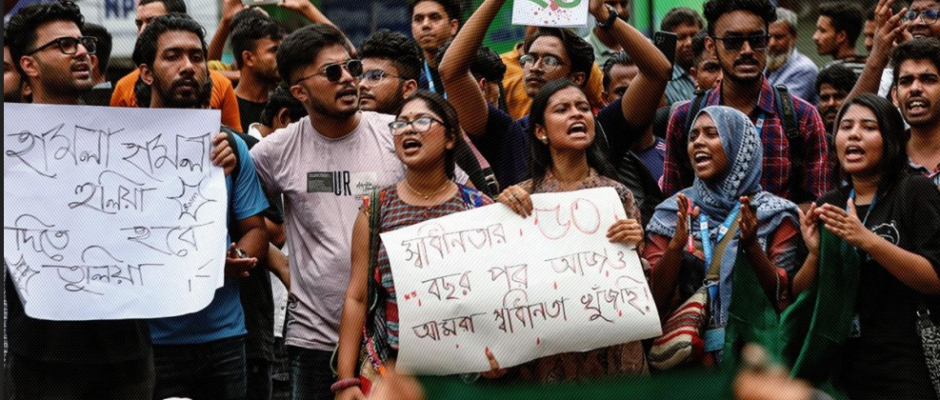
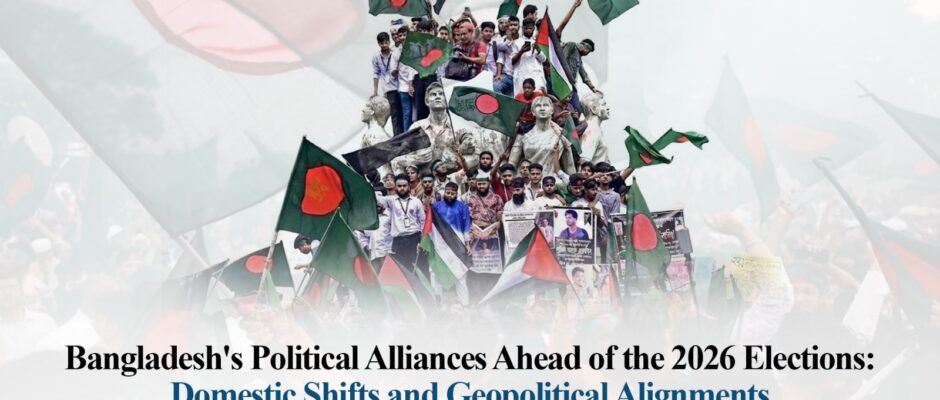
By R K Raina The events that unfolded in Dhaka this week should end any remaining illusion that Bangladesh’s current political drift is a contained or internal matter. On Wednesday afternoon, hundreds of protesters marched towards the Indian High Commission under the banner of July Oikya, raising anti-India slogans and issuing open threats against a diplomatic mission. Police restraint prevented immediate escalation, but the message was unmistakable: radical forces now feel emboldened enough to challenge diplomatic norms in broad daylight. The protest was not spontaneous. July Oikya, a front comprising several groups linked to the July mass uprising, had announced its “March to Indian High Commission” in advance. Its leaders warned that they would forcibly enter the High Commission if their demands were not met. These included the return of individuals convicted in the so-called July massacre case, including former Prime Minister Sheikh Hasina, and an end to what they described as “Indian conspiracies” against Bangladesh. Such rhetoric mirrors the familiar language of Islamist mobilisation across the region, where external enemies are invoked to justify internal radicalisation. What makes this incident especially alarming is not merely the hostility directed at India, but the broader political context in which it occurred. Several fundamentalist and extremist figures, previously detained on terrorism-related charges, have been released in recent months under the current interim administration. Many of these elements are now active on the streets, shaping protest narratives and openly threatening foreign missions. This is not accidental. It is the predictable outcome of legitimising radical actors under the pretext of political transition. Threatening a foreign high commission violates the most basic norms of the diplomatic community. When such acts are tolerated, or downplayed as expressions of popular anger, the consequences extend far beyond bilateral relations. They signal a breakdown of state authority and a willingness to allow extremist mobilisation to dictate political space. This moment must be understood within Bangladesh’s longer historical arc. The country was born in 1971 as a rejection of Pakistan’s ideological model. Bengali nationalism asserted that language, culture and democratic choice mattered more than religious uniformity imposed by the state. Sheikh Mujibur Rahman articulated this vision decades earlier, insisting that Bengal’s history and identity could not be erased. That vision guided Bangladesh through its most successful periods of economic growth and social stability. The forces now gaining ground stand in direct opposition to that legacy. Pakistan’s role in this trajectory is being conspicuously ignored. Since 1971, Islamabad has never reconciled itself to the idea of a secular, culturally confident Bangladesh. Its historical hostility to Bengali identity culminated in genocide, and its ideological influence has since flowed through organisations that opposed Bangladesh’s independence. Jamaat-e-Islami, banned for its collaboration with Pakistan during the liberation war and now politically rehabilitated, remains the clearest example. Its ideological alignment with Pakistan is neither incidental nor historical trivia; it is central to the current moment. Yet while these forces resurface, much of the  world has chosen silence. Worse, some have framed recent developments as a domestic political correction, urging restraint while avoiding any serious engagement with the ideological direction Bangladesh is being pushed towards. Treating the rise of radical street power, the intimidation of diplomatic missions and the release of extremist figures as internal matters is not neutrality. It is abdication. This selective blindness sets a dangerous precedent. Terrorism, it appears, is being judged differently depending on the target and the geography. Threats against Indian diplomatic property are brushed aside, while the same actors would be condemned instantly if they appeared near other embassies. Such double standards undermine the very international norms. The regional consequences are serious. South Asia is already burdened by fragile borders, unresolved conflicts and ideological fault lines. Allowing Bangladesh to slide towards Pakistan-style politics, marked by street radicalism, ideological hostility and economic uncertainty, risks destabilising an entire neighbourhood. The early economic signals are already troubling. Political instability and radical mobilisation have begun to erode confidence in what was once one of Asia’s most promising growth stories. Equally at stake is Bangladesh’s cultural future. The sustained assault on symbols of the liberation movement, and the replacement of Bengali nationalism with political Islam represent an attempt to rewrite the country’s founding narrative. History shows that such projects do not end with symbolism. They reshape education, law and social norms, often irreversibly. World policymakers should be under no illusion. Pakistan itself is a case study in how tolerating or enabling radical forces for short-term stability leads to long-term dysfunction. Decades of engagement have failed to undo the damage caused by ideological capture of the state. To allow Bangladesh to move down the same path is not a policy error; it is a strategic failure. The warning signs today are far clearer. Threats to diplomatic missions, the release of extremists and the open mobilisation of radical fronts are not normal features of democratic transition. They are indicators of state erosion. If the world continues to look away, it will share responsibility for what follows. The erosion of peace in this region, the empowerment of extremist networks and the slow destruction of Bengali cultural identity will not remain confined within Bangladesh’s borders. Silence, in this case, is not caution. It is complicity. (Author is a former diplomat and policy commentator focused on South Asian geopolitics, Tibet and India’s neighbourhood. He contributes to leading think tanks and policy platforms on regional and civilisational issues.)

Read More

Reject Hindu Label to Slow Growth

Hinduphobia, colonial enslavement led certain intellectuals, socialists to frame Hinduness for tardy progress. Real culprits are socialists and their handlers! K.A.Badarinath It’s a colonial era slur. None has the right to deride about two billion Hindus living in 100 countries on some pretext or the other. Debunking Hindutva as being somehow responsible for Bharat’s tardy progress or sub-optimal GDP growth of 3.5 per cent in 1950s and 1980s era reeks of hatred. At last week’s Hindustan Times annual leadership summit, Prime Minister Narendra Modi rightly pointed to colonial mind-set for framing Hindu faith with tardy economic growth. Big question is why does one attribute slow economic progress and development to Hindutva? Why do some scholars make derogatory remarks and prejudiced framework to point fingers at Hindu people? Why do self-proclaimed intellectuals and economists ignore Bharat’s seven to eight per cent growth in last two decades was precisely due to these very Hindus? Colonial overhang and socialist underpinning of some intellectuals may have led to bracket low growth with Hindutva. As per The Oxford Companion to Economics in India, economist Raj Krishna made an attempt in 1982 to link the then 3.5 per cent economic growth to an inherent cultural phenomenon. Raj Krishna, a faculty member with Delhi School of Economics, blamed Hindus for not thinking big, staying reticent sans ambition etc. Well, Raj Krishna or his disciples’ arguments are not tenable. He may have grossly erred on intent and by design. Economic progress and development models hitherto adopted during Smt Indira Gandhi or Pandit Jawahar Lal Nehru were largely socialist in orientation and governance. Till, economic reforms were unveiled in 1991, state controls were overbearing and stifled growth. In pre-liberation era, strangulating free enterprise, spirit of Bharat’s businesses and individuals was the norm. Even the governance model was socialist in nature with most power concentrated in Prime Minister like the communist oligarchy. Most annoying was accusing Hindus of strangulating socio-economic development in Bharat and slowing down fight against poverty. It’s rather well documented that economist Raghuram Rajan had revived the debate on linking Hindutva to slow growth rates in 2023. In last quarter ending September 2025, Bharat’s economy reported an expansion of 8.2 per cent with about 65 crore people going to work. Similarly, Bharat was the top major economy to report growth of 7.3 per cent globally, highest amongst G-20 nations with China and Indonesia at second and third position with 5.3 per cent and 5.1 per cent respectively in 2024-25. Countries like Italy and Canada reported contractions in their economies during some quarters. Germany reportedly was at bottom of the pyramid with a feeble 0.2 per cent growth. Stellar economic performance by Bharat was not given a cultural, civilizational or Dharmic label? If it’s not Hinduphobic mind-set, why did self-proclaimed intellectuals bring in Hindu angle to lack of or slow economic progress? Consequence of this Hinduphobic mind-set was that ‘Hindu rate of growth’ gained credence internationally amongst academics and audience thereby driving wrong notion and reinforcing that Bharat and Hindus was incapable of development. Attaching a civilizational label or wrongly portraying Hindus as lethargic or not being innovative may be rejected lock stock barrel. In fact, socialist policies adopted in first four decades put Bharat’s economy on a slumber. Unleashing the potential in a free, flexible and predictable policy paradigm would allow Bharat to realize its potential and emerge the ace. Getting out of colonial mind-set and rejecting out-dated socialist doctrines is pre-requisite to further hastening growth the Bharatiya way. (author is Director & Chief Executive at New Delhi based non-partisan think tank, Centre for Integrated and Holistic Studies)

Read More

Analysis: From Siege to Staccato Strikes: 26/11 Mumbai Attack to 10/11 Red Fort Blast

From foreign-directed, 26/11-style mega-operations to low-signature, micro-cell, digitally inspired strikes like 10/11 and the foiled ricin plot, India’s terror landscape has changed. Through community monitoring, hardened cities, quick forensics and sharper intelligence India has reduced incidences significantly. In order to combat terror ecosystems at their root, world must now embrace India’s zero-tolerance policy and modernise international counter-terrorism frameworks.

Read More

Sunshine in Human lives!

Chinmaya Mission’s contribution to spiritual awakening, emancipation, selfless service and compassionate development in 75 years stands out! Editorial Team, Chinmaya Mission, New Delhi As Chinmaya Mission rings in seventy-five years of dedicated service and spiritual awakening, it stands as living testament to timeless ideals and eternal wisdom of Hinduism. What began in 1951 with Pujya Gurudev Swami Chinmayananda has grown into a global movement with over 350 centres uniting seekers through knowledge, devotion and selfless service. Hinduism in trying times Hinduism rests on divinity that pervades all existence.  The mission’s goal is to work towards inner transformation in human beings, to realize the infinite self within. This vision naturally extends to how we see the world around us: not as divided by boundaries or differences but as one big, interconnected family, Vasudhaiva Kutumbakam. Swami Chinmayananda’s mission was to rekindle this living faith, encapsulated in the Mission’s guiding statement: “To provide individuals, from any background, the wisdom of Vedanta and the practical means for spiritual growth and happiness, thereby enabling them to become positive contributors to society.” Through his dynamic Jnana Yajnas in English, he unfolded Upanishads and Bhagavad Gita for modern minds, making Vedanta accessible to all. This revival of scriptural learning became renaissance of Hinduism. Pujya Gurudev reintroduced Guru – parampara – sacred lineage of teacher and student relationship in pursuit of truth. Grooming Teachers The mission’s spiritual training is centered on Sandeepany Sadhanalayas that conduct two-year residential Vedanta Courses in English, Hindi and other languages. Here, young brahmacharins – celibate scholars live the life of seekers – studying scriptures, meditation and serve in the Guru’s presence. These Sandeepanys ensure that flame of Sanatana Dharma, righteous living based on values, continue to guide and inspire generations. Education Illuminates In Hinduism, vidya (education) is illumination, not information. To turn education into a journey of awakening, Pujya Gurudev founded Chinmaya Vidyalayas. Over 80 such schools blend academic excellence with value-based education. Among them, Chinmaya International Residential School (CIRS) in Coimbatore has earned global recognition for seamlessly integrating academic rigour with holistic education rooted in Indian culture. Carrying forward this vision is Chinmaya Vishwa Vidyapeetha (Chinmaya University) that bridges India’s spiritual heritage with contemporary scholarship. Its programmes in Vedanta, Sanskrit, psychology and Indian Knowledge Systems train scholars who live and share Hinduism’s wisdom in modern life. Chinmaya International Foundation (CIF) set up at Adi Sankara’s maternal home in Kerala integrates ancient and modern, preserving scriptural knowledge through research, publication and online learning. Nurturing at each stage True to Sanatana Dharma’s inclusiveness, Chinmaya Mission nurtures individuals from every age group through programmes that transform learning into living. From Shishu Vihars that introduce toddlers to love and prayer, Bala Vihars that cultivate value-based living in children to Chinmaya Yuva Kendra (CHYK) and Yuva Veers that empower youth to live Vedanta dynamically. The mission believes that each stage of life is guided towards outer excellence and inner growth. Adults and seniors find spiritual enrichment through Study Groups, Swaranjali and Vanaprastha Sansthans while Bhagavad Gita chanting competitions and spiritual camps connect seekers across generations and continents. Swara to Ishwara In Hinduism, art is not merely entertainment, but sadhana. Reflecting this, Chinmaya Naada Bindu, the mission’s performing-arts academy at Chinmaya Vibhooti near Pune, celebrates Naada Brahman, the divine as sound. Through classical music, dance and theatre, artists turn creativity into worship and beauty into devotion. Leadership & Legacy After Swami Chinmayananda attained Mahasamadhi in 1993, his immediate successor, Pujya Guruji Swami Tejomayananda carried forward the mission. Under his leadership, the mission expanded its educational, cultural and humanitarian wings while deepening its spiritual foundation. A scholar, poet, singer and devotee, Pujya Guruji is cherished for moving bhajans, discourses on Ramcharitmanas and Shrimad Bhagavatam. Today, under guidance of Pujya Swami Swaroopananda, the mission is embracing new media and learning platforms, carrying Gurudev’s teachings into a rapidly changing world. His popular “Make It Happen” course empowers youngsters to discover purpose, self-discipline and inner strength. Knowledge, Devotion & Service Chinmaya Mission exemplifies Hinduism in action, where Jnana (knowledge), Bhakti (devotion) and Karma (service) come together in harmony. Through CORD (Chinmaya Organization for Rural Development) and numerous community projects, the mission empowers rural families, women and children, translating Vedanta into compassionate living. Landmark Event The Mission will hold a landmark event commemorating its 75th anniversary with tagline, “Dilli गाओ Jai Hanuman,” an offering of devotion through collective Hanuman Chalisa Chanting at Yashobhoomi, Dwarka, Delhi, on January 11, 2026. Light That Shines As Chinmaya Mission marks seventy-five luminous years, its story is not measured by number of centres built but by hearts that were illumined, minds awakened and lives uplifted. Flames kindled by Swami Chinmayananda burn brighter than ever before – a flame of knowledge, love and service. It glows radiantly at homes, in hearts, classrooms and temples through songs and silent meditation – ever guided by the Mission’s motto: “To give maximum happiness to maximum number for maximum time.” As it embarks on onward journey, the mission continues to resound with eternal prayer: “Tamaso ma jyotir gamaya – Lead us from darkness to light.”

Read More

India Stopped an ISIS-K Bio-Terror Plot the World Needs to Talk About

An ISIS-K bio-terror attack that could have killed over a hundred thousand people was just stopped in India. Why isn’t the world talking about it? Rahul PAWA In a world saturated with headlines of conflict and calamity, an extraordinary victory against terrorism has gone almost unnoticed beyond specialist circles. Indian authorities quietly dismantled a bio-terror plot so chilling in ambition that its success would have rewritten the story of global security. Just days ago, India’s Gujarat Anti-Terrorism Squad (ATS) dismantled an Islamic State Khorasan Province (ISIS-K) cell, the South Asian affiliate of the Islamic State preparing to unleash a mass biological terrorist attack. At its core lay ricin, a toxin so lethally efficient, one of the deadliest known toxins, derived from something as ordinary as the castor bean. It was a scheme as simple as it was monstrous, poisoning the essentials of life itself, and it was stopped just in time. Its story came to light with an arrest that barely drew notice. Acting on specific intelligence, Gujarat ATS arrested Dr Ahmed Mohiyuddin Saiyed, a China-educated MBBS graduate, in Ahmedabad for his links to ISIS-K. Investigators say he had been extracting ricin from castor oil, four litres of which were recovered from his possession and had already procured laboratory equipment and begun initial chemical processing when officers arrested him.  According to police sources, his plan was as insidious as it was horrific: to poison public drinking water supplies and even food (prasad) at Hindu temples, thereby silently killing masses of civilians. Officials estimate the plotters intended to kill “scores of people” and were aiming for catastrophic casualties. In worst-case scenarios, analysts have speculated that hundreds of thousands of lives might have been at risk, had a major water reservoir or a large temple gathering been successfully poisoned. The ambitious reach of this foiled plot underlines why it deserves far more international attention. This was not a lone wolf or a fringe fanatic acting in isolation; it appears to have been coordinated by ISIS-K, working through educated operatives. Dr. Saiyed’s handler, Abu Khadija, was an Afghanistan-based terrorist associated with ISIS-Khorasan, and he potentially arranged arms deliveries for the cell via drones crossing the Pakistan border. Saiyed did not act alone. Two other accomplices, 20-year-old Azad Suleman Sheikh and 23-year-old Mohammad Suhail from Uttar Pradesh, India’s northern state were arrested alongside him. These men had spent the last year conducting reconnaissance on potential targets across India, scoping out crowded public places where a poison attack could yield maximum chaos. Among the locations they surveilled were Asia’s largest wholesale produce market in Delhi (Azadpur Mandi), a bustling fruit market in Ahmedabad, and even the headquarters of RSS, a prominent social organisation in Lucknow. The chosen targets, places of food, water, community life, speak volumes about the terrorist’s cruel intent to strike at the very heart of ordinary society. By targeting temple prasad (food offered to Hindu devotees) and municipal water, they aimed to turn sustenance into a weapon. The depravity is chilling. Ricin itself is a nightmare agent. Tasteless and deadly, it is classified as a Category B bioterrorism agent under the Chemical Weapons Convention. A dose of a few milligrams can kill an adult if delivered effectively, and there is no antidote. Notably, ricin is not a typical weapon in the terrorist arsenal. it has surfaced mostly in fringe plots and isolated incidents (such as poisoned letters addressed to U.S. Presidents Barack Obama and Donald Trump in past years), but never before at this scale. The rarity of ricin attacks is partly why this plot is so alarming: intelligence agencies warn that ISIS and its affiliates have been actively discussing bio-terror tactics in encrypted chats, marking a strategic shift towards unconventional methods. In other words, the very fact that jihadist groups are exploring bioweapons is a worrisome evolution of terror. Unlike bombs or guns, a biological or chemical attack can sow panic far beyond the immediate victims. It contaminates the basic trust we place in our communal resources. As one counter-terror official noted, poisoning a city’s water or food supply would not only kill people but “wreak havoc in the minds of the people”, inflicting psychological trauma on society at large. Had the ricin plot succeeded, it could have easily been one of the deadliest terror attacks in modern history, a silent mass murder stretching over days or weeks as poisoning victims fell ill, and an entire populace plunged into fear. Thankfully, that nightmare never came to pass. Indian security forces acted on a tip and caught the plotters red-handed, seizing their cache of castor oil, weapons (including imported semi-automatic pistols), and digital evidence of their plans. The swift operation, coordinated by Gujarat ATS with central intelligence support, likely saved countless lives. It was, in effect, a major victory in the global fight against terrorism. Yet outside of India, this triumph registered barely a blip. Global media outlets that routinely headline terror incidents offered only cursory reports, if any, on India’s ricin plot bust. Why? One reason may be that success stories simply garner less attention, when disaster is prevented, there are no dramatic visuals of carnage to propel 24/7 news coverage. A bomb that didn’t go off is often a footnote, while a bomb that explodes is breaking news. This asymmetry in coverage creates a perverse situation where we pay more heed to terrorist violence than to vigilance that averts violence. There is also an uncomfortable truth about geographic bias. Had a quarter-million people in a Western city been in danger from a foiled bio-attack, one suspects it would dominate international headlines and talk shows. But when such a plot is foiled in India, it struggles to capture the world’s imagination. This is despite the fact that ISIS’s operations in South Asia are very much a global concern, the ISIS-K module behind the ricin plot has ties spanning Afghanistan and Pakistan, and reflects the same menace that threatens cities from London to New York. Indeed, an Indian investigation report recently

Read More

Get Economic Governance Model right!

Taking off from Bihar debate, centre has to balance welfare pitch with sustainable development, reverse migration & make prosperity inclusive K.A. Badarinath Two simultaneous developments have had happened. Both these, though unconnected, have a linkage of sorts. Our most vibrant state, Bihar has gone to polls and a new government will be in place few days from now. On the other end, finance minister Nirmala Sitharaman has begun a mammoth exercise to present her next federal budget on February 1, 2026. One could be wondering as to what’s the linkage between the two albeit even indirectly. This budget will have to put together a new model for socio-economic development taking on board political freebies that are promised in state legislative assembly elections or Lok Sabha polls. Freebies, Revdies & Social welfare Not many socio-economic analysts or thinkers would support the idea of a welfare state in a globally inter-connected world of markets, investments and trade that’s fiercely competitive. Ahead of state elections, Nitish Kumar led BJP – JDU alliance with splinter parties in tow announced two big projects. Through Mukhya Mantri Mahila Rojgar Yojana (MMRY), Rs 10,000 was given to each of 1.5 crore women through direct benefits transfer (DBT). About 1.1 crore elderly women, widows and disabled were given enhanced pension of Rs 1100 from earlier Rs 400 per month. The two schemes alone added an extra outgo of Rs 14240 crore that constitute about six per cent of total revenue expenses of Rs 252,000 crore for 2025-26. Over and above, BJP – JDU led National Democratic Alliance has promised free power, water supply, one crore jobs, higher support to farmers etc in its bid to return with a thumping mandate. Some bracket these freebies as tools for socio-economic empowerment while others call them ‘Revdis’ or vote doles’, the sweet snack made out of sesame seeds and jiggery. Well, the debate is not about direct benefit transfers which have been refined by Narendra Modi government as surest way of reaching benefits to the needy, eliminate inefficiency and pilferage of funds. Larger question is what’s the sustainable model of economic governance that Bharat should adopt to expand, deepen her growth story and spread prosperity? Cash doles can at best act as booster dose for economic empowerment on temporary basis but unsustainable in the long run as experienced in several states including Karnataka, Himachal Pradesh and now Madhya Pradesh and Maharastra. Skilling and competencies, creating work opportunities for goods and services, low-cost credit support to making large chunk capital investments that create jobs may be sustainable. No two economists agree on either of the models for development. A blend of these two approaches may be workable in the medium to long term. Taking Bihar as latest to join the bandwagon of states on the cusp of economic development, Finance Minister Nirmala Sitharaman would do well in providing clarity on approach to economic development. For several years, NDA, BJP and Prime Minister Narendra Modi resisted temptation of going populist through their campaigns in states and centre. But, competitive populism practiced by its political rivals has pushed NDA to rethink on ‘freebies’ or cash doles as a ‘winning formula’ and ‘economic empowerment’ tool. Both, Karnataka and Himachal Pradesh states have been pushed into economic chaos or deep debt burden by respective Congress governments that promised the moon in their political campaigns drawing inspiration from Aam Admi Party’s manifestos in Punjab and Delhi. Therefore, big question to be addressed by finance minister Sitharaman was salience of freebies. Mirgration & Economic Empowerment Both NDA and opposition parties led Maha ghatbandan have made huge promises on jobs to win votes in Bihar. One crore jobs have been promised by NDA and one government job in each Bihar family is what Rashtriya Janata Dal has promised. Jobs creation, investments and migration have direct and intricate linkages in Bihar and elsewhere. As per New Delhi based Institute for Human Development, over 65 per cent households in Bihar cutting across caste lines have at least one migrant each. Their remittances constitute at least 50 per cent of a household’s income. Outward migration from Bihar tripled rural wages centred in construction and agriculture sectors. The data suggests manufacturing employs a measly five per cent people. It’s near impossible to provide jobs to growing youth population. As per the institute, in 2025, 12.8 lakh youngsters completed secondary school education and over 27 per cent of state’s population was aged below 15 years. For different states, these numbers may differ. But still, youngsters below 15-years age would constitute a whopping 15.6 per cent of total population in Bharat. Creating opportunities in manufacturing, services and agriculture apart from exports from rural India is relatively more sustainable to tackle migration. A comprehensive survey on opportunities, jobs, industry, agriculture and exports in each state should dictate our policy priorities. Sridhar Vembu of Zoho Corporation has demonstrated that he could lead a global corporation even while being in a remote Tamil Nadu village. Remote working by professionals across sectors has allowed them to move out of cities while they discharged job related tasks. Huge network of roads, rail, ports, airports infrastructure, data and telecom connectivity in semi-urban and rural areas should come handy in formulating a policy against migration. First step will be to stop this migration out of villages. Secondly, reversing the migration back to villages and finally reversing brain drain from the country should be an economic priority. Re-modelling our economic development paradigm with migration at centrality of policy making should be attempted. Ultimately, economic growth should be sustainable in long run, translate into prosperity for last man standing in the spirit of Antyodaya, make welfare and opportunities inclusive while expanding global linkages. Getting the economic governance model right is the challenge. (Author is Director & Chief Executive of New Delhi based non-partisan think tank, Centre for Integrated and Holistic Studies)

Read More

Mayor Mamdani: Socialist agenda in Capitalist New York

India-Focused Rhetoric Risks Splitting New York’s Diaspora, Straining US-India Ties and Fueling Political Firestorms N. C. Bipindra Zohran Mamdani’s victory marks a striking moment in New York politics: a young, Muslim, democratic socialist, son of filmmaker Mira Nair and Mahmood Mamdani, will lead US largest city at a time of heightened identity politics and global polarization. His biography helps explain ferocity of the debate around him. It’s his stance on India-related issues, Kashmir, Palestine, criticism of Prime Minister Narendra Modi and pointed public comments about Gujarat that has transformed what might otherwise be a municipal governance story into a transnational political flashpoint. This is not just about ideology; it is about how rhetoric issued from City Hall can fracture diaspora coalitions, complicate diplomatic ties and provide political fodder for opponents at home and abroad. Mamdani’s critics, ranging from conservative commentators to influential diaspora organizations argue that some of his statements are one-sided, factually shaky and politically inflammatory. Misinformation on Gujarat Row over his remarks about Muslims in Gujarat is instructive. Opponents in India and beyond called out a claim he made suggesting a dramatic demographic or social shift in Gujarat’s Muslim population; fact-checkers and Indian commentators quickly disputed that account, saying it mis-states census data and on-ground socio-economic diversity of Muslims in the state. Whether these were careless rhetorical flourishes or substantive errors, they gave immediate ammunition to critics who charge Mamdani with repeating misleading narratives about India. No Sympathy for Israelis, Kashmiri Pandits On Palestine and Kashmir, Mamdani’s record reflects unmistakable activism. His vocal support for Palestinian rights, his positions on settlement funding and public statements criticising Modi government’s purported human rights record have resonated with some New Yorkers particularly youngsters and left leaning advocacy networks. But these positions have alarmed others. Jewish social groups and centrist constituencies have warned that his rhetoric can blur lines between legitimate criticism of Israeli policy and statements that some interpret as insufficiently condemnatory of extremist violence; that perception has hardened a political fault line in a city with world’s largest Jewish population outside Israel. Jewish Reactions to Mamdani Several mainstream Jewish organizations issued cautious, measured statements after the election, underscoring their vigilance about anti-semitism while also acknowledging internal divisions over Israel policy – a reflection of broader tension Mamdani now inherits. Importantly, most stinging critiques do not simply target Mamdani’s policy preferences; they attack his credibility. Opponents say his India-related assertions sometimes rely on sweeping narratives rather than granular, verifiable evidence. In public fora and on social media, detractors frame those statements as kind of moralising shorthand that, in a globalised information environment, can be magnified into misinformation or selective history-telling. Indian Americans Call Him Biased For New York’s diverse South Asian community that encompasses people with attachment to India, Pakistan, Bangladesh and beyond: such simplifications risk alienating those who do not see their lived realities reflected in Mamdani’s public claims. The result is a fractured coalition: socialist base that propelled him to victory and diaspora groups who feel caricatured or dismissed. Another dimension is geopolitical optics. Mayors generally have limited formal capacity to change US foreign policy, but New York’s Mayor remains a global figure whose words carry diplomatic weight. Misinformation as a Weapon Critics warn that incendiary or ill-substantiated claims about India could complicate US–India municipal and cultural ties, from sister-city arrangements to trade and philanthropy, and could be seized upon by political actors in New Delhi eager to paint American democrats as biased or hostile. That risk is magnified because India has a politically active and often transnational diaspora that reacts swiftly to public statements by prominent figures; controversy can therefore ripple back to New Delhi and become a bilateral talking point. Indian American community in New York has sharply criticised his comments on India, as “bigotry and bias” against Indian communities, and called him “divisive, discriminatory, and unbecoming.” Fanning Domestic Polarisation Domestically, Mamdani’s India-focused controversies also feed a very immediate vulnerability: nationalised political polarisation. President Donald Trump and conservative pundits have already shaped a narrative casting Mamdani as dangerously radical, a framing Trump used in the campaign to argue that federal funds should be withheld should Mamdani assume office. That nationalisation of a municipal election transforms local disputes over housing and transit into existential fights over patriotism, security and cultural loyalty. In a hyper-partisan media environment, claims about “misinformation” on issues like Gujarat riots or about Pakistan/India politics can be weaponised to de-legitimize policy initiatives, no matter how pragmatic their intent. Keeping Governance Promises Policy implications matter. If Mamdani wants to deliver on his agenda, rent stabilisation, transit relief, childcare expansion, he must secure broad administrative cooperation, funding and buy-in from constituencies that feel threatened by his rhetoric. That requires the kind of political translation that sanctified rhetoric rarely achieves: careful, evidence-based communication; clear sourcing for claims about international events; and consistent, unequivocal condemnations of violence and extremism coupled with nuanced critiques of state policies. Failing that, even feasible policies will be cast through the prism of identity and foreign-policy controversy, making compromise harder and governance costlier. Gujarati Muslim Father, Punjabi Hindu Mother There is, however, an opening: Mamdani’s background and family story provide him with a platform to reframe the debate. His parents’ Indian origins, public intellectualism, and filmmaking sensibility give him rhetorical gifts that could be used to de-escalate rather than inflame. By commissioning independent fact-finding on contested claims, clarifying past statements and engaging directly with South Asian and Jewish community leaders not as adversaries but as partners in city governance, he could shift the narrative from cultural combat to municipal competence. That won’t please hardliners on either side, but it could blunt attacks that center on his credibility rather than his policies. Fueling Identity Politics Finally, case of Zohran Mamdani is a cautionary tale about modern urban leadership: global identity politics are now inseparable from municipal governance. Mayors must navigate local service delivery while managing transnational reputations and diaspora sensibilities. For Mamdani, pragmatic path is clear even if politically costly: root his public statements

Read More